Community

How much debris litters Alaska’s beaches?

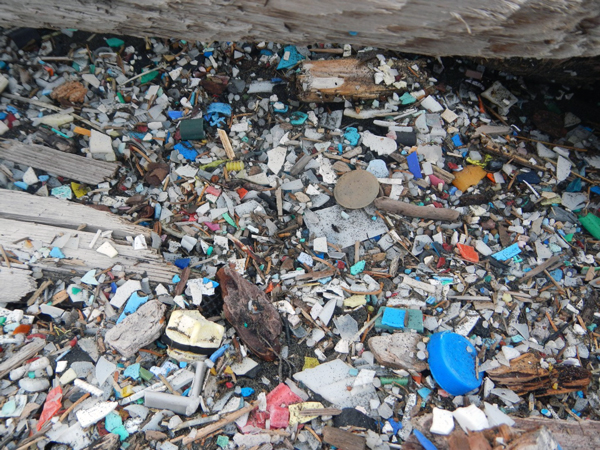
Crushed plastic debris on beach at Patton Bay, Montague Island. (Photo courtesy Chris Pallister)

Thanks to funding from the government of Japan, plans are being made to pick up hundreds of tons of plastic marine debris that has been gathered from Alaska beaches.

Gulf of Alaska Keeper was already in the trash business, picking up old fishing gear, when the 2011 tsunami swept away miles of buildings, docks, vehicles, contents of dumps, tanks, and other materials along the coast of Japan and sent much of it floating across the Pacific. The organization knew where it was most likely to hit. And it did, says Keeper President Chris Pallister.

“A tremendous amount of trash,” Pallister said. “Some of our outer coastline beaches that are hard on the Gulf of Alaska have as much as 30 tons of plastic debris per mile, which is an astounding amount of plastic.”

Talk of Alaska: Plastics in the Ocean

The resources to respond were nowhere near adequate, but concern about the debris was widespread, particularly in villages along the coast, which often organized their own cleanup efforts. A number of organizations got involved, including the cruise ship industry. There was a small helping of federal funds – $50,000 per state, but then the Japanese government sent $5 million to help with the cleanup. Part of that money was released to Alaska through the National Oceanic and Atmospheric Administration last year. Gulf of Alaska Keeper was able to bring more cleanup workers to some of the shores. It wasn’t easy:

“Every year we get our small skiffs and stuff flipped and you know it’s a challenge, and it costs a lot of money,” Pallister said. “We’re exposed out there in the Gulf with our small vessels, and it’s a very, very difficult, dangerous job for all of us.”

The plastic was gathered up, often placed in huge bags, but then it had nowhere to go. It was just left stacked up, waiting for whatever arrangements could be made to remove it.

This year another $900,000 has been released to Alaska from the Japanese donation, and Pallister plans to use it to engage a helicopter to lift the material, and a huge barge to take it to a destination that is still undetermined.

“Now that we have some money, we can do this. It’s not gonna be enough money to do everything we want to do. We hope to get down there and work with the Sitka Sound Science Center and all the folks down in southeast Alaska that are consolidating debris this summer,” Pallister said. “And hopefully this barge will just make a circuit around the northern Gulf, go down to southeast Alaska and we’re talking with our colleagues in British Columbia, they may join us too, and take a big load of trash down to a recycling center in Seattle.”

It’s going to have to be a pretty big barge, and it’s going to take another cleanup mobilization as well.

“We have 1,800 super sacks and a lot of other loose debris,” Pallister said. ”It’s probably about pretty close to 3,000 cubic yards of plastic, and we expect to double that by mid-July of this year.”

And it won’t be the end of the plastic trash. In recent years, Gulf of Alaska Keeper’s cleanups have been coming across a lot more than fishing gear on those exposed beaches. The way Chris Pallister sees it after 12 years of beach cleaning, the tsunami just added to an already existing – and growing – plastic debris problem on Alaska’s coasts.

“That basically doubled our volume, but we’ve always had a really bad problem up here, and it’s mostly western pacific drift that we’re gettin’ up here, it’s not local,” Pallister said.

The material that drifts and blows ashore during storms is just the most visible form. A lot more has broken down into small pieces that can be mistaken for food and ingested by birds and fish. Efforts to assess the impacts of those micro- and nano-plastics in the marine environment are just beginning.

Norton Sound women rally against high cancer rates among Alaska Natives

Women from 15 communities in the Norton Sound gather for a photo after a conference packed with emotion and energy. (Photo courtesy of Opik Ahkinga)

Recently, on the top floor of Norton Sound Regional Hospital, two-dozen women gathered around a large table. They traveled to Nome for a conference to discuss a dire concern: high rates of cancer, developmental disabilities and other diseases linked to contaminants and former military sites in the Bering Strait.

“We hear over and over: by the time we found out we have cancer, it’s too late. We have a cancer crisis. So, my goal was to bring women from each of the 16 communities NSHC serves to document health concerns,” said Vi Waghiyi of Savoonga. She’s the environmental health and justice program director for ACAT: Alaska Community Action on Toxics.

At this gathering in Nome, the woman began documenting their communities’ health concerns. With support from ACAT, they want to present a report to healthcare providers and policymakers to ask for change.

“We wanted to empower the women—how to testify, write letters to the editor—because as women, we’re the backbones of our communities,” said Waghiyi.

The women raised concerns about lack of information on toxic sites, lack of effective communication with health care providers, and not having environmental health threats taken seriously. According to ACAT Executive Director Pam Miller, “There’s concern that a lot of this illness might be related to chemical exposures from military contamination, and also this region, because it’s in the Arctic, is on the receiving end for global contaminants that move into this area on wind and ocean currents from all over the world.”

Military contamination has been of much concern on St. Lawrence Island, where two U.S. bases were established during the Cold War. Savoonga health aide Annie Alowa started noticing an unusual number of cancers among the people—before she passed away of cancer herself in 1999. Waghiyi says these contaminants are still in the marine mammals that constitute most of island residents’ traditional diets.

While some of these larger battles over eliminating toxins may take years to wage, there are short-term goals in sight. The gathering concluded with a call to Senator Donny Olson in Juneau thanking him for support of the Toxic Free Children’s Act, which would eliminate toxic flame-retardants from children’s products. The group asked him to push for an even stronger bill during this legislative session. While Olson is in the minority this year, he says he’ll continue leveraging his support and call on the women for testimony.

“That’s exactly what we need,” said Olson, over the teleconference. “We need people out there who are passionate about the subject, who are knowledgeable and who go and make their voices known.”

Waghiyi says it can be overwhelming trying to change the business practices of large companies that are producing products with toxins, but now a grandmother herself, she says there’s no other choice but to keep fighting for a safer, cleaner world for her children.

“We’re up against multinational corporations that have no idea what’s going on with our people. We have to be the conscience,” she said. “So that’s why we go miles and miles away, travel to Washington, DC. We have a right to be at the table for making decisions.”

ACAT was founded in 1997, and is composed mostly of women who work for environmental health and justice in Alaska Native communities.

Joyce Kerttula dies at 91

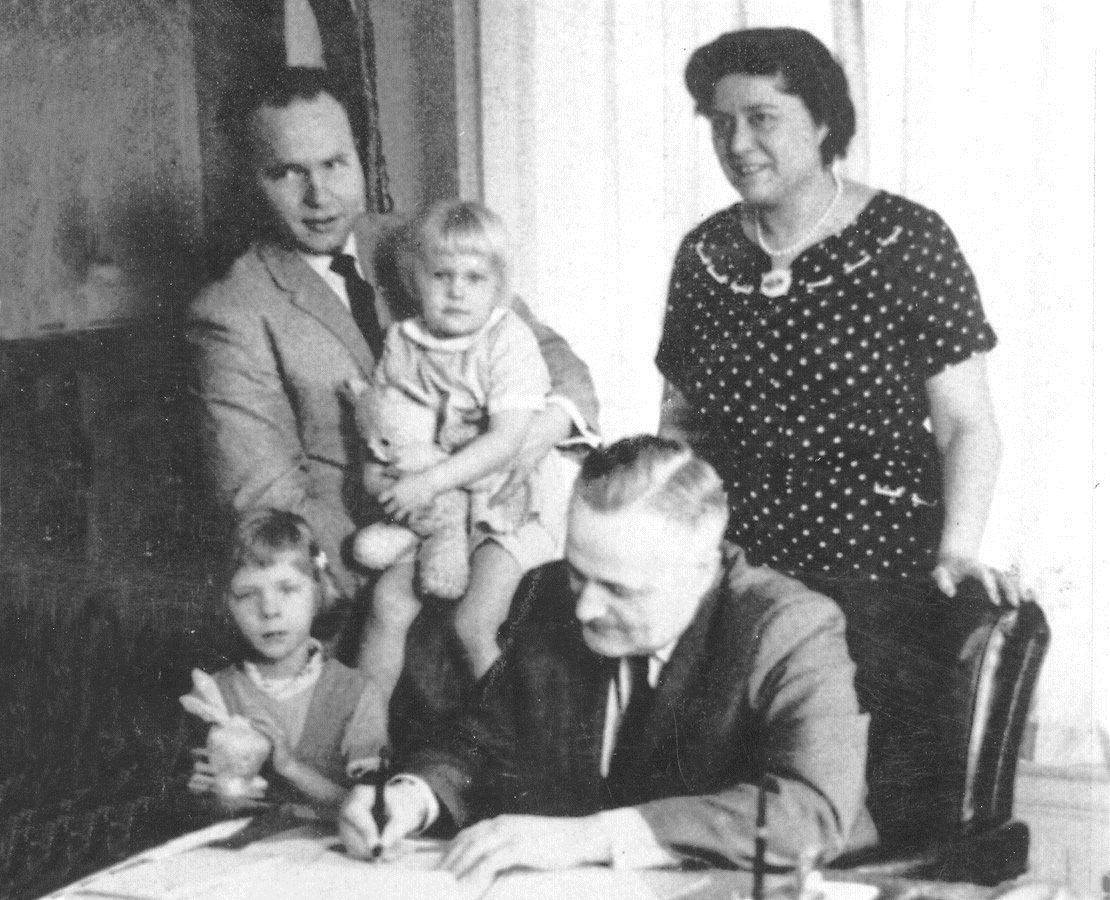
Gov. Bill Egan signs a bill by Rep. Jay Kerttula, holding his daughter Anna, into law. Also pictured, wife  Joyce Kerttula and daughter Beth Kerttula.
Joyce Kerttula stands behind Gov. Bill Egan as he signs a bill by Rep. Jay Kerttula, holding his daughter Anna. Beth Kerttula is standing beside the governor. (Uncredited photo via Alaska House Democrats)

Joyce Kerttula died Monday at age 91 after a long fight with lymphoma, but not before helping two generations of Kerttulas rise to political power in the state.

Beth Kerttula, the girl with the bunny in the photo, likens her mom to a 61st legislator who made Jay Kerttula’s historic rise to power possible.

“My dad’s the only guy to have ever been both speaker and president of the Senate, and I just, I never could figure out how he could have ever done that until I was in and realized, you know, it’s because of my mother. If you have someone working with you who you trust implicitly and who works side by side, and who really is a, frankly a second legislator, you can get a lot done. And that’s what happened. They were a tremendous team,” Kerttula says.

Beth Kerttula represented Juneau in the Alaska House for 15 years.

Joyce Kerttula
Joyce Kerttula in 2013. (Photo courtesy Beth Kerttula)

Jay Kerttula represented Palmer in the Alaska Legislature for 34 years, and Joyce Kerttula worked alongside him as an unpaid volunteer for almost that entire time.

In a 2014 interview, Joyce recalled how her unofficial career in the legislature began with an office visit. His secretary pulled open – then shut – a desk drawer that was full of papers.

“And I said, ‘Would you mind telling me what was in that drawer?’ And she says ‘Oh, that’s letters that I don’t know how to answer and I’ll get to them one of these days.’ And I said would you mind if I looked at one of them?’ And I pulled one out at the bottom and not the top and it was over a month old. And I said this can’t go on.”

Beth Kerttula picks up the story from there.

“And my mom just sat down and started writing, writing letters on one of those old Underwood typewriters. And she just kept going, and that was it,” she says.

Thirty-some years later, she was still at it. Joyce Kerttula handled the legislative offices, the campaigns and constituents. In her obituary, the family calls Joyce Kerttula “the heart and soul” of her husband’s legislative offices.

Originally from Oklahoma, she was born Helen Joyce Campbell in 1923. After finishing college, she left Oklahoma to be a personal assistant to a scientist working on the Manhattan Project in New Mexico, where she witnessed a test detonation of an atomic bomb.

She moved to Alaska in 1954 and taught English at Palmer High School. She met and married Jay in 1955. Joyce Kerttula’s unofficial career in the Alaska Legislature began after he was sworn into office in 1961.

An Alaska memorial service is in the works for the summer. She had been living in Palmer, but was in Palm Springs, Calif., for medical care when she died.

“My mother used to say, you’ve got to live every day. And I, I’m going to try to emulate that a little bit better,” Beth Kerttula says.

Joyce Kerttula is survived by her husband, daughters, a sister, two grandchildren and a large extended family.

Beth Kerttula shared her mom’s full obituary in this Facebook post:


Rosemarie Alexander contributed to this story.

Headcount of city’s homeless conducted at charity event

Locals experiencing housing or financial troubles could enjoy a free hot meal on Wednesday at the annual Project Homeless Connect event. Services from 28 local agencies trying to combat homelessness were also available. (Photo by Kevin Reagan/KTOO)

At Juneau’s Project Homeless Connect workers and volunteers tried to get more than 200 people on track to permanent housing on Wednesday. The annual, one-day event held at the Juneau Arts and Culture Center surveys the number of local homeless people to contribute to a national tally.

One of those counted as currently homeless is Guy Walther. He has a job interview later in the afternoon, but can’t make it there on his own because he doesn’t have a driver’s license.

It’s a reoccurring predicament among Juneau’s homeless population, finding decent transportation. Today though, Walther’s waiting for a caravan to shuttle him to the Department of Motor Vehicles to get his license back. It’s one of the many complimentary services offered at Project Homeless Connect.

“It’s very convenient downtown, and all the services are right here,” Walther says. “So if you don’t need one thing, you need another. There’s something here for everybody that needs help.”

Other free services at Project Homeless Connect include blood tests, footbaths, oral cancer screenings and haircuts.

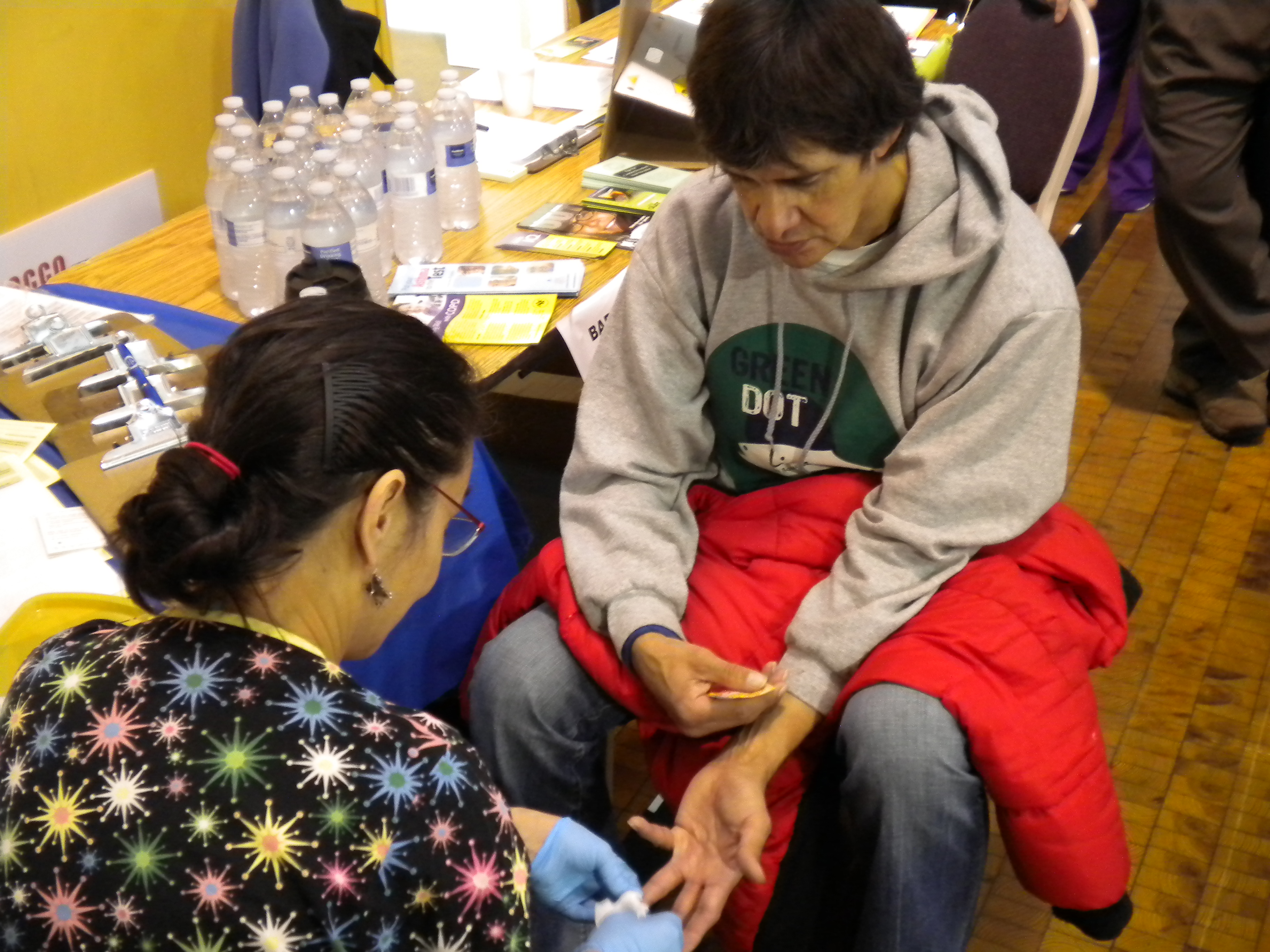
Charles Wheaton gets his blood sugar checked by a nurse from Bartlett Regional Hospital at Project Homeless Connect. (Photo by Kevin Reagan/KTOO)

This is Walther’s second time attending the event. He’s spent the last couple years in and out of shelters around Juneau and now lives on a friend’s boat. His goal is to find full-time work so he won’t have to apply for subsidized housing. That process previously had him on a waiting list for almost two years.

“This event is a piece in a large puzzle of the services and providers around town,” says Mandy Cole, a member of the Juneau Coalition on Housing and Homelessness.

Cole has been working at Project Homeless Connect since it started in the capital city five years ago. She makes sure visitors meet with a volunteer upon arrival to complete a questionnaire on their living situation.

They’re asked how long they’ve been homeless and the primary reason for their homelessness. The data collected is sent to the U.S. Department of Housing and Urban Development, which requires communities receiving federal grant funding to complete this survey once a year.

In 2014, the department reported the nation’s total homeless population at over 578,000, with less than one percent of that number living in Alaska.

Cole says the number of attendees at Juneau’s Project Homeless Connect remains consistent at around 200. She says the homelessness could decrease with lower housing costs.

“My hope is that increased units in Juneau will drive down the price, such that people don’t necessarily have to have a voucher or have to have subsidized housing,” Cole says. “We can kind of use our ingenuity and connection between people to share spaces and to make the most out of what we have.”

Data collected from previous years reveals that the most common reason for homelessness in Juneau is job loss — a situation Guy Walther may be one step closer to rectifying.

“You know if it works out, it works out. You have to wait, things just don’t come instantaneously,” Walther says.

Results from this year’s survey will be made public in March.

Slideshow: JDHS beats Houston High in hockey series

Juneau-Douglas High School hosted Houston High School in a weekend series of hockey at Treadwell Ice Arena. Juneau won both games, 7-3 and 7-2. The Crimson Bears close out their regular season this weekend against Fairbanks’ Monroe Catholic High School.

All photos by Steve Quinn.


Site notifications
Update notification options
Subscribe to notifications