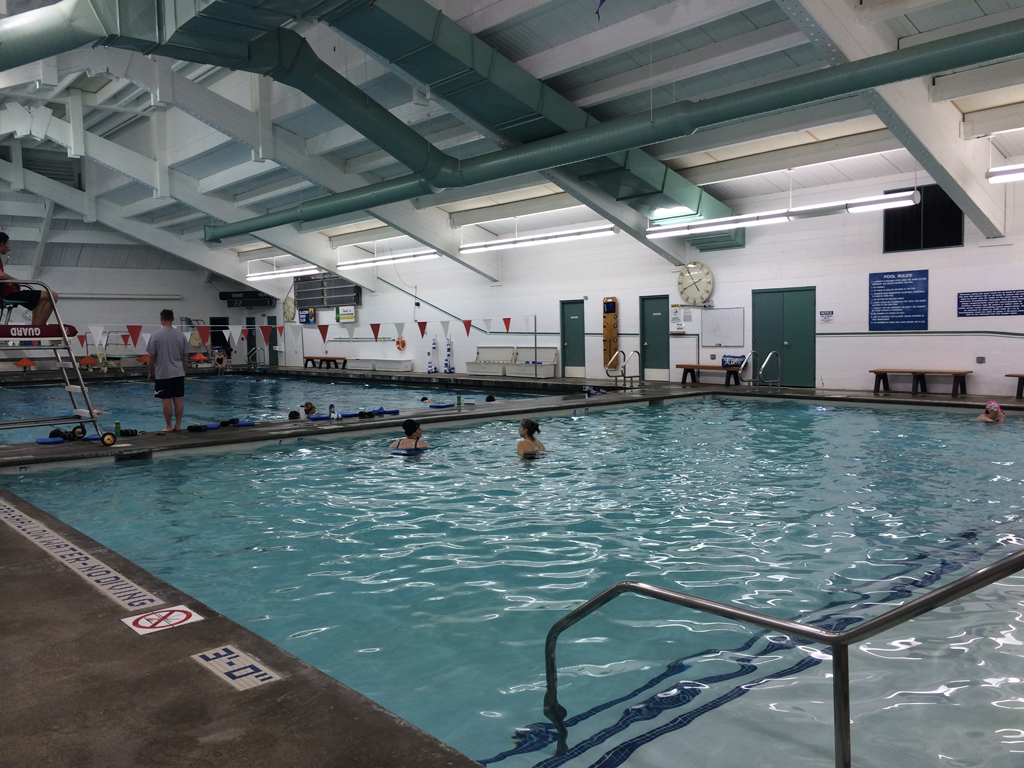
The Augustus Brown facility includes two pools, a sauna and an exercise area. (Photo by Aaron Russell)
Juneau City Manager Kim Kiefer is expected to detail her proposed budget cuts to the Assembly Finance Committee on Wednesday, as the city faces a $12 million shortfall over the next two budget years.
On Tuesday, Kiefer told the city’s Aquatics Facilities Advisory Board she would recommend temporarily mothballing the Augustus Brown Swimming Pool downtown. According advisory board member Tom Rutecki, the pool would close Nov. 4 this year through either the mid-2015 or mid-2016. During the closure the city would assess the cost of renovating the facility.
Rutecki says the manager did not mention how the plan would impact employees. He says hours would be extended at the Dimond Park Aquatic Center in the Mendenhall Valley.
Kiefer was unavailable for comment.
Rutecki says closing the pool would affect many Juneau residents, including students taking water safety courses, seniors in water aerobics classes and members of the Glacier Swim Club.
“There’s a pretty strong clientele that goes down there, especially people right now—legislators use it and state office workers at noon. And in the morning the place is packed, if you go to the 6 o’clock lap swim it’s like 3 to 4 people to a lane,” Rutecki says.
He says he suggested to the manager that the city lease or rent the pool to the Glacier Swim Club, which has a wait list for people wanting to join.
Kiefer told the committee that there would be cuts to other Parks and Recreation programs discussed in the finance committee meeting.
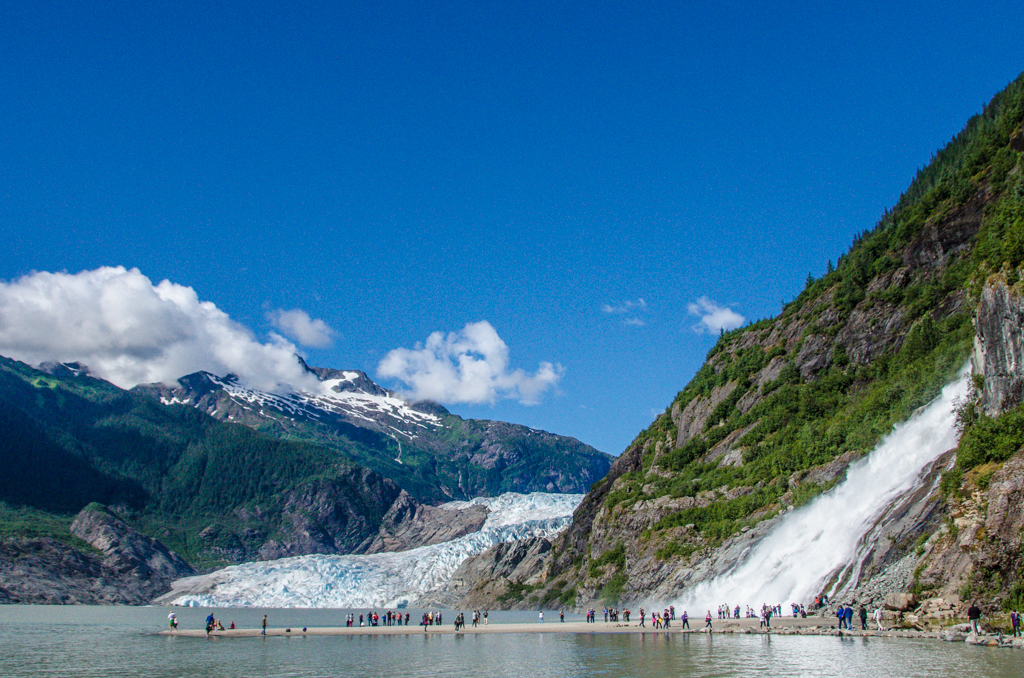
Summer tourists surround Nugget Falls during a visit to Mendenhall Glacier. (Photo by Heather Bryant/KTOO)
Nearly half a million cruise ship tourists visited the Mendenhall Glacier last year.
John Neary is director of the glacier’s visitor center, run by the U.S. Forest Service. He’s trying to figure out how to maximize enjoyment of the glacier as both a National Forest destination for tourists and a city park for locals.
Neary says part of that involves informing people about climate change and its effect on the glacier.
“How can we give people a message about sustainability? How can we motivate the community and others to step forward and say this looks like a great opportunity to affect half a million people a year with a very proactive message about, ‘What can I do to help climate change?’” he says.
Neary wants to start creating a master plan for the Mendenhall Glacier and its visitor center. He’s speaking at the Mendenhall Glacier Visitor Center at 7 p.m. tonight about “Changes Coming to Your Backyard Glacier.” He says it’s an opportunity for people to say what they want the visitor center and surrounding area to look like in the next couple of decades. Community input in the plan is critical, including from local residents who participate in tourism, like bus and taxi drivers.
“I would hope that the industry leaders, the company owners would come out to the table. I would hope that the agency representatives that represent the bears or the salmon or the birds or all the wildlife that has no voice – I would hope they would come to the table to advocate for those resources,” Neary says.
Each year, 465,000 cruise ship visitors are allowed to visit the glacier, a limit imposed by the Forest Service. Permitted tour companies are each allocated a certain portion of that total.
Neary says the tourism industry would like to bring more visitors, but there are limitations, including current infrastructure and complying with environmental regulations.
“Until we have better traffic flow and better parking and better restrooms, more stalls – until we have those things in place, we can’t just offer more, more, more. We’re saying it’s a community response we need to this and we don’t have the funding, so we have to come up with other solutions,” Neary says.
Meanwhile, the public can expect to see a change at Mendenhall Glacier as early as this summer. Neary says, for the tourist season, temporary rubber speed bumps will be placed on the last half mile of road leading to the glacier.
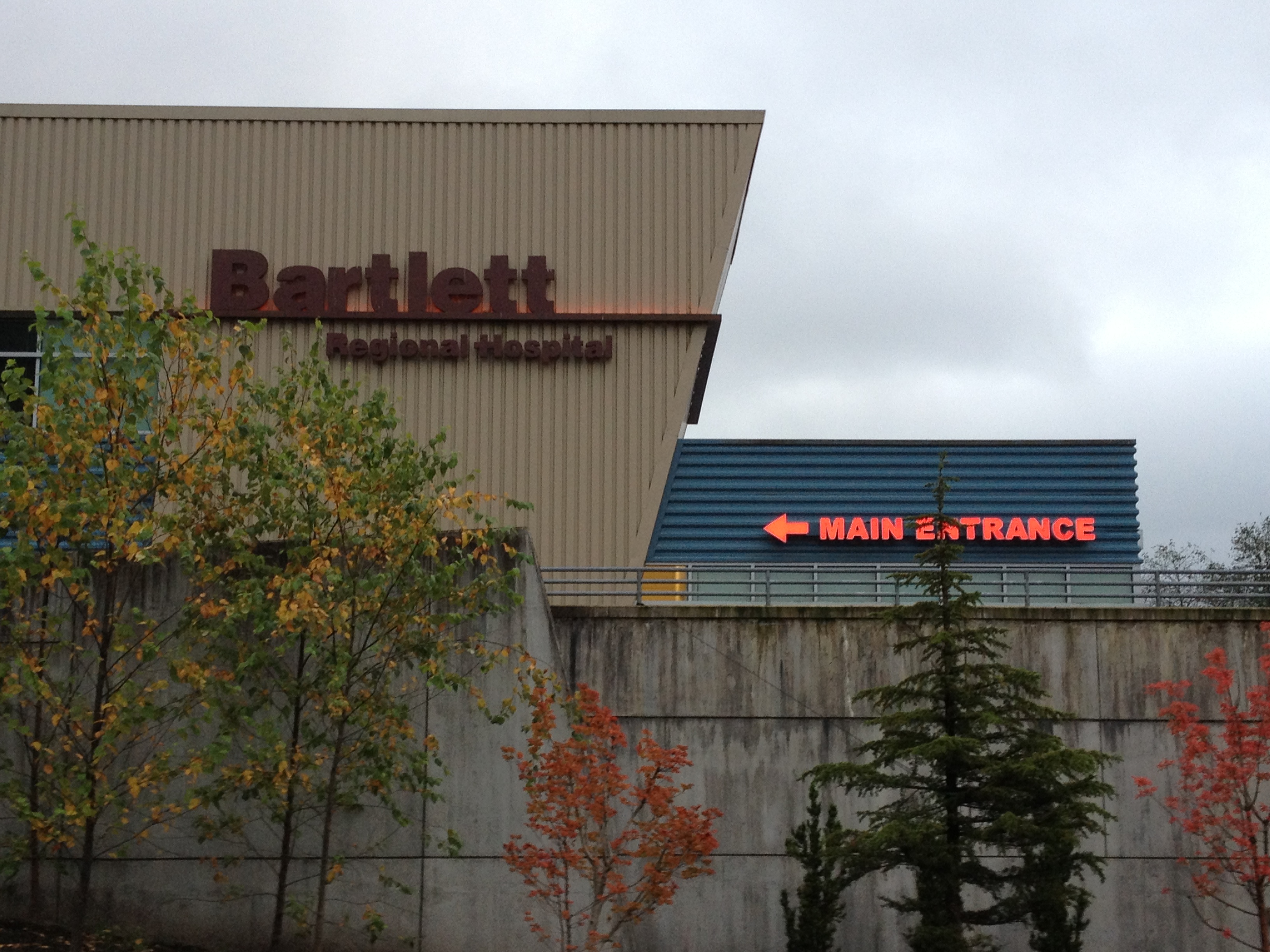
Bartlett Regional Hospital is owned by the City and Borough of Juneau. It’s board of directors is appointed by the Juneau Assembly. (Photo by Lisa Phu/KTOO)
Bartlett Regional Hospital’s board of directors meets tonight to begin deliberations about who should be the next chief executive officer of Juneau’s city-owned hospital.
Dr. Paul Franke, interim administrator of the Alaska Native Medical Center in Anchorage.
David Abercrombie, CEO of Madison County Memorial Hospital in Madison, Fla.
Charles Bill, assistant administrator of Physician Development with Centura Health Physician Group in Durango, Colo.
Joe Cladouhos, CEO of Syringa Hospital and Clinics in Grangeville, Idaho.
Craig Dahl, CEO of Alaska Pacific Bank in Juneau.
During the interviews, the candidates met with the hospital board, medical staff and other employees. They also met with city officials, including Mayor Merrill Sanford and City Manager Kim Kiefer. City Human Resources Director Mila Cosgrove says a public meet and greet last Wednesday was attended by nearly 90 people.
Cosgrove says all five candidates are still under consideration.
“They all have a combination of strategic management experience, they all have experience working with boards and they all have experience heading up complex organizations,” Cosgrove said.
Bartlett’s last permanent CEO, Chris Harff, was the first chief executive hired after the board terminated its contract with longtime hospital management company, Quorum Health Resources. She lasted just over a year, and was one of three top administrators to resign following a personnel investigation into allegations of a hostile work environment at the hospital. When she announced her resignation, Harff said her professional expertise was not a good fit for the Juneau community.
Cosgrove says the board changed the recruitment process this time in an effort to hire someone who would be a good fit for Juneau. The biggest difference, she says, is the board did not use an executive recruitment firm.
“Internal staff was more heavily involved, which meant we had from the very beginning a lot more touch with candidates to talk with them about the realities of living in Juneau,” Cosgrove said.
She notes that all of the finalists except Abercrombie already have ties to Juneau or Alaska. Dahl is a longtime Juneau resident; Franke currently lives in Anchorage; Bill’s mother grew up in Juneau; and Cladouhos used to work for SEARHC, the Southeast Alaska Regional Health Consortium.
Cosgrove says the hospital board will begin deliberations on the candidates tonight, but she does not expect a decision for another two to three weeks. The discussions will mostly take place in executive session. She says the board hopes to make a hire by mid-April and have the new CEO on the job in May. Interim CEO Jeff Egbert is expected to stay on for a transition period.
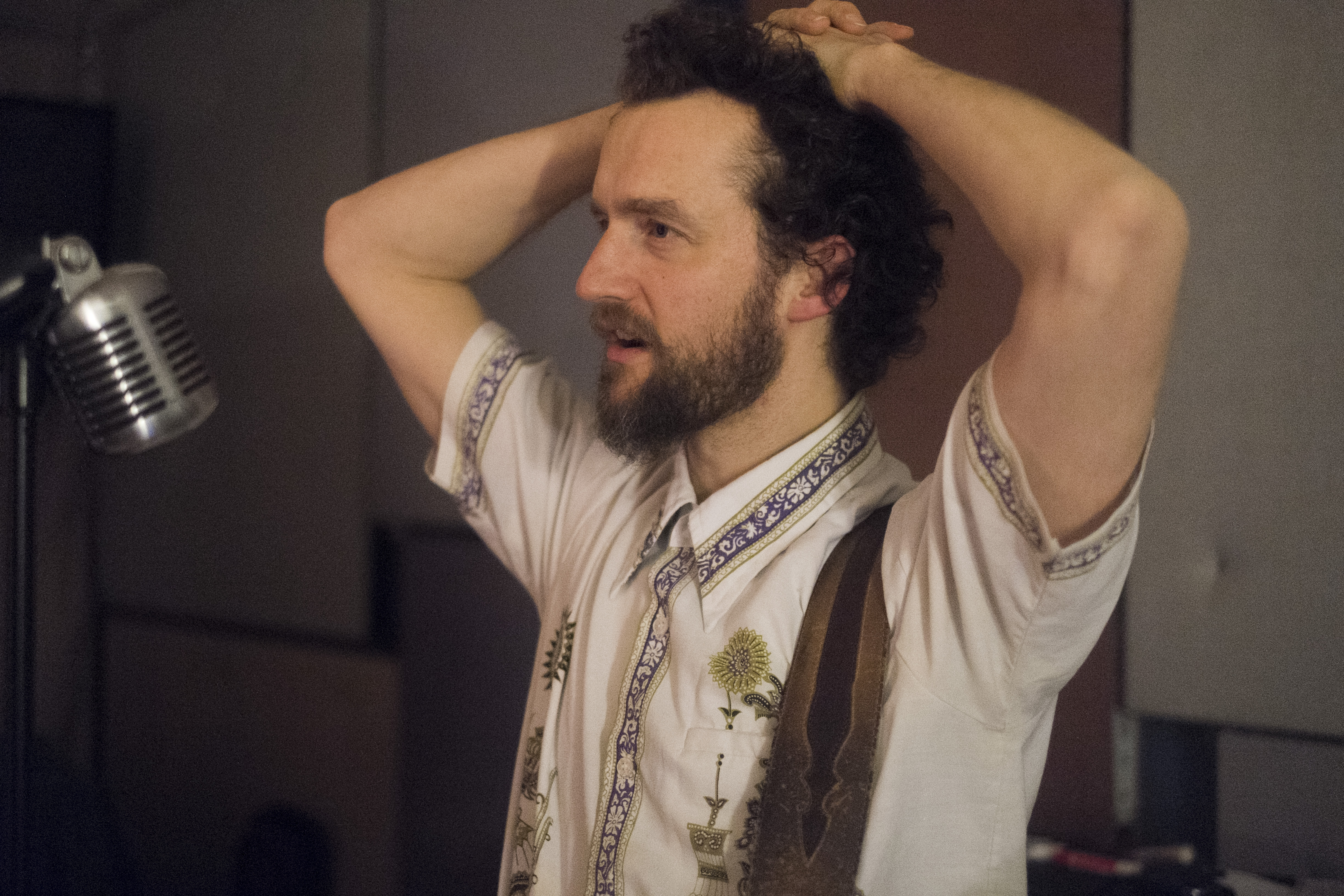
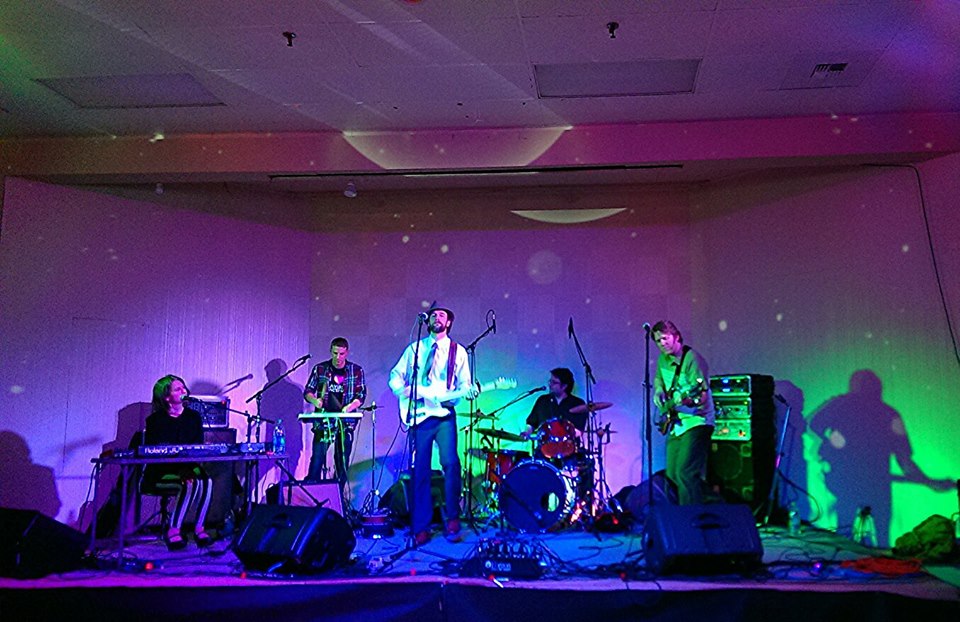
George Kuhar rehearses with his band Playboy Spaceman at Peabody’s rehearsal space in downtown Juneau on Feb. 17, 2014. (Photo by Annie Bartholomew/KTOO)
Last month, Juneau musician George Kuhar performed his new album with his band Playboy Spaceman the Rockwell ballroom.
One Heart Army was mixed, mastered, and created in Juneau. The band recorded the album with Betsy Sims at Juneau’s Studio A with musicians Nick Wagner, Jason Messing, Simon Taylor and Kuhar’s wife Bridget.
Kuhar’s title track, “One Heart Army” begins slowly with an acoustic intro, steadily marching forward, reaching a stadium rock epic chorus.
“I just finished mastering it about a month ago. I spent several months mixing it. I spent several years writing the songs and you know it’s been a real labor of love.”
Kuhar’s favorite song on the album is called “Pattern of Your Mind,” a space age medley cut with Wagners playful electronics, Bridget’s synthesizers, and a gritty guitar solo at the heart of the song.
“That song was kind of an experiment. It was very experimental in every way – the way it was recorded, the lyrics were written and it was a real pleasant surprise the way it turned out. The guitar solo was a first take, and that’s always a great feeling to play a take for the first time and go, ‘Well, I don’t think I could play it any better than that so let’s just leave it behind,’ and it just continued to grow on me.”
Though the album is full of upbeat rock and roll sing-alongs like “Teach Me To Love,” it is also filled with moments of beauty of vulnerability.
George and Bridget harmonize over handclaps and ukulele on the track “Sonneman” written after visiting the home of his friend Joseph Sonneman who died of Lou Gehrig’s disease. Sonneman had a miner’s cottage near Bullwinkles on Willoughby Avenue where Kuhar rented week-to-week when he first moved to Juneau. Years after his death, the house was converted into the Twilight Café where George went to get coffee one day.
“I went in their just to check it out because I’d been in there before and it was so different inside. And there must have been a trace of him left because when I walked out of there I wrote that song and then I went home and played it for Bridget on the Ukulele and she cried. So I guess I knew that was a song I needed to keep playing at that point.
It felt thick and dense, so you know, when you have those feelings they often turn into good songs. I mean as an artist you hope you’re creating work that’s dense with meaning and life and you just kind of have to get lucky I think.”
Kuhar says he doesn’t know if he got lucky yet. He thinks he’ll never know.
“I just hope that I put it out and people like it, or that they find some value in it.”
The band Playboy Spaceman performs the album One Heart Army at the Rockwell Ballroom on Friday, Feb. 28, 2014. (Photo by Jessie Herman-Haywood/KTOO)
The album is now available for download on iTunes or you can find the CD at Alaska Robotics.
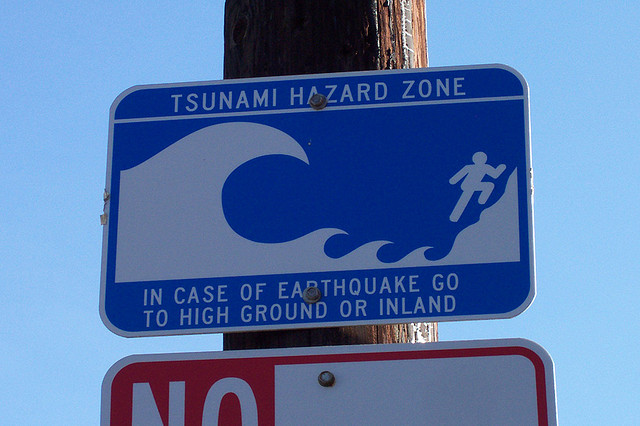
A Tsunami hazard zone warning sign. (Photo by Derin/Flickr Creative Commons)
Thursday morning’s live test of the state’s Tsunami Warning System went pretty well — except many people didn’t realize it was a test.
Most of us are accustomed to hearing the words “This is a test” with the routine monthly broadcasts. This message however, was triggered using so-called “live codes.”
Jeremy Zidek is the public information officer with the state Division of Homeland Security and Emergency Management.
“The live code has a little bit different message that is broadcast over televisions and radios. It really enables us to see the reach and effectiveness of those live codes before there is an event that happens.”
The test — at least as heard over coastal public radio stations — gave a rundown of warning areas. It was eerily similar to what we heard following the earthquake in January 2013 — because it was that message, more or less.
According to Joel Curtis with the National Weather Service, the message that was broadcast was an actual warning “template,” which overwrote the warning message composed for the live test.
In short, it was a software error.
And errors, says Jeremy Zidek, are what the tests are designed to discover.“Every year when we test the live codes we do find anomalies, some places where we do need to improve the system. But that’s the purpose of the test.”
The live test was targeted at coastal communities — and that part of the test worked — except for receiving the same alarming test message.
In Sitka, the test was followed-up by a call burst from the Code Red system in the Police Department, reassuring residents that the tsunami warning message was just a test.
The annual live test has taken place for the last several years on the anniversary of the 1964 Alaska Good Friday Earthquake, which killed 131 people — 116 of them in the subsequent tsunami.
For the 50th anniversary of the quake this year, public safety officials conducted a day-long preparedness event called “Alaska Shield.” Fourteen communities participated, along with the Alaska National Guard, active military personnel, the Federal Emergency Management Agency, and numerous state agencies.
The live Tsunami Warning Test was the kick-off for a pretty big day, says Zidek.
“The exercise is really focused around an event similar to the 1964 event — a 9.2 earthquake — and the impact that type of event would have in today’s built environment.”
So, the fact that the live test message got our attention may have actually been a good thing.
Said meteorologist Joel Curtis:
“At least the message, however poorly it was constructed, was heard by an awful lot of people along the coast. We’re pretty happy about that.”
Rep. Benjamin Nageak raises his fist in solidarity with the effort to reduce domestic violence in Alaska at the Choose Respect rally on the Capitol steps, March 27, 2014. (Photo by Skip Gray/KTOO)
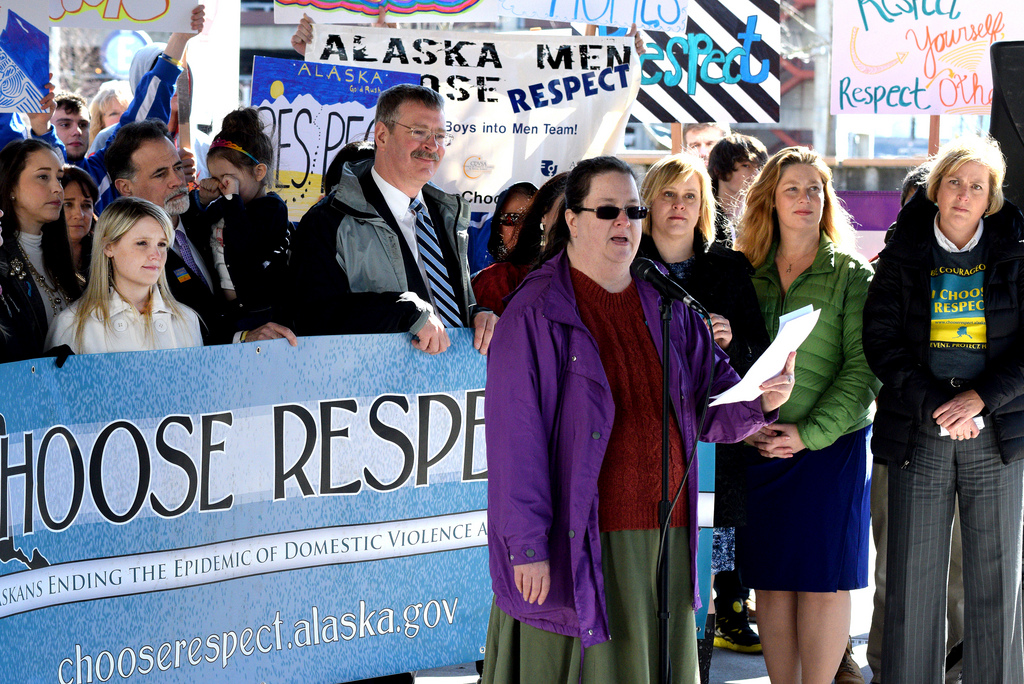
Ati Nasiah, prevention manager at the AWARE women’s shelter in Juneau, speaks out against domestic violence at the Choose Respect rally. (Photo by Skip Gray/KTOO)
Supporters of the Choose Respect campaign listen to speakers during a rally at the State Capitol. (Photo by Skip Gray/KTOO)
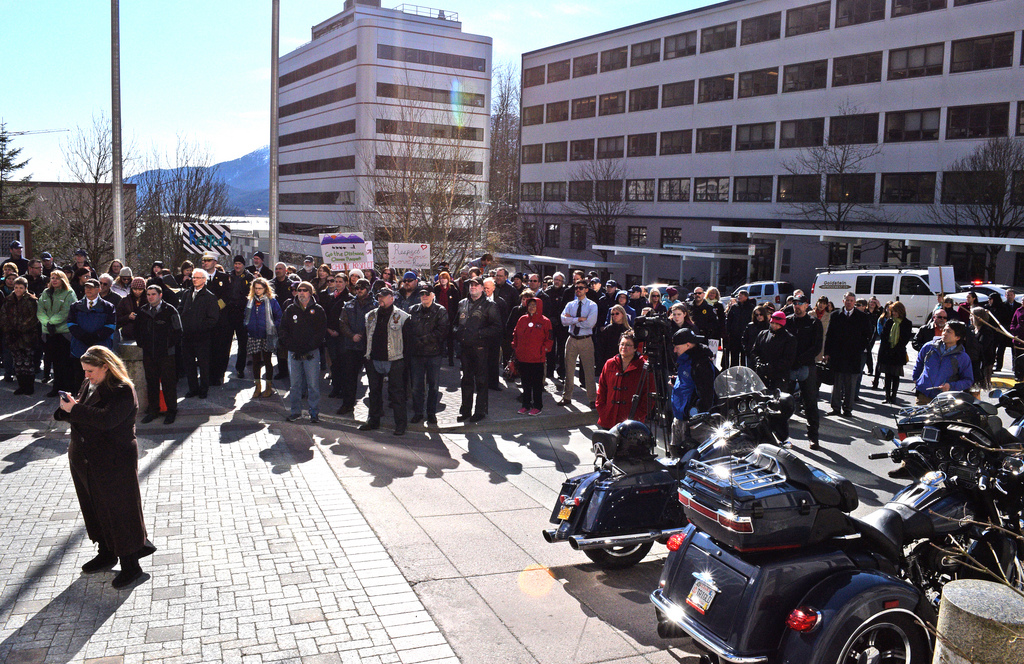
Gov. Sean Parnell's Choose Respect campaign addresses domestic violence and sexual assault prevention in Alaska. About 150 people attended Juneau's Choose Respect event. (Photo by Skip Gray/KTOO)
A group of mostly legislators led the Choose Respect march down Main Street in Juneau. The rally began on the steps of the State Capitol, the brown brick building in the background. (Photo by Skip Gray/KTOO)
Lauree Morton, executive director of the Council on Domestic Violence and Sexual Assault, gives closing remarks. (Photo by Skip Gray/KTOO)
On a sunny but blustery Juneau Thursday, around 150 people gathered and marched down Main Street, including Michael Uddipa, a Thunder Mountain High School varsity basketball player.
“We are a team that chooses respect,” Uddipa said after marching to Marine Park with his team.
Although Gov. Sean Parnell’s Choose Respect campaign is geared towards eradicating domestic violence and sexual assault in the state, Uddipa said there are other ways to embody the message, which he and his teammates learn about from basketball coach John Blasco.
“We go over, like, what we can do if an opposing team tries to start a fight in the game and see which ways we can handle it without using violence. And we talk about how it is appropriate to compliment women and to not say anything too rude,” he says.
Lt. Kris Sell was one of many Juneau Police officers who marched Thursday. She says law enforcement is intricately entwined with domestic violence and sexual assault.
“We respond to so much domestic violence. We’re in the homes. We see the victims. We see the devastated expressions on the faces of the children who have witnessed it. And we watch the multiple generations that suffer when this is going on,” Sell says.
By participating in the event, Sell hopes to show victims that police officers support them and want to stop the violence.
“This is not okay. We may come from a macho culture but taking domination into the homes is a weak thing to do,” Sell says.
Choose Respect marches took place in more in 170 communities around the state. Throughout the year, these communities are invited to participate in state-sponsored domestic violence and sexual assault webinars that focus on education and prevention.
Close
Update notification options
Subscribe to notifications
Subscribe
Get notifications about news related to the topics you care about. You can unsubscribe anytime.