Community

Alaska’s long-term unemployed to see a reduction in benefits

As federal agencies are beginning to lay off employees and close offices in Alaska, the long-term unemployed in Alaska are about to see a reduction in their unemployment benefits.

In Alaska, the state provides up to 26 weeks of unemployment benefits. Then, people can apply for federal benefits, which are organized into tiers based on how many weeks the person’s been jobless Bill Kramer is chief of the unemployment insurance program for the state of Alaska. He says the federal spending cuts required under the Budget Control Act passed by Congress in 2011, will affect people as they move through the system:

“For all new emergency unemployment compensation claims or for people transitioning from one tier of benefits to the next tier of benefits on or after May 19, the weekly benefit amount will be reduced by 23.92 percent.”

The budget cuts won’t affect the state’s 26-week program. They apply to the 37 weeks of federally funded assistance people can apply for after their state benefits run out. Kramer says the state has sent out letters to about 14,000 Alaskans who are expected to be affected:

“The average weekly benefit amount is $245 per week, so under the sequestration cut that would reduce that weekly benefit amount to about $186 per week.”

George Lamont says he hasn’t been able to find another job after getting laid off last year from his job as tribal administrator for the village of Tuluksak. He says his family has already cut out all non-essential spending, so it’s hard to figure out how to handle the coming reduction:

“It’s going to affect me in a lot of ways. It’ll be harder for me to purchase fuel or get enough fuel, plus of a lot of other things that are necessities.”

Kramer says the state operates 23 job centers offering employment services, as well as a labor exchange website where employers post jobs and unemployed people can search for work, and post their resumes’ online.
Assembly ratifies firefighters’ contract

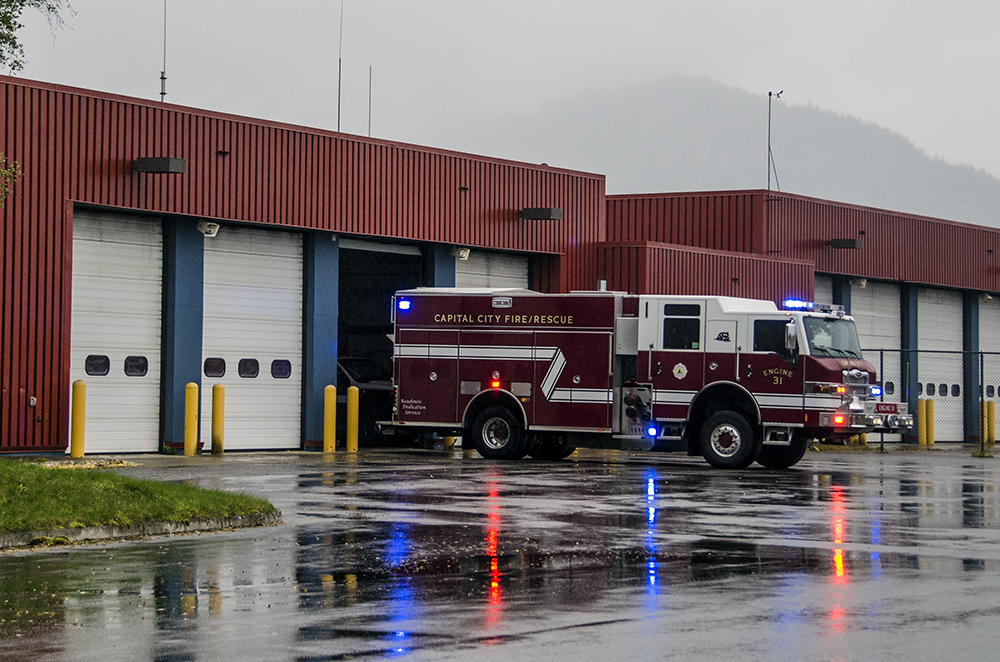
A fire truck returns to the Glacier Fire Station near the airport. (Photo by Heather Bryant/KTOO)

The Juneau Assembly has ratified terms of a new three-year contract agreement between the city and firefighters.

Members of the International Association of Firefighters, Local 4303, already voted to ratify the negotiated agreement, which includes a 1 percent pay increase on July 1, the start of the new fiscal year.  Next year, wages go up 1.5 percent.

Employer health care contribution rates also increase in fiscal year 2015.

In addition, the Capital City Fire and Rescue pay schedule has been rewritten.

The contract changes will cost the city a total of $555,737 over the life of the contract, according to CBJ Manager Kim Kiefer.  It expires on June 30, 2016.

Assembly member Randy Wanamaker wanted to delay the vote, objecting to the way the tentative agreement was presented to the Assembly. It was on the Assembly’s Consent Agenda.

Wanamaker said he wanted more information, though the entire agreement was provided to the Assembly in its packet before Monday’s meeting.  City Manager Kim Kiefer also briefed the Assembly in a closed door session prior to the  meeting.  Other Assembly members said they had enough information to take the vote.  It passed unanimously.

Other Assembly news

Trucano Construction is the winner of a CBJ bid to construct a new Fisheries Terminal Dock in downtown Juneau.

The Assembly Monday awarded the Juneau-based company the contract to rebuild the dock near the University of Alaska Southeast Technical Center.  The existing dock was struck by a boat and damaged beyond repair.

Trucano was the low bidder of three companies who submitted proposals for the construction project.  Trucano’s contract with the city totals $106,489.  The CBJ engineer’s estimate is $120,000.


CBJ to create city traffic hearing officer positions

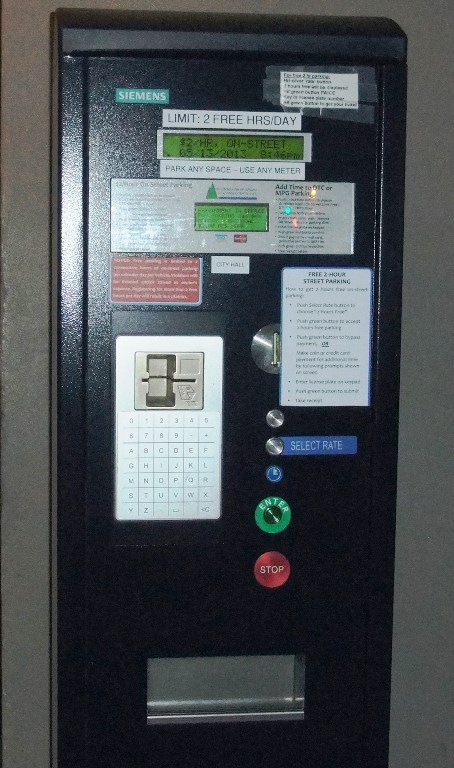
The CBJ parking kiosk near city hall. Parking laws are not changing, just the way fines will be handled.

Juneau parking violators will soon get a “notice of violation” and those who want to appeal will appear before a city hearing officer, not a district court magistrate.

The Assembly Monday night approved an ordinance changing the way the city handles civil fines.  It comes in response to a recent Alaska Supreme Court order that nullified citations not delivered in person.

Violation notices will still be put on the vehicle windshields, but instead of being an infraction sent to district court, the city must set up a traffic court system.

Only Ketchikan and Anchorage have municipal traffic courts.  When the Supreme Court issued its order last month, most other cities were forced to throw out their traffic offense system, according to CBJ attorney John Hartle.

“In Anchorage, they have their own municipal court system and they have municipal judges to hear these things.  In Ketchikan, I understand it’s the manager’s secretary.  So it shows a rather broad continuum; I think we will fall somewhere in between those,” Hartle told the Assembly.                                                                                                                                                                                                                                                                                                                                                                                                                                                                                                                                                                                                                                            City Manager Kim Kiefer said a hearing officer will initially be located in her office.  She plans to move a current city employee into the position.

“At some point we’re potentially going to set up a traffic court time and we need to determine if that’s two or three hours.  We’re looking at trying to set it up over a lunch hour to make it easy for people to come to it and not have to take off work,” Kiefer said.

The ordinance does not change current parking laws.

The state Supreme Court order that nullified traditional parking tickets was in response to a housekeeping measure approved by the Alaska Legislature in 2010.  Hartle said he hopes the legislature next year will reverse what has been called an unintended consequence.

APOA, the HUB team up for “Safe Summer 2013”

The Alaska Peace Officers Association and the HUB after school program are teaming up to provide a safe place for Juneau kids to go this summer. They’re calling it “Safe Summer 2013.”

Conan Vandel is executive director of the HUB after school program. He says the nonprofit went to the Capital City Chapter of APOA with a proposal for a program aimed at giving middle and high school kids a safe place to hang out this summer. The HUB estimated the cost of the program at $10,500, or $3,500 a month for the months of June, July and August.

Vandel says he was blown away when APOA agreed to fund the entire amount.

“We were hoping that they would donate a portion of that. Did not anticipate anything like what they offered,” he says. “Didn’t know what to say, just incredibly excited. We get to run the program, and we get to offer something that, so far, since I’ve been in Juneau, we haven’t had.”

The HUB is located in the same building as the Juneau Christian Center, where Vandel is youth pastor. But he says it’s a separate nonprofit that aims to serve all Juneau youth, regardless of religion.

The HUB after school program debuted about two years ago. It offers a lounge, video games, Internet stations, as well as pool and ping pong tables. Vandel says “Safe Summer 2013” will be largely the same, but with more special events.

“We’ll host dances, we have a light show, we’ll have open mic nights, we’ll have video game tournaments, all sorts of things to fill that time,” he says. “So, that Friday night, everybody goes, ‘Hey, what do you want to do?’ ‘Well, I don’t know, what do you want to do?’ ‘Oh, let’s check the HUB website.’ And there’s something that’s actually going to be really fun.”

Dee Ojard is the Public Safety Systems Coordinator at the Juneau Police Department and a member of APOA. She says it’s a natural fit for the organization to give money to the HUB to provide a safe place for teens and tweens to hang out.

“Juneau is pretty limited on some of the things that are offered for that age group,” says Ojard. “So, we would like to see them engaged in healthy activity.”

By healthy activity, Ojard means one that does not involve drugs or alcohol. She says the goal of “Safe Summer 2013” is to have zero preventable deaths among Juneau youth over the next three months.

“Anytime you get drugs and drinking involved, you’re going to have problems,” she says. “And we just really don’t want any fatalities with our teenagers and our kids.”

When he moved to Juneau from Seattle two years ago, Vandel says he was surprised by the prevalence of drug and alcohol use among the city’s young people. Before joining the HUB he worked at Juneau Youth Services, where he saw firsthand the need to provide kids with safe and healthy alternative activities.

He says that’s the goal of the HUB after school program, and “Safe Summer 2013.”

“When there’s a kid who’s motivated to drive out the road and drink,” Vandel says. “And they got to drive back in, we’re providing a safe place for that kid to come, to have fun without having to go out and put themselves in danger.”

The first event of the HUB’s summer program is a middle school dance on May 24th – the last day of school. Other events will be posted on the HUB website.

Saturday is Juneau’s annual cleanup day

Litter Free Cleanup Day 2012
Volunteers collected about 20,000 pounds of trash during Litter Free’s 2012 Cleanup Day. Photo courtesy Litter Free, Inc.

Break out the yellow and green trash bags, because Saturday is Litter Free’s annual Cleanup Day in the Capital City.

Randy Hurtte is a board member for the Juneau nonprofit, which has been organizing the event every May for almost 30 years.

“The main thing is, it’s a public cleanup, not really a time to clean out your garage and toss it out on the curbside,” Hurtte says. “But really a public area, so we’ve got people that are every year hitting their favorite trail heads, the streets in front of their house, and really trying to just get the whole town picked up.”

Litter Free provides the trash bags – yellow for regular garbage and green for recyclables – at various places around town.

The cleanup starts at 8 a.m., and wraps up around noon. Hurtte says volunteers can leave full bags on the side of any major road and Litter Free will collect them and take them to the dump.

“All the tons and tons of garbage that we pick up, Waste Management accepts that without any fee or charge,” says Hurtte. “So, it’s been a great community-wide effort.”

Once again this year, the Juneau Watershed Partnership will hold a volunteer picnic from noon to 1:30 at Duck Creek Market.

Since 1985, Litter Free has picked up nearly two million pounds of trash during its annual cleanup days. That’s according to board president Laurie Sica, who keeps official statistics. Last year was kind of a light year, likely due to heavy rain and wind. Still, in 2012, volunteers gathered about 20,000 pounds of trash.

Litter Free Bag & Sign-Up Stations:
-Foodland parking lot
-Douglas Fire Hall
-Western Auto Marine
-Lyle’s & Jensen’s Home Furnishings
-Super Bear Supermarket
-Duck Creek Market
-UAS Student Bookstore
-Lynn Canal Fire Station

Vietnam POW urges students to rely on ‘parachute packers’

Capt. Charlie Plumb (Ret.) describes those who provided invaluable support and advice that helped him survive six years in a Vietnam POW camp.

A former Vietnam prisoner of war encouraged Juneau and Hoonah youth to make their own choices and take advantage of challenges and opportunities presented by adversity.

Capt. Charlie Plumb (Ret.) was a Navy fighter pilot who served as an adversarial pilot at Navy Fighter Weapons School at Miramar Naval Air Station in San Diego, now known as Top Gun.

He was later based on the carrier U.S.S. Kitty Hawk, flew an F-4 Phantom jet, made over a hundred carrier landings, and flew 74 combat missions over North Vietnam. But Plumb and his co-pilot were shot down over Hanoi just five days before the end of his eight-month tour. He was tortured and spent the next six years in a prison camp.

I’d like for you to try your best to smell the stench of that imaginary two-gallon bucket in the corner I call my toilet. I’d like for you to feel the baking heat of a tropical summer in a tin roof prison cell ten-thousand miles away from Juneau. I like for you to taste the salt, the annoying taste of salt in the corners of your mouth from the sweat, the tears, and the blood. Not that you’ll ever be prisoners of war, God forbid!”

During the last installment of the Pillars of America speaker series on Wednesday, Plumb described the lessons he learned as he and his colleagues survived and supported each other.

Plumb said his fellow prisoners, usually in darkened cells or separated from each other, communicated by code that was based on tugs of a wire pushed through cracks in the walls.

Wearing a khaki garrison cap and flight suit, Plumb started his talk Wednesday in near-total darkness, pacing off the three steps that he could take in his eight-foot by eight-foot cell. Sometimes he would hold out his hand and move it forward and back quickly to demonstrate the pull of the wire as he communicated with his fellow prisoners.

Capt. Charlie Plumb (Ret.) describes how he and his fellow prisoners of war communicated with a wire pushed through the cracks in the walls of their darkened cells. For example, five tugs followed by five more tugs represented the letter ‘Z’. Photo by Matt Miller/KTOO News

This silly, archaic, cumbersome code became our language. No, more than that. It became our lifeblood. It was absolutely vital; It was life or death that we communicate with each other. And the interesting part was (that) it wasn’t the words, it wasn’t the phrases, it wasn’t the meaning of the sentences that was the important part. The life saving value of communication in a prison camp was the simple validation of another human being.”

He used the story of eventually coming home and meeting the seaman on board the Kitty Hawk who packed his parachute and knew exactly who Plumb was.

The best I could do was stagger to my feet, reach out a very grateful hand of thanks. He came up with just the proper words. The guy grabbed my hand, he pumped my arm, and he said ‘I guess it worked!”

‘Parachute packer’ was Plumb’s metaphor for those who gave of themselves, passed on important principles in life, and asked for nothing in return. They were those who youth could look to for support in time of need. Plumb said some of the more-important parachute packers in his life included his middle school basketball coach and the superintendent of the Naval Academy.

If adversity is a horrible thing to waste, how do you waste adversity? Well, you start by blaming other people for your problems. And when you do, you give away control of your life. You start wasting adversity by feeling sorry for yourself and crawling over in the corner of your little mental prison cell and wait for something better to happen. You waste adversity by expecting somebody else to make it fair in your life. And what you find out is — once you’ve worked yourself through this is — that the person in control is you.”

This was at least Plumb’s second visit to Juneau as part of the motivational series organized by the Glacier Valley Rotary. His first visit was in 1995.

Six students from Hoonah were flown into Juneau to eat lunch with First Lady Sandy Parnell during Plumb’s hour-long talk.

Site notifications
Update notification options
Subscribe to notifications