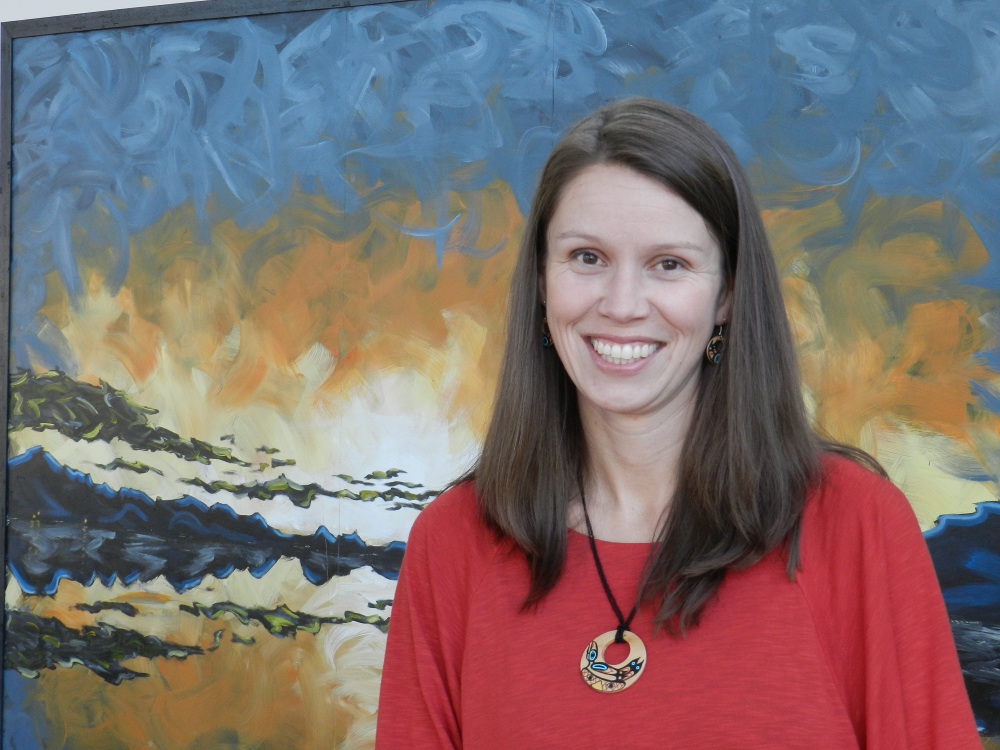
Paula Casperson. Photo courtesy Juneau School District.
Paula Casperson is the new principal of Juneau-Douglas High School.
The Juneau School Board approved her hiring at its meeting Tuesday night.
Casperson is currently assistant principal, and was one of two finalists for the top job. A third candidate dropped out before the interview process.
According to a statement from the Juneau School District, Casperson has been assistant principal for the last nine years. She also worked as a high school social studies teacher for eight years in Alaska and California.
She has a Bachelor’s degree in Anthropology and a Masters in Education from Stanford University. She also completed an administrative program in Education Leadership at the University of Alaska Anchorage.
UAA awarded Casperson the 2012 William Demmert Leadership Award for significant contributions to the education of Alaska Native youth.
She replaces outgoing principal Ryan Alsup who has lined up another high school principal position in his home state of Colorado.
Alaska often gets left out of maps of trends in the United States. The clean cluster of the contiguous states fit perfectly in maps of trends in the U.S. The presence of Alaska and Hawaii is often determined by the impact of the data to be displayed or the thoroughness of the graphic artist making the map. Sometimes, we’re left out because not enough information is available for the nation’s largest state.
But when it comes to watching YouTube, Alaska makes it on the map.
The tool’s information page says that the dashboard is an experiment in visualizing YouTube data. The map displays the most shared or viewed videos from the last 12-24 hours.
Information is available for Alaska’s three largest cities.
So what are Alaskans watching?
In Anchorage the most shared video is the “True Blood Season 6 Trailer”
Fairbanksans are into music videos today with “Queens of the Stone Age – I Appear Missing”
Juneau is sharing the “Young Woman Being Arrested for Nothing” video from the story about the Alaska State Trooper investigation.
You can sort the information for views or shares and by age groups below the map. A list of videos on the right also show the most popular videos overall. A more comprehensive dashboard is also included, yet Alaska cities are absent from those lists.
The FAQ notes the tool is just getting started and with the nature of YouTube in mind answers another important question:
Why is ____ video so popular with 13-17 year old females?
Hundreds of Juneau residents flocked to the downtown waterfront Saturday to celebrate two major components of Southeast Alaska’s economy – the Alaska Marine Highway System and the fishing industry.
Alaska Marine Highway ferries haven’t been a regular sight in downtown Juneau for about 30 years. But early Saturday morning, the Malaspina quietly sailed into a rainy Gastineau Channel, and tied up at a downtown dock more likely these days to be hosting a cruise ship.
The unusual trip into the heart of the Capital City was part of the Malaspina’s 50th Anniversary Golden Voyage.
Former Mayor Bruce Botelho was the first passenger to disembark. He recalled being on one of the first Malaspina sailings out of downtown Juneau when he was just 15 years old.
“We got to do a special sailing to Auke Bay as part of an Explorer Scouts color guard,” Botelho said. “And of course, the Malaspina in the years since was the way we connected for sports events, it’s the way we did debate tournaments. It really proved itself to be the marine highway.”
Irene Cadiente was one of the few Juneau residents waiting to greet the Malaspina when it arrived at 6 a.m. Her late husband, Andres, was the vessel’s first cook.
“When the ship landed here, they hired him from the Baranof Hotel and he worked on there until he retired,” said Cadiente. “In fact, he wrote a cookbook and it has a picture of the Malaspina on there.”
Cadiente says she and their children would often join her husband on trips up and down the Inside Passage.
“At the time they had a dining room in there, and they had waiters, and my son – the oldest one – also worked on there, and he was a waiter,” she said. “So, it has a lot of memories for us and we’re happy to see it here.”
By 8 a.m. about 250 Juneau residents lined up to tour the Malaspina, including the bridge and other areas usually off limits to passengers. Another 400 people boarded by 10 a.m. for a special day cruise to Tracy Arm.
On her way to the popular wildlife viewing fjord, the ferry participated in Juneau’s annual Blessing of the Fleet, honoring the Capital City’s commercial fishing boats. Pastor Phil Campbell of Northern Light United Church did the blessing.
“Bless now the ferry Malaspina on this celebratory voyage,” Campbell said. “Bless the crew and passengers and bless our great state that has made the marine highway a reality.”
Seven names were added to the Alaska Commercial Fishermen’s Memorial as part of this year’s ceremony: Charlie Clements, John Winther, Jr., Tom and Dorothy Osborne, brothers Casey and Kelly Newman, and Eric McDowell, who founded the research firm McDowell Group.
McDowell passed away last year at the age of 69 of complications from a staph infection. He joins his son Mark in being honored on the memorial. His other son Chris skippered his father’s boat, the Whisper, during the Blessing ceremony.
“It’s really a nice touch,” Chris McDowell said of having his father’s name added to the memorial. “He loved fishing and did it right up until the end of his life. So, got the boat blessed and got tied up and got up here in time for the reading of the names. So, it’s worked out pretty nicely.”
McDowell says it’s fitting that the Malaspina participated in this year’s Blessing. Over the years, the McDowell Group made a name for itself researching the economic impact of both the commercial fishing industry and the state ferry system.
“My dad was born in Southeast and spent his whole life here,” McDowell said. “It’s kind of part and parcel of being a Southeast resident. Half a century of ferry service and for my dad a little over half a century of fishing – there was kind of a nice parallel there.”
After its Tracy Arm cruise the Malaspina was scheduled to return to downtown Juneau to drop off passengers, then head to the Auke Bay Ferry Terminal. On Sunday she had events planned in Haines and Skagway.
Johnson is credited for successfully managing a number of construction projects at the airport. (Photo by Heather Bryant/KTOO)
Juneau International Airport Manager Jeannie Johnson is retiring.
Johnson’s last day is May 15, but she is currently on leave and Deputy Manager Patty DeLabruere has already taken over as acting manager.
Airport Board Chairman Jerry Godkin said it could be four to six months before a new manager is hired.
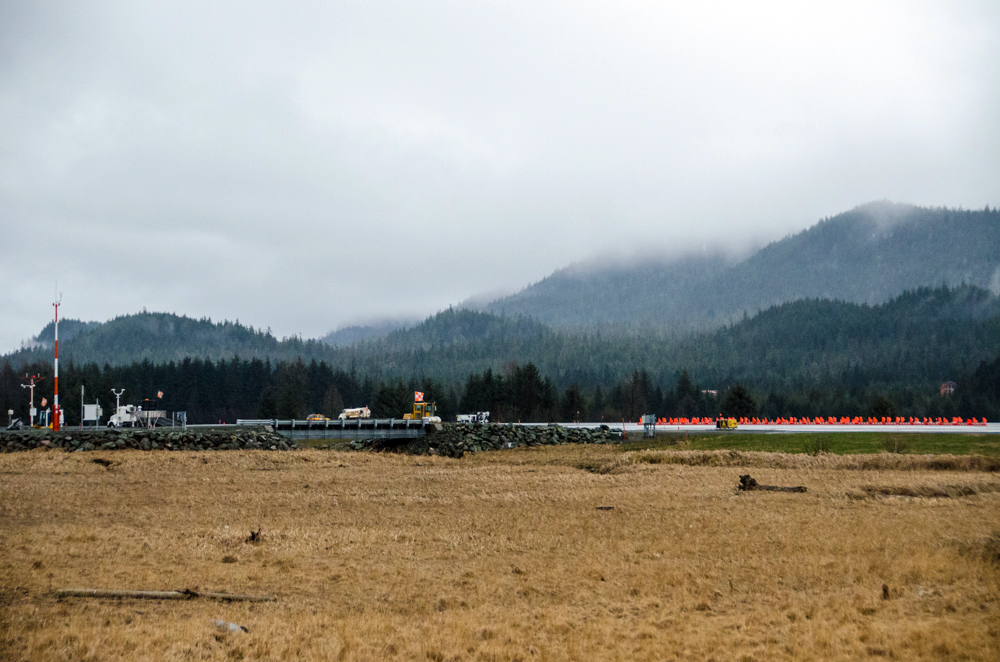
Johnson has put her stamp on the airport terminal remodel, runway safety project, and funding for snow removal equipment and facility.
Godkin said Johnson’s strength as a manager has been dealing with the federal government, since federal dollars make up the largest portion of funding for airport construction projects.
“Ninety-six percent plus of airport funding comes from the federal government. The other small percentage is from the city of Juneau, the municipality,” Godkin said. “So we’ll be looking for someone that has those skills.”
He said the Airport Board will begin the hiring process at its monthly meeting on May 8th, when members will go into executive session to discuss advertising the job and the type of manager to lead the airport.
Alaska Airlines is the airport’s largest tenant. Godkin said the board also will look for a manager with good people skills on both the corporate and personal level.
“You’ve got to have good skills in dealing with the tenants, i.e., the Ward Airs, Wings of Alaska, Alaska Airlines, all of those things. We’ve got a wide range of employees at the airport, so having good people skills is a big thing,” he said. “And keeping good relations up with not only the feds, keeping good relations up with the state of Alaska, and downtown at the city assembly level.”
Juneau International Airport is owned and operated by the City and Borough of Juneau.
In a news release, Johnson said she will miss being part of the CBJ team. She was not available for an interview.
Meanwhile, the Juneau Police Department is recruiting for five new officers to take over public safety at the airport.
The U.S. Transportation Security Administration is requiring airports the size of Juneau and larger to have a police force, according to Acting Manager deLaBruere. Airport public safety in Juneau has been handled by Goldbelt Security.
“If you go around the Lower 48 and even Fairbanks and Anchorage, they have their own police department already. So Juneau is kind of in this boat by themselves where they were still under an old waiver and still allowed to have armed guard security,” deLaBruere said.
She said funding for the new positions will come from the airport operations and maintenance budget, comprised of user fees that are set by regulation, such as airport concession fees, landing fees, tenant rentals, and fuel flowage fees.
She says JPD will take over public safety on October 1st.
The addition of five officers to JPD’s staff will be the largest expansion of the department since 1986. JPD is also hiring to fill two existing vacancies.
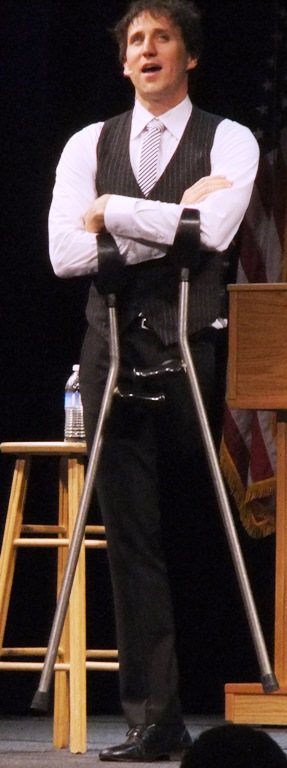
Josh Sundquist was the second speaker of three for the 2013 Pillars of America series.
At 20-something, Josh Sundquist has already written a memoir. It’s a national best seller with a title that implies some struggles: Just Don’t Fall.
“We all have some sort of problem, some thing, some disability if you will. I happen to be missing one leg,” he said. “What are you missing?”
Sundquist lost his left leg to cancer when he was 9-years old. He’s fallen a number of times since then, but knows how to get up.
“I think we have a choice about the way we want to look at things,” he told an audience of hundreds of Juneau middle and high school students and Hoonah High School at the Pillars of America luncheon, hosted by area Rotary Clubs.
His choice is to overcome his disability. In fact, he said it’s because he’s an amputee that he’s gotten to do many things he never would have imagined when he had two legs.
“That’s not to say that I wouldn’t prefer to have two legs, but that is to say now that I do have one leg, I’m happy to try to look for the good things that come out of this,” he said.
Sundquist uses forearm crutches to get around, but most of the time during his talk they hung from his arms as he stood perfectly balanced on his right leg. Some of his speech sounded like a comedy routine as he regaled the audience with stories about living with his disability.
He says laughter has helped him deal with many of the issues that come up.
“I would suggest that if I can laugh about having one leg then maybe there are some daily annoyances, some problems in your life that you can laugh about as well,” he said.
Sundquist had a number of somber stories, too, like when he first tried hitting a baseball on one leg. He was 10-years old.
Each time, he’d strike, lose the bat and fall down. He was allowed to keep swinging, but on the ninth pitch, the little boy was in tears.
“I would not let my friends see me cry. So I picked up my crutches again and started to march off the field,” he said. “And this time my dad called out to me from behind the chain link fence. He said, ‘You almost had that last one.’”
If the proverbial pin had dropped as he told the story it would have been heard in the silence of the room.
“My dad was my hero and I knew if he were up to bat, he would keep swinging. So I went back over, took another swing, another strike, another and another. And finally on the 13th pitch I felt the ball bounce off the bat. I watched it roll up the infield. By the time it reached the short stop’s glove, my friend and designated runner named Tim was already on first base.”
When Sundquist was 16 years old, he started ski racing with the objective of making the U.S. Paralympic Ski Team.
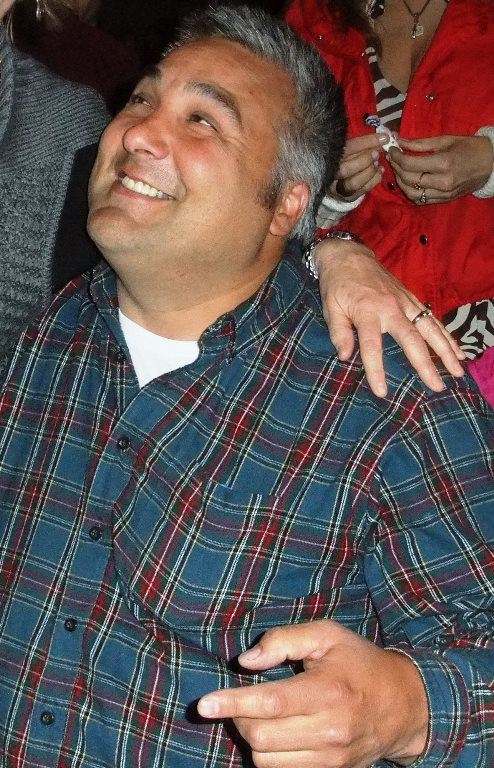
Paralympian Joe Tompkins, of Juneau, gets a hug from some friends after Sundquist’s speech.
It was at the training center in Colorado that he met Juneau’s Paralympian Joe Tompkins. He called him “Big Joe.”
“When you’re starting out in a new endeavor like that, whether it’s a goal, or some adversity you’re trying to overcome, there’s nothing more powerful than having a hero that you can look up to, somebody who’s has already traveled that path that you are pursuing,” he said.
Sundquist made the team and in 2006 competed in the Paralympics in Turino, Italy. He described himself as a determined, but not decorated racer like Tompkins.
Joe Tompkins was in the audience for Sundquist’s speech. Like the younger man, he has a story to tell about his paralysis. After the speech, he said his advice to the audience would have been similar:
“One more swing, never give up. There’s going to be trials and tribulations that you’re going to go through the rest of your life, and if you’re that young you just don’t ever give up,” Tompkins said.
As Sundquist closed out his speech, he put it this way:
“Keep swinging,” he said. “Those would be the last two words that I would leave with you this afternoon: To keep swinging.”
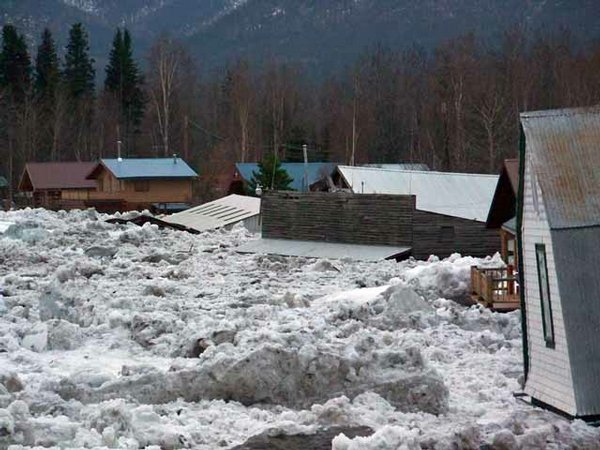
Massive ice blocks and flooding inundate the town of Eagle, Alaska, during the 2009 Alaska floods. (Photo courtesy NPS)
National Weather Service Hydrologist Ed Plumb says breakup-related flood potential is moderate throughout the state.
“Some places could be cut off by water,” he says, “because the water is too high to cross. You may need to get around with boats to get to some structures. It causes more of an inconvenience for people and also moderate could mean we could have some buildings with water into the buildings and not just under the buildings.”
That moderate rating has residents of Eagle on edge. The tiny Upper Yukon River community survived a devastating flood back in 2009. When a massive ice jam broke free that spring, a deluge of water wiped out the community’s historic riverfront and leveled the nearby Athabascan village. Some residents are preparing for another major flood this spring.
Predicting breakup along the Yukon River isn’t that straight forward, but current snowpack, river ice thickness and cool temperatures are coming together in a “perfect storm” scenario.
“We still have over a foot of snow in the woods right now,” says Andy Bassich. He homesteads roughly 12 miles downriver from the city of Eagle.
“The ice was close to five feet thick and very solid with about eight inches of snow on it,” he says. “So all those indicators are pointing towards the possibility of a very high jamming-type breakup here at our place.”
Bassich and his partner Kate Rorke own a small house that’s nestled up against a place called Calico Bluff.
“We’re at the apex of a turn,” explains Bassich. That turn in the river made the homestead a prime target for floodwaters back in 2009. Bassich and Rorke nearly lost their lives four years ago. Along with their 25 dogs, the two were rescued by helicopter off the top of their house. This year, Bassich isn’t taking any chances.
“I built a large raft about 16 by 20 foot with large barrels underneath of it and we plan on putting snow machines and tools up on top of that,” he says. “We just moved our fish rack with about 1500 fish on it and then I’m gonna start working on building an extension on the upper deck of our porch so that we can have an area to put all of our household goods.”
While he finds ways to float his belongings and move them above ground, partner Kate Rorke is moving their dogs. She’ll care for them at a small home the two maintain in town.
“I still haven’t stopped having dreams about water for four years,” says Rorke. “So that will tell you the impact it had.”
Before 2009, Eagle residents used to look forward to breakup. Pat Sanders has lived in Eagle for more than thirty years. In an interview last summer, she recalled a celebratory mood at the onset of warmer weather.
“Store owners will leave their stores and run to the riverbank when the ice starts to move,” she remembered. “Everybody’s jovial and happy and noisy and making jokes and barbeques and all sorts of things. After the 2009 flood, you really didn’t see people run to the riverbank when the ice started to move.” Sanders likened her feelings to Post Traumatic Stress Disorder. “Maybe akin to that in a small way, because when you see that that ice move… you see it moving and it sort of scares you now.”
Ann Millard has similar feelings. She’s lived along the Yukon River bank for 17 years. Instead of cleaning off her barbecue this spring, she’s loading her personal belongings onto a school bus she can move to higher ground.
“We have artwork, some beading things that I won at the fair, a cook stove and we just bought a new Blaze King and so those things will be taken out and put into the storage bus with the motorcycle,” says Millard. She’s packing a second school bus with household items, in case she and her husband have to live in it this summer.
“It’s like my grandma used to say, ‘Hope for the best and prepare for the worst,’ and so we’ve decided we’re going to clear out everything of value in our house and if we have a house after break up then we’re going to paint it inside,” she says.
Other residents who live along the riverbank got a personal visit from Eagle City Mayor Don Woodruff. He’s trying to make those affected by the 2009 flood aware of conditions this year. Woodruff also posted lists of items to have on hand in the event of a flood or emergency evacuation. While he’s not necessarily a betting man, he says breakup in Eagle will likely happen before June, but after May 15th.
Close
Update notification options
Subscribe to notifications
Subscribe
Get notifications about news related to the topics you care about. You can unsubscribe anytime.