FV Katmai has been found about 200 miles offshore of Mobile, Ala. It disappeared in February 1972. Photo courtesy U.S. Coast Guard.
Forty-one years ago, a Kodiak-bound fishing boat out of Mobile, Alabama, disappeared without a trace, taking all hands with it. Now the Coast Guard says the fishing vessel Katmai has been found.
A Schmidt Ocean Institute survey of the ocean floor came across the Katmai in December, while working for the U.S. Bureau of Ocean Energy Management.
The crew of the research vessel Falkor saw an unknown sonar blip about 200 miles offshore of Mobile, in the Gulf of Mexico, but had no record of a sunken vessel in that spot. They sent a remote operating vehicle, or ROV, to investigate, and found the Katmai in 9,000 feet underwater — in remarkably good shape.
The Coast Guard was notified and initiated a cold-case investigation.
They determined the vessel was constructed by Bender Ship Building and it departed Mobile on February 18, 1972. It never made its destination of Alaska, or even as far as the Panama Canal, and was presumed at the time to have sunk in the Gulf of Mexico.
It was skippered by owner Oskar Joos. His wife and their eight-year-old child were on board, and crewman Clinton Hollevoet.
The Coast Guard has contacted the families of the victims and told them what happened to their loved ones.
A decade ago, during the winter of 2003, a lone black wolf appeared near Juneau’s Mendenhall Glacier. He soon captured the hearts of many in the community.
He was seen more and more, and began to seek the companionship of humans and domestic dogs. Someone gave him the name Romeo and for several winters he was regularly seen around the glacier to the delight of many Juneau residents and visitors.
But in the fall of 2009, Romeo was killed. It was believed two trophy hunters shot the beloved wolf.
Park Myers III of Juneau was sentenced in 2010 to two years’ probation and a fine for unlawfully taking big game and bear baiting. His hunting partner, Jeffery Peacock, of Lebanon, Pennsylvania, was later sentenced to three years’ probation and a fine for his role in the illegal hunting activities. Prison time for both was suspended.
Many in the capital city reacted with outrage over the death of the wolf. But that was not the reason former University of Alaska Southeast Professor Alex Simon decided to analyze the case.
“As a sociologist what I think is important to do is step away from individual personality traits and to look at the larger social context,” he says.
Simon has done that, in the February journal Capitalism Nature Socialism. His article looks at the reasons why many trophy hunters are hostile toward wolves and people who advocate for wolves.
Simon is a hunter, but not for trophies. He admits he was personally outraged by Romeo’s death and the way the case was handled in the courts. But for him it’s a chance to identify the social factors that may help explain Myers, Peacock and others’ animosity toward the wolf.
“Over the last couple of decades the public’s perception of wolves has become increasing positive and the perception of hunters, particularly trophy hunters, has become particularly negative,” Simon says. “So even in a hunting state like Alaska, the majority of the public actually has a negative view of trophy hunters.”
Simon says it is common for some groups to feel threatened by those who regard wolves and other wildlife. His research indicates that certain segments of the hunting population suffer from what he calls out-group anxiety.
“The groups that are suffering from this out-group anxiety, a lot of times what they want to do is step in and punish the groups that they feel have had rewards unjustly conferred upon them,” he says.
Hence, shooting the beloved wolf.
“You know in the past it might be in the U.S. maybe burning down an African-American store because they’re seen as too prosperous, so to restore the morale order of white superiority,” he says.
In this case, stories, books and pictures were sold about Romeo; the wolf became a symbol of living with wildlife in Alaska. After his death, a community tribute was held on the shore of Mendenhall Lake.
“With some people in this community they really see that as an inversion of the moral order. There was certainly a lot of outrage about the crime, but there also were certainly a lot of people who really approved of those actions,” he says.
Simon taught sociology at UAS for five years when the black wolf was getting a lot of attention. Simon is now teaching at Utah Valley University in Orem, but is back in Juneau to present his paper.
He’s already presented his thesis at the University of Alaska Fairbanks and Anchorage. He says he hopes the Juneau talk will attract some critics:
“There’s a lot of self-selection of people who up to these things. And in both Fairbanks and Anchorage I was essentially preaching to the choir. I suspect this will attract a wider audience hopefully it will attract some people who are critical of my position.”
He says he’s looking forward to a lively discussion.
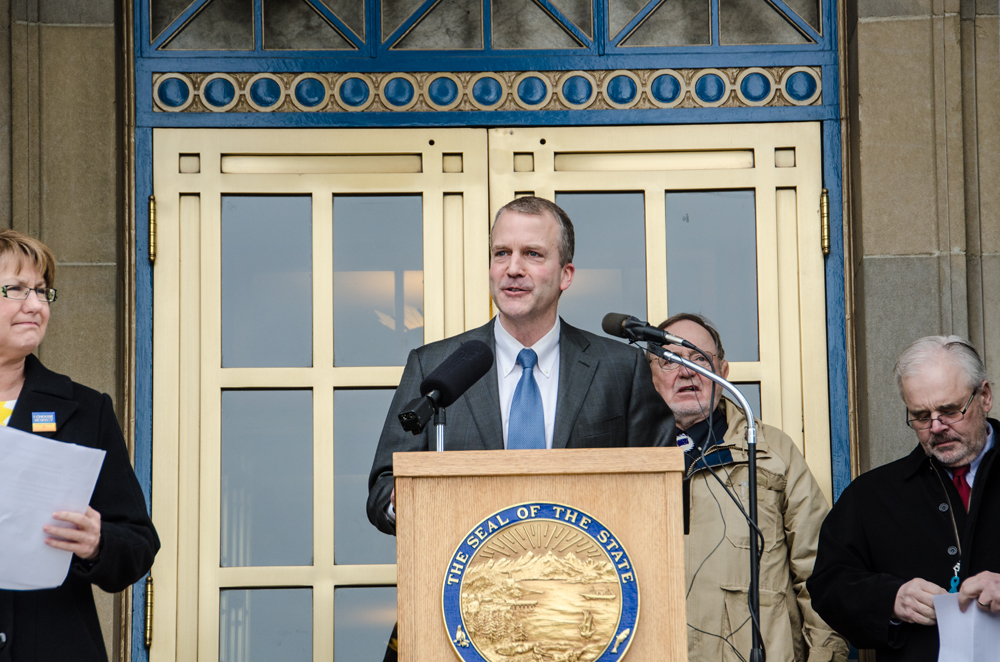
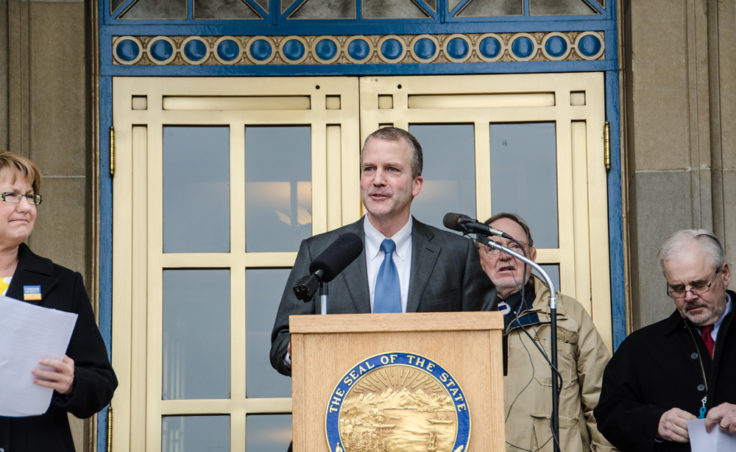
DNR Commissioner Dan Sullivan led the Juneau rally. (Photo by Heather Bryant/KTOO)
Signs at the rally. (Photo by Heather Bryant/KTOO)
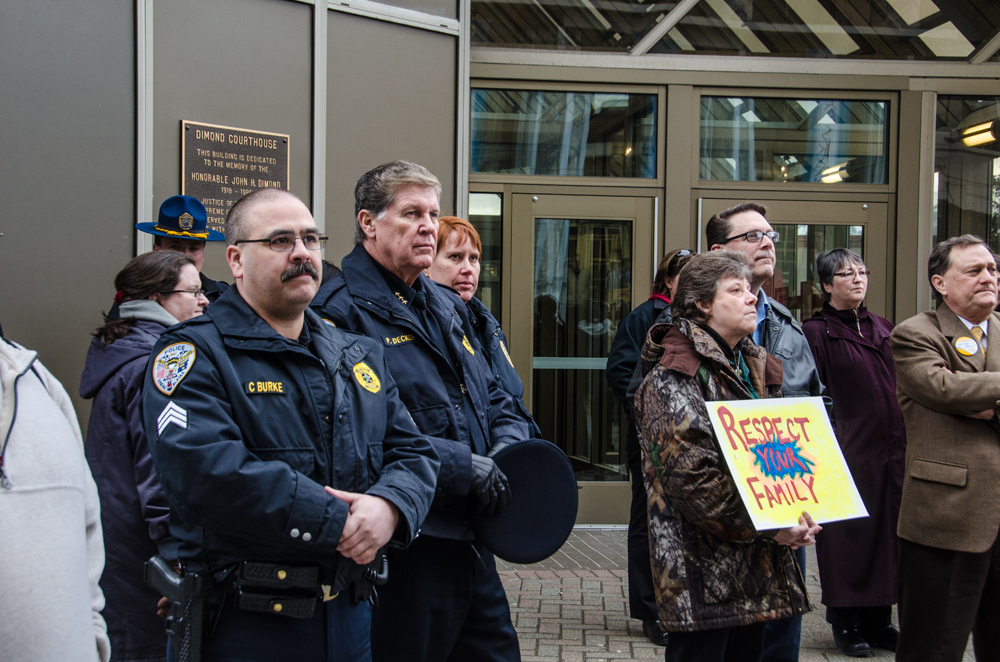
Members of the Juneau Police Department and Juneau detachment of the Alaska State Troopers attended the rally. (Photo by Heather Bryant/KTOO)
AWARE and DART are two organizations that work to help victims of abuse. (Photo by Heather Bryant/KTOO)
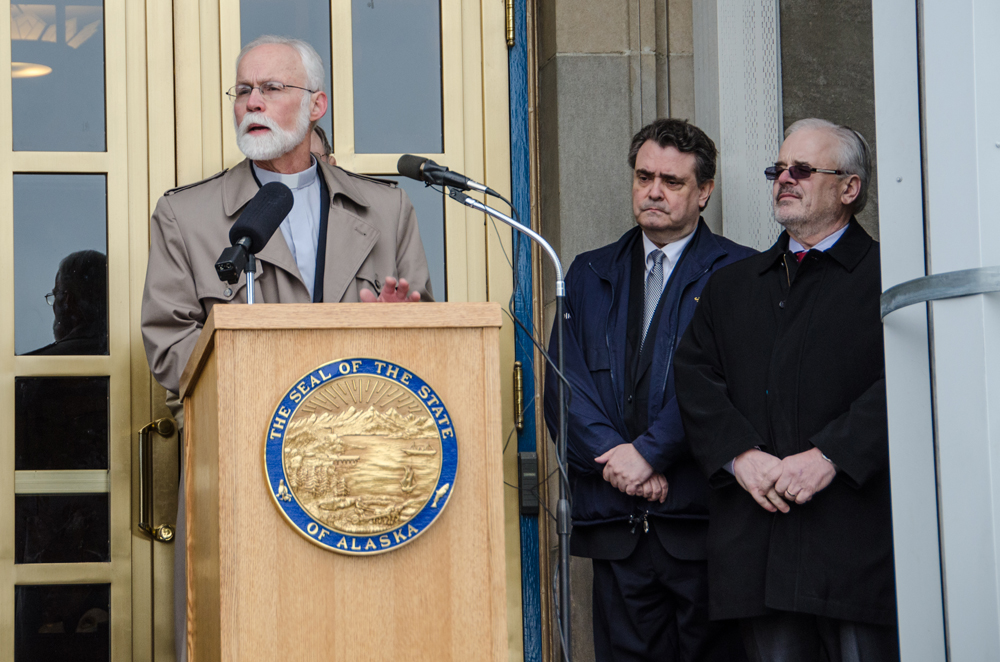
Reverend Phil Campbell spoke on the importance of respect and prevention. (Photo by Heather Bryant/KTOO)
Juneau Mayor Merrill Sanford. (Photo by Heather Bryant/KTOO)
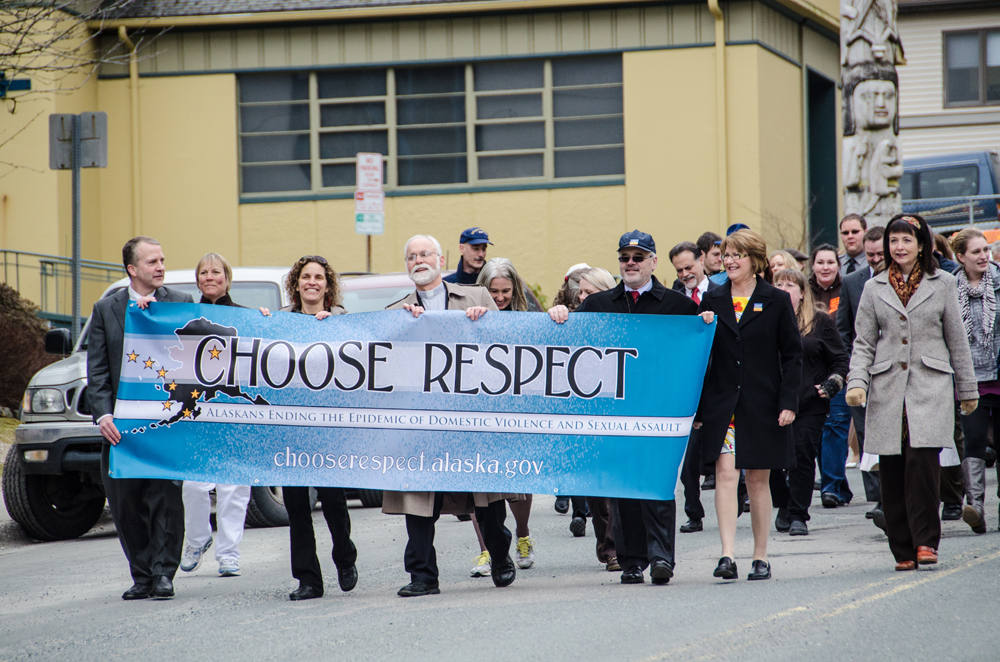
The crowd met at the Capitol steps before marching down Main Street. (Photo by Heather Bryant/KTOO)
The march was led by a procession of the HOGS (Photo by Heather Bryant/KTOO)
The march down Main Street during the 2013 Choose Respect rally. (Photo by Heather Bryant/KTOO)
Ishmael Hope and a group of concerned people carried signs asking representatives to address issues with VAWA. (Photo by Heather Bryant/KTOO)
Many attendees carried signs
Isabella Booth helped pass out fliers to the crowd. (Photo by Heather Bryant/KTOO)
The group handed out letters asking Governor Parnell to speak with Alaska's congressional delegation to fix VAWA. (Photo by Heather Bryant/KTOO)
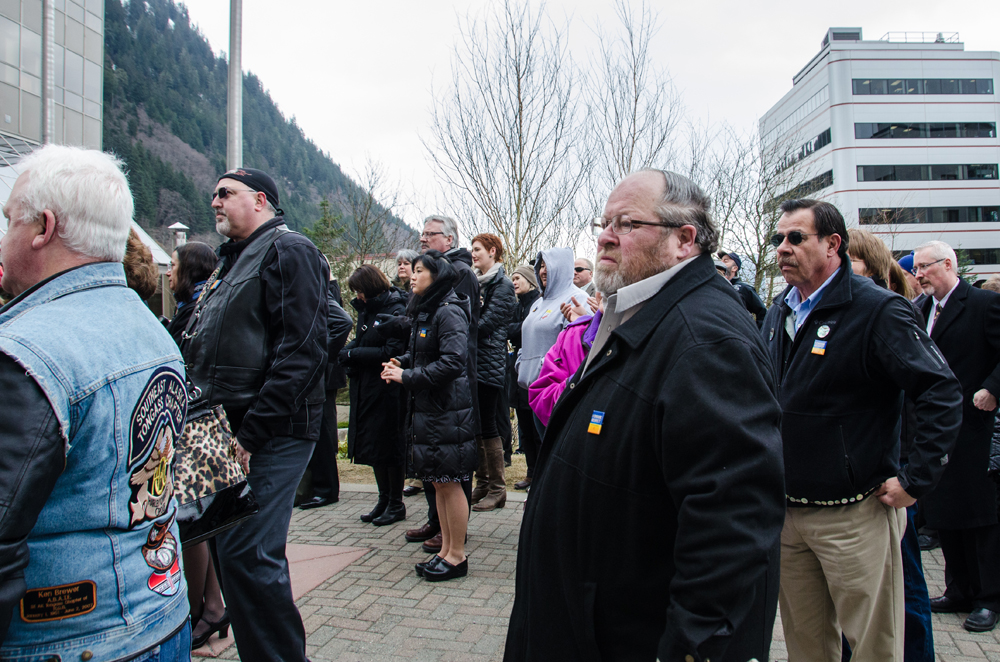
More than two hundred people gathered for the annual Choose Respect Rally today on the capitol steps.
Juneau’s was just one of 143 such rallies happening across Alaska. Governor Parnell was in Palmer, and Natural Resources Commissioner Dan Sullivan led the capital city event.
It’s the Parnell’s administration goal to reduce sexual assault and domestic violence, support victims of abuse and to get as many people involved as possible in the choose Respect campaign.
“Three years later, how are we doing? Well, we certainly have not ended the epidemic of sexual assault and violence in the state of Alaska. But we knew this was going to be generational undertaking. So we’re making progress but it will take years. As for the second goal, giving voice and hope to those that have been abused. We think we’re getting pretty close. There is power and healing in doing this for our citizens.”
The Reverend Phil Campbell of Northern Lights United Church participated in the march. The church works in in partnership with AWARE to reduce sexual violence.
“It is both to state the obvious and to name something too often unsaid– It is males that commit most the acts of sexual violence and abuse. As men we need to face this, to change what it means to be male, to disentangle it from some distorted notion of macho dominance and to declare our intention to part of the solution, rather than remaining part of the problem even if it is by our silence rather than active engagement.”
Congressmen Don Young also spoke to the crowd, highlighting the connection between alcohol and violence.
Juneau’s Choose Respect march ended at the future site of the downtown Walter Sobeloff Center, where the lack of respect for Native women in the Violence Against Women Act became the topic.
Congress recently reauthorized the federal law, called VAWA for short. While it grants tribal courts jurisdiction over non-Natives in domestic violence crimes in Indian Country, in Alaska, that applies only to Metlakatla, the only Indian reservation in the state. Many Native groups do not believe the act sufficiently protects Alaska Native women.
In an open letter to Governor Sean Parnell, a group of concerned citizens urge Parnell to work with Alaska’s congressional delegation to fix the law.
Jessie Reinhardt and Ishmael Hope were representing the group.
“We just wanted to make a direct, but still respectful and courteous statement, about just how Alaska Native women, Alaska Native Tribes should be included in the Violence Against Women Act.”
Alaska Senator Lisa Murkowski worked to insert language in the legislation to make sure Metlakatla would be treated like Lower 48 reservations. Reinhardt says that doesn’t help other Alaska Native women.
“When VAWA was reauthorized, it excluded Alaska Native tribes from issuing Civil Protection Orders. And that’s really important in southeast as well as other villages throughout Alaska…Murkowski, unfortunately, went in and put language in the VAWA act that has the words “Indian Country.” So whenever you use those words you’re excluding Alaska tribes, except for Metlakatla. So most of Alaska tribes do not have Indian country.”
The letter says the new Violence Against Women Act “singles out Alaska Natives for discriminatory treatment” because of what the group calls the “Murkowski Fix.”
The group requests the state of Alaska work with Alaska tribes and the delegation for civil protections of Alaska Native women.
Gastineau Community School (Photo by Heather Bryant/KTOO)
Education advocates have long promoted pre-school as a way of closing the achievement gap between rich and poor students, and this year the president named expanding early education programs as one of his top priorities in his State of the Union address. But here in Alaska, fewer kids could end up having access to pre-school due to budget cuts.
Students are trickling into Ms. Deana Wanner’s classroom at the Gastineau Community School. The kids take off their jackets, and then sit down at tables with paper and markers. Today, the focus is dinosaurs.
The four-year-olds are part of a small and relatively new state-managed pre-kindergarten program. It was created in 2009, and it uses certified teachers to serve kids who are at or below the poverty level. The goal is to sharpen their motor skills, pump up their vocabulary, and get them used to being in a classroom. So, when kindergarten comes, they’ll basically be ready.
At Gastineau, the program works as a partnership with Head Start. Deana Wanner makes up half of the teaching team.
“I like having the relationship with the family to come in and make sure they’re making the progress to help their child come to school on a regular basis. Because some of those families need that extra support, and that’s where we come in.”
At pre-school, the kids learn more than just how to count. It’s a stable environment for them to socialize, get basic life skills, and receive adult supervision.
These aren’t kids whose parents can afford fancy private pre-school programs. When one student gets dropped off, the dad alerts Wanner that a family member had been hospitalized and that the kid could need extra attention as a result. At recess, Wanner consults with support staff about a different family that needs help getting their kid on something as basic as a bathing schedule.
Teachers mix little lessons on nutrition and hygiene in with the academic stuff. Before the students eat their snacks, Wanner sneaks in a lesson on how to say the ABCs and wash your hands at the same time.
A ten-minute drive away at the state capitol, Wanner’s classroom and others like it have become part of a fight over early education funding. Almost immediately after the pre-kindergarten program was created, Republican lawmakers targeted it for cuts. That’s despite a track record of academic improvement and ever-increasing demand for pre-school, says state Education Commissioner Mike Hanley.
“We just don’t have the access to pre-school in our state for kids that a lot of other states have, or that we really need, at any level, whether it’s private or public. It’s challenging to find it always on the chopping block.”
Gov. Sean Parnell had funded the program at $2.5 million next year, but about a half million of that has been slashed from the budget being considered by the legislature. Hanley says that if that cut goes through, the program will have to turn away 135 kids. And that gap won’t be made up by the federal Head Start program. Because of sequestration, Head Start is shrinking by almost the same number of kids.
One of the justifications for the funding cut was that state pre-K could be in competition with privately owned schools or daycare centers. Hanley’s skeptical of that, especially when it comes to some of the rural districts the program serves:
“I think the argument that we’d be taking students — clients, if you will — from the private and suddenly sacrificing the private side … It seems to be an erroneous type of an argument. There are a lot of kids that need the support.”
Back at Gastineau, Wanner tries to avoid thinking about the politics surrounding her classroom. But’s she also puzzled by the confusion over what her program does and who uses it:
“Oh my gosh. It’s a 100 percent different from day care. We do individual plans, so if a kid needs special areas where they need to work on best, you know, I can tell you social and emotional skills are the key component for here in our classroom because that’s the first thing they need to get those pre-academic skills going.”
Wanner says it’s difficult not knowing how big her classroom will be next year with all the uncertainty surrounding the program. Right now, the Alaska Senate is set to take up the state operating budget on Thursday, with Democrats planning to introduce amendments to restore the pre-school funding. But given their small minority, the change is not expected to get traction. Some Republican senators have said that they’re working on a separate education funding package that could include more money for early education, but so far, details have not been released.
The Alaska Marine Highway wants feedback from the communities it serves on the upcoming schedule.
The ferry system plan for fall, winter and spring of 2013 and ’14 is out for review.
Ferry officials try to keep schedules consistent from year to year, says spokesman Jeremy Woodrow. They also work with school districts and communities along the routes to accommodate planned events.
“Of course there are changes that have to happen with different vessels when they go up into overhaul and lay up periods and those type of things,” Woodrow says. “So when we meet the schedule with that consistency, it’s looking at what major events are going on throughout the year, and it’s trying to then schedule either additional vessels to meet that traffic demands or to accommodate maybe a larger vessel instead of a smaller one that might be serving that community to meet that traffic demand as well.”
Woodrow says written comments on the proposed schedule should be emailed to dot.amhs.comments@alaska.gov and or faxed at 907-586-8365 before April 5th.
An April 9th teleconference is scheduled at 10 a.m. to take comments on the Southeast Alaska schedule, and at 1:30 p.m. on the Southwest and Southcentral schedules. The teleconference number is 1-800-315-6338, conference code 3902#.
Woodrow says changes requested by groups, such as city assemblies, village councils, chambers of commerce, or school districts, will carry more weight than those proposed by individuals.
A pro-gay-marriage protester stands in front of the Supreme Court on Tuesday, the first of two days of oral arguments on challenges to laws that limit the definition of marriage to unions of a man and a woman. Karen Bleier/AFP/Getty Images
After weeks and months of public debate and speculation about the legal fate of same-sex marriage, the second round of arguments takes place at the U.S. Supreme Court on Wednesday.
After hearing a challenge on Tuesday to California’s ban on same-sex marriage, the justices move Wednesday to the 1996 Defense of Marriage Act, known as DOMA. The law bars federal recognition and benefits for same-sex couples married in any of the states — and there are nine currently — where such unions are legal.
There are more than 1,000 federal laws that confer benefits of one sort or another on married couples — everything from tax savings to Social Security benefits, but DOMA excludes those benefits for legally married same-sex couples.
The test case involves a couple from New York, Edith Windsor and Thea Spyer, who had been together for 42 years prior to their marriage in 2007. When Spyer died, however, the federal government, acting under DOMA, required Windsor to pay $363,000 in estate taxes that she would not have owed if her spouse had been of the opposite sex.
“If Thea had been Theo, I would not have had to pay those taxes,” says Windsor. “It’s just a terrible injustice and I don’t expect that from my country. I think it’s a mistake that has to get corrected.”
At the Supreme Court on Wednesday, Windsor’s lawyer, Roberta Kaplan, will tell the justices that the federal government, throughout the nation’s history, has always deferred to state definitions of marriage, because regulating marriage is a state function. But because of DOMA, that traditional deference to the states doesn’t exist for same-sex couples. Edie Windsor’s marriage, recognized as legally valid by the state of New York, is not recognized by the federal government.
And that, Kaplan argues, creates a “second-class citizenship, or at least second-class marriages, that the Equal Protection Clause of the Constitution forbids.”
The 14th Amendment guarantees all citizens equal protection of the law, and Kaplan will argue that the government has to have “a good reason” for distinguishing between gay and straight couples. Contending that DOMA supporters have been unable to justify treating legally married gay couples differently, she argues that it is unconstitutional to “allow straight married couples to have all the benefits of federal law and gay couples to have none.”
Normally, the federal government defends all acts of Congress, but the Obama administration, in a rare move, has declined to defend DOMA in court and instead is siding with those challenging the law.
The House Republican leadership has stepped in to defend the statute, hiring former Bush administration Solicitor General Paul Clement to do the job. About half of the oral argument will focus on whether Congress has legal standing to defend the law in court. And because the administration agrees with Congress that it does have standing, the Supreme Court has appointed a private lawyer to argue that Congress does not.
Those defending DOMA have been strangely unwilling to make their arguments outside of the court. House Speaker John Boehner, R-Ohio, declined to be interviewed for this article, as did Clement and leading House members who voted for the law. Even Sen. Orrin Hatch, R-Utah, who filed a friend of the court brief supporting DOMA, was unavailable for an interview. The primary sponsor of the bill, former Rep. Bob Barr, R-Ga., now retired, has changed his mind and now opposes the law. President Clinton, who signed DOMA into law, has also reversed course.
Rep. Steve King, R-Iowa, however, is an outspoken DOMA supporter. Equal protection, he says, means “equal protection for a man and woman to be able to get married to each other,” because “that’s been the definition of marriage for thousands of years.”
And as for Edie Windsor: She simply “wasn’t married in the eyes of the United States Congress, according to DOMA.” Under our system of federal and state shared power, King says, states are free to recognize same-sex marriages, and the federal government is free to not to recognize those marriages.
Brigham Young University Law School professor Lynn Wardle puts it this way: “Since the Constitution was drafted in 1787, it’s been the federal government that has had the authority to define who is eligible for federal programs and benefits.”
Wardle, who testified in support of DOMA in 1996, notes that at the time, Hawaii seemed poised to become the first state to legalize same-sex marriage, “and Congress said nope, there’s a very clear consensus on what marriage is. … It’s the union of a man and a woman.”
The House leadership, in its legal brief, makes similar arguments in support of DOMA. In the face of state and public debate over same-sex marriage rights, the brief says, the federal government had good reason to “retain the traditional definition” of marriage as “the uniform rule for federal-law purposes.”
Like proponents of California’s ban on same-sex marriage, the brief also highlights the reproductive ability of opposite-sex couples, arguing that “the core purpose and defining characteristic of the institution of marriage always has been the creation of a social structure to deal with the inherently procreative nature of the male-female relationship.” This inherent difference between same-sex and opposite-sex couples is just one of the rational justifications for their unequal treatment under federal law, according to the brief.