Cathie Roemmich. Photo courtesy Juneau Chamber of Commerce.
Juneau Chamber of Commerce CEO Cathie Roemmich has been selected to serve on the U.S. Chamber of Commerce Committee of 100.
The committee – made up of local and state chamber executives from around the country – advises the U.S. Chamber’s board of directors.
Roemmich believes she’ll be the first Alaskan to sit on the committee.
“As an Alaskan, I think our particular issues are our natural resources,” she says. “We have energy issues that we need to get settled, we have transportation infrastructure that we need to work on, we need to protect our fishing and our mining and our tourism, and make sure that our economic development is responsible.”
The U.S. Chamber of Commerce is the largest business lobbyist group in the nation.
Just like the State of Alaska doesn’t always see eye-to-eye with the federal government, Roemmich says local chambers don’t always agree with the U.S. Chamber. In 2011, the Homer Chamber of Commerce parted ways with the national Chamber over its stance on taxes, climate change and the Exxon Valdez Oil Spill litigation.
Roemmich says that’s understandable, but she looks forward to bringing an Alaska perspective to the Committee of 100.
“The problem is, when you don’t have a seat at the table, they don’t know what the real issues are,” she says. “So that’s why I look at this as an incredible opportunity to actually be at that table.”
Roemmich says she was invited to join the panel after completing the U.S. Chamber’s Institute of Organization Management.
Her first Committee of 100 meeting will be later this month. The group meets twice a year.
State officials say that a brand of Greek yogurt usually sold in Alaska is being recalled because some consumers have become ill.
Chobani, Inc. is recalling all flavors of its yogurt produced with the Lot Code starting with 16-012 and with Best By Date codes starting with Sep 11-13 to Oct 07-13.
The recall includes 3.5 ounce and 6 ounce cups, 2.25 ounce Champions tubes, 3.5 ounce Bite and Champions cups, 5.3 ounce Flip containers, and 16 ounce and 32 ounce tubs.
Department of Environmental Conservation officials says the product is sold in Alaska, but there have been no reports yet of any illness in Alaska attributed to the product.
According to a bulletin issued by the U.S. Food and Drug Administration, Chobani has ceased the distribution of the product because of product bloating and swelling, and some claims of illness by consumers. The FDA says the company is investigating to identify the root cause.
The potentially affected product was distributed nationwide from Chobani’s Twin Falls, Idaho facility and was delivered to consumers through retail and club stores.
Here is Chobani’s customer contact link that was embedded in the above Tweet.
Chobani Greek yogurt purchased at Juneau’s Foodland IGA on Thursday shows the Best By Date code and Lot Code on top of a 6 ounce cup. Photo by Matt Miller/KTOO News
The Biosolids Incinerator (located at the Juneau-Douglas Facility) is used to burn the solid waste matter produced in the wastewater treatment processes at both the Juneau-Douglas and Mendenhall facilities. (Photo courtesy CBJ website)
Juneau’s poop is getting expensive.
Bidding closed last week on a 5-year contract for municipal sewage sludge disposal with only one viable bid.
Bicknell Inc., a Juneau home building and paving company, has proposed a cost of about $1.6 million per year.
That’s roughly 40 percent more than the city pays for disposal between in-house costs and under the contract that expires at the end of the year with Waste Management. Homeowners and businesses bear that cost, among others, through wastewater utility fees, which have been about $64 a month for most addresses since July 2011. A city-commissioned study to inform potential rate changes is due in May.
The new contract may be the long-term solution that Juneau officials have sought for years. Or it may be the latest stopgap since the city’s sludge incinerator went offline in 2010.
The sludge is a form of treated sewage, also known as biosolids. It’s the product of Juneau’s wastewater treatment facilities.
Bicknell’s contract award will come before the Juneau Assembly on Monday. If approved, Bicknell may still have to wade through local zoning and permitting issues before the operation gets the green light.
Public Works Director Kirk Duncan declined to comment on the pending contract. And Bicknell owner and president, Spike Bicknell, declined to comment until a contract is in place.
However, his bidding documents offer clues about his plan. It is clear Bicknell plans to dispose of the sludge locally, but not specifically how or where.
Waste Management’s Lemon Creek landfill is the only site permitted for sewage sludge disposal, according to the state Department of Environmental Conservation. That suggests Bicknell plans to incinerate the sludge itself, or do additional treatment so it can be recycled as fertilizer or in other beneficial uses; those are the only alternatives to landfill disposal under the Environmental Protection Agency’s rules.
Price differences in the transport costs of moving the sludge to the undisclosed disposal site offer another clue about its location. Bicknell’s bidding documents quote the cost of one round-trip from the Mendenhall Valley treatment plant at half that of a round-trip from the Juneau-Douglas plant; suggesting the site is closer to the valley than downtown.
Waste Management also bid on the new contract, but was undercut by about $90,000. Its bid required the city treat the sludge to the EPA’s minimum standard for recycling. That caveat invalidated the bid, according to the city purchasing office.
Public Works Director Kirk Duncan says managing sewage sludge has been a longstanding local issue common in many communities.
“It’s interesting to note that back in 1985, the two priorities of the Assembly were biosolids and landfill,” Duncan said. “And we’re still sort of in that situation, so. Communities just struggle with what they do with biosolids.”
(Full disclosure: Duncan is a member of the KTOO Board of Directors.)
The contract has a 5-year renewal option.
How we got here
In late 2010, the city’s 20-year-old sewage sludge incinerator at the Juneau-Douglas Treatment Plant off Thane Road went offline. City officials initially sought repairs and a replacement, but ultimately decided replacing it was too expensive; the capital cost was estimated in the tens of millions, plus high operating and maintenance costs.
Every month, Juneau produced hundreds of tons of sludge that used to be burnt into vapors and ash.
The city bought time by signing a short-term contract with Waste Management to take the sludge. At first, Waste Management put all of the sludge in its Lemon Creek landfill. It’s got a strong odor, unlike more thoroughly treated, fertilizer-quality sludge.
Eric Vance, Waste Management’s local manager, said he curbed the odor by mixing sludge with garbage and burying it. But eventually, he ran out of places to put it.
To avoid violating nuisance laws, Waste Management began shipping some sludge in the summer of 2011 to a bigger landfill it operates in Arlington, Oregon. As odor-fighting capacity at Lemon Creek fell, the ratio shipped south rose. And so did costs. The per-ton cost of disposal in Oregon was regularly 30 percent or more than the local rate.
This year, almost all of the sludge has been shipped out of town.
Oct. 22, 2013, Correction: An earlier version of this story understated current sludge disposal costs and overstated the cost increase under Bicknell’s proposal. Disposal costs would not double, but increase by about 40 percent.
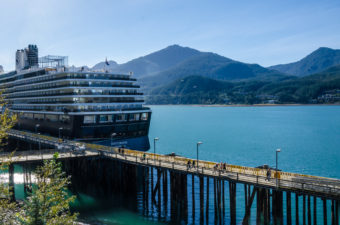
The Holland America Cruise Ship Westerdam prepares to dock in Juneau July 16, 2012. (Photo by Heather Bryant/KTOO)
The world’s largest cruise corporation will soon install new pollution-control equipment on 32 of its ships. Carnival, Princess and Holland-America vessels sailing Alaska waters are likely to be among those getting the gear.
Carnival Corporation owns 10 cruise lines operating about 100 ships from ports in North America, Europe, Australia and New Zealand.
It’s a significant player in the Alaska market.
Corporate officials say the technology, called scrubbing, will meet new international requirements for sulfur and smoke emissions. They say they’ll spend about $180 million on the equipment over the next two to three years.
“We haven’t determined which ships of the 32 will be implemented in what markets and what ports,” says Roger Frizzell, spokesman for Carnival, which is headquartered in Miami and London.
“Alaska’s obviously an important market, and I’m expecting that if they don’t have it right away they will have it shortly,” he says. (Read Carnival’s announcement.)
The equipment has been tested on one ship’s diesel engines so far. The evidence helped win conditional approval from the federal Environmental Protection Agency and the U.S. Coast Guard.
A dog watches as a Holland-America cruise ship, part of Carnival Corporation’s holdings, sails down Gastineau Channel off Sandy Beach in Douglas Sept. 5, 2013. Ed Schoenfeld, CoastAlaska News photo.
Frizzell says Carnival eventually plans to use scrubbing on all of its 102 vessels.
“This is going to be a real change in our industry and I think it’s something for Alaska and some other key ports it’s going to be beneficial to the environment,” he says.
Carnival’s scrubbers target sulfur oxides, which contribute to global warming and acid rain. They also remove soot and other small particles that make up ships’ exhaust.(Read an EPA paper on scrubber technology.)
Frizzell says the technology is common onshore.
“This is the first time this combination is being developed to accommodate restricted spaces on the ships. Q: Did that require significant reengineering of the technology? A: It did. When we moved it from the power plants and the factories to the ship it really was a complete overhaul of the systems and resizing.”
“I think there’s just been a whole shift at Carnival, with all the problems they’ve had and everything,” says industry critic Chip Thoma of Juneau.
He says the corporation is making a significant – and welcome – change. But the president of the group Responsible Cruising in Alaska says it’s not all good attentions.
“They’re making so much money. It’s such a lucrative corporation that they’ve decided to switch gears and get into the 21st Century. And it’s a wonderful move that they’ve done so,” Thomas says.
The EPA says the agreement is a trial effort and the technology will be closely monitored. (Read the EPA’s announcement.)
Carnival spokesman Frizzell says it exempts equipped ships from new, stronger air-quality regulations aimed at lowering pollution along the coast.
“The exemption gives us the flexibility to use whatever fuel source we determine. And that’s significant for us because it gives an economic value,” Frizzell says.
That’s because low-sulfur fuel is more expensive than what cruise ships usually burn.
The agreement still requires Carnival ships to use that fuel while in port – or plug into an onshore power source.
The EPA has also reached agreements with Royal Caribbean and Norwegian cruise lines, as well as barge companies and owners of some other large vessels. Some are using different approaches.
The Trans-Alaska Pipeline System (TAPS) includes the trans-Alaska crude-oil pipeline, 12 pump stations, several hundred miles of feeder pipelines, and the Valdez Marine Terminal. (Photo by Cedric Husler/Fotopedia)
The state Division of Elections has certified a referendum to repeal a new state law that reduces taxes on oil companies.
In a letter to the citizen group organizing the effort, Elections Director Gail Fenumiai says the division has verified 45,664 signatures of registered voters. The group needed 30,169 qualified signatures to get the issue on the August 2014 primary election ballot.
The referendum calls for repeal of Senate Bill 21, signed into law in May, and pushed by Gov. Sean Parnell as a way to bolster oil production. Opponents call it an oil giveaway.
In a news release from the group “Vote Yes! Repeal the Oil Giveway,” prime sponsor and former state Sen. Vic Fischer says the successful petition effort “demonstrates how widespread dissatisfaction is with SB 21.”
The ballot question will ask if the new law should be rejected. The primary is Aug. 19, 2014.
The state’s largest public employee union and the Parnell administration will enter into arbitration over the issue of office space.
An arbitrator has been selected, but the time frame for the negotiations are still unknown.
Arbitration depends on the availability of the state, the union, and the person selected to settle the dispute. The state says that may not be until August 2014.
Alaska State Employees Union Executive director Jim Duncan says that’s not acceptable.
“Members have a right to have their issues heard in a timely manner and a year from now is not timely. And meanwhile, during that period of time, we will have members who’ll continue to be negatively impacted by the issue that we are in arbitration about.”
The union filed a class action grievance in July because it believes the state’s office standards drastically change the work environment. Duncan says the state failed to negotiate with the union prior to implementing the standards, which violates the collective bargaining agreement.
Deputy administration commissioner Curtis Thayer says the state has had space standards for at least 33 years.
“They’re never bargained them with the union. Management has always had the right to establish the space and the desk and the working environment,” he says.
“We have members who deal with a lot of issues that are confidential in nature, protected issues under federal law,” explains Duncan. “The clientele they serve needs to know their conversations are being held in private.”
The state’s office standards include private telephone booths, conference rooms, and other features that Thayer believes improve the work environment.
“We’re giving them ergonomically correct furniture. We’re giving them right to light. They’re getting new break rooms and dishwashers and microwaves and coffee pots that they never had before and the employees are thanking us for it,” Thayer says.
Duncan says the state is painting a picture that employees are happy with the new office space. “That’s entirely false. I am getting emails constantly. We are getting many more members attending our work site meeting than we’ve ever had on this topic. There is more interest in this. There is more opposition to this. There is more concern on this issue from our members than any other issue that we’ve been addressing in recent times.”
Deputy commissioner Thayer doesn’t know what the union wants out of the arbitration. He says employees are already in the new cubicles.
“We can’t put them back into the old stuff. It’s not here anymore. The old break rooms are already triple the size they used to be. We’re not going to return the new refrigerator and the dishwasher to the local appliance store. So that’s one of the things that I’m trying to understand is what do they want?”
Duncan says the union continues to ask the state for the same thing, “Before they proceed, they have to sit down and negotiate those changes with the union and get our involvement. That would mean that they wouldn’t proceed until have an agreement. By delaying the arbitration until August of next year, it’s working in their benefit. They’re going to continue to install the cubicles and it’s going to continue to have a negative impact on our membership.”
According to Thayer, the Division of Insurance on the 15th floor of the Robert Atwood Building in Anchorage is up next for a space renovation. He says the division asked for it.
Close
Update notification options
Subscribe to notifications
Subscribe
Get notifications about news related to the topics you care about. You can unsubscribe anytime.