Business

Growth group pushes new Tongass approach

Second-growth trees cover a Tongass National Forest hillside in southern Southeast Alaska. A proposal from the Southeast Conference could use newer forested areas to replace old-growth habitat. (CoastAlaska News photo.)

The Southeast Conference wants to change the way the Tongass National Forest is managed.

The regional development-advocacy organization is developing a strategy to grow the timber industry and create jobs, while maintaining environmental protections. It announced the plans at its annual meeting Sept. 17-18 in Sitka.

Conference leaders say the U.S. Forest Service is failing to do its job.

That, in the organization’s view, is to sell enough timber to support a strong, regional, wood-products industry. 

Southeast Conference Executive Director Shelly Wright.

“We’re trying to open up the landscape to a management strategy that is changing over time,” says Shelly Wright, executive director of the Southeast Conference, which is made up of business, government and tribal leaders, as well as interested individuals.

“Rather than set aside a big chunk for logging and a big chunk for no logging, open up all of the regulated set-asides and use it as a flexible forest,” she says.

National monuments, designated wilderness and some other protected areas would stay the same. Buffer zones would still be required near beaches, streams and rivers.

But Wright says many other parts of the Tongass would be open for multiple – and sometimes changing – uses.

“A stand of trees doesn’t have to be 150 years old to be habitat. Different habitat is good for different times of year and different kinds of animals. So we want them to … actively manage and monitor all parts of the forest for habitat and economic development,” she says.

“I think they’re looking backwards to recreate the glory days of timber on the Tongass, which unfortunately are over,” says Andrew Thoms, executive director of the Sitka Conservation Society, which has been part of the forest management debate.

Sitka Conservation Society Executive Director Andrew Thoms.

“The Tongass produced a record number of salmon this past year that created a ton of jobs and a ton of economic activity from the fisheries. I think that the Southeast Conference wants to ignore the fact that all these salmon come from the forest and that they’re produced because of the protections that we have on the salmon streams,” he says.

And, by the way, he says the forest does take 150 years – or longer – to fully mature.

The existing Tongass management plan has been developed over years of public debate. It’s attracted attention from national environmental organizations and has been driven in part by policy calls from Washington D.C.

So what does the Forest Service think about the conference’s idea?

“I believe that it’s a legitimate proposal,” says Tongass Forest Supervisor Forrest Cole.

He hasn’t seen the conference’s strategy, though he’s talked to its authors. He says it could be considered if it’s submitted during the process of reconsidering Tongass policies.

Tongass Forest Supervisor Forrest Cole.

“I believe over the life of the current forest plan we’ve looked at 30 or 40 different alternatives. And I’m guessing if that if we get into a modifying of the plan in the near future, we’ll look at a wide variety again. So having a recommendation from Southeast Conference for looking at alternatives is a welcome proposal for us,” Cole says.

Canadian timber consultant Don Reimer provided the research to back up the conference’s approach.

He says it could increase timber jobs from about 500 to more than 2,000 over a number of years. And he says it would save taxpayers’ money.

“We think that it would be able to eliminate most of the cash drain that you have on the Tongass, because you’d now have an active timber program like you used to have in the past that should pay for the restoration work and some of that stuff that needs to be done instead of having a drain on the treasury,” he says.

Southeast Conference leaders acknowledge their approach could be a hard sell.

That’s why they hired Willis Lyford of Anchorage-based Porcaro Communications to spread their message.

“We need to change the debate and the discussion about the timber industry in Alaska. And that takes a lot of hard work and research and a lot of study and people who are experts,” he says.

The company recently polled Southeast and other Alaskans to gage their views of the industry.

He shared results indicating strong support for logging, including its expansion. But it also showed concerns about environmental damage and other impacts.

Alaskan Hotel to get TV makeover

The Alaskan Hotel opened in 1913 and is on the National Register for Historical Places. It will be featured on the Travel Channel reality show Hotel Impossible. (Photo by Lisa Phu/KTOO)

The oldest operating hotel in Alaska will get a makeover – on TV.

The Travel Channel’s reality show Hotel Impossible will be in the capital city next week to film an episode on the Alaskan Hotel.

According to the show’s website, each episode features a hotel that is having problems or is not living up to its potential. Hotel Impossible host Anthony Melchiorri identifies problem areas and works with staff to transform the hotel.

The Alaskan Hotel recently celebrated its centennial anniversary. It opened September of 1913. The hotel was placed on the National Register of Historic Places in 1978. Current owners are Michael and Bettye Adams.

Hotel Impossible is employing two local general contractors while in Juneau – Alan Wilson with Alaska Renovators and Greg Stopher of Stopher Construction. Stopher says he is getting paid to work on the show. He wouldn’t specify the amount but says it isn’t very much.

This is not the show’s first time in the 49th state. Hotel Impossible filmed an episode at Yakutat’s Glacier Bear Lodge September 2012, which aired this past January.

“They come in and they beat you up pretty hard and then give you some ideas of what to do,” says Pete Eads, general manager of the fishing lodge

Eades says Hotel Impossible updated Glacier Bear’s website, bought the lodge space at travel expos on the East Coast, offered ideas on how to save on shipping costs, and renovated a room. Glacier Bear Lodge spent $100,000 to renovate an additional ten rooms.

Eades says up to 85 percent of the lodge’s business is from returning clients every year. The occupancy rate of the lodge has only increased one-and-a-half percent since Hotel Impossible.

“I know for a fact we’ve got maybe two or three reservations of people who saw the show and wanted to come to Alaska, but they were talking about how it’s going to just make the lodge go off the hook and it did not do that,” Eades says.

Hotel Impossible is revisiting the Glacier Bear Lodge this weekend before traveling to the capital city. The television crew arrives in Juneau on Monday and will be here for a week.


Juneau businessman Larry Spencer dies

Larry and Carola Spencer. Photo courtesy Facebook.

Well-known Juneau businessman Larry Spencer has died. He was 63.

A former president of the Downtown Business Association, Spencer is described as totally committed to the capital city.

He came to Juneau from Minnesota in the late 1970s and quickly became active in his adopted community.

Business partner Bruce Denton says the two first worked together on a townhouse project in West Juneau.  At that time Denton was looking for a business partner who could run his construction business while he was training and running the Iditarod Sled Dog Race.

They formed Senate Properties and their first project was the renovation of the old Senate Building in downtown Juneau.  They’d taken a big gamble on the building purchase, closing on it the day before a statewide 1982 capital move vote, which failed, sparing the capital city.

Denton says renovating the historical building was Spencer’s idea.

“It was his vision and I think it was really the beginning of the refurbishing or the gentrification of the historic district downtown,” he says.

Spencer also owned Spencer Realty, a real estate and property management company.

Over the years, Spencer and Denton collaborated on a number of projects in the Juneau area, from condominium developments to the first SEARHC Clinic buildings on Hospital Drive to several mini-storage projects.

“He was the developer and I was the builder,”  Denton says.

A lifelong Democrat, Spencer never ran for public office but was recruited in recent years by opposite political camps.  Denton says it was a testament to his ability to balance development and preservation.

“The preservationists and the developers were both recruiting him at the same time to run for the Assembly. And he would have been an incredibly good Assembly person because he just had a brilliant mind and could think really fast on his feet.”

He didn’t have to be in office to be active in his community.  Spencer worked on a number of major Juneau issues, including tourism management and legislative housing.

He loved the arts and was a founder of Perseverance Theatre, serving on the Board of Directors for years.

Spencer died late Thursday at his home in Juneau, surrounded by his family.  He was diagnosed with brain cancer about five years ago.  After he underwent surgery in 2008, Juneau Rotary clubs and local businesses collected baseball caps to send to him as he went through therapy.

He is survived by his wife Carola, daughter Sophie and son Logan.


Why “Alaska” means milk and basketball to many Filipinos

When Filipinos hear “Alaska,” often the first two things that come to mind are milk and basketball.

(Composited from photos by @Doug88888 and Ion Botezatu via Flickr Creative Commons)

That’s according to the Philippines’ recently appointed honorary consul to Alaska, Jenny Gomez Strickler.

It turns out, the Philippines-based Alaska Milk Corporation sells milk in the country and sponsors the Alaska Aces — not Anchorage’s minor league hockey team, but a professional basketball team in the Philippines. Neither the milk nor the basketball team have a meaningful connection to the 49th state.

That means if Alaska wants to make inroads in trade with the Philippines, the state has a lot of work to do. In 2012, less than 1 percent of Alaska’s exports ended up in the Philippines, according to census data.

Jenny Gomez Strickler, Philippines honorary consul to Alaska

But Strickler says connections are being forged that could help build a market for Alaska seafood, and even liquefied natural gas.

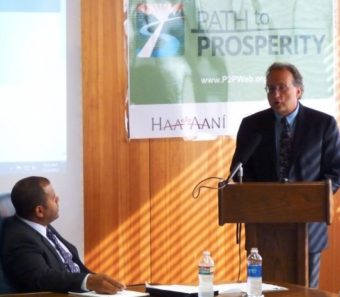
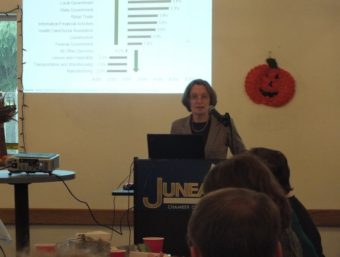
The Juneau resident and retired Alaska Department of Commerce and Economic Development worker spoke to the Juneau World Affairs Council on Wednesday. In her new honorary role for the government of the Philippines, she’s part bureaucrat, and part international trade facilitator.

She’s trying to make the case that “Alaska” should mean “seafood” in the Philippines.

“The Philippines is a fish-eating country,” she said. “Yet its fish is imported from other countries. And its imported salmon is farmed salmon.”

Strickler, Juneau Rep. Cathy Munoz and the governor’s office are trying to put together a seafood festival in Manila next year to show the country what Alaska has to offer.

Strickler shared an anecdote about a missed connection that networking at the festival might fix. A former Juneau resident brought some Alaska seafood to Manila for his friends to try. One of samplers happened to be a hotel owner.

“The business owner enjoyed it so much, he said, ‘If I get this from you, can you guarantee me X amount throughout the year, or a portion of the year?’ He looked him straight in the eye and said, ‘I can’t, cause I’m not a fisherman.’”

She said they’re working on a pitch to get support from the Alaska Seafood Marketing Institute.

Strickler also said she was on a recent conference call between Philippines Ambassador Jose Cuisia Jr. and state officials. The ambassador said he’s putting together a team to visit Alaska and investigate opportunities to import liquefied natural gas.

Finally, Strickler said Aklan State University in the Philippines is interested in sending instructors to the University of Alaska Southeast through an exchange program. They want to learn about saltwater fisheries.

Strickler said she expects that arrangement to come together after the Juneau Assembly adopts a sister city proclamation linking Juneau and Kalibo, the capital city of the Philippine province Aklan.

A Juneau Assembly committee backed the proclamation on Monday.

Jenny Gomez Strickler’s talk with the Juneau World Affairs Council is tentatively scheduled to air on 360 North on October 11th.

Southeast leaders consider region’s maritime industry

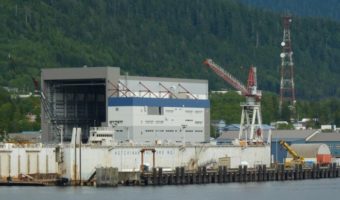
he Ketchikan Shipyard is a big part of the region’s maritime industry, which will be discussed at this year’s Southeast Conference meeting. (Ed Schoenfeld/CoastAlaska News)

About 250 Panhandle business, government and nonprofit leaders will gather in Sitka Sept. 17-19. It’s the annual meeting of the Southeast Conference, one of the region’s larger organizations.

This year’s meeting will look toward the sea.

That’s according to Shelly Wright, executive director of the Southeast Conference, which is headquartered in Juneau.

“We’re really focusing on the maritime industry in Southeast Alaska, the seafood industry, some of the transportation industry pieces (and) workforce development,” she says. “(We’re) trying to get back to the small business and how we can grow as a region by growing our businesses.”

The organization has been in the middle of a number of efforts to reinvigorate the region’s logging and wood-processing industry.

They include the many-membered Tongass Futures Roundtable and Gov. Sean Parnell’s Alaska Timber Task Force.

Wright says the conference will announce plans at the meeting for its own effort.

“To try to manage the Tongass in the way that’s going to create a universal strategy for habitat as well as resource development.”

Q: “And isn’t that something that the Forest Service is already doing?”

A: “We would like to show them a better way.”

The Southeast Conference meeting will include the release of their annual economic roundup at the meeting. (Click to read the conference agenda.)

And a variety of speakers and panelists will talk about mining, transportation and vocational training.

“It really is a one-stop shopping event where you have access to leadership throughout the region and state,” says Robert Venables of Haines, the organization’s energy coordinator.

“We have agency participation and the communities all have an opportunity just to do lessons learned and share experiences of what they’ve been accomplishing, what they hope to accomplish and how we’re doing,” he says.

Yakutat, for example, is trying to be the first Alaska community to use wave power to generate electricity. The conference will get an update from Columbia Power Technologies, a Lower-48 company working on the project.

Venables says a variety of speakers will provide updates on hydropower, biomass and other energy projects throughout the region.

(We have so much surrounding us with wave, water, wood and wind. Those are the technologies that we really need to tap into,” he says.

Conference attendees will tour the Blue Lake Dam expansion project, Sitka’s brewery and the shipbuilding company Allen Marine.

Wright says a panel will also showcase locals.

“We’ve got some entrepreneurs in Sitka that are going to be presenting their business, how they started and how they succeeded in Sitka,” Wright  says.

The Southeast Conference will also hold its annual board election. Six of 13 seats are up for grabs.

Juneau-Petersburg boundary dispute argued in court

Final Petersburg Borough Map Illustration
Final Petersburg Borough Map Illustration (Click on image to enlarge)

The City and Borough of Juneau says the northern boundary for the recently-formed Petersburg Borough is wrong. It’s a jagged line that starts in northwestern Holkham Bay and runs from peak-to-peak north of Endicott Arm all the way east to the Canadian border.

The CBJ says the mistake was made by the Local Boundary Commission, the state panel charged with reviewing the creation or alteration of municipal governments. They want the LBC to go back and redraw that line, preferably much further south than it is now.

The CBJ, which had its own petition to annex the mainland down to Cape Fanshaw, is making its case with a judicial appeal of the LBC’s approval of the Petersburg Borough incorporation petition. Arguments were held Wednesday afternoon in Juneau Superior Court.


Superior Court Judge Louis Menendez
Superior Court Judge Louis Menendez listens to arguments in the appeal of the Petersburg Borough incorporation petition. Photo by Matt Miller/KTOO News

For much of the nearly hour-and-fifteen minute hearing, attorneys provided their own interpretation of what was done with both petitions, and why.

City and Borough of Juneau attorney Amy Mead referred to a constitutional requirement for the LBC to fully and fairly consider both competing claims for the overlapping area between Holkham Bay and Cape Fanshaw before a boundary was set. But she says the LBC only considered whether the Petersburg petition met incorporation standards.

In a situation such as the LBC had before in this case, when there were competing claims for the same area and two pending petitions filed for the same area, the LBC was obligated to fully consider all of the competing claims. Nothing justifies the first-in-time approach that the LBC took in this matter.”

Juneau Annexation proposal map (Click to enlarge)

Mead said that both petitions could have been consolidated, or considered separately, but fully by the LBC.

Mead says there was no hearing physically in the CBJ on the Juneau annexation petition and the CBJ did not have opportunity to fully present their claims. They were only able to present their claims on the Petersburg petition, and CBJ’s own annexation petition was eventually set aside by the LBC pending outcome of the December borough vote by Petersburg citizens.

State attorney Erling Johanson, representing the LBC, says Juneau’s comments were not ignored. The CBJ annexation petition was accepted nearly two months before a multi-day public hearing in Petersburg that included witnesses from Juneau.

The commissioners had the entire volumes of Juneau’s petition. All the back up material and everything.”

Petersburg Mayor Mark Jensen
Petersburg Mayor Mark Jensen listens to arguments in Juneau Superior Court. Photo by Matt Miller/KTOO News

Jim Brennan, attorney for Petersburg, says there was substantial evidence that demonstrated Petersburg’s dominance in the disputed area with tourism and commercial fishing. But he also points to the Tracy Arm area that was carved out from the proposed Petersburg boundaries as the LBC recognizing Juneau’s stronger ties to that part of the mainland.

In this case, Petersburg’s efforts to form a borough had been pending for five years. Ms. Mead tried to equate the two. What Juneau did is sit on their hands all that time. And so, finally at the eleventh hour, when Petersburg’s petition was set to be heard, that’s when they filed their annexation petition.”


Petersburg Proposed Borough Map
Petersburg Proposed Borough Map (Click to enlarge)


Brennan also argued that requiring an amended boundary would invalidate the vote by Petersburg residents or force dissolution of the new Borough, creating chaos and a legal mess. But CBJ’s Amy Mead said during rebuttal that would not happen in this instance, and she said it was not their intent to invalidate the new borough anyway.

Mead was accompanied at the appellants table during arguments by Juneau Mayor Merrill Sanford while Petersburg Mayor Mark Jensen joined Johansen and Brennan at the appellees table.

Attorney Jim Brennan
Attorney Jim Brennan represented the Petersburg Borough during Wednesday’s hearing in Juneau Superior Court. Photo by Matt Miller/KTOO News

Juneau Superior Court Judge Louis Menendez asked only a few questions as he patiently listened to all the arguments.

I have the documents. We’re starting to review them to a greater extent. We’ll take it under advisement. Thank you for your time. It’s been very interesting.”

He’s expected to issue an opinion anytime within the next six months.

Jensen Sanford Mead
Petersburg Mayor Mark Jensen (left) shakes hands with CBJ Attorney Amy Mead, accompanied by Juneau Mayor Merrill Sanford (center), following arguments in Juneau Superior Court on the Petersburg Borough incorporation petition. Photo by Matt Miller/KTOO News


Related documentation:

Juneau’s Annexation Petition

Juneau’s Appellant Brief on boundary appeal

Petersburg Appellee Brief in response to Juneau appeal

State LBC Appellees Brief


Related stories:

Juneau boundary appeal could have serious Petersburg consequences

Petersburg becomes 19th borough in Alaska

Unofficial results show Petersburg borough passing

Site notifications
Update notification options
Subscribe to notifications