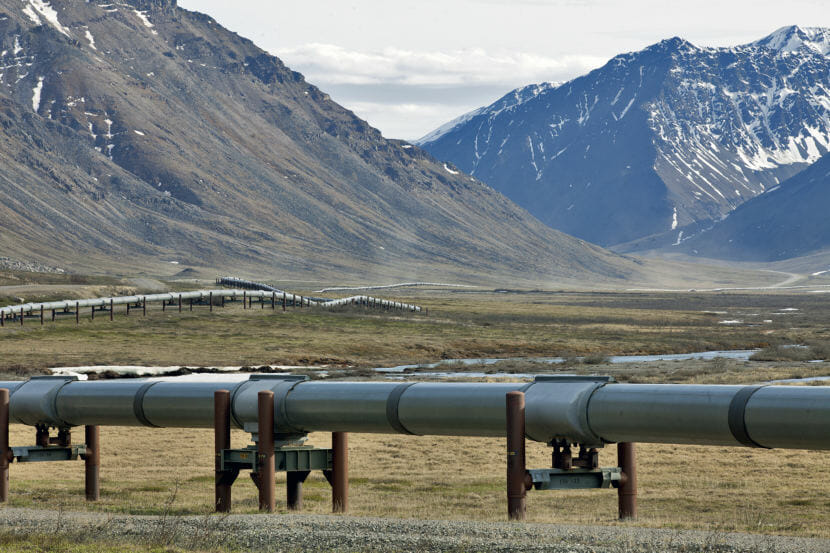
The trans-Alaska Pipeline runs alongside the Dalton Highway near the Toolik Field Station on June 9, 2017, in the North Slope Borough. (Photo by Rashah McChesney/Alaska’s Energy Desk)
Gov. Mike Dunleavy convened energy leaders in Anchorage this week for the second annual Alaska Sustainable Energy Conference, aimed at highlighting new opportunities for energy in the state. But a major focus on Tuesday was a very familiar project: a proposed 800-mile natural gas pipeline to run from oil fields on the North Slope to a liquefaction plant on the Kenai Peninsula.
Versions of the Alaska LNG project have been discussed for decades, but the project has mostly failed to get traction because of its high cost. Estimates place the price tag for construction at around $40 billion. But supporters argue that Russia’s invasion of Ukraine last year has added new uncertainty to world natural gas markets and Alaska’s project could provide stability.
Ambassador Rahm Emanuel, the U.S. envoy to Japan, attended the Anchorage conference in person and spoke in favor of the project. In remarks on Tuesday, Emanuel argued that exporting Alaska’s gas could offer energy stability to parts of Asia, plus generate thousands of jobs at home.
“I believe in the promise of what Alaska has to offer as a strategic tool for the United States to win the future of the most important region in the world, the Indo-Pacific,” Emanuel said.
Emanuel predicted that as Europe turns away from Russian natural gas, there will be increased competition to supply gas to Asia. He said the U.S. should move quickly to fill that need — with Alaska’s gas.
Environmental groups criticized Emanuel’s support for developing natural gas. In a news release, the California-based group Pacific Environment and Alaska-based Cook Inletkeeper said it runs counter to the Biden administration’s climate commitments. Emanuel said he believes natural gas is necessary to support the transition from fossil fuels to renewable energy sources.
U.S. Sen. Dan Sullivan, a strong proponent of the pipeline, also argued that Alaska is well-positioned to supply natural gas internationally.
“We know we have enormous natural gas, conventional natural gas resources on the North Slope,” Sullivan said in a pre-recorded video. “At least a 50-year supply for us and our allies in Asia.”
Sullivan organized meetings last fall with leaders from Japan and South Korea to pitch the advantages of supplying Asia with Alaska natural gas. Among those advantages, Sullivan said, is the relatively quick shipping time across the Pacific, and the high environmental standards for Alaska gas production.
While permitting on the project has moved forward, critics like Larry Persily, former federal coordinator of Alaska Natural Gas Transportation Projects, say the cost and time required to build the pipeline are still prohibitive, and existing sources elsewhere in the world remain more competitive.
“There’s a lot of LNG in the world that is less risky than the Alaska project. And I think that is always going to haunt this, and nothing has changed,” Persily said.
Persily added that as the world transitions away from fossil fuels, there may not be significant demand for natural gas by the time a pipeline is built.
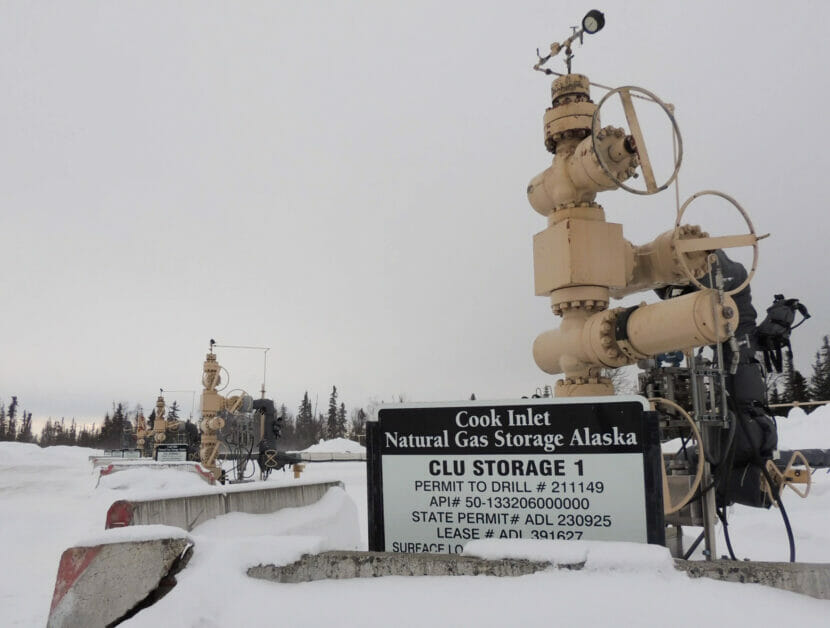
The Cook Inlet Natural Gas Storage Alaska facility was built the last time there were warnings about potential shortages. (Sabine Poux/KDLL)
Perched high above Kachemak Bay, Scott Waterman’s house in Homer is a museum of energy-efficient technology. A heat pump hangs on the side of his garage. Out front, a hulking row of blue solar panels angle toward the high April sun.
Waterman, a retired energy programs manager, has been building his setup for more than a decade. But, he said, today there are more people considering upgrades of their own.
“There are lots of people, now, thinking about how they can use solar to not necessarily just lower their costs of utilities, but to avoid the volatility,” he said.
That volatility is going to be inevitable as heating and electric utilities from Homer to Fairbanks — an area known as Alaska’s Railbelt — have to reconsider where they’re getting their power.
For a long time, they’ve sourced most of it from Cook Inlet natural gas. But now, for the second time in just over a decade, utilities and lawmakers in Southcentral Alaska are talking about importing liquified natural gas amid looming gas shortages in Cook Inlet.
Oil and gas producer Hilcorp — which has a sort of monopoly in Cook Inlet and provides some utilities with as much as 85% of their gas supply — recently warned that it won’t commit to signing new gas contracts, and few other companies are interested in looking for more gas in the inlet. That means Alaskans will likely have to pay more — maybe even a lot more — in a state that already has some of the highest energy costs in the country.
“That’s worrisome,” said Waterman, who worked for years with low-income renters at the Alaska Housing Finance Corporation. “If that’s a trend that continues, many, many people are going to have hard times making the choice as to whether to pay their power bill or buy groceries for their children.”
Years of warning
The impending gas shortages have loomed for decades.
Newspaper headlines in the 1990s warned that there wasn’t enough gas production in Cook Inlet to keep business going forever, and the state has long forecasted that demand for gas in Southcentral would outpace supply without more production. The most recent numbers estimate that could happen as soon as 2027.
Still, over the years Alaska has largely remained dependent on natural gas, building storage facilities to hold more and subsidizing production through big legislative packages.
“And we just have put all our eggs in that basket, ever since,” said McKibben Jackinsky, a retired oil and gas journalist in Ninilchik, on the southern Kenai Peninsula.
Companies have long warned of potential shortages in Cook Inlet — as shown in this 1998 story from the Alaska Oil and Gas Reporter. (Courtesy Shana Loshbaugh)
She said Alaska has always known natural gas was a bridge between other hydrocarbons and greener sources of energy, and that Cook Inlet wasn’t going to have gas to last a lifetime. Now, she said Hilcorp wants to drill on her property as it looks for more gas to meet its contracts.
“It’s the one leg under our stool and when it moves, we just collapse,” she said. “ And we can’t see beyond that, you know? We can’t see beyond developing something else that will sustain us, truly, without having to have this fear put in us every few years about running out.”
Alaskans aren’t going to freeze, or face blackouts.
What’s at stake here is cost. In the short term, utilities are considering new Cook Inlet gas supply contracts and imports of liquified natural gas, or LNG, which will be more expensive for Railbelt customers.
To get that LNG, utilities could go out to the spot market — where gas can be purchased for immediate delivery, but where it can be more than twice as expensive as what they’re paying now. The price is much more volatile, too. The other option is utilities will have to lock into longer-term contracts, if they can get them. How much those contracts would cost is unknown, since Alaska has never before had to import gas.
So — with decades of warning, how did Alaska get here?
“I just think it’s a human nature thing,” said Peter Micciche, mayor of the Kenai Peninsula Borough and former manager of the liquified natural gas plant in Kenai.
“We get very comfortable very quickly when things seem solved,” he said. “And we have a very difficult time having a long-term comprehensive plan and when we mobilize, and when we don’t.”
He wonders what higher and more volatile energy costs could mean for his constituents.
“And that’s going to be a problem for us,” he said. “I can’t imagine the Railbelt not having adequate supplies of natural gas.”
Deja vu all over again
There’s a framed copy of a 1958 Anchorage newspaper hanging on the wall of Micciche’s Soldotna office. In big, block type, it reads, “WE’RE IN” — marking the moment Alaska became the 49th state.
That was thanks, in no small part, to oil discoveries on the Kenai Peninsula. In their search for oil, companies stumbled across large reserves of natural gas, which they shipped out to Japan from a liquified natural gas plant in Kenai. Producers also sold a lot of gas to a fertilizer plant next door.
Micciche, now mayor of the Kenai Peninsula Borough, remembers coming to work for Tesoro as a summer intern in Kenai in 1982. Later, under ConocoPhillips, he managed the export facility – which, for decades, was the country’s only exporter of LNG.
“In 22 months, from conception to operation, they designed and built the LNG terminal, the platform, the pipelines, the receiving terminal in Tokyo harbor, the regasification facility in Tokyo, and the ships that would go back and forth and cross halfway through for 40 years,” he said.
There was plenty of gas to go around — too much. Big companies like Chevron, ConocoPhillips, Marathon and Unocal produced gas from large fields and sold the excess to Alaska utilities at very low prices. That kept costs low for Alaska consumers — well below the national average.
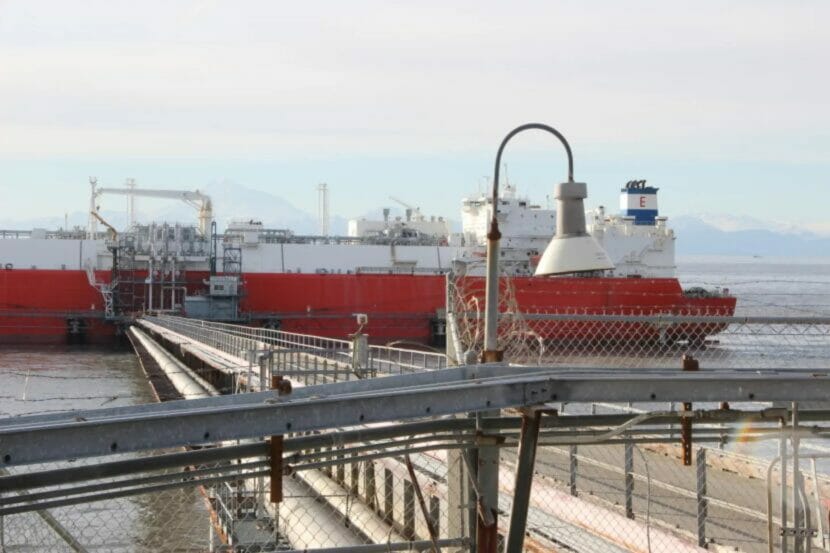
A tanker takes on a shipment at the Kenai LNG plant in October 2015. The plant, which used to be the only LNG export facility in the U.S., no longer exports natural gas overseas. Now-owner Marathon is considering turning it into a LNG import facility. (Rachel Waldholz/APRN)
Still, it was known that the market wasn’t going to last forever. The easiest-to-reach gas ran out, and without money flowing in from overseas, companies weren’t interested in drilling expensive new wells when they had better prospects elsewhere. Agrium, which used cheap gas to make fertilizer, closed its Kenai plant in 2007 when the price of gas went up.
The export facility saw a steep drop-off in shipments in 2005 and largely stopped exporting a few years later in 2013, with just a few small cargoes going out after that. ConocoPhillips mothballed the facility in 2017, citing competition.
That left just one gas market intact — local utilities. And that market was too small to keep the big companies invested. They left, and Southcentral Alaska was left wondering if it had enough gas to keep the lights and the heat on.
“It’s definitely history repeating itself,” saidAnchorage Democrat Sen. Bill Wielechowski, who co-chaired the Senate Resources Committee at that time.
Without interest in new production, Southcentral Alaska was, like today, facing the possibility of not having enough local gas to meet its energy needs.
“They’re saying we’re running out of gas in Cook Inlet. It’s the same exact scenario,” Wielechowski said. “I remember in Anchorage, going back a ways, people talking about brownouts.”
Then, in 2010, the Alaska Legislature passed the Cook Inlet Recovery Act. The act provided incentives for oil and gas companies to make claims in the inlet and expanded existing tax credits.The Alaska Public Interest Research Group, a consumer advocacy nonprofit, estimates that the state granted $1.64 billion in tax credits for oil and gas production between 2006 and 2016, when the Legislature retired those credits.
Jackinsky, the retired oil and gas journalist, said those incentives were never about putting money in the state’s coffers. Officials were clear that they were meant to literally keep the lights on.
“It was for us to continue our nice, easy lifestyle, dependent on natural gas,” she said.
In some ways, the act was a short-term success. It helped usher in a new oil and gas production company and Alaska avoided having to import gas, as lawmakers had feared.
But Wielechowski, who still serves on Senate Resources today, said it didn’t solve the root of the problem.
“We’ve got these massive incentives that we’ve provided over the years,” he said. “And it just hasn’t worked. And so I think it’s time for us to look at what are some different policy options we can look at? Because obviously what we’re doing is not working.”
From the other side of the aisle, Micciche also took issue with the bill because he said it didn’t provide any production requirements for companies.
“We have to get the Legislature to look more in advance at solutions so we don’t make sloppy decisions going forward,” he said. “You have to think about the behavior you want to see before you create an incentive.”
There was another product of the recovery act: the Cook Inlet Natural Gas Storage Alaska facility.
Lindsey Hobson is a spokesperson for Enstar, the gas utility that runs the facility off Beaver Loop in Kenai. Enstar supplies gas to about half of Alaska’s population and gets all of its gas from Cook Inlet.
Standing among CINGSA machines that compress gas before it heads into five underground wells, across the street, she said Enstar and other electric utilities dip into those reserves when they need gas most, on the coldest days. The facility can hold 11 billion cubic feet of gas — about a third of the amount Enstar customers use each year.
“We can take greater volumes in the summer and store those volumes and call on them in the winter when we require more gas,” she said.
Hobson said the utilities are considering more storage as another partial solution, this time. But storage alone won’t fix Southcentral’s problems. She said a crucial factor back in the 2010s was the entry of a new company into Cook Inlet.
“And that’s an important piece, and something that we are looking for in terms of, what will that next step be? What will that major investment be?” Hobson said.
A Goldilocks company
When supermajor oil and gas companies lost interest in Cook Inlet and left in the early 2000s and 2010s, a new company entered — Hilcorp, a Houston, Texas-based company whose strategy of rehabilitating old oil and gas fields made them a good fit for the aging basin.
“Hilcorp was a Goldilocks company,” said Antony Scott, who was a commercial analyst with the state’s Division of Oil and Gas when Hilcorp entered the inlet.
He said Hilcorp was big enough that it had the capital to invest in the inlet and expertise to redevelop old fields.
“But they were also small enough that the prizes available were a pretty good fit for their capacities and their objectives as a company,” he said.
Hilcorp had a strategy that worked for the aging oil and gas basin — squeeze the last bits of production out of existing rigs and platforms and get them going again. The company’s then-CEO described it as a “quick hit, remedial program,” according to a 2012 story from the Anchorage Daily News.
Scott said that model was more economic for Hilcorp than building big new projects, which could cost millions of dollars and take years to permit.
As a result, Hilcorp outlasted other companies that tried to come in and gained a sort-of monopoly on Cook Inlet natural gas. The company bought up Chevron’s assets, and then Marathon’s. It hired an all-Alaskan staff and signed long-term contracts with utilities.
In the last decade, Hilcorp has ramped up its presence on the central Kenai Peninsula. Here, a sign thanks Hilcorp for its support in Ninilchik. (Sabine Poux/KDLL)
But Scott said that strategy won’t keep the basin going forever. Without a willingness to build new platforms to access harder-to-get Cook Inlet gas, there has always been an expiration date, especially as future demand for gas in Southcentral remains an unknown.
“What we need now are new resources,” Scott said. “And the problem with bringing on brand-new resources is that the geologic risk is much bigger. You really don’t know what you’re going to find.”
Last spring, Hilcorp told utilities it wouldn’t guarantee future contracts and that it would like utilities to be less reliant on the company to meet their energy needs.
They’ve said little, publicly, about their reasoning. Company spokesperson Luke Miller, in an emailed statement, said the company is working with utilities to develop a way forward.
“In recent years, as Hilcorp has been asked to shoulder more of the burden, we felt it was prudent and responsible to communicate with Railbelt utilities our long-term view of the Cook Inlet basin, particularly as other producers have exited and non-Hilcorp investment levels have fallen significantly,” Miller statement said, adding that the company plans on investing nearly a billion dollars or more on new projects in Cook Inlet over the next five years, including drilling new gas wells.
Lackluster industry interest
Economists and industry experts, like Scott, say business in the inlet isn’t as profitable for Hilcorp as it used to be. New development is getting harder and more expensive, while the market remains relatively small.
“We just have a problem where the risks and the size of the market and the incentives don’t seem to be hanging together,” Scott said.
At a State Senate hearing in January, Department of Natural Resources Commissioner John Boyle warned of low interest from new companies in the basin. Today, there are a myriad of smaller, local oil and gas companies in Cook Inlet, like HEX and Blue Crest. But they’re not producing enough to sign big contracts.
“We do see an environment where there’s a need for policy discussion around if the path that we’re on is sustainable for providing energy to Southcentral into the future,” Boyle told lawmakers.
Jackinsky, the retired journalist, said those discussions are overdue.
“There was a need for policy discussion, how many years ago?” she said.
She’s frustrated that the Railbelt is still so dependent on natural gas, even though it’s been clear for so long that gas was a finite resource and that supply shortages loomed.
And now, it’s personal. With demand for gas high and years left on some of its contracts, Hilcorp is looking for gas in her backyard. The company is drilling new wells from onshore pads on the southern Kenai Peninsula, where it’s much cheaper and easier to explore. The gas from those wells won’t be a panacea to the shortages, and don’t replace the level of production that could come from new fields, but it could backfill some declines in Cook Inlet production.
Jackinsky said Hilcorp has asked for the subsurface rights to her property — a parcel in Ninilchik passed down through generations from her homesteading ancestors.
She and her daughters have told Hilcorp no, repeatedly. Hilcorp won’t comment on conversations it’s had with property owners on the southern peninsula.
But some of her neighbors have already signed with the company.Nearby, the company is burning off gas to get rid of the excess as it tests new wells — a noisy process known as flaring.
“That comfortable lifestyle that the state talked about, and has subsidized — it may be continuing it for some people. But it’s ruined that lifestyle for me and my neighbors,” she said.
Searching for the big home run
The gas-dependent Railbelt utilities are patching together other ways to get natural gas to power Alaskans’ homes in the next few years. They’re meeting monthly, along with two state groups, to brainstorm solutions to their Alaska supply woes.
Hobson, Enstar’s spokesperson, said the group plans on coming out with a report with some possible solutions in June.
“I think that all options are on the table, at this point,” she said earlier this year.
So — what are the options?
In the short term, utilities are looking for other ways to get natural gas.
Some with near-expiring contracts are signing agreements to buy supply from other utilities that have years still before theirs run out.
Homer Electric Association, for example, gets 85% of its power from Cook Inlet natural gas through a contract with Hilcorp that expires next year — the soonest expiration date on the Railbelt. Last month, the utility signed a procurement agreement with Enstar to get some of its gas; Enstar’s contract with Hilcorp doesn’t expire for another decade. As a gas utility, Enstar has fewer options to diversify its power generation away from gas on a short time frame than electric utilities do.
The terms of the agreement between Enstar and HEA have not yet been approved by the Regulatory Commission of Alaska and therefore aren’t public yet, according to HEA, so it’s hard to say how that will impact pricefor HEAcustomers. Fairbanks’s Golden Valley Electric Association signed a smaller contract with Enstar this year that included gas at a small markup over what Enstar currently gets for its gas.
And now, utilities are talking about considering importing LNG from out of state. Imported LNG would be more expensive than the local gas utilities get and could raise residential rates by as much as 30%, in some cases.
Earlier this year, Chugach Electric Association CEO Arthur Miller told state legislators that importing is not a step utilities want to take.
“We think that would be a very unfortunate situation,” Miller said. “A state as rich as Alaska is with natural gas to have to import LNG. However, we recognize we need gas, and we want to have a competitive price for that gas. And if that’s what it will take to get gas, then we will pursue that.”
Homer Electric Association said it’s working on cost studies and analysis for getting LNG from multiple suppliers. Enstar also has a study in the works on gas supply options from out of state.
Pricing would depend on whether utilities get that LNG from the spot market or through long-term contracts. Prices for spot market gas are much more volatile. But renewables advocates worry long-term contracts would lock utilities into expensive deals and that would take away any incentive to diversify into other energy sources.
Any plan to import would also require building up infrastructure to bring in gas, and factoring in those costs. Marathon, which now owns the former export facility, is considering turning that plant into an import facility.
Champions of the long-fought Alaska LNG project say it’s time to start talking about that plan again. The project would send natural gas down from the North Slope to Nikiski for export and use in the state.
Cost has long been an obstacle to the Alaska LNG project, and previous employees of the project say it’s never going to happen. There’s also talk of a smaller project, known as the bullet line, or “ASAP line” — a 36-inch-diameter pipeline that would bring gas down from the North Slope for use domestically. But without buyers overseas helping to finance the project, it seems financially unviable.
Micciche, the Kenai Peninsula Borough mayor, said hopes enthusiasm from potential buyers abroad could finally push the Alaska LNG project across the finish line.
“I think it would buy us the time for a responsible transition, where renewables will fit into the global portfolio,” he said.
Raising the standard
Some renewables advocates say the time for that transition is now.
Solar and wind projects are becoming cost competitive with natural gas and some private power producers have approached utilities and municipalities with plans to place large-scale projects on their grids.
Alaskans across the political spectrum are now acknowledging that renewable energy will have to provide a larger share of Alaska’s power in the future. Republican Gov. Mike Dunleavy’s administration is working on a bill to make geothermal projects more affordable. And Hilcorp itself is looking into turning some of its old Cook Inlet oil platforms into tidal sites. That’s on top of multiple other permitted tidal projects that would turn Cook Inlet’s massive tides — some of the biggest in the world — into power, but would take years to come to fruition.
Today, the Bradley Lake Hydroelectric Project, across Kachemak Bay, provides the cheapest power to the Railbelt. Utilities across the Railbelt have a stake in, and get power from, the project.
But that’s one of the only large-scale renewable energy projects in the region. Chris Rose with the Renewable Energy Alaska Project said utilities aren’t doing enough, and that it’s time to stop waiting around for the big homerun.
“I think there’s always this notion that something is going to come in and change things,’ he said. “But the fact is is that we haven’t got a gas pipeline yet, even though we’ve been talking about it for 40 years, and we’ve also never gotten a hometown discount on oil and gas in Alaska, so even though we produce oil and gas, we have some of the highest energy costs in the country.”
He has been trying to get legislation passed that would set a renewable portfolio standard, which would require electric utilities to get a certain percentage of their energy from renewables by a certain date.
As it stands, those utilities have goals to incorporate renewables into their portfolio. Homer Electric Association, for example, has a goal of reaching 50% renewable energy by 2025 — a goal set by then-Gov. Sarah Palin’s administration. The utility says it’s in its best interest to not be so majorly dependent on one producer for power.
But with two years away from that non-binding deadline, HEA gets just 14% of its power from the Bradley Lake hydro project. It estimates it could meet about 25% of its demand with renewables by 2027, the year gas demand is expected to outpace supply, through another hydro project, a solar project and a landfill gas project, according to a January filing with the Regulatory Commission of Alaska.
Rose said aspirational goals are not good enough. His legislation would fine utilities about $20 per megawatt hour if they don’t meet certain standards — 25% renewable by 2027 and 80% by 2040.
He said those standards would help create competition among private energy companies — something the Railbelt doesn’t have much of now — that would generate power in state to sell back to the utilities.
And he said unlike LNG on the world market, energy from renewable projects in Alaska could be more stably priced.
He said it’s not just about Alaskans’ gas and electric bills, although that’s important. It matters a lot for the broader state economy.
“We already have very high energy prices in the Railbelt,” Rose said. “And so we can’t really afford to be increasing our energy costs. That’s going to impact businesses, that’s going to impact people’s decisions to invest here, and to live here.”
Rose’s standard, widely opposed by utilities, didn’t pass before the regular session ended. For most of the session, lawmakers were focused on big-ticket items like the PFD and school funding, rather than energy.
Scott Waterman has been working on making his Homer house more energy efficient for more than a decade. (Sabine Poux/KDLL)
In the absence of action from lawmakers and utilities, some Alaskans are taking matters into their own hands.
Waterman, the Homer resident, said the solar panels, heat pumps and other energy efficient upgrades on his house help reduce the pressure he’s putting on the system.
“If we could get 25% of the homes on the Kenai with 5 to 10 kilowatts of of solar on them, that would make a significant dent in the gas that Homer Electric has to purchase — and keep our costs from rising quite as rapidly,” he said.
As an energy efficiency enthusiast, Waterman is maybe more attuned to his own rates than most.
But at the end of summer, when they switch on their lights and turn up their thermostats again, all Alaskans should be thinking more about how their lives could be impacted when the costs of doing so are a lot more expensive.
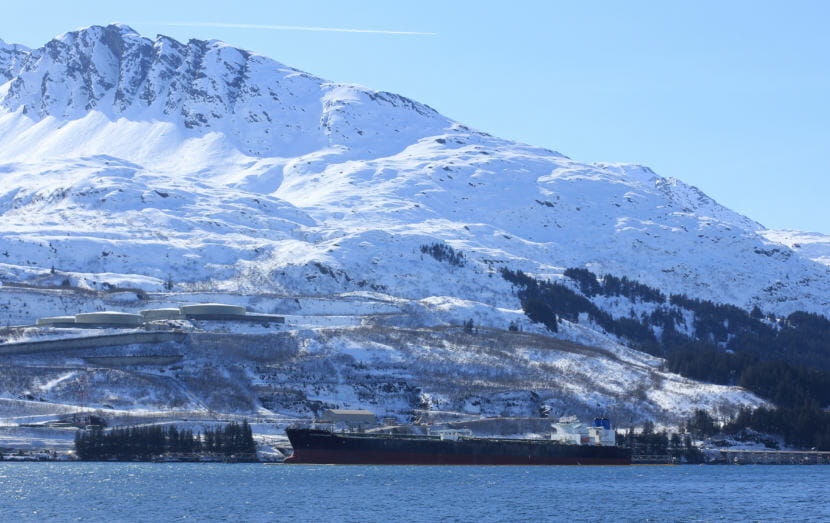
An oil tanker docked at the Valdez Marine Terminal in April. (Photo by Elizabeth Harball/Alaska’s Energy Desk)
The Valdez terminal of the Trans-Alaska Pipeline System is at “risk of a serious accident or incident in the near future.” That’s a main takeaway of a sweeping 180-page report that was published in April, detailing wide-ranging safety concerns at the Valdez Marine Terminal, where North Slope crude is loaded onto ocean tankers.
The Alyeska Pipeline Service Company says it’s taking the report seriously, but coastal communities say time is of the essence.
Early last year, an Alyeska employee working at the Valdez Marine Terminal — which is the southern end of the trans-Alaska pipeline — reported smelling fumes. Heavy snow had damaged oil storage tanks at the facility — venting petroleum vapors into the atmosphere.
“It was noticed by an employee at Alyeska that was walking around, happened to smell toxic fumes coming out of the tanks,” said Wayne Donaldson, the city of Kodiak’s representative on the Prince William Sound Regional Citizens’ Advisory Council, or PWSRCAC.
The advisory council is one of two federally mandated oil spill prevention groups formed in response to the 1989 Exxon Valdez spill, which saturated more than a thousand miles of Alaska’s coastline – including Kodiak Island’s shores – in oil.
Donaldson is one of 19 members of the group and has served on the council for eight years. The federal Oil Pollution Act of 1990, which was passed after the Exxon Valdez oil spill, also led to the formation of the Cook Inlet Regional Citizens Advisory Council.
He said after the incident at the terminal last year, more Alyeska employees started contacting the group.
“And as time went on, more people started coming to us giving safety concerns, as well as retired people from Alyeska,” Donaldson said.
The advisory council commissioned a review of safety practices at the terminal last summer in light of the complaints. And a final report was published last month.
It encompasses nearly 200 pages of major safety concerns at the Valdez Marine Terminal: equipment the report calls “aging and obsolete;” a work culture that includes retaliation among employees, mismanagement and turnover; and shrinking federal and state budgets that have decreased regulatory oversight.
In response to the report, the advisory council sent letters to lawmakers – including Gov. Mike Dunleavy and Alaska’s congressional delegation – citing the need for federal audits of the terminal by the Government Accountability Office and the Occupational Safety and Health Administration.
The report was prepared by corporate safety consultant Billie Garde, who has worked both with Alyeska and BP in the past. Harvest Alaska, a Hilcorp subsidiary, ConocoPhillips and ExxonMobil all own portions of Alyeska Pipeline, which operates the terminal.
“We don’t agree with everything in the report, but we do take it as an opportunity to improve,” said Michelle Egan, Alyeska’s chief communications officer.
Egan is also from Kodiak, and she says she – like many others at Alyeska – is acutely aware of what an oil spill does to coastal communities. She said Alyeska has formed a management team to work on an action plan in response to the report.
Much of the report, however, comes directly from Alyeska staff — many of whom said they think a “serious incident is imminent.”
Brooke Taylor is the director of communications for the Prince William Sound Regional Citizens’ Advisory Council. She said the internal knowledge of problems at the terminal is one of the biggest weaknesses identified in the report.
“There wasn’t any substantive information in the report regarding safety or process safety issues that wasn’t already available to Alyeska,” said Taylor.
About 4% of the nation’s crude oil departs from the Valdez Marine Terminal, a percentage that could swell in the coming years as oil from the recently approved Willow project makes its way down the pipeline.
Taylor said an incident at the Valdez Marine Terminal has the potential to be environmentally devastating, and it threatens one of the state’s main sources of revenue.
“For us, it’s not pro or con industry, it’s — if oil is going to be transported through our region, we want it done as safely as possible,” she said.
Alyeska hired a new chief executive officer the same month the report came out, former BP executive John Kurz. Egan said he’s met with members of the group several times since then.
“He wants to work with [PWS]RCAC and with our employees to make this the safest environment we can possibly have,” she said. “So, I think that commitment has been clear. He’s communicated that repeatedly to our workforce, and to all of our stakeholders.”
The advisory council’s Taylor agrees that Alyeska has responded quickly to the report, and understands changes at the terminal won’t happen overnight.
“Time will tell on what actions are done. So, we know our biggest successes have always happened when industry regulation and citizen groups work together. And so we are hoping this will be another example of that,” Taylor said.
Wayne Donaldson said he’s also encouraged by Alyeska’s initial response to the report. But it’s been more than 30 years since the Exxon Valdez oil spill – he worries that the biggest challenge now is time and complacency.
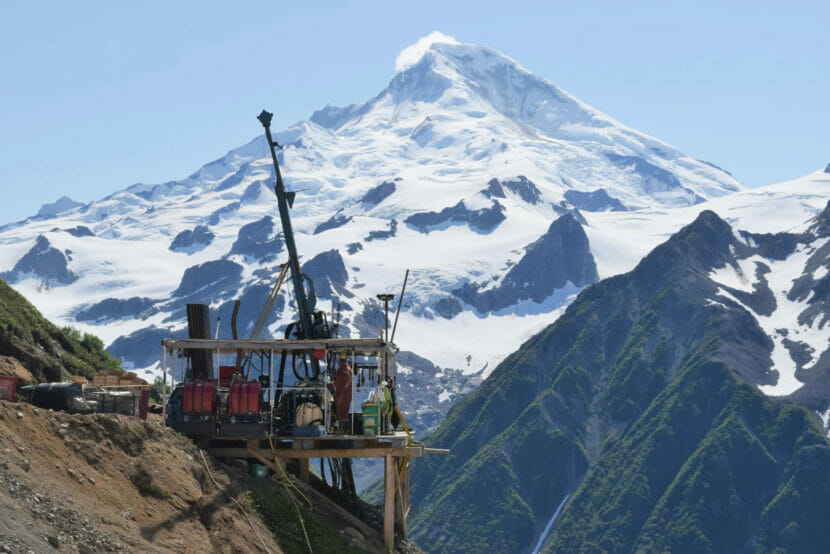
Exploratory work at Johnson Tract, on the west side of Cook Inlet. (Courtesy of HighGold)
Plans to build an underground gold mine at the base of Mt. Iliamna have been in the works since the 1980s. Now, a Canadian mining company and the Alaska Native corporation that owns the land are in the advanced stages of exploring the area to see if it could be a viable project.
While HighGold, the mining company, says they’ll be careful about potential development on the land — which is inside a national park — not everyone is convinced. Although the project is still in early stages, environmental groups and the owners of the nearby historic cannery are raising red flags.
The site of the proposed project, called the Johnson Tract mine, is located 10 miles inside the boundary of Lake Clark National Park and Preserve, on the west side of Cook Inlet, on a 20,000-acre parcel of land owned by the Cook Inlet Regional Native corporation, or CIRI. The corporation picked that plot in a 1976 land exchange because of its resource extraction potential and benefit to shareholders.
Darwin Green is the CEO of HighGold. He said even though his company knows the tract contains rich deposits of gold, copper and zinc, it’s doing studies now to see whether the project makes economic sense. Deposits there were found decades ago.
“It was discovered in the early 1980s, and then advanced through the mid-1990s,” Green said. “There was an operator at that time that had a mine project elsewhere, and they were looking at just shipping the ore to that site to mill it and process it there. And that’s where it stopped, and it sat idle for 25 to 30 years until CIRI approached our management group.”
The project site is remote, and HighGold is applying for a permit to build an airstrip and an inland road that would connect the airstrip to the site. The company estimates the earliest it would begin underground exploration is 2025.
So far, the project has generally flown under the radar while more high-profile Alaska mine prospects, like Pebble Mine, have had the spotlight. Unlike the controversial Pebble project, Johnson Tract would be underground, not an open pit mine, which can release contaminants into the water and damage salmon habitat.
But local environmental groups have been keeping an eye on the project for a while now — including Homer environmental nonprofit Cook Inletkeeper, which first raised concerns about it in 2020.
“To get that ore out, you’re gonna have to go through the park lands, and you’re gonna have to open up the incredibly pristine and scenic and rich fish and wildlife area to industrial development,” said Bob Shavelson, who was Inletkeeper’s director at that time and penned the concerns about the project.
Another group, the National Parks Conservation Association, has been hosting biweekly meetings about the project for months, said Jennifer Woolworth, the Alaska program manager with the association. She said although the meetings were originally a time set aside to talk about Pebble Mine, they’ve evolved into discussions about the potential harms of Johnson Tract.
She said the group is concerned about the impact of possible contamination and the effects of development on local wildlife, including the highly endangered Cook Inlet beluga whale and brown bears. She pointed to research that shows one of the primary causes for brown bear decline is roads built for resource extraction projects.
Shavelson also raised concerns about HighGold because it’s a spinoff of Constantine Metals, the company behind a controversial Haines mining prospect. Many locals have also been rubbed the wrong way by comments CEO Darwin Green made about the state, where he described mining in Alaska as “going into a third world country with low hanging fruit,” but with first world regulations. Green said this quote has been taken out of context, and that he was promoting the high regulatory standards of mining in Alaska as an advantage in, “answering the world’s metal demands for a low carbon future.”
Green said environmental studies will be an important part of the project at every stage, and that the unique location of the project inside the national park is a critical consideration.
“We obviously want to be incredibly good stewards of the land where we operate, it’s part of our culture and philosophy everywhere we’ve been, but probably even more so now, given the optics,” he said. “It’s a really special place out there, and we’re well aware of that.”
Even though the land is inside a national park, it’s available for development because the tract has belonged to CIRI since the 1976 Cook Inlet Land Exchange. After land was allotted to Native corporations during the Alaska Native Claims Settlement Act, CIRI was disappointed with the economic possibilities for the lands they received. They selected this area because of its resource development potential, according to CIRI spokesperson Ethan Tyler.
“CIRI really strikes a balance between preserving its lands for future generations for shareholders and descendants with resource development,” Tyler said. “And the benefits to shareholders and descendants really comes down to sustainable development of resources that provide for the services and distributions that we provide to our stakeholders.”
In a summer job posting, CIRI says the company and Native corporation are prioritizing CIRI shareholders and their descendants for positions with the project.
Green said HighGold is working closely with CIRI to meet their interests, and that it was refreshing to be approached by a Native corporation interested in developing their resources.
“The economic benefits from that development will flow directly to Alaskans, it’s gonna flow really, directly to Indigenous Alaskans who are shareholders, and that’s something to feel good about,” he said. “That’s something Alaska should feel proud about.”
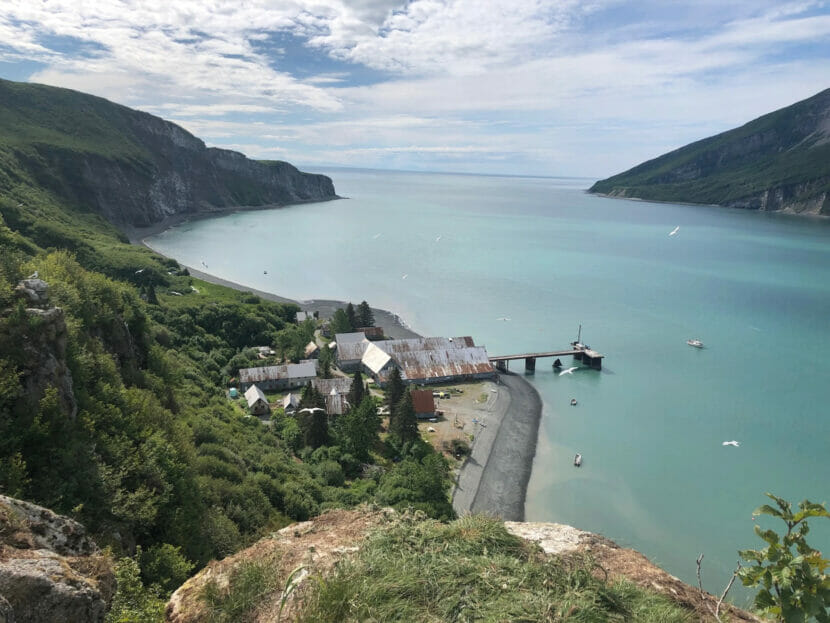
(The Snug Harbor Cannery on Chisik Island. (Courtesy of Snug Harbor Outpost)
But not everyone is convinced the project would be good for business.
Abe Porter is one of the owners of the old Snug Harbor Cannery on the west side of Cook Inlet.
“My family and I bought it in the early 2000s. I grew up there, my dad grew up there commercial fishing for the cannery, when it was a fully functioning cannery, my grandpa started fishing there in I believe the ’30s,” Porter said.
The cannery opened in the early 1900s and operated first as a razor clam and then salmon cannery until 1980, when it closed and sat vacant for decades. The Porter family has been working to restore the complex over the past 20 years, and recently reopened it as the Snug Harbor Outpost, an ecotourism lodge for visitors interested in bear viewing and fishing off remote Chisik Island.
“We’ve sunk everything into this. It’s my brother and I’s dream,” Porter said.
He said the proposed mine project would directly impact what his family has worked to create at the cannery. He also said the bay is too shallow for large boats, so HighGold would need to build a long dock out into the water of Tuxedni Bay. Green said the project is in too early of the stage to be looking at this type of infrastructure, but confirmed that if HighGold goes through with the mine, a dock or loading facility would be necessary.
Porter is also worried about the fate of commercial salmon fishermen on the west side of the Cook Inlet, and how the mine could impact the value of existing fisheries — regardless of the protections put in place.
“All of the fisheries have a reputation, and that reputation dictates the popularity of it,” he said. “If people hear that there’s a big gold mine, for commercial fishermen the price of fish goes down. For sports fishermen, less people want to come here.”
Proponents of the project say it’s too early to have concerns, since all of its parts and pieces remain hypotheticals, for now. Porter said that’s part of his worry — that the company will keep putting off public concerns until it’s too late to stop the project.
Green said HighGold will continue to study the site and conduct environmental studies there this summer.
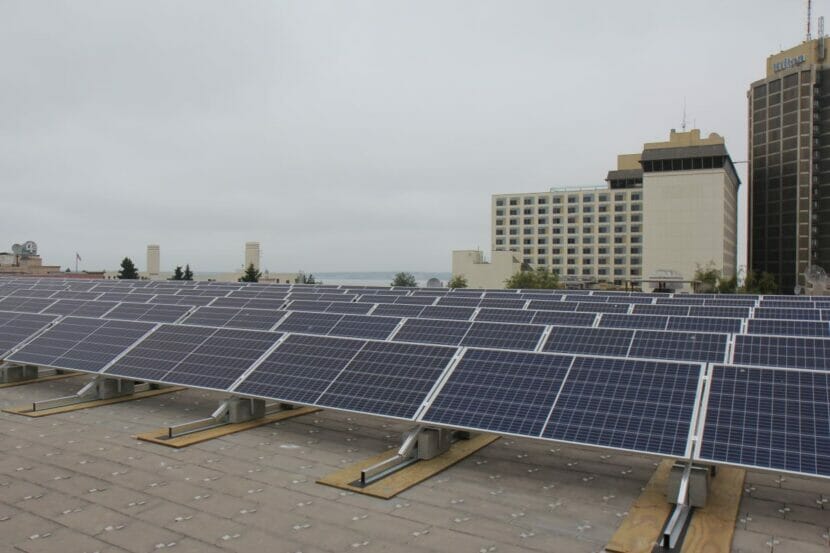
Solar panels on the rooftop of the Egan Center in Anchorage. (Amy Mostafa/Alaska Public Media
Anchorage and the rest of urban Alaska are facing a natural gas supply shortage, and fears are rising about how the region will secure reliable access to fuel to heat homes and generate electricity.
Consumer advocates and environmental groups say one way to reduce the state’s dependence on natural gas is through something called a “renewable portfolio standard.” That’s a mandate that Alaska’s electric utilities generate a certain amount of power from renewable sources.
Freelance journalist Nat Herz, at his publication Northern Journal, has been reporting about state lawmakers’ efforts to craft such a mandate. But Herz says the proposal has stalled at the Alaska Capitol amid intense opposition from utilities.
Listen:
The following transcript has been lightly edited for clarity.
Nat Herz: Yeah, so we pay pretty high prices for our natural gas-generated power here on the Railbelt. And in a few years, the big natural gas company that operates in Cook Inlet, Hilcorp, has said, “Look, you guys are essentially out of gas that we can find in a way that doesn’t cost more money than anyone is going to want to pay for it.” And so there’s kind of this natural gas cliff that we may fall off in a few years where, all of a sudden, we are either going to have to generate power in some other way or we’re potentially going to have to pay a lot of money to import natural gas in liquefied form in tankers from outside the state.
So one thing that folks think we could do about that is find ways to reduce our dependence on natural gas, such as by installing large amounts of wind, solar, hydroelectric, other forms of renewable power. But there’s not a lot of confidence by these advocacy groups that utilities are going to do this on their own. And so one way that they have tried to encourage this to happen is through what’s called a “renewable portfolio standard.” And that is essentially a piece of legislation that would require utilities to generate a certain amount of power from renewable sources by a specific time.
Casey Grove: And here in Alaska, there was a renewables bill in the legislature last year. Tell me about that.
Nat Herz: What’s interesting is that Republican Gov. Mike Dunleavy was the one who proposed this renewable portfolio standard to require the utilities to generate 80% of their power from renewable sources by 2040, which is a pretty quick turnaround, given that they generate about 20% right now. But the governor’s bill didn’t really seem to get anywhere. And we obtained some emails through public records requests that showed that the deputy that Dunleavy assigned to carry the bill through the Legislature, Curtis Thayer, who heads the Alaska Energy Authority, the emails showed that he actually was working behind the scenes early on, as the legislation was being developed, to try to make the legislation a little bit more palatable to the utilities, which were objecting to the pace and the high degree of renewables adoption that was originally put in the bill. And through the legislative process, last year, the legislation was kind of amended, to allow sources like nuclear power, for example, also to maybe push off the implementation by about 10 years to 2050. But ultimately, the bill never passed, and it died at the end of the legislative session last year.
Casey Grove: Am I getting this right, that the concerns about putting more solar, wind, other renewable power sources onto the grid, those concerns are that that will raise electricity prices or affect reliability? What do we actually know about that?
Nat Herz: You know, what’s interesting is that they are actually very, very, very different analyses of, is this going to cost more money? Because the price of renewables has just gone down so far in the past, you know, five, 10, 15 years. And so the utilities say they’ve got some models that suggest that moving to renewables in the way that the governor’s legislation last year wanted would drive rates up by as much as 15%, 20%, 25%. There’s another analysis done by a credible independent energy analyst that shows actually the the cost of building all of the renewable stuff would be far smaller than the fuel savings that would result in not having to buy natural gas to feed our natural gas power plants. There is a more authoritative study that’s expected out from the National Renewable Energy Laboratory that was commissioned by the governor’s office that should actually sort of put this debate to rest. But it’s not done yet, so we don’t really have the information. And it’s really become a kind of point of debate, as lawmakers have considered this proposed legislation.
Casey Grove: So the debate has not been laid to rest this point. Where does this proposal stand right now?
Nat Herz: Yeah, so the governor did not reintroduce this bill this year. I interviewed him about this, and he basically said, “I had too much other stuff on my plate. I was proposing legislation to monetize Alaska’s forests. I appointed a clean energy task force.” The governor said he was waiting for legislators to likely introduce it. There were a couple of them that did ultimately propose a bill, but it took them two months into the legislative session. They basically started from square one without all of these items that had been previously added at the request of the utilities, like including nuclear power in the renewables category, like delaying the implementation. So now they’re kind of starting through the legislative process again.
But meanwhile, we’ve gone another two years, basically, since the governor introduced his first proposal, where we’ve been, you know, using that dwindling supply of natural gas in Cook Inlet without a clear solution of what we’re going to do when that gas is no longer available and without really a whole lot of obvious urgency and new projects being announced by the utilities. So there’s some pretty big questions about how this is all going to play out.
President Biden celebrated his conservation record Thursday in a Rose Garden address, leading with his administration’s decision blocking the development of the Pebble Mine at the headwaters of Bristol Bay. Alannah Hurley, executive director of the United Tribes of Bristol Bay, introduced him. (C-SPAN screenshot)
President Joe Biden celebrated his conservation achievements Thursday with a Rose Garden address. The No. 1 item on his list? Blocking the Pebble mine, a proposed open-pit gold and copper mine upstream from the sockeye-rich waters of Bristol Bay.
“Bristol Bay is an extraordinary place, unlike anywhere in the world,” the president said. “Six rivers meet there, traveling through 40,000 miles of tundra, wetlands and lakes, collecting freshwater and salmon along the way … making this the largest sockeye salmon fishery on all the earth.”
Biden announced no new developments in the ongoing Pebble saga. His speech cited scores of sanctuaries and safeguards his administration created, from the mountains of Nevada to the Pacific Ocean. But the primacy he gave to this one part of Southwest Alaska shows how committed Biden is to stopping Pebble, and how he sees it as a centerpiece of his environmental record.
United Tribes of Bristol Bay Executive Director Alannah Hurley was invited to Washington, D.C., to introduce the president. In a blue print kuspuk, she spoke of how her salmon-centered community has lived with a threat looming over them for 20 years.
“But our people stood up and fought back to protect what we hold sacred. President Biden heard our voices,” she said. “He and his team listened to Bristol Bay and our many partners across the nation. And together we stopped the Pebble Mine.”
Biden said he listened to stakeholders and scientists and determined the mine – specifically the dam that would have to hold the waste rock in perpetuity – was too risky.
“In the end, we used our authority under the Clean Water Act to ban the disposal of mine waste and Bristol Bay watershed, period,” Biden said, to cheers from the invited guests. “That means the mine will not be built.”
President Biden holds 2-year-old Mancuaq Mann, of Dillingham, Alaska. Her mom, Alannah Hurley, says Mancuaq did well at the White House event despite missing nap time. (C-SPAN screenshot)
Biden spoke of the mine as dead, but Hurley said mine opponents are still seeking “permanent, watershed-wide protections” through an act of Congress.
At least for now, the federal government is blocking the mine on two fronts. The Army Corps of Engineers denied Pebble’s permit application, and Pebble is appealing.
The larger problem for the mine developers is that the Environmental Protection Agency has essentially vetoed all plans to use the proposed mine site for rock disposal, meaning Pebble can’t just design a different dam and re-apply. The appeals of that decision could last years.
Hurley said there’s more work ahead. More than 20 other mines are proposed in the Bristol Bay watershed, and the EPA veto only protects two river systems. Still, she said, it was a day to relish victory. About a dozen Bristol Bay kids were at the White House for the ceremony.
“This is everything our people have been fighting for: To make sure that our children will know who they are, and will be able to continue to be Native people in Bristol Bay for generations to come,” she said. “So to see our kids with the president today, celebrating this monumental, historic victory for us was just profound.”
A Pebble spokesman declined to comment, but the company maintains the dam design is state-of-the-art and that the project doesn’t pose a risk to the fisheries.