Energy & Mining

Chevak Native Village joins others in federal lawsuit over Donlin Gold permits

A foggy treeless hill
The Donlin Gold mine site is located about 70 miles up the Kuskokwim River from Aniak. (Photo by Katie Basile/KYUK)

The number of Kuskokwim River tribes challenging the federal permits for the Donlin Gold project in court has doubled from three to six. They say that the process was flawed and that tribal consultation was inadequate. They want the court to order the federal government to take a closer look.

On June 7, the Chevak Native Village joined other Yukon-Kuskokwim tribes in their federal lawsuit challenging the proposed Donlin Gold mine.

“You know, it’s just something that we’ve been involved with all along is this opposition of one of the world’s greatest, biggest, most open pit mines that’s proposed upstream or upriver from the Kuskokwim River,” said Second Chief and Councilmember of Chevak Native Council Richard Slats.

The Chevak Native Village, along with other tribes, is requesting more scrutiny of the Donlin project to ensure protection of the Yukon-Kuskokwim Delta ecosystem and the natural resources they depend on for their existence and traditional ways of life. Slats does not think that there was sufficient Tribal consultation.

“And the majority of this has mostly been through the environmental impact statement that was approved, and then mostly that without adequate consultation to the tribes after the final, and it’s moving forward,” Slats said.

There are 56 tribal communities in the Yukon-Kuskokwim Delta, including 13 downriver that could be directly affected if something went wrong at the massive project.

Tribal leaders say that what happens at the Donlin mine has the potential to affect the entire Yukon-Kuskokwim Delta, including coastal communities like Chevak, and the fish and wildlife resources people in the region depend on for their existence. Slats said that dwindling salmon stocks within the region highlight the need to protect the entire ecosystem, including salmon and smelt habitat.

The lawsuit targets flaws in environmental and subsistence studies. It alleges that permits for the mine are deficient in many areas. Slats said that when the final environmental impact statement for Donlin came out in 2012, only selected villages were afforded the opportunity to consult.

“Not all of the villages were consulted. Final EIS came out in 2018 with 10,668 pages with 30 days of comment period,” Slats said.

Donlin disagrees. The company responded with a press release which pointed out that it has held hundreds of public meetings to encourage open engagement and create opportunities for residents of the region to share their concerns and questions.

“We have a longstanding history of investing in the region’s communities to share our values of safety, environmental stewardship, community wellness, cultural preservation, and education,” the company wrote in the release.

The court challenge, if successful, would invalidate key permitting documents and authorizations for the mine and would require federal agencies to identify and require measures to prevent predicted harm to rainbow smelt from Donlin’s barges.

If built, the proposed mine would include a vast and deep open pit, a 316-mile buried natural gas pipeline, a processing plant, waste rock and tailing storage facilities, water treatment and power plants, dams and reservoirs, and transportation infrastructure including airstrips, access roads, a port expansion in Bethel, and a barge corridor along the Kuskokwim River.

There are now six tribes suing in federal court to halt Donlin, represented by Earthjustice. The three original plaintiffs were Orutsararmiut Native Council, Tuluksak Native Community, and the Organized Village of Kwethluk. Three tribes joined as plaintiffs in the amended complaint filed this week: Native Village of Eek, Native Village of Kwigillingok, and Chevak Native Village.

Pebble Mine company to pay shareholders who claim they were duped

Spawning Bristol Bay sockeye salmon, with their distinctive red bodies and green heads, swim in the waters of Lake Clark National Park and Preserve in 2003. Potential effects on Bristol Bay’s bountiful salmon runs have been at the heart of opposition to the Pebble Mine, and the Environmental Protection Agency in January invoked a rarely used provision of the Clean Water Act to bar Pebble’s permitting. Some investors in 2020 sued parent company Northern Dynasty Minerals Ltd., claiming that corporate leaders misled them about the project and its environmental effects. The parties have reached a settlement totaling nearly $6.4 million. (Photo by D. Young/National Park Service)

The company behind the controversial Pebble Mine in Southwest Alaska has agreed to pay nearly $6.4 million to a group of shareholders who claim they were misled by corporate leaders.

Vancouver-based Northern Dynasty Minerals Ltd. reached the settlement with the named plaintiffs, according to documents filed last week in the U.S. District Court for the Eastern District of New York.

The settlement is the product of two lawsuits, later consolidated, alleging that Northern Dynasty and the Pebble Limited Partnership had defrauded investors through false and misleading statements. Northern Dynasty is the sole owner of the Pebble Limited Partnership.

The court filings name only a few individual investors, but the lawsuit has become a class-action claim with “likely hundreds, if not thousands of potential Settlement Class Members” to share in the payment, said the settlement memorandum filed on Wednesday. If the court approves the agreement and certifies the class, others who owned Northern Dynasty securities between Dec. 21, 2017 and Nov. 25, 2020 could be eligible for payment from the settlement total, according to the memorandum.

At issue were revelations in recorded conversations released in 2020 that became known as the Pebble Tapes. In those conversations, which were recorded by an environmental organization working undercover, Northern Dynasty Chief Executive Officer Ron Thiessen and Tom Collier, then the Pebble Limited Partnership CEO, described a strategy of getting a relatively small mine plan through the permitting process and following up with a massive expansion. Additionally, the two men touted political connections that they said would ease permitting.

“When the truth emerged through a series of corrective disclosures and materializations of risks that the Pebble Project would not receive a permit, Northern Dynasty’s stock went into a tailspin, wiping out hundreds of millions of dollars in market capitalization and injuring hundreds of thousands of investors,” said the amended complaint filed in 2021 in the consolidated case.

The mine, targeting copper primarily, appears to be administratively blocked; the Environmental Protection Agency in January invoked a rarely used Clean Water Act provision that precludes permitting of the Pebble Mine or any similar mine in the specific sites targeted for development.

EPA said the Pebble Mine would have “unacceptable adverse effects” on salmon habitat in the Bristol Bay region, site of the world’s largest sockeye salmon runs, and the people and ecosystem dependent on that habitat.

A sticker expressing opposition to the Pebble Mine is seen on a coffee shop window in Kodiak on Oct. 3, 2023. Opposition to the mine has been widespread in Alaska’s fishing communities for several years. (Photo by Yereth Rosen/Alaska Beacon)

Northern Dynasty, however, continues to pursue the Pebble project and is gathering information to present to the U.S. Army Corp of Engineers to support issuance of a critical permit to develop that wetlands area. The Corps denied Pebble’s permit in 2020, but in April its reviewing officers ordered a reconsideration of that decision.

In a statement sent to the Alaska Beacon on Monday, a Northern Dynasty official said the company disclosed some information about the settlement in recent financial reports and that the settlement “does not contain any admission of liability.”

“To the contrary, Northern Dynasty firmly believes that the notion of a ‘secret mine plan’ is baseless and the company denies any wrongdoing alleged by the plaintiffs. The Company is confident that it would have prevailed at trial on the merits, when the full context and facts underlying the permitting process would show the allegations to be without merit. Nonetheless, this settlement brings to an end what would have been a costly and protracted legal process, with the settlement amount representing a fraction of the expected costs of litigation to bring this case to verdict,” said the statement, from Mike Westerlund, vice president of investor relations.

Since the total is within the company’s insurance policy limits, Northern Dynasty “does not anticipate corporate funds will be used to fund the settlement,” the statement said.

According to its financial report for the first quarter of 2023, Northern Dynasty has CA$139.5 million in total assets, of which CA$127.2 million was in the company’s mineral property, plant and equipment.

The Bristol Bay Defense Fund, a coalition of community, nonprofit, Indigenous and business organizations opposed to the Pebble Mine, said the settlement “demonstrates yet again how untrustworthy Northern Dynasty Minerals is and always will be.”

“Not only did they mislead investors, they lied to the people of Bristol Bay, and since they aren’t using any corporate funds for this settlement, the Biden administration should order them to remediate the parts of the watershed they damaged and left behind polluted for the community to clean up,” the Bristol Bay Defense Fund statement said.

The Bristol Bay Defense Fund and similar organizations are calling for watershed protections that go beyond the EPA’s action. “Our elected officials must recognize the duplicity of Northern Dynasty and the recklessness of their project, and pass watershed-wide protections to protect all of Bristol Bay, our salmon and our way of life, forever,” the statement said.

This story originally appeared in the Alaska Beacon and is republished here with permission.

America is going through an oil boom — and this time it’s different

Drilling rigs sit unused on a lot in Odessa, Texas, in the Permian Basin, in March 2022. U.S. oil companies are thriving as they look to avoid the boom-and-bust cycles of the past. That has big implications, including for consumers and global producers. (Joe Raedle/Getty Images)

MIDLAND, Texas — America’s oil industry is booming — in a surprising way.

It doesn’t look much like the booms of the past, when companies would scramble to pump as much oil as possible and the region would attract so many workers it became impossible to find housing and free hotel rooms.

Instead, a sector infamous for its booms and busts is finally learning how to embrace the one thing they’ve never been known for: moderation.

This shift is doing a lot of good in the Permian, America’s most prolific oil basin. Oil companies are raking in profits, and the steadier work has also been good for workers across the region.

But the economic, geopolitical and climate implications are more complicated.

Here are five things to know about this shift, and what it means.

Oil prices are volatile — but still very profitable

Last year, Russia’s invasion of Ukraine sent crude prices soaring well past $100 a barrel, and that meant producers were making money hand over fist.

Prices have since fallen, but they remain at or above their pre-pandemic levels. Significantly, they’ve consistently been high enough for most producers to drill new wells at a profit.

The most recent survey from the Dallas Federal Reserve found that the average Permian producer can break even on a new well when WTI (a key reference price for oil prices) is trading at $61 a barrel. And currently, prices are well above that level.

The result: Big profits for companies and higher employment and wages for workers in the Permian Basin.

… but something unexpected is happening

Before the pandemic, the U.S. oil industry followed a predictable pattern.

“When there was an increase in prices, the U.S. shale players would rush in and increase production to try to capture that price increase,” says Angie Gildea, the head of U.S. energy for global accounting firm KPMG.

In previous boom times, more than 500 drilling rigs were operating simultaneously across the Permian as oil companies chased high oil prices.

All those wells contributed to a huge growth in oil supply, which then led to a huge oversupply, which then inevitably led to … huge price crashes and a resulting collapse in drilling activity. Boom, bust. Boom, bust.

But last year, despite prices topping $100 a barrel, rig counts stayed in the mid-300s. They held there as prices dropped. And that’s where they remain today, more or less leveling off.

There are multiple factors keeping companies from drilling even more — supply chain shortages, trouble hiring workers, or for some companies, a lack of good sites to drill.

But a huge factor in this shift towards moderation is pressure from investors who want oil companies to share their profits with them, rather than funneling the earnings back into the ground to make more oil.

“Investors are actually demanding … more discipline from these shale producers,” says Gildea. “They want return of dividends and cash back to shareholders versus prioritizing just growing production.”

The result: Production in the Permian is still growing, but it’s growing more gradually. And it’s been growing steadily even as prices swing around.

That’s good for producers, including OPEC+

More restrained investment means oil companies are less likely to suffer the busts that used to roil the industry.

And while oil prices are high, companies are paying down debt, merging with rivals to strengthen their positions and churning out cash. That has positive economic impacts for individual companies, for oil-producing regions like the Permian and for a major segment of the American economy.

More discipline from American oil companies is also good for the global cartel known as OPEC+.

The shale revolution has reshaped global oil politics, turning the U.S. into the world’s top’s producer and an OPEC+ rival instead of just a customer.

That means that any time OPEC+ considers cutting production, it has to weigh whether U.S. producers will jump in to pump more crude, seizing more market share from the cartel.

That’s much less of a concern today. With shale producers keeping their growth in check, OPEC and its allies can cut output, pushing up prices, without risking a shale bonanza.

In fact, Saudi Arabia announced yet another voluntary cut in production over the weekend, while some other members of OPEC+ extended their own voluntary cuts.

“They believe, over the medium term, that they are in a very strong position in the market, that shale companies do have to respond to shareholders who do ask for capital discipline,” says Helima Croft, global head of commodity strategy at RBC Capital Markets, who was in Vienna for the OPEC+ meeting.

The impact on markets will play out for years, Croft predicts.

And it’s not great for consumers

As usual, good news for oil companies is bad news for oil consumers – even if it’s not currently visible from prices at the pump.

Gasoline prices in the U.S. currently average a little over $3.50 nationally, more than a dollar lower than last year. For the next few weeks and months, gasoline analysts aren’t predicting anything close to last year’s sky-high prices.

But in the medium- and long-term, less investment in oil production means less supply, which drives prices up.

A customer pumps gas at an Exxon gas station in Houston, on July 29, 2022. U.S. oil companies are becoming a lot more restrained about production, and that could keep gas prices high over the longer term. (Brandon Bell/Getty Images)

To be clear, U.S. oil production is still increasing, but it’s not increasing as quickly as it once would have.

The big wild card is whether a global recession materializes. But if it doesn’t, analysts think supply will continue to lag demand, given the restrained production from U.S. and OPEC+ producers.

A forecast released this week by Enverus, an energy data analytics company, predicts Brent, the global crude benchmark, will top $100 a barrel again later this year.

The impact on climate is less clear

Climate scientists say the world needs to rapidly reduce its use of oil and natural gas and implement other emissions cuts to limit the devastating impacts caused by climate change. And that’s doable, they say, thanks to cheaper renewable energy and other alternatives.

So is a slower-growing Permian in line with a transition away from oil?

Gildea argues that this restraint from producers could free up money and bandwidth for companies to focus on cleaner energy and emissions reduction, positioning themselves to continue to profit as the world shifts away from oil.

But so far, oil and gas companies are sending the bulk of their cash back to investors in the form of dividends and share buybacks, rather than dedicating it to new, greener ventures.

And the sheer profitability of oil means that companies have very little incentive to invest in anything else — in fact, they can be punished by the market if they try.

Oil companies are also unconvinced that the world actually will transition away from oil, at least at anything approaching the speed necessary to stop climate change.

Blocks of ice drift on the water off the coast of Collins glacier on King George Island, Antarctica, on Feb. 1, 2018. Climate scientists say the world needs to quickly start addressing the devastating impacts caused by climate change. (Mathilde Bellenger/AFP via Getty Images)

The oil industry is talking (and advertising) about climate change now, but companies are openly skeptical about the actual speed of a transition away from oil. That’s true for big companies — and small ones.

The U.S. oil patch may have discovered restraint. But there’s no indication that it’s on the road to reinvention.

Copyright 2023 NPR. To see more, visit https://www.npr.org.

Saudi Arabia’s oil production cut could affect Alaska’s state finances

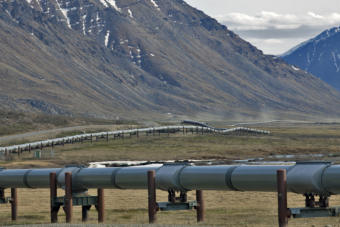
An above-ground section of the Trans-Alaska Pipeline System near the Toolik Lake Research Station in the North Slope Borough. (Photo by Rashah McChesney/Alaska's Energy Desk)
An above-ground section of the Trans-Alaska Pipeline System near the Toolik Field Station in the North Slope Borough. (Rashah McChesney/Alaska’s Energy Desk)

Alaska’s state budget for the next fiscal year hasn’t even been signed into law yet, but its expectations for oil revenue may already be out of date.

On Tuesday, the U.S. Energy Information Administration raised its estimates for oil prices in the second half of this year and in 2024. The revised estimate came two days after Saudi Arabia announced that it will cut oil production by 1 million barrels of oil per day.

The EIA now estimates that Brent crude — a key measure of oil prices — will average $79.54 per barrel for the rest of this year and $83.51 per barrel next year because diminished supply will cause prices to rise.

EIA acknowledged that the forecast comes with “significant uncertainty” around global economic growth, a key driver of demand for oil.

A barrel of North Slope oil was worth $75.75 per barrel on Monday; that was about a dollar below the Brent price. The two prices are closely correlated.

Alaska’s budget for the 12 months that begins July 1 expects that North Slope oil prices will average $73 per barrel over those 12 months. Oil revenue represents about two-fifths of Alaska’s general-purpose state revenue and is the second-largest source of that revenue, behind only an annual transfer from the Alaska Permanent Fund.

If prices exceed the revenue threshold, the budget contains a “waterfall provision” that automatically deposits some of the excess earnings into the state’s Constitutional Budget Reserve.

Some of the excess earnings would also be set aside for a boost to the as-yet-unset 2024 Permanent Fund dividend.

Oil forecasts are notoriously erratic. The April EIA forecast projected oil at $85 per barrel this year and $81 next year; that fell in the May forecast to $79 in 2023 and $74 in 2024.

Alaska’s oil revenue is even more uncertain because it also depends upon the amount of oil produced on the North Slope and estimates of how much companies will claim in tax deductions.

The windfall provision itself is uncertain, too. Gov. Mike Dunleavy has yet to sign this year’s budget into law, and the governor has the ability to veto that section of the budget, potentially deleting the section entirely, an act that would leave the excess earnings on the table for future debate by legislators.

This story originally appeared in the Alaska Beacon and is republished here with permission.

Dunleavy says Alaska can boost fossil fuels and renewables. Clean energy advocates disagree.

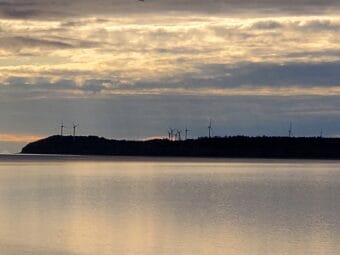
Wind turbines in Wales, Alaska. (Photo courtesy of Alaska Center for Energy and Power)

Standing in front of a crowd of energy experts and industry leaders in Anchorage last week, Gov. Mike Dunleavy outlined his vision for Alaska’s energy policy.

“When we talk about energy, for Alaska, it is going to be all-in,” Dunleavy told the audience at the Alaska Sustainable Energy Conference, which his administration helped organize.

Alaska is an oil and gas state, Dunleavy said, but it can no longer only be an oil and gas state. Going forward, he said, “it is going to be oil, it is going to be gas, it’s going to be wind, it’s going to be solar, it’s going to be geothermal, it’s going to be biomass, it’s going to be nukes.”

Alaska officials at the conference repeatedly made the case that the state should both increase fossil fuel production and boost renewables like wind and solar. But critics argue this vision ignores the devastating impacts of climate change.

Alaska has long faced an energy paradox. The state is a major oil producer, and oil taxes and royalties have for decades been a major revenue source, supporting state spending on everything from schools to roads. But most of that oil is shipped out of state. Meanwhile, rural communities in Alaska face some of the highest energy costs in the nation, often relying on expensive imported diesel and heating oil.

In an interview with Alaska Public Media, Dunleavy laid out his vision for how to address this dilemma. He argued that Alaska should double down on the production of fossil fuels as a revenue source, while building more renewable energy in-state to lower bills at home.

As part of that vision, Dunleavy and other Alaska officials used the conference to reiterate support for the Alaska LNG project: a proposed 800-mile natural gas pipeline from the North Slope to the Kenai Peninsula, which would potentially allow Alaska to export liquified natural gas to buyers in Asia.

“We want to be a player on the world stage in oil and gas, as well as coal, as well as biomass,” Dunleavy said in the interview. But, he added, “internally, we have to lower the cost of energy and make it stable. And that’s where you see a lot of the renewable concepts come into play.”

Dunleavy said for him, investing in renewables is not about lowering carbon emissions or combatting climate change, it’s about securing cheap energy for Alaskans that’s not tied to the volatile price of oil. The cost to operate renewable energy projects has dropped dramatically in recent years.

“From my perspective, if a diesel generator could be producing electricity at a very low cost consistently, we would consider that as well,” Dunleavy said.

But critics say this vision is short-sighted and fails to take climate change into account.

Phillip Wight, an energy historian at the University of Alaska, Fairbanks, said Alaska has pursued a similar approach for decades.

“Historically, Alaskans have not pursued renewable energy because of climate benefits. We have pursued renewable energy because it has reduced our reliance on diesel and other higher cost fossil fuels,” Wight said. “We’ve done it for economic reasons, not climate reasons.”

But Wight said today, as climate change accelerates, Alaska needs to consider more than just economic benefit.

Alaska faces growing impacts from climate change, from sea ice loss and thawing permafrost to species die-offs. Scientists say the world must slash carbon emissions, including from burning fossil fuels, nearly in half by the end of this decade to avoid the worst impacts of climate change. The state’s total contribution to the global oil and gas market is relatively small, but Wight argued that as long as Alaska continues to drill, it’s contributing to its own environmental problems.

“We’re still exacerbating a global problem, and a global problem where Alaska is warming four times faster than the rest of the planet,” Wight said. “We’re not escaping that problem. We’re on the front lines of the climate crisis.”

Proponents of fossil fuel production point out that there’s no clear alternative state revenue source that could replace oil production. But experts like Wight predict that as the world transitions away from fossil fuels, eventually Alaska will have to stop drilling. The International Energy Agency warned in 2021 that any new fossil fuel infrastructure would make it harder to meet global climate targets.

Meanwhile, some clean energy advocates say the state still isn’t doing enough to invest in renewables at home. Rachel Christensen with The Alaska Center, an Anchorage-based nonprofit, said she’d like to see the governor make renewable policy a bigger priority.

“What we’re seeing is just talk about the potential of solutions,” Christiansen said. “We need to see him actually taking action on putting those into place.”

Christiansen pointed to two proposals that were before the legislature this year: one would have required utilities to source a certain amount of their energy from renewable projects. The other would have created a “green bank” to help finance renewable projects in small communities.

Dunleavy supported both, but neither passed. In response to Christiansen’s criticisms, a Dunleavy spokesperson reiterated the governor’s goal to provide Alaskans with low-cost, reliable sources of energy.

Christensen said would also like to see the administration take climate change more seriously in its energy policy.

“It should be more than just an economic move,” Christiansen said. “Our people and industries are already feeling the effects of the climate crisis. And we can’t keep pushing these large scale extraction projects for export, just because it’s what we’ve always done.”

Hilcorp fined again for deviating from permit at Milne Point

(Hannah Lies/Alaska Public Media)

A state regulatory agency has fined Hilcorp $267,000 for making unauthorized equipment changes at Milne Point, one of its North Slope oil fields.

The Alaska Oil and Gas Conservation Commission order says that Hilcorp’s drilling permit for a well called I-27 allowed for the use of an electrical submersible pump. An investigation later revealed the company had substituted a jet pump without notifying the agency of the change.

The order says Hilcorp has a track record of regulatory non-compliance that includes more than 60 enforcement actions. Regulators found problems at Hilcorp operations in Cook Inlet and on the North Slope. Several of them were for making changes to a permitted plan.

At Milne Point, three workers nearly died in 2015 after Hilcorp pumped nitrogen down a well without authorization instead of the seawater it said it was going to use. The nitrogen leaked into a trailer where the men were working.

Hilcorp said it launched an investigation as soon as it learned of the unauthorized pump substitution and has already begun revising procedures and training.

“An important part of Hilcorp’s culture is to get better every day, and we look forward to continuing to work closely with AOGCC to ensure compliant, safe and responsible operations,” the company said in an email.

The Alaska Oil and Gas Commission order says the steps Hilcorp has taken are too narrowly focused and are unlikely to prevent a similar reoccurrence.

Site notifications
Update notification options
Subscribe to notifications