Energy & Mining

Alaska loses lawsuit that challenged the western boundary of the Arctic National Wildlife Refuge

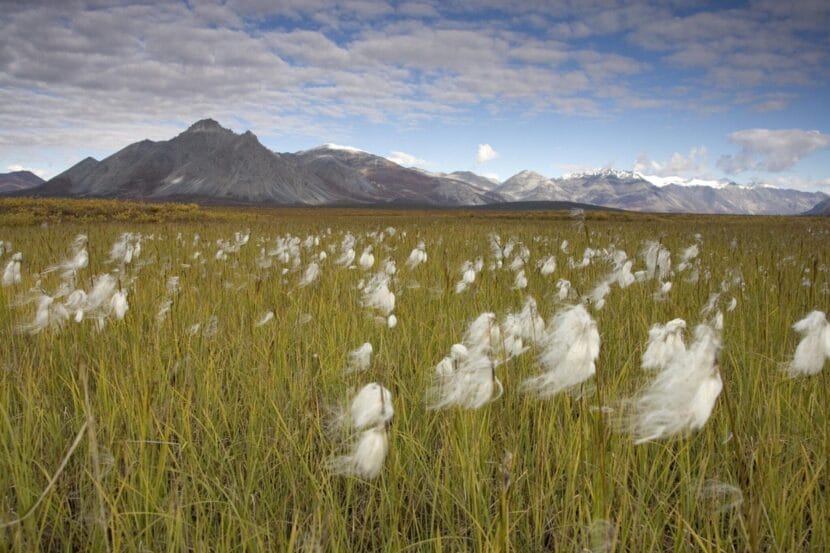
A field of tall grass with cottony seedheads in front of a stark, treeless mountain range
Cottongrass wafts over the tundra in the Arctic National Wildlife Refuge on Sept. 2, 2006. (Steve Hillebrand/U.S. Fish and Wildlife Service)

A U.S. District Court judge in Anchorage has ruled against the state of Alaska in an 11-year-old legal dispute that has significant implications for the Arctic National Wildlife Refuge and state finances.

On Wednesday, Judge Sharon Gleason ruled that laws and regulations setting the western border of the Arctic National Wildlife Refuge are “ambiguous,” but federal regulators made a reasonable decision when they declared the border to be the western bank of the North Slope’s Staines River, rather than on the western bank of the Canning River.

There are 20,000 acres of potentially oil-rich land between the two waterways, and the state of Alaska had sought ownership of the area — sited just to the east of the Prudhoe Bay oil field — for oil and gas drilling.
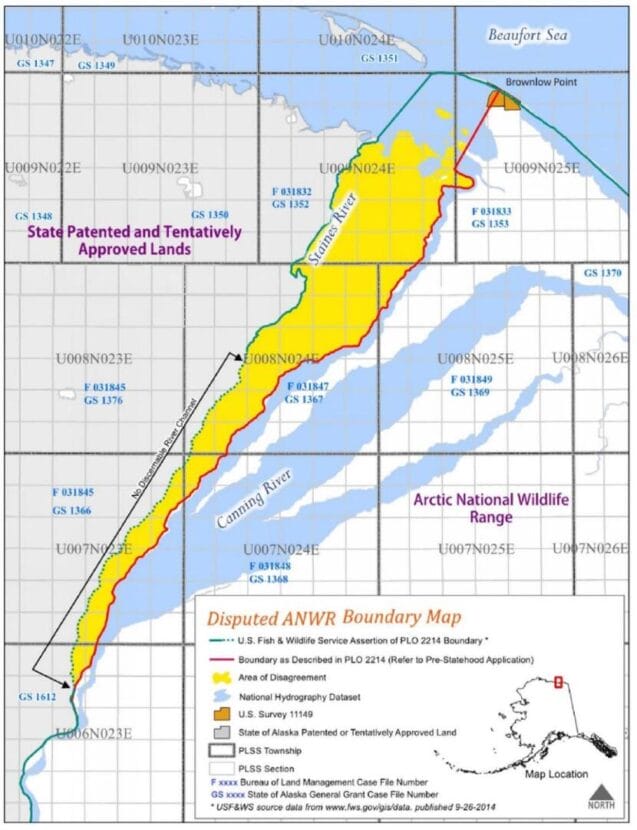
This map, published by the Alaska Department of Law as part of its summary judgment motion, shows the area contested between the state of Alaska and the federal government. (Screenshot from Alaska Department of Law)

While the federal government is now advancing plans for oil and gas leasing in the disputed area, the decision to keep it under federal control means that if oil and gas are discovered there, the state of Alaska would receive far less revenue than it would if it were state-owned land.

“The state of Alaska is disappointed that the court failed to recognize the state’s ownership of this disputed area on the border of the Arctic National Wildlife Refuge,” said Patty Sullivan, communications director for the Alaska Department of Law, which brought the case against the federal government.

“This land may hold significant resource potential for the future of energy for Alaska and the United States and would likely be thoroughly explored and developed under state management. We will evaluate our options and are glad to, at least, have a federal administration currently in place that recognizes the importance of responsible resource development in this area,” she said.

Attorneys for the U.S. Department of the Interior and the U.S. Department of Justice did not return messages seeking comment.

The state’s dispute with the federal government revolves around whether federal mapmakers viewed the Staines River as a separate river from the Canning, or simply a “distributary,” a different channel of the same river, in 1957.

The Bureau of Land Management used the boundary drawn that year to create the Arctic National Wildlife Range in 1960, and it became the refuge in 1980. Maps published at that time show the border running along the Staines River.

As Gleason explained in her 74-page order, “If the Staines River was considered to be part of the Canning, then the extreme west bank would follow the west bank of the Staines distributary of the Canning River. But if the Staines and the Canning were considered to be two separate rivers, then the boundary would follow the west bank of western-most channel of the main Canning River.”

The dispute also included a marker designating the northwest, seaward boundary of the refuge, but the main issue was about the river-defined border.

In 2014, the Alaska Department of Natural Resources requested ownership “of certain lands west of” the Arctic National Wildlife Refuge.

The Alaska Statehood Act, which remains partially unfulfilled more than 65 years after statehood, allows the state to select more than 100 million acres of federal land for state ownership.

In 2016, the U.S. Bureau of Land Management responded to the state’s request, saying the state had already selected all available land in the area. The state protested, saying that federal officials were drawing ANWR’s border west of where it should have been because they were relying on the Staines River, not the Canning.

The state appealed to the U.S. Interior Board of Land Appeals, which ruled in favor of the BLM. The state sued over the issue in 2022 and won an early victory when Judge Gleason ruled the following year that the land appeals board failed to consider a 1951 map that showed the Staines as a separate river from the Canning.

But in 2024, the land appeals board again ruled against the state, which promptly renewed its case in the U.S. District Court and requested summary judgment, a request that was answered Wednesday.

Explaining her order, Gleason noted a 1906 U.S. Geological Survey dictionary that labeled the Staines and the Canning as the same river, but “on the other hand, some contemporaneous maps label the two rivers separately, indicating that the Staines and the Canning may have been considered to be two separate rivers. And yet other contemporaneous maps do not label the Staines or do not separately label the Canning River at the mouth,” she wrote.

While that might have favored the state’s position, Gleason concluded that the land appeals board’s interpretation of the border was reasonable, not arbitrary, was supported by substantial evidence and wasn’t contrary to law, meaning that the state doesn’t have grounds to overturn it.

Gleason concluded, “the court upholds the IBLA’s finding that the northwest boundary of the refuge follows the Staines River, a distributary of the Canning River.”

If the state chooses to appeal Gleason’s decision, it will have 30 days after final judgment.
AK LNG nets two new agreements as development decision looms

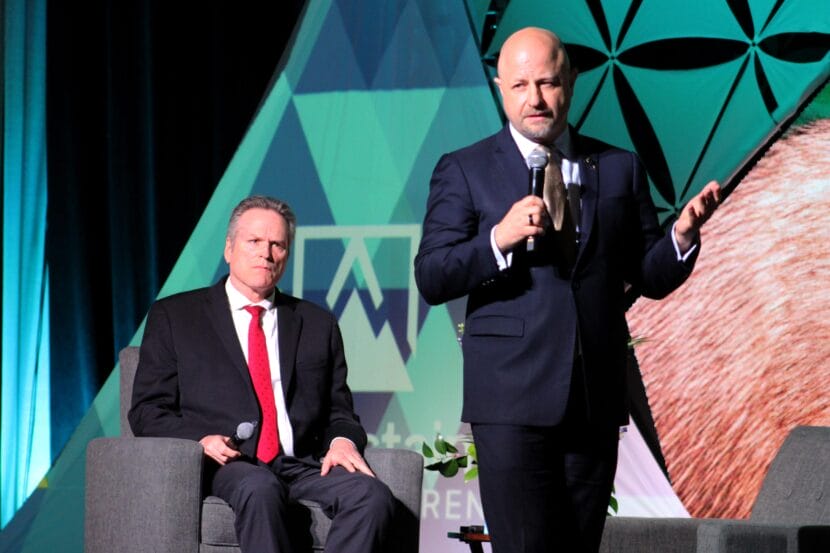
Gov. Mike Dunleavy (left) listens to Glenfarne CEO Brendan Duval (right) talk about the Alaska LNG Project during a panel on Thursday, June 5, 2025 in Anchorage, Alaska.
Gov. Mike Dunleavy (left) listens to Glenfarne CEO Brendan Duval (right) talk about the Alaska LNG Project during a panel on Thursday, June 5, 2025 in Anchorage, Alaska. (Ashlyn O’Hara/KDLL)

The Alaska LNG Project netted two more agreements earlier this month during an energy conference in Italy. Both agreements are nonbinding, but proponents say it’s proof of ongoing positive momentum. The developments come as the company behind the project aims to decide whether to move forward with development, or not, by the end of the year.

Adam Prestidge remains optimistic about the Alaskan LNG Project’s commercial viability. He’s the project president under Glenfarne Group, which assumed majority ownership earlier this year.

“We think it is a fantastic project from an infrastructure fundamental standpoint,” he said. “Its commercial attributes, we think, make it a really attractive project, and put it in a really advanced state.”

The idea of a natural gas pipeline between the North Slope and Southcentral has been tossed around for decades.

If it’s built, the three phase project would extract and treat natural gas on the North Slope, move it through an 800-mile long pipeline to Southcentral and then liquefy it in Nikiski for export overseas. The project already has the necessary land and permits. What it needs now are customers – and, of course, to be built.

Since taking over, Glenfarne’s secured five nonbinding agreements with potential project customers. Two of those were signed at the Gastech Conference earlier this month in Italy.

One agreement is with JERA Co. – Japan’s largest power generation company – to purchase a set amount of liquefied natural gas from the project over two decades.

The other agreement outlines a “strategic partnership” with POSCO International. The company is the sales representative of POSCO Group, Korea’s largest steel producer, and also imports liquefied natural gas.

Prestidge says he’s aware of the skepticism around nonbinding contracts. But he says the scale and scope often require a drawn out negotiation process – sometimes up to one or two years.

“They’re enormous contracts, and they don’t just turn into binding agreements overnight,” he said.

Glenfarne Communications Director Tim Fitzpatrick says four of the agreements are at the first in a three-step process to get to a binding agreement.

The agreements come as project owners prepare to make a final decision whether to move forward with development – a decision expected by the end of the year.

Glenfarne enlisted another firm to update the project’s current cost estimate. Prestidge says Glenfarne does not expect construction costs to be “significantly more expensive” than previous estimates, but they’re keeping the final construction price tag secret.

“You wouldn’t normally be publishing publishing costs for a project – for a private project, kind of on a recurring – rolling updates,” he said. “And so the ultimate cost to complete is going to be something that is most likely not going to be made public.”

Glenfarne says construction costs are only one part of the equation. Prestidge says steel tariffs and the cost of liquefied natural gas will ultimately dictate final project costs, and Glenfarne thinks its commercially viable.

Larry Persily is a former state revenue commissioner and Federal Coordinator of the Alaska Natural Gas Transportation Projects. He suspects Glenfarne’s decision won’t sit well with Alaskans.

“I think keeping it secret, which is another way to say private, will just increase the skepticism among Alaskans who think this thing has been a multi-million dollar wasted effort over the years,” he said.

And Persily is doubtful project costs will come in at previous estimates, around $44 billion, pointing to rising labor costs and project overruns in other parts of the country. In the mid-2010s, the total estimates were between $45 billion and $65 billion. In 2020, the estimate dropped $37.5 billion, but then came back up, in part, due to inflation.

“It’s really hard to believe that is going to come in at that [Alaska Gasline Development Corporation] estimate,” he said. “Mega-projects like this are notorious for going over budget.”

Prestidge says Glenfarne’s team is up to the challenge.

“We’re very appreciative of the reception that we’ve gotten from Alaskans,” he said. “We know, we know that we’re new in the state, and we’re going to continue working, working really hard to deliver this fantastic project for the state.”

Glenfarne and the Alaska Gasline Development Corporation will hold an open house Oct. 8 at the Nikiski Community Recreation Center from 5:30 to 7:30 p.m. to share project updates and meet with residents.

What does a North Slope ‘renaissance’ mean for Alaska’s state budget?

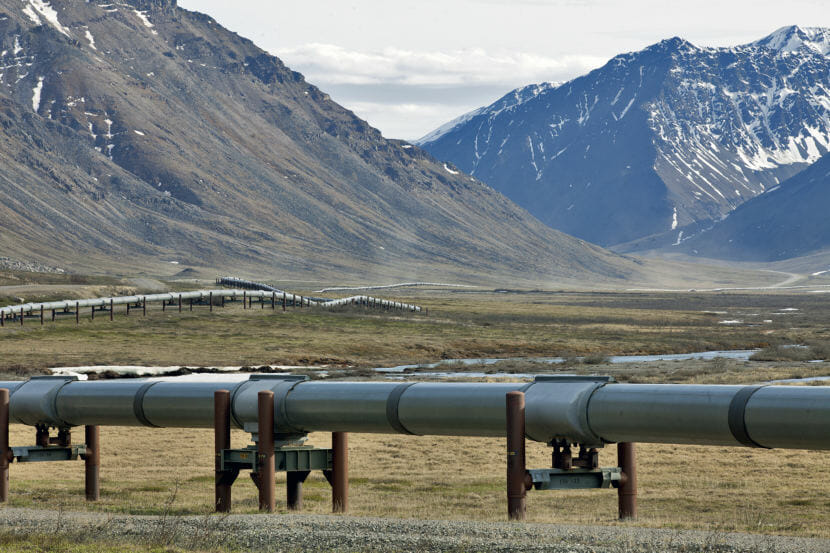
The Trans-Alaska Pipeline runs alongside the Dalton Highway near the Toolik Field Station on June 9, 2017, in the North Slope Borough. (Photo by Rashah McChesney/Alaska's Energy Desk)
The trans-Alaska Pipeline runs alongside the Dalton Highway near the Toolik Field Station on June 9, 2017, in the North Slope Borough. (Photo by Rashah McChesney/Alaska’s Energy Desk)

Industry leaders say a “renaissance” is underway on the North Slope. Major projects are well on their way to production, and oil companies say they’re planning to expand even further, helping to reverse a long-running decline in production in the Arctic.

Construction is well underway on high-profile oil development projects like ConocoPhillips’ Willow and Santos and Repsol’s Pikka. Both of those stand to substantially boost the amount of oil flowing south.

At the Alaska Oil and Gas Association’s annual conference last month, ConocoPhillips’ Donald Allan said Willow remains on track to start production in 2029.

“It’s a super exciting time for Alaska,” he said. “We have big projects happening right now. We have a whole new play ramping up, and there’s more to come with our exploration season and future projects.”

Meanwhile, Santos VP of Business Development Peter Laliberte shared the news that the Pikka project is running months ahead of schedule and is more than 90% complete. It’s on track to produce its first barrel of oil in the first quarter of next year, he said.

“Once we start up, we’ll ramp up about mid-year,” he said. “We’ll ramp up to 80,000 barrels a day, and by then, we’re going to be looking on for the next project.”

An additional 80,000 barrels a day would boost North Slope production by nearly 20% from where it is right now.

What does that mean for the state’s economy — and the state’s stretched budget?

“I look at it as all positive,” said Sitka Republican state Sen. Bert Stedman, one of the top budgeters in the state Legislature. “Quite frankly, this is just the beginning. There’s going to be probably a decade of build-out going on on the Slope.”

It’s a boon for the economy, he said, and a welcome source of relief for the state budget. Pikka — which, importantly, is on state-owned land, and thus generates more state revenue than projects on federal land — is likely to yield more than $200 million for the state in its first year, according to an analysis from the state revenue department.

That’s a significant, though not life-changing, chunk of change for the state, Stedman said. For comparison, the education funding boost lawmakers approved this session cost about $170 million.

“It’s not going to be, you know, you’re in euphoria because you have massive surpluses in your budget or anything like that, but it’s definitely positive,” he said. “You want to take multiple steps like this forward, then they all add up to definitely helping the state balance its budget.”

Higher-than-expected oil prices are also providing a lift to the budget, he said.

Sen. Bill Wielechowski, an Anchorage Democrat, said the surge in North Slope activity is, indeed, good news. But not as good as it could be.

“Absolutely, $200 million, of course, happy to see it. It will help the budget,” he said. “But when you compare it to what other jurisdictions are getting, it is nowhere near what we should be getting.”

He pointed to oil-producing states like Texas and North Dakota, which have substantially higher tax and royalty rates than Alaska. Of course, the fact that most of Alaska’s oil comes from the remote North Slope, where costs are high, complicates the picture.

“We can’t even afford to fund our schools. We’ve got schools falling in the ocean. We’ve got communities that still have honey buckets. We can’t maintain our roads, we can’t plow our roads,” he said. “We have colossally mismanaged our oil wealth in the state of Alaska.”

Wielechowski said lawmakers should make changes to the state’s tax and royalty system to take advantage of the surge in activity. For one thing, he said he’d like to prevent companies from deducting investments on federal land — like Willow — from the state taxes they owe on other projects. State revenue officials recently cut the state’s projected income from Willow by half.

“Why should we subsidize that?” he said. “Why should the state of Alaska be subsidizing hundreds of millions to billions of dollars for production, for exploration costs, drilling costs, for which we get zero royalties, for which we get very little in production taxes?”

Wielechowski has backed a number of bills that would stiffen the state’s oil and gas taxes, though they have yet to advance to a final vote.

ConocoPhillips plans large layoffs, potentially slowing or reversing Alaska’s oilfield jobs growth

The ConocoPhillips Alaska Inc. building in Anchorage is seen on June 28, 2023.
The ConocoPhillips Alaska Inc. building in Anchorage is seen on June 28, 2023. (Yereth Rosen/Alaska Beacon)

The top oil-producing company in Alaska is planning significant layoffs, it announced last week.

In a series of statements, the oil giant ConocoPhillips said it will be firing between 20% and 25% of its global workforce of about 13,000 people. That would mean between 2,600 and 3,250 layoffs worldwide.

“We are always looking at how we can be more efficient with the resources we have. As part of this process, we have informed employees that a 20% to 25% reduction in our global workforce, which includes employees and contractors, is anticipated. The majority of these reductions will take place in 2025,” said Rebecca Boys, director of external affairs for ConocoPhillips Alaska, on Thursday.

Boys declined to say how many people the company employs in Alaska, but prior documents published by the company say that it has “about 1,000 people in Alaska,” and of those, about 80% live in the state.

Altogether, the oil and gas industry employed 8,800 people in Alaska as of July, according to state statistics. If ConocoPhillips were to lay off a quarter of its Alaska workforce, it likely would reverse an upward trend for the oil and gas industry here.

Since bottoming out at 6,100 people in November 2020, during the COVID-19 pandemic emergency, the number of people employed by the oil and gas industry rose throughout President Joe Biden’s administration.

ConocoPhillips produces the most oil of any company operating on the North Slope and holds the second-most oil and gas lease area in the state.

According to state data, ConocoPhillips leases about 490,000 acres of Alaska land and water for oil and gas drilling. That’s behind only privately owned Hilcorp, whose holdings exceed 500,000 acres.

ConocoPhillips is developing the large Willow project in the National Petroleum Reserve-Alaska, which is expected to begin producing oil in 2029.

According to the Alaska Division of Oil and Gas, ConocoPhillips is also planning to drill four exploration wells in other parts of the reserve this winter.

On its production side, ConocoPhillips was planning to drill 12 new production wells this year and next from the Kuparuk oilfield west of Prudhoe Bay.

Gold exploration success extends Kensington Mine life for five years

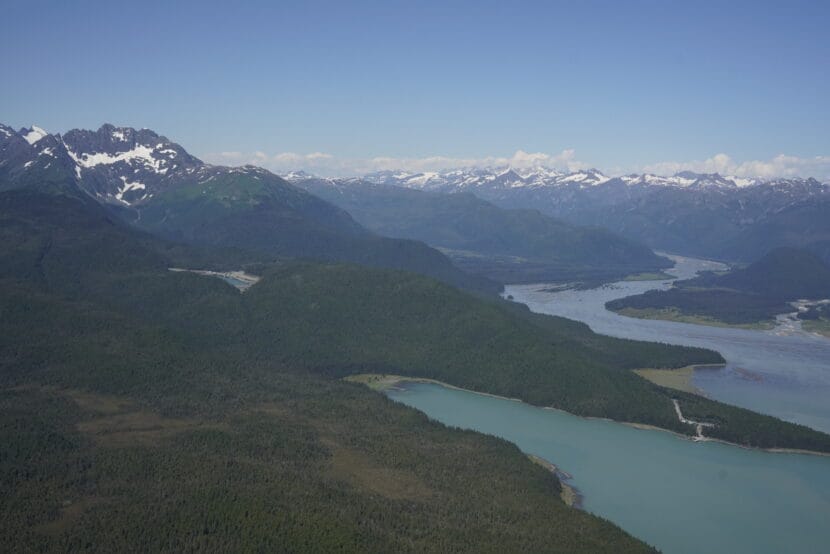
Coeur Alaska’s Kensington Mine. Lower Slate Lake is tucked in the trees on the left and the port is on the bottom right (Photo by Alix Soliman/KTOO)

A gold exploration project at Coeur Alaska’s Kensington Mine north of Juneau has revealed thousands more ounces of precious metals. The high-grade gold deposits will extend the mine’s life through 2029. 

Steve Ball, the general manager at Kensington, said the company spent a few years and nearly $90 million drilling to discover more gold. Now those efforts have paid off. 

“We increased our reserves from a low point of 261,000 ounces at the end of year 2022, to 501,000 ounces at the end of year 2024.” 

Ball said those new reserves, which they’ve already started excavating, represent around five years of mine life.

Brian Holst is the executive director of the Juneau Economic Development Council. In an email, he said this is promising for workers here, since the mining industry is one of the community’s largest private employers.

“Both Kensington and Greens Creek Mine provide some of Juneau’s highest paying jobs, averaging over $120,000 a year, so knowing that Kensington Mine has a longer future of work in Juneau ahead of them is great news for the workers and our community,” he said. 

Kensington employs around 380 people and roughly 40% of them live in Southeast. The mine is also Juneau’s second largest taxpayer after Hecla Greens Creek Mine. 

Kensington mine is located about 45 miles northwest of Juneau in the Berners Bay Mining District. It’s owned by Coeur, a multinational company based in Chicago, Illinois, which began operating it in 2010.

The mine has raised environmental concerns. Last year, it reported a tailings spill. Separately, it was potentially responsible for a fish die-off downstream. In 2019, the U.S. Environmental Protection Agency fined Coeur more than $500,000 for multiple environmental violations

The price of gold is on the rise. As of today, it’s at roughly $3,600 per ounce. 

Deantha Skibinski is the executive director of the Alaska Miners Association. She said the positive trend makes Alaska a more attractive place to drill, given how expensive it is to establish gold mines here. 

“That certainly incentivizes companies to do that exploration in Alaska to hopefully bring more mines online,” she said. “So it really is a positive driver in terms of growing our industry here.”

Ball said that Kensington staff have already started more exploratory drilling with the hopes of extending the mine’s life even further. 

Skagway, Yukon to pursue federal permits for new ore dock

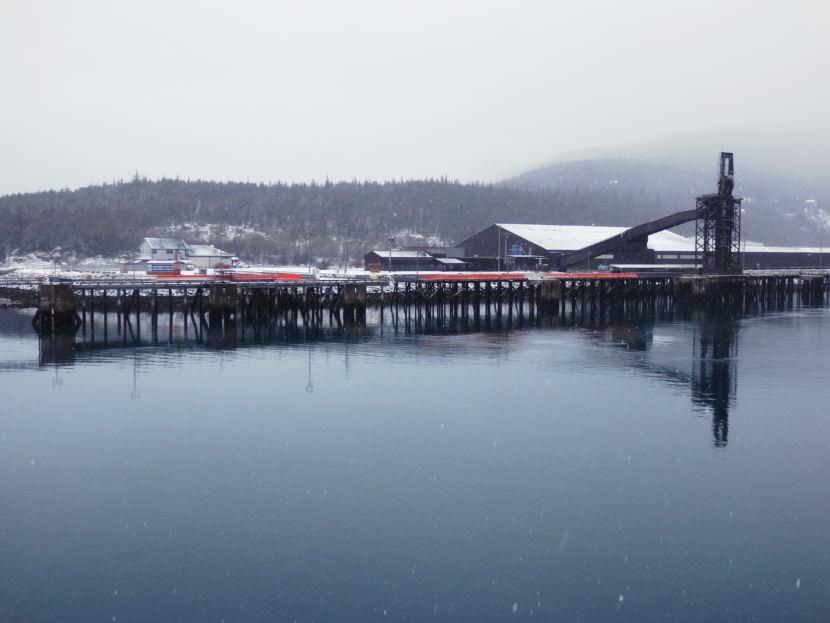
The Skagway ore dock.
The Skagway ore dock. (Emily Files/KHNS)

Skagway is inching toward building a dock that Canadian mining companies could use to once again export ore from the local port.

The municipality of Skagway has been in talks with officials in Yukon, Canada for several years about building a new dock that would allow mining companies to get bulk minerals to market.

But doing so would require a handful of federal permits. Skagway’s borough assembly voted unanimously earlier this month to begin that process, which can take up to two years. During an assembly meeting last week, Yukon Minister of Economic Development Ranj Pillai said kickstarting the permitting process is an important next step.

“If an agreement is reached and approved by Skagway and the Yukon, the project will be able to move quickly to tendering and construction,” Pillai said.

Skagway will need to secure three federal permits for the project: one from the U.S. Army Corps of Engineers, and two others under the Marine Mammal Protection Act and the Endangered Species Act.

The permitting process will cost upwards of $120,000 – and the Yukon government has committed to footing the bill. The job will be handled by contractors, including Washington-based KPFF Consulting Engineers.

Pillai emphasized during the meeting that moving forward on permitting does not mean the project itself is a done deal.

“A positive decision on this item will not bind the municipality of Skagway to future decisions on this project but will support our ability to meet potential demand in the near future,” Pillai said.

Demand for the dock would stem from Yukon mining projects set to come online in the coming years. During an interview earlier this week, Skagway Assembly Member Deb Potter nodded to a copper, gold, molybdenum and silver deposit that the Casino Mining Corporation is developing northwest of Whitehorse, Canada.

“It’s going to be a massive operation,” Potter said. “And they want to ship out of Skagway.”

There’s a long history of mining companies shipping ore out of the small, tourism-dependent town. The municipality previously had an ore loader on one of its docks that was most recently used by Minto Metals’ Corp. Minto used the facility up until March of 2023.

But the loader wasn’t in great shape, Potter said, and was removed when Skagway replaced that dock last summer.

Potter said the project could help diversify the local economy and provide a major financial boost, given that mining companies would pay fees to use the dock. That’s different from how it worked before, when the White Pass and Yukon Route Railway held a 55-year lease on the Skagway port.

“The benefit now that that lease has expired is, we’re just looking at bringing in a bunch more money,” Potter said. “That money goes to Skagway now, not to White Pass.”

Negotiations are ongoing between Skagway and Yukon officials on an export cooperation agreement.

Skagway will need to hammer out more details as the project moves forward. That includes making sure that exporting ore via the new dock would not lead to contamination in the area, which was a problem in the past. The assembly has already passed an ordinance that says the ore would need to come through the port in sealed containers, for that purpose.

Correction: This story previously misstated Ranj Pillai’s official title. Pillai was formerly the Yukon premier, but stepped down from that role earlier this year. He is currently the Yukon Minister of Economic Development.

Site notifications
Update notification options
Subscribe to notifications