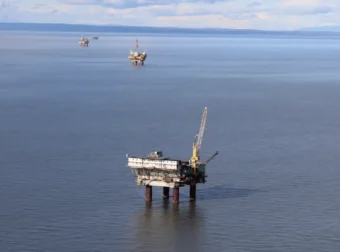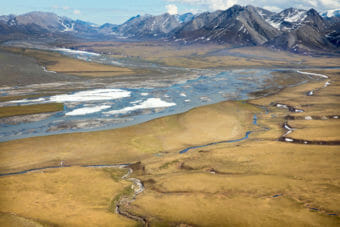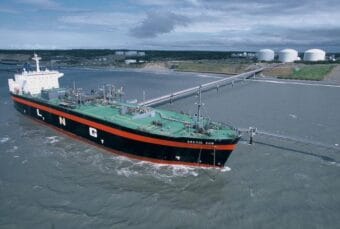
The sun sets behind Marathon Petroleum Corportation’s Kenai LNG Terminal on Thursday, Feb. 6, 2025 in Nikiski, Alaska. (Ashlyn O’Hara/KDLL)
The proposed Alaska natural gas pipeline project picked up another nonbinding agreement last week. This time, the letter of support comes from Tokyo Gas Company, one of Japan’s largest energy utilities. It’s the fifth acquired for the project since Glenfarne, a private energy asset developer, took over majority project ownership earlier this year.
If it’s built, the Alaska LNG Project will move natural gas from the North Slope through a roughly 800-mile pipeline to Nikiski to be liquefied and shipped overseas.
Adam Prestidge is the project president with Glenfarne. He told KDLL last month that preliminary agreements, though nonbinding, are a necessary first step toward agreements that are binding. But he says that can take a while.
“Typically, an LNG contract like this, can take, you know, 12, 18, 24 months to go from initial concept to being a binding agreement,” he said.
Glenfarne celebrated the preliminary Tokyo Gas agreement in a press release for pushing the project over the halfway mark of its LNG export capacity.
Glenfarne Communications Director Tim Fitzpatrick said the project’s annual capacity boils down to two separate numbers.
The first is the natural gas capacity of the pipeline, measured as a volume in billion cubic feet. The second is the liquid volume of natural gas for export, measured as a weight in million tons.
Fitzpatrick says the pipeline has an estimated capacity of 3.3 billion cubic feet of natural gas per day. Of that, 15.2%, or 500 million cubic feet, is earmarked for in-state use by Alaska residents as natural gas. According to a report commissioned by the Alaska Gasline Development Corporation, that’s roughly double what Alaskans in the Anchorage, Matanuska-Susitna and Kenai Peninsula regions actually use each year – between 180 and 200 million cubic feet.
The remaining project output will be converted to 20 million tons of liquefied natural gas for export, Fitzpatrick said. Of that, 11 million tons already have tentative customers through the handful of preliminary agreements reached this year.
Glenfarne estimates it needs binding commitments for five million more tons of liquified natural gas to fund the full $44 billion project.
This week, the head of the International Energy Agency predicted a forthcoming increase in liquefied natural gas supply could change global markets. Reuters reports the shift is creating a buyer’s market, pushing prices down for importers in places like Asia.
Glenfarne is eyeing the end of this year to decide whether to move forward with project development or not.
Correction: A previous version of this story incorrectly stated the annual natural gas capacity of the pipeline.
John Boyle, commissioner of the Alaska Department of Natural Resources, speaks on Nov. 15, 2023, at the Resource Development for Alaska annual conference in Anchorage. (Yereth Rosen/Alaska Beacon)
John Boyle, commissioner of the Alaska Department of Natural Resources, abruptly resigned his position on Friday.
Gov. Mike Dunleavy announced the appointment of his deputy, John Crowther, as acting head of the agency that regulates Alaska’s agriculture, mining, oil and gas.
The governor’s office declined Monday to answer questions about the resignation, which had not been previously announced.
Dunleavy is term-limited and will leave office in December 2026. Boyle’s departure follows those of Revenue Commissioner Adam Crum and Attorney General Treg Taylor.
The resignations of both of those men — who are now Republican candidates for governor in next year’s elections — were announced in advance, unlike Boyle’s departure.
Boyle could not be reached for comment on Monday.
The departing commissioner has extensive experience in the oil industry. Before joining Dunleavy’s cabinet in 2023, he was a lobbyist for BP and Oil Search.
Crowther, who will replace Boyle on an interim basis, has been with the Department of Natural Resources since 2012, the governor’s office said.
He previously worked as director of the governor’s Washington, D.C. office and served on the staff of the U.S. Senate’s Energy and Natural Resources Committee. He holds a law degree from Georgetown University.
“The Department of Natural Resources is at the forefront of protecting and developing Alaska’s precious land and waters. Mr. Crowther’s legal background and experience as a deputy commissioner make him a great choice to advance the responsible development, and maximum use, of Alaska’s natural resources consistent with the public interest as mandated by Alaska’s Constitution,” the governor said in a prepared statement released on Friday.
Correction: This story originally had the wrong byline.
US Department of Interior Sec. Doug Burgum at a news conference with Gov. Mike Dunleavy, Alaska’s congressional delegation US Sen. Lisa Murkowski, Rep. Nick Begich, and Sen. Dan Sullivan, announcing several actions advancing resource development projects in Alaska on Oct. 23, 2025 (Screenshot)
The federal government is proceeding with efforts to expand drilling in the Arctic National Wildlife Refuge, mining in northwest Alaska, and construction of a road between King Cove and Cold Bay on the Alaska Peninsula, US Interior Secretary Doug Burgum announced Thursday.
At an event in Washington, D.C. that was dubbed “Alaska Day” by the federal department, Burgum signed a series of documents pertaining to all three projects as well as an ongoing effort by the federal government to give land to the families of Alaska Native Vietnam War veterans.
“This is our first, this won’t be our last, Alaska Day. We have a lot more things to accomplish, a lot more things to celebrate going forward,” said Burgum, flanked by Gov. Mike Dunleavy and all three members of the state’s congressional delegation.
“I told the president, it’s like Christmas every morning,” said Dunleavy. “I wake up, I go to look at what’s under the proverbial Christmas tree to see what’s happening. And here’s another example of more presents for not just Alaska, but for this country.”
Tribal and environmental groups opposed to the three development projects saw Thursday’s action differently, with Defenders of Wildlife, a national group, dubbing the event “Alaska Sellout Day.”
“Today’s announcements are the latest step in Donald Trump’s plan to sell out our wildest landscape and natural heritage to corporate polluters,” said Dan Ritzman, director of conservation for the Sierra Club.
What was done on Thursday
Burgum signed previously announced permits for the 211-mile Ambler Road, which is intended to connect the Dalton Highway with a series of potential mine sites in the Brooks Range of northern Alaska.
He also signed a record of decision for the federal government’s oil and gas drilling program in the coastal plain of the Arctic National Wildlife Refuge of northeast Alaska.
That re-establishes a program that had been in place during the first term of President Donald Trump but which was subsequently reversed by President Joe Biden.
Burgum also reversed the Biden administration’s decision to suspend oil and gas leases issued by the federal government in 2020 to the Alaska Industrial Development and Export Authority.
Barring further litigation, that move clears the way for AIDEA — Alaska’s state-owned development bank — to begin seismic surveys that could reveal the amount of oil available within parts of the Arctic refuge’s coastal plain.
While the Ambler and ANWR actions effectively took the projects back to where they stood in 2020, the King Cove road is now closer to construction at any point in its decades-long development process.
Envisioned as a gravel road between King Cove and an all-weather airport at Cold Bay, the road would pass through the Izembek National Wildlife Refuge, a nationally important bird sanctuary.
Eleven miles of new road are needed to link existing roads to the two towns, but those 11 miles would pass through a wilderness area.
On Thursday, Burgum signed documents that complete a land exchange between King Cove Corp., the local Alaska Native corporation, and the federal government. King Cove Corp. gives up about 31,200 acres to expand the refuge, and in return, it receives the 490 acres of refuge land needed to complete the road.
In a move with more limited statewide impact, Burgum signed paperwork awarding three Alaska Native Vietnam War veterans with 160-acre plots of land under a federal allotment program. As of March, 453 veterans and their families had requested plots authorized under legislation authored by Alaska Sens. Lisa Murkowski and Dan Sullivan.
For King Cove, a medevac-avoiding road moves forward
King Cove’s airport is frequently closed by bad weather, and since 2014, there have been more than 100 Coast Guard medevacs from the community because regular air ambulance service was unavailable.
Murkowski, who has previously vowed to complete the road, noted that this is the third time that the federal government has embarked on a land exchange for the road, with the prior two attempts blocked and reversed by litigation.
“We’ve reached a point with the King Cove exchange that we haven’t yet before, and that’s actually the official patent being issued to KCC, so we’re one step further. I think that’s important,” she said.
The road, though supported by local residents, is opposed by some Yukon-Kuskokwim river delta tribal leaders and subsistence bird hunters who fear its effects on wildlife.
“Surely, the people of King Cove can see the value of leaving the habitat for so many species intact would be far more valuable than any road could be,” said Angutekaraq Estelle Thomson, Traditional Council President of the Native Village of Paimiut, one of several communities that have supported lawsuits seeking to prevent road construction.
Rebecca Noblin, an attorney with the Center for Biological Diversity who has fought the road on behalf of several area villages, said Thursday that “we have significant questions about the legality of the exchange. We, along with the Native Villages of Hooper Bay and Paimiut, expect to bring those issues to court soon. Road construction will also require additional permits, including an Army Corps 404 permit and Endangered Species Act consultation, so this is far from a done deal.”
With Ambler and ANWR, a triumph of economics over environment
On the first day of his second term in office, Trump issued an executive order seeking to encourage oil and gas development, mining and logging in Alaska.
US Rep. Nick Begich, R-Alaska, US Dept. of Interior Sec. Doug Burgum, and Alaska Gov. Mike Dunleavy pose for a photo at a news conference announcing advancements to several resource projects, including oil drilling in the Arctic National Wildlife Refuge on Oct. 23, 2025 (Screenshot)
Elected officials said they see Thursday’s actions in line with that decision.
Alaska Republican Rep. Nick Begich said projects like the Ambler Road and ANWR drilling matter because they create jobs.
“We need the jobs. We need high-paying, good jobs, and these resource industry jobs fit that bill completely. And so whether it’s mining, timber, oil and gas development or other resources, these are necessary for the functioning of Alaska’s economy,” he said.
The coastal plain of the Arctic National Wildlife Refuge is believed to contain billions of barrels of recoverable oil that could be sold on global markets.
Sullivan noted that previous North Slope oil development has been good for the region’s residents.
“The life expectancy, mostly of the Native people in our state, has increased in the North Slope and the Northwest Arctic Borough and by dramatic numbers … and a lot of that is due to the benefits that come from responsible resource development: jobs, revenues, water and sewer, gymnasiums, health clinics. So it’s a real life and death issue,” he said.
The predominantly Alaska Native town of Kaktovik is located on Barter Island, within the refuge.
“Developing ANWR’s Coastal Plain is vital for Kaktovik’s future,” said the town’s mayor, Nathan Gordon Jr., in a written statement. “Taxation of development infrastructure in our region funds essential services across the North Slope, including water and sewer systems to clinics, roads, and first responders. Today’s actions by the federal government create the conditions for these services to remain available and for continued progress for our communities.”
To date, no oil companies have shown interest in drilling within the refuge, leaving only Alaska’s state-owned development bank, which won leases in a 2020 sale, to work there.
So far, no actual work has taken place because of repeated lawsuits seeking to overturn the sale.
The bank, which has filed several lawsuits over federal restrictions on drilling within the refuge, did not respond to a request for comment on Thursday.
Several legal challenges to the 2020 ANWR plan of development — which was restored Thursday — are still pending in federal court.
Some of those challenges revolve around the possible effects that ANWR development and the burning of those fossil fuels will have on climate change.
Thursday’s announcement came just a week after the remnants of Typhoon Halong devastated coastal communities in southwestern Alaska. Experts say that storm was worsened by climate change.
Murkowski said she does not shy away “from the fact that the impact of that typhoon was made more fierce and more destructive because it was able to travel over a large body of what is now warmer, open ocean with lack of ice. I get that, and I call it climate change.”
At the same time, people worldwide are continuing to consume fossil fuels. Murkowski said that for her, the choice is straightforward: Will they get those fossil fuels from Alaska or some place with worse environmental standards?
“I’d much rather be producing in Alaska, than just across the Bering Strait there, over in Russia, where I don’t think that they respect the same level of environmental standards and safeguards,” she said. “So is it complicated? Yes. But am I proud of how Alaska has led in terms of meeting environmental standards that are amongst the highest in the world? I am.”
What comes next for Ambler, King Cove and ANWR?
All three development projects boosted by the federal government on Thursday are a long way from construction, both supporters and detractors say.
In all three cases, proponents need to obtain additional federal permits and will have to cope with lawsuits brought by opponents.
The environmental law firm Earthjustice has repeatedly been involved in lawsuits against the federal government over the issue of arctic refuge drilling.
“Interior has re-adopted the maximally destructive plan from President Trump’s first term,” said Earthjustice attorney Erik Grafe, by email on Thursday. “That plan was unlawful in 2020 and is still unlawful today. The bedrock environmental laws that protect the Arctic Refuge’s irreplaceable natural resources remain despite Congress passing reconciliation bills on leasing in the refuge.”
The Gwich’in Steering Committee, represented by attorneys from Trustees for Alaska, is among the organizations that have repeatedly sued to block drilling in ANWR.
The committee is concerned about the effect that refuge development would have on local caribou herds used by subsistence hunters. In a statement, the committee’s executive director, Kristen Moreland, implied that further litigation will come.
“This action by the Trump administration is a direct attack on the Gwich’in, who have for decades been a voice for the caribou and stood against the destruction of the Arctic Refuge. A leasing program that would open the entire Coastal Plain completely ignores the impacts that oil and gas development would have on the land, on wildlife, and on our communities,” she said.
“We condemn these efforts by the Trump administration to exploit the calving grounds of the Porcupine Caribou herd for short-term gain, and we know that we are not alone. We will continue to raise our voices and fight for the protection of this sacred land and for our way of life.”
A man stands in front of acid mine drainage from British Columbia’s Tulsequah Chief Mine, which has been leaching acid mine drainage into the transboundary Taku River since it was abandoned in 1957. (Photo by Chris Miller)
Listen to this story:
Canagold representatives faced resistance from residents about their proposed New Polaris underground gold mine at an open house in Juneau last month.
The mine site is a remote area where the Tulsequah River joins the Taku River in British Columbia, around 40 miles northeast of Juneau. As the mine goes through its environmental assessment across the border, some Alaskans feel they don’t have a meaningful say in the process.
The Taku River runs through the traditional homelands of the T’aaḵu Kwáan. Butch Laiti is president of the Douglas Indian Association, which represents the T’aaḵu Kwáan. He said the tribe isn’t willing to gamble with the health of the river.
“We’re not gonna back down or give way, because there’s too much at stake here,” Laiti said. “If we lose the Taku, and then that’s it, it won’t come back. And that’s the bottom line, right there.”
The mine is projected to produce around 800,000 ounces of gold over about a decade. The project is part of a controversial wave of mining expansion in British Columbia upstream of the Taku, Stikine, and Unuk Rivers in Southeast Alaska.
Laiti said past mining projects in Canada set a precedent of damaging and neglecting the rivers that flow into Southeast.
“I know you understand our nervousness, but a lot of that’s from the history of all the mining that comes out of BC,” Laiti said.
The Tulsequah Chief mine, located just across the river from the New Polaris site, was abandoned in 1957 and has been leaching unsafe levels of toxins, including aluminum, cadmium, chromium, copper, lead, mercury and zinc into the Taku River since.
Canagold CEO Catalin Kilofliski said that the province is cleaning up the site, but it could take a decade. And he said it’s given mining a bad rap.
“I think the issues you mentioned, unfortunately, that’s the legacy of mining,” Kilofliski said. This is the legacy we are faced with — miners too.”
That legacy has continued.
For instance, the Premier gold and silver mine in British Columbia was found responsible for releasing toxic materials into the Portland Canal Watershed for years near Hyder, Alaska, and was fined in March. Also this spring, the Red Chris copper mine in British Columbia was found to have leached heavy metals into the Stikine River Watershed. In September, the province fined that mine for failing to monitor the water. Last year, a failure at the Eagle gold mine in Yukon spilled cyanide into the Yukon River Basin.
The state of Alaska signed a non-binding memorandum of understanding with British Columbia a decade ago meant to keep Alaskans informed about water quality beneath existing mines and to engage them in the public process for developing new mines. But some Alaskans say it’s not enough to make sure they’re heard or to protect the waters they depend on.
So far, almost all of the public comments submitted on New Polaris were written with concern for the lower reaches of the Taku River in Alaska.
Heather Hardcastle has been fishing at the mouth of the Taku River since she was a kid, and said the mine could harm this essential salmon run. She’s a campaign advisor at SalmonState, a nonprofit that advocates for salmon habitat across borders, and said the provincial government isn’t required to take Alaskans’ concerns into consideration.
“We still don’t have any kind of binding forum through which those of us downstream have any meaningful say in whether or not and how a mining project is developed,” Hardcastle said.
The U.S. has atreaty with Canada called the Boundary Waters Treaty of 1909. It states that “waters flowing across the boundary shall not be polluted on either side to the injury of health or property on the other.”
Despite pressure from Southeast cities and Alaska’s congressional delegation, the federal government has yet to raise the issue with the International Joint Commission, which is a framework for resolving issues under the treaty.
Canadian officials are mandated to consult with Indigenous peoples on projects that could affect their territories. There’s an ongoing dispute about whether that mandate extends consultation to tribes across the border.
Canagold signed an agreement with the Taku River Tlingit First Nation, whose territory is on the Canada-side of the border, that it won’t build the mine without their consent. It’s unclear when the First Nation will decide. The Taku River Tlingit First Nation did not respond to requests for comment.
New Polaris is now going through Canada’s environmental assessment process. A representative from Canagold said mine construction could start in 2027 at the earliest.
In this screenshot from a White House news conference, Interior Secretary Doug Burgum points to a map of Alaska on Monday, Oct. 6, 2025, as he announces the Trump administration’s decision to reverse a Biden administration action that canceled a right-of-way permit for the Ambler Road. (Screenshot)
The action removes a major hurdle for the project, but developers would still need to overcome lawsuits and opposition from environmental and tribal groups. They would also need approval from NANA and Doyon Ltd., two Alaska Native regional corporations who own land in the road’s path.
Ambler Road, planned by the state of Alaska’s development bank and supported by state officials and Alaska’s congressional delegation, would link the Dalton Highway with a mineral-rich region of northwest Alaska, providing access to the mining of rare minerals needed for batteries and high-technology manufacturing.
“It’s an economic gold mine, so to speak. I signed this years ago, and Biden un-signed it for me,” Trump told reporters on Monday at the White House.
Last year, the U.S. Bureau of Land Management concluded that the road would have a litany of negative impacts, and the Biden administration issued a record of decision saying that the best route for the project was no route at all.
The Alaska Industrial Development and Export Authority, Alaska’s state-owned investment bank and the road’s developer, sued the Biden administration, seeking a reversal.
U.S. Interior Secretary Doug Burgum, speaking at the White House on Monday, said the state of Alaska requested an appeal of that decision, and that under federal law, President Trump has the executive authority to make decisions on land use.
The appeal in question was filed by AIDEA under Section 1106 of the Alaska National Interest Lands Conservation Act of 1980.
“This opens up a wealth of resources,” Burgum said, adding that the federal government will also take partial ownership of Trilogy Metals, one of several firms exploring for minerals in northwest Alaska.
As currently planned, the road would consist of a gravel strip stretching from the Dalton Highway almost to Kotzebue. It is envisioned as a toll road, with no public access, and the cost of construction would be paid for via fees levied on users, similar to the way the AIDEA-funded DeLong Mountain Transportation System provides a port for lead and zinc exported from the Red Dog Mine in northwest Alaska.
In a special late-September meeting, AIDEA’s board voted to authorize limited negotiations with landowners in the road’s path.
The road is expected to cross more than 10 miles of land owned by Doyon Ltd., the regional Alaska Native corporation for Interior Alaska.
To date, that corporation hasn’t expressed official support or opposition for the road. Sarah Obed, senior vice president of external affairs for Doyon, said by email that Monday’s announcement was “not a surprise to Doyon” because of a different executive order signed earlier this year.
NANA Regional Corp. owns more than 20 miles of land in the path of the road. In a written statement, NANA President and CEO John Lincoln said the company “appreciates the Trump Administration and Governor Dunleavy’s support for economic development in Alaska and their work towards stabilizing the federal permitting process” but he declined to express support for the road.
Lincoln said that still stands: “Our position on the Ambler Access Project has not changed and will only be reconsidered if and when our established criteria are satisfied, in consultation with shareholders, local communities, and other stakeholders.”
Trump’s action on Monday restores a federal right-of-way grant issued in 2021, at the end of the first Trump administration. It also requires federal agencies to issue clean-water permits and other approvals needed for the road.
A lawsuit challenging the 2021 right-of-way grant remains open in U.S. District Court in Anchorage. Attorney Bridget Psarianos with the non-profit law firm Trustees for Alaska is one of the attorneys challenging that right-of-way.
By phone, she said she hasn’t ever seen a president use the authority that Trump did on Monday.
“He’s wielding this presidential power like a cudgel, including to overturn decisions that his own agencies have made and provided good reasons for,” she said.
Several dozen communities and Alaska Native tribes in Interior Alaska have opposed the road to date.
“I think it’s also just important to remember that there’s widespread opposition to this road in Alaska and by local communities, and the reason the alums said no to this was because they found that there would be significant impacts to subsistence and to communities and their health along the road corridor,” Psarianos said.
Athan Manuel, director of the environmental non-profit Sierra Club’s Lands Protection Program, offered similar thoughts in a written statement. “This order ignores those voices in favor of corporate polluters. The Ambler Road will lead to significant harm to fragile Alaskan landscapes and the local communities and wildlife that rely on them,” he said.
Most of the road’s path is on land owned or controlled by the state of Alaska; an easement allowing the road remains under consideration by the Alaska Department of Natural Resources, but approval is expected.
In a statement published after Trump’s announcement on Monday, Gov. Mike Dunleavy thanked the president for his action, saying, “this decision will unleash development opportunities, create new jobs for Alaskans and secure access to strategic minerals.”
Similarly, all three members of Alaska’s congressional delegation expressed support for Trump’s decision.
“By advancing this access, we are creating new opportunities for Alaskans while strengthening America’s supply chain and reducing dependence on foreign adversaries for our critical mineral needs,” said U.S. Rep. Nick Begich, R-Alaska. “I applaud the President’s decision to support this appeal, and I look forward to working with the Administration, state leaders, and Alaska Native communities to ensure this project moves forward in a way that benefits all Alaskans.”
U.S. Republican Sens. Lisa Murkowski and Dan Sullivan also thanked the president for his action.
“The President’s re-approval will unlock a world-class mining district, deliver quality-of-life benefits for communities in the region, and help grow Alaska’s economy. It will also improve our national security by strengthening our mineral security and enabling us to produce more of our most important resources here at home,” Murkowski said.
Sullivan said, “I’m glad to see another critically important project for our state’s economy and working families being put back on track.”
Stibnite, the predominant ore mineral of antimony, is shown. (U.S. Geological Survey)
As the race to mine antimony is gaining traction in Alaska, so is the rush for the federal government’s financial backing.
Now, the Trump administration is injecting millions of dollars into an Australian company’s project about 100 miles northwest of Anchorage.
Nova Minerals isn’t the only antimony interest in Alaska hoping for investment from the feds, but this week, the Pentagon awarded a grant worth more than $43 million to the Alaska subsidiary of Nova, Alaska Range Resources. The money is intended to turn the company’s Estelle Project, located in the Mat-Su Borough, into a hub for producing munitions materials.
Nova CEO Christopher Gerteisen said the project is on a two-year schedule, and that he doesn’t anticipate that the ongoing government shutdown will affect the funding.
“And so what this grant is for is to further define our resource out there, and then to mine the material, and then … process the material, to produce the munitions-grade ‘antimony trisulfide,’ they call it,” he said in a short interview.
Antimony, which is often associated with gold deposits, has a number of possible applications, including flame retardants, solar panels, semiconductors and ammunition. The U.S. government considers it a critical mineral.
Antimony was mined in Alaska off and on between 1905 and 1986, typically in response to wartime needs or higher prices. The revived interest comes amid a push from the federal government to boost mineral production and China’s ban on antimony exports to the U.S. China has been the United States’ biggest supplier of the mineral.
The award to Nova Minerals comes through Title III of the Defense Production Act, which allows the President to approve aid for businesses that buttress productive capacity for national defense purposes. That’s a lever the Biden administration also pulled to bolster critical mineral production and reduce reliance on foreign supply chains.
Gerteisen said the award will fund what he calls a pilot phase. He said Nova hopes to later build a refinery at Point MacKenzie in Southcentral to produce more than munitions with Alaska’s antimony.
“This grant is so important for Alaska because the race is on. Other states have some antimony discoveries, and this and that,” he said. “And the race is really on as to … where is the antimony refining hub is going to be for the United States.”
Other companies with antimony projects in Alaska may have different models, goals, and stages than Nova. But, on top of the mineral they want to mine, the companies share at least one other thing in common: They’re also looking to tap the Trump administration for funds.
Dallas-based U.S. Antimony plans to recover the mineral from discarded rock waste at historic mining sites in Alaska and truck the ore down to its smelter in Montana. The company began its first small-scale antimony reclamation in Alaska in early September at the Mohawk Mine near Ester.
And last week, U.S. Antimony inked a $245 million contract with the Defense Logistics Agency to supply antimony ingots to the Defense Department’s store of critical minerals.
In response to a question about U.S. Antimony’s efforts to secure federal funding, Vice President of Investor Relations Jonathan Miller sent KUAC a link to a September investor’s conference.
During the conference, Miller said the company has been working with Pentagon officials throughout the year.
“At the DoD’s request, we put together scope papers and white papers for a grant, essentially outlining what would be needed for us to expand our operations and our claims,” he said at the time.
Miller said in the presentation that the company will likely announce a federal award of just under $30 million in the near future. That was before the government shutdown began, however, and it wasn’t immediately clear how, or if, that timeline might be affected. Miller also did not say whether the money would be directed toward the company’s Alaska operations during the conference.
In an email Wednesday, Miller congratulated Nova on their award, and suggested companies should approach the endeavor collaboratively.
“We believe it’s critical to build bridges with Nova and with all miners in Alaska who are producing, or will produce, antimony in the future,” he wrote.
Another Australia-based mining company, Felix Gold, still says it’s targeting the end of this year to start mining antimony at its Treasure Creek project just north of Fairbanks.
Similar to the other two companies, Felix Gold has also formally sought federal support for that plan, and the company is touting a visit from officials with the Environmental Protection Agency and Federal Permitting Council, saying their recent stop at Treasure Creek represents a “substantive milestone.”
In a call with investors last month, Felix Gold Executive Director Joseph Webb said the visit was “as good as you can get” and helped the company’s case, but that he couldn’t guarantee anything just yet.
Close
Update notification options
Subscribe to notifications
Subscribe
Get notifications about news related to the topics you care about. You can unsubscribe anytime.