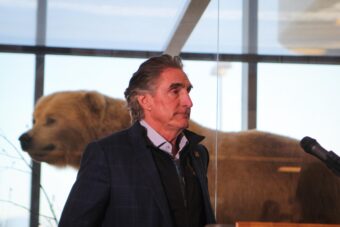
Alaska’s U.S. House Rep. Nick Begich speaks at a Juneau Chamber of Commerce luncheon on Thursday, Feb. 20, 2025. (Photo by Clarise Larson/KTOO)
The U.S. House Natural Resources Committee is touring Alaska this week to take a closer look at the land they spend so much time talking about in Congress.
Rep. Celeste Maloy, R-Utah, was in Juneau with 10 other members of Congress on Monday.
“We set natural resources policy, and obviously, Alaska is a big natural resources state, so we’re here seeing things on the ground so that when we’re talking about it in Washington, D.C., it’s not just an academic exercise for us,” she said.
They toured the Hecla Greens Creek Mine on Admiralty Island and flew over parts of the Tongass National Forest.
The visit comes after the Trump administration’s tax and spending bill, known as the One Big Beautiful Bill, was signed into law July 4. It boosted oil and gas leasing in Alaska, mandated the expansion of timber harvest on public lands, and allocated more than $7 billion dollars to grow the U.S. military’s mineral stockpile.
Rep. Bruce Westerman, R-Arkansas, is chairman of the committee. At a press briefing at Ward Air in Juneau, he said there is a growing demand for metals like silver that are used in AI data centers and military weapons.
“It’s imperative that Congress work with everyone who’s in the business to help figure out how to get more mining done here in the U.S., and not just mining, but also the refining of the metals, which is a huge issue,” he said.
Westerman says the committee could help Hecla further extend the lifetime of Greens Creek Mine, the most productive silver mine in the nation. Its mine life was recently extended by more than a decade.
Alaska’s Rep. Nick Begich said forestry is another big focus for the committee.
“In the One, Big, Beautiful Bill Act, there are provisions to unlock additional forestry resources for timber, particularly in the Tongass, but across the nation as well,” he said. “This is something I hear from folks from Ketchikan all the way up to Yakutat on a regular basis. How do we bring timber back?”
The U.S. Forest Service is currently revising the Tongass Management Plan, which is set to take effect in 2028 and will determine how logging is done.
The committee heads to the Kenai Peninsula tomorrow and will attend the Alaska Oil and Gas Association conference in Anchorage on Wednesday.
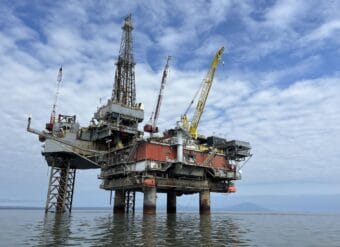
Oil and gas platforms in Cook Inlet in 2021, as seen from a floatplane. (Liz Ruskin/Alaska Public Media)
The Trump administration has announced plans to hold six oil and gas lease sales in Cook Inlet over the next six years, starting next March.
The plan “ensures Alaskans benefit from new jobs, stronger local economies and long-term investment in their communities,” the Interior Department said in an emailed statement.
Southcentral Alaska depends on natural gas from Cook Inlet for heat and electricity generation, but industry has shown only mild interest in the area in recent years.
It takes more than a lease sale to boost production, said Larry Persily, a former Kenai Peninsula Borough official for oil and gas matters.
“ That’s the first step. But there’s not really a shortage of opportunities in Cook Inlet. There’s more a shortage of capital and interest,” he said. “So I guess the first test we’ll see is who bids in March of 2026.”
Hilcorp is the primary producer of Cook Inlet gas. It has been the only bidder in the last two federal offerings. The company has warned that it may not be able to supply enough gas by 2027 to meet Southcentral’s demand.
Persily said the newly announced lease schedule doesn’t solve the near-term problem.
“Because by the time you have a lease sale and you get permits and you explore and you find something to turn to production, it’s probably not going to come in time,” he said. “So dealing with the Southcentral gas shortage is going to have to come from existing leases” or outside the region.
The offshore oil and gas leasing plan announced this week was mandated by Congress in the reconciliation bill it passed in July.
A drill site at the Palmer Project north of Haines. (Constantine Metal Resources)
A company that owns a controversial mining exploration effort outside Haines says work will continue at the site despite plans to sell some or all of the project.
The so-called Palmer Project is a zinc, copper, gold, silver and barite exploration site that has long divided Chilkat Valley residents over its potential economic benefits — and environmental impacts.
American Pacific Mining said in May that it planned to distance itself from the development. That news came several months after the project’s biggest investor backed out and American Pacific took full ownership of the project.
The company didn’t give much insight into its plans in a press release Thursday beyond saying that merger and acquisition talks are ongoing – and that some work will happen this year. American Pacific said it started tearing down one worker camp at the site in July, a move the company says will save money.
American Pacific plans to use a different camp to support mineral exploration and construction crews. The company says those crews will tackle three different efforts as part of the broader project this year.
That includes surveys using drone and laser technology to investigate what the company called “key prospects” in the area, which sits above the Chilkat River, about 40 miles north of Haines.
Mapping and sampling work will examine copper and cobalt prospects on the west side of the Little Jarvis glacier and gold prospects in the Porcupine-McKinley Creek area.
As of Thursday afternoon, Constantine Mining LLC, which operates the project locally, declined to comment before press time on the exploration efforts or the decision to shut down one camp while using another one.
The Trans-Alaska Pipeline crosses the landscape, seen here south of Copper Center, Alaska on August 13, 2024.
Alaska lawmakers overrode Gov. Mike Dunleavy’s veto of a bill intended to bolster the authority of the legislative auditor on Saturday, handing the governor a defeat with the first vote of a special session.
Along with an attempt to override Dunleavy’s veto of more than $50 million in public school funding, House and Senate leaders said the vote on Senate Bill 183 was a top priority for the special session. The state Constitution requires lawmakers to hold override votes within five days of reconvening.
The bill passed the Senate unanimously and by a 30-10 vote in the House. Lawmakers said it was necessary to address what the heads of the state House and Senate described as a “persistent pattern of obstruction within the senior ranks of Alaska’s Department of Revenue.” It came after a precipitous dropoff in revenue from so-called oil tax and royalty settlements, which the state negotiates with oil companies. In 2020, those provided $281 million for the state’s main savings account; in 2024, that number dropped to $3.1 million.
Legislative leaders said Dunleavy’s administration had not fully cooperated with an audit that seeks to examine the state’s collection of oil taxes by failing to produce a summary table outlining settlements that the governor’s administration provided as recently as 2019. Instead, in recent years, the administration has offered raw data that the legislative auditor said was unusable. The bill would have required the administration to turn over information to the auditor “in the form or format requested.”
Dunleavy vetoed the bill, saying it raised constitutional issues. He said any allegations that the administration had acted unethically or illegally were “baseless.”
The Legislative Budget and Audit Committee earlier this summer authorized a rare use of its subpoena power to compel the administration to turn over the data lawmakers are looking for.
A person takes a photograph of Chilkoot Inlet while on the MV LeConte shortly after departing Haines for Juneau on Sunday, Nov. 13, 2022. (Emily Mesner / ADN)
The administration of Gov. Mike Dunleavy has signed a $28.5 million contract for work on a new ferry terminal north of Juneau, days after an oversight board said the state had not proved that the project is economically viable.
Dunleavy administration officials say the new terminal at Cascade Point, located 30 miles north of an existing terminal in Auke Bay, will cut ferry time from Juneau to Haines and Skagway by two hours.
But the chair of the Alaska Marine Highway Operations Board — which was created by Dunleavy four years ago — says the department hasn’t shared “some kind of business plan or feasibility study” to establish that the terminal is necessary and economically viable.
“The Alaska Marine Highway System has been plagued for 50 years with one-off projects that get foisted upon it, that create operational challenges, that then the system and the users have to deal with,” said Wanetta Ayers, chair of the board, during a Friday meeting.
“This is another one of those situations where it’s going to get foisted upon the system and we’re going to have to cope with it for 20 or 30 years until somebody admits it’s not going to work,” Ayers added.
The Cascade Point ferry terminal is planned on land owned by Goldbelt Inc., a Juneau Alaska Native corporation.Ithas been under consideration since Dunleavy took office in 2019. In May, his administration announced its intention to seek bidders for the first phase of the project.
After receiving two bids, the transportation department signed a contract Monday with K&E Alaska Inc., an Oregon-based company with an office in Sitka. The contract, which has a 2027 completion date, covers engineering and environmental permitting, a bridge over Cascade Creek, a gate, site preparation and retaining wall construction.
The contract does not include any funding for the ferry terminal itself, which is set to cost tens of millions of dollars. The state expects to pay for the terminal using primarily federal funds.
Ayers said Friday that the Dunleavy administration had not provided answers to board members’ previous questions, and she is troubled by “the pursuit of this project in what is a very unconventional process, where design and now construction are way ahead of operational feasibility and customer service.”
Katherine Keith, a deputy transportation commissioner, said during the Friday meeting that the department had commissioned an independent economic analysis of the project, but it was still in “draft form” and had not been released. She did not provide any specifics on when it would be available to members of the board or the public.
“We continue to believe that this is a strong benefit to the state, to the system and the public, which is why we’re moving forward with expenditure of public dollars, but understand we haven’t communicated that in a complete narrative document to make it more accessible and comprehensive,” said Keith.
Keith pointed out that the Cascade Point project had been recommended in 2020 by a marine highway reshaping working group commissioned by Dunleavy.
Ayers, who served on the working group, said that report and its accompanying recommendations “came together on a wing and a prayer at the last minute to meet the governor’s deadline.”
“To stand on it as a justification for Cascade Point is, to me, a pretty big stretch,” said Ayers.
One of the primary reasonings provided in the working group report for the new ferry terminal was that it would “avoid the need to modify the new Alaska Class ferries to add crew quarters” by allowing for trips between Juneau, Haines and Skagway to last less than the 12-hour crew day mandated by the Coast Guard.
But that reason is partially moot because the state has already committed to retrofitting the Alaska Class ferries with crew quarters, at a cost of roughly $30 million, and because the route length between Cascade Point, Haines and Skagway exceeds the 12-hour crew day, according to Marine Highway spokesman Sam Dapcevich.
The trip from Cascade Point to Haines and Skagway, as envisioned by transportation planners, would run up against the 12-hour work limit for crew, “requiring full staffing and accommodations,” Dapcevich said in an email last week.
“A more efficient service model,” which wouldn’t necessitate crew sleeping onboard, would require ferry trips from Cascade Point to go either to Haines or to Skagway, rather than visiting both communities on a single trip, Dapcevich said. The Marine Highway System would then have to use a yet-to-be-constructed “shuttle” ferry between Haines and Skagway.
‘Standing on a cliff’
Ayers wasn’t alone among board members to raise concerns about the process used by the department to advance the Cascade Point project.
Board member Paul Johnsen, a former Marine Highway engineer, said it seemed that the board was “being ignored” by the transportation department. Member Bob Horchover, who was appointed to the board by Dunleavy, agreed.
“I’m against this until we have more information,” said Horchover. To move ahead with the project “without even a reason for doing it is, to me, a boondoggle,” he added.
Anthony Lindoff, vice chair of the board, said the department had not provided enough information for him to form an opinion of the project.
“I certainly don’t have enough information regarding Cascade Point to be unequivocal, one way or the other,” Lindoff said. “I’m just eager for more information.”
While the Dunleavy administration is moving ahead with the Cascade Point project, it is also working simultaneously on a study of a possible new road-and-terminal project on the west side of Lynn Canal.
A $2.4 million study of the project is set to examine multiple options, all of which are predicated on the existence of the Cascade Point ferry terminal, according to a service agreement signed in May.
The northern lights glow over Auke Bay as the Alaska Marine Highway ferry Kennicott approaches Juneau on February 25, 2024. (Marc Lester/ADN)
Keith told board members that the study, with initial findings expected in January, is set to examine connecting Cascade Point with new ferry terminals and road stretches on the west side of the canal, to better tie Juneau to the Alaska Highway. Keith said the “Chilkat Connector,” as the Dunleavy administration called it, would include construction of one or two new ferry terminals on the west side of the canal, along with several miles of new road.
Some board members said it appeared that Cascade Point would only be economical if paired with west Lynn Canal infrastructure, but with those infrastructure projects yet to be studied, moving ahead with Cascade Point was premature.
“If it was part of a larger infrastructure plan to build a road up the west coast of Lynn Canal, then that might have some more impact and be worth investing in that kind of a facility,” said Horchover.
“I’m a little concerned that we’re standing on the cliff and saying, ‘Why not? Let’s jump,’ ” he added.
Juneau Access
The Chilkat Connector study, like the Cascade Point ferry terminal, is funded using appropriations made by state legislators nearly 20 years ago for what is called the Juneau Access Project, a decades-old effort by the state to improve transportation options to the state’s capital that has been reimagined under each new governor.
Former Gov. Tony Knowles in 2000 nixed the idea of a 90-mile road north of Juneau toward Haines, saying its price tag — in the hundreds of millions — was too high. Former Gov. Frank Murkowski revived interest in the plan, and state lawmakers in 2006 approved $45 million for the Juneau Access Project, under a vision for a road from Juneau to the Katzehin River, allowing for quick ferry shuttles from there to Haines and Skagway and on to the mainland road system.
Former Gov. Sarah Palin paused the plan while she was in office, only for her successor, former Gov. Sean Parnell, to revive it, at a projected cost of more than $500 million.
The Parnell administration spent $5 million extending the Glacier Highway to the Goldbelt-owned land at Cascade Point. More than a decade ago, Goldbelt considered constructing a dock to transport Kensington Mine employees from Cascade Point to the mine. That hasn’t happened.
When Gov. Bill Walker was elected — and oil prices crashed — the Juneau Access Project was shelved again. Then came Dunleavy, who turned from the longer road to the Katzehin River to a plan that involved constructing the new Cascade Point terminal.
In 2023, the Dunleavy administration agreed to work with Goldbelt to study the feasibility of a terminal on land owned by Goldbelt. Members of the Alaska Marine Highway Operations Board wrote last year that “with the current information available to AMHOB and the public, we cannot see the merit of the proposed Cascade Point project.” The Dunleavy administration did not provide any further information to the board in response to their letter, members said.
A draft of the 20-year long-range plan for the Marine Highway System signed by Transportation Commissioner Ryan Anderson in February contains no recommendations regarding the Cascade Point terminal. It states that a feasibility study for the terminal was ongoing as of the time of the report’s publication. But department officials said this month that there is no ongoing feasibility study.
‘Rearranging the deck chairs’
Dunleavy vetoeda move by state lawmakers in May to reappropriate Juneau Access Project funding toward other transportation plans, stating the funds had already been obligated.
Since then, both the Skagway and Haines borough assemblies have formally expressed their opposition to the Cascade Point terminal.
“It is difficult to understand why the State is choosing to invest in the construction of a new marine facility rather than rehabilitating existing terminals, many of which — including those serving northern Southeast Alaska — are in urgent need of repair,” Skagway Assembly members wrote.
View of Auke Bay from the bridge of the Hubbard before it set sail to Haines and Skagway in Juneau on May 22, 2023. (Sean Maguire/ADN)
While Haines and Skagway leaders have bristled at the news that the Dunleavy administration is moving ahead with the terminal, one mining company celebrated the announcement.
Grande Portage, a Canada-based company with a plan to build a new gold mine near Juneau, said in a press release that it has an existing agreement with Goldbelt to cooperate on building a barge terminal at Cascade Point for transportation of ore.
Though the barge terminal is not contingent on the ferry terminal, “having the ferry terminal proceed first is highly advantageous as it would result in the development of infrastructure that will also be necessary for the ore terminal, particularly the new access road and bridge. This reduces the time and cost required for future ore terminal development,” Grande Portage wrote in its press release.
The work on Cascade Point comes as the Marine Highway System is wrapping up its work on a 20-year long-range plan. Ayers said work on that plan, and renewed focus on the system’s efficiency, have allowed it to move away from “just rearranging the deck chairs on the Titanic.”
“Here we are, spending lots of time and resources about planning and being strategic, and yet, the other hand is going to deliver us a one-off carbuncle,” said Ayers. “I feel like it’s undoing a lot of good progress.”
The proposed site of the Pebble Mine. (Jason Sear/KDLG)
The Environmental Protection Agency is sticking with its veto of the proposed Pebble Mine project in southwest Alaska.
Northern Dynasty, the parent company behind the Pebble project, is still suing to get the veto overturned. A document filed in that lawsuit early this month said the company and the EPA were in settlement talks, and that the Trump administration said it was open to reconsidering the Biden-era veto on the controversial mining project.
But on July 17, attorneys in the case filed another document to update the judge. It says that negotiations between the company and the EPA did not reach a resolution, and that the Trump administration will continue to back the veto.
The proposed site for the copper and gold mine is upriver from Bristol Bay, home to the world’s largest sockeye salmon fishery. The mining project is unpopular in the region, where many people believe the open-pit mine would put the salmon run at risk.
Karla Jensen is an environmental specialist from Pedro Bay. Her village is close to the proposed mining site. She says that after the veto of the project in 2023, many of the mine’s opponents felt relieved but remained wary.
“It reminded me of a cancer,” Jensen said. “Some people were like, ‘We don’t have to worry about that… I don’t have cancer anymore.’ But you always have that nagging in the back of your mind that it can always come back.”
The Pebble Limited Partnership is now asking the court to rule on whether the veto is lawful.
Close
Update notification options
Subscribe to notifications
Subscribe
Get notifications about news related to the topics you care about. You can unsubscribe anytime.