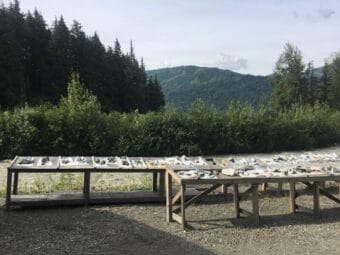
An air-to-air heat pump can provide a more efficient alternative for heating a home, particularly in regions of Alaska with less dramatic temperature swings like Southeast. Because they run off of electricity, they can also reduce greenhouse gas emissions in communities that use renewable alternatives like hydropower or solar. (Erin McKinstry/KCAW)
A federally funded program meant to help Alaskans lower both their energy bills and planet-warming emissions is set to roll-out this summer after months of uncertainty.
Its ultimate aim is to defray the cost of installing electric heat pumps, which can heat and cool homes in place of fossil-fuel based systems – sometimes at a lower cost.
Under the program, lower-income households will get $8,500 to put toward a heat pump. Higher-income households will get either $6,000 or $4,000.
“We do think that for households that have lower income, below 80% area median income, that the incentive should cover the full cost of the installation,” said Cady Lister, a senior energy advisor at Southeast Conference, which is helping manage the grant.
The grant was awarded to Southeast Conference and Alaska Heat Smart, a Juneau-based nonprofit. The two groups say the money could help install more than 6,000 air source heat pumps in households that primarily use fossil fuels or wood for home heating.
Lister said households will be responsible for paying for the installation up front and will be reimbursed afterward. She also emphasized that a newly installed heat pump does not mean households should remove their existing heating systems – especially in Alaska.
“On very, very cold days, it could be that you need to, or want to, turn your Toyo stove or your boiler back on,” she said. “But most if not all of your heating needs could be met with the heat pump.”
Months of uncertainty
The U.S. Environmental Protection Agency first awarded the money to the two Alaska nonprofits last year, aiming to help thousands of coastal and Southeast Alaska households install heat pumps. The target area includes dozens of communities across the region, including Haines and Skagway.
But then President Donald Trump took office in January and halted funding for federal contracts, loans and grants. That included a $38.6 million grant for the heat pump program.
“Our funding was frozen twice,” said Lister. She added that the funding has been available again for the last month and a half.
Organizations across the country experienced a similar chain of events after a federal judge blocked the funding freeze and the Trump administration rescinded the original memo that ordered it.
Lister said the freeze resulted in a lot of uncertainty around the program – and a slight delay. But now that the money is available, the group is racing to finalize program requirements and other details.
Within the next month, they plan to release more information about how households can apply and which contractors they can use.
“We’re working hard to catch up now so that we can get this program out on the street,” Lister said.
Pipelines stretch toward the horizon in the National Petroleum Reserve-Alaska. (Photo by Elizabeth Harball/Alaska’s Energy Desk)
The Trump administration’s National Energy Dominance Council is planning an Alaska summit with leaders from Japan and South Korea in early June to discuss the Alaska LNG project.
That’s according to reports from the New York Times and Reuters citing unnamed sources familiar with the matter. The White House, the Energy Department and the Interior Department all declined to confirm the summit reportedly scheduled for June 2 in emails to Alaska Public Media.
The White House and the Energy Department each emailed identical statements touting the potential benefits of the project and saying the administration was “committed” to supporting the Alaska LNG project.
“Unlike the previous administration which openly discouraged investment in American LNG, President Trump and (Energy) Secretary (Chris) Wright are committed to expanding American energy infrastructure, including by supporting the Alaska LNG Project,” White House and Energy Department spokespeople said.
The $44 billion, 800-mile Arctic gasline project would connect North Slope natural gas fields with a liquefaction facility and export terminal in Southcentral Alaska. But for decades, the Alaska LNG project has failed to attract enough investors to make the complex and expensive project a reality, leaving trillions of cubic feet of natural gas stranded without a market.
Since returning to office, Trump has repeatedly said the gasline project is a priority for his administration. The state agency working towards the gasline project signed an agreement last month with developer Glenfarne to bring the project towards a final investment decision. That’s expected late this year.
Gov. Mike Dunleavy traveled to Asia earlier this year to seek foreign investors for the gasline. He returned with a nonbinding letter of intent saying Taiwanese state energy company CPC Corp. would purchase gas from the project. But the governor did not return with commitments from enough partners to allow the project to move forward.
The reports from the Times and Reuters say federal officials hope to use the summit to announce commitments from Japan and South Korea to purchase gas from the project. Trade talks with Japan and South Korea are underway, and Japan has floated increasing LNG imports as an element of a potential trade deal. But the Korean industry minister told Reuters he was not aware of any plans to announce a commitment from South Korea.
Lawmakers at the Alaska State Capitol would have to approve any changes to mining taxes. (Photo by Nathaniel Herz/Northern Journal)
When oil prices rise, the state of Alaska gets a windfall in taxes and royalties.
When gold prices rise — as they have, in dramatic fashion, this spring — state revenue barely ticks up.
Industry critics often draw this comparison, arguing that the huge mining corporations that operate in Alaska aren’t compensating the state enough for the minerals they produce.
Those minerals yielded just $28.5 million from Alaska’s mining license tax, on average, during each of the past four fiscal years.
In that same period, the state’s oil and gas industry paid an average of roughly $1.2 billion each year in production taxes, according to state figures.
“Essentially, Alaska is subsidizing a huge giveaway of its public resources,” an economist wrote in a 2022 report commissioned by the mining watchdog group SalmonState.
Mining boosters and some economists say simply comparing state revenue from oil production and that from mining can be misleading, given the huge scale and high profit margins of the petroleum industry. They also note that the value of Alaska’s oil and gas pumped from state land, where production is subject to royalties, dwarfs that of minerals mined from state land.
“Our world class oil fields — Prudhoe Bay, Kuparuk — are in fundamentally a different category,” said Dan Stickel, chief economist at the state’s revenue department.
Dan Stickel of the Alaska Department of Revenue testifies in front of the Alaska Senate Finance Committee on Friday, Jan. 20, 2023, at the Alaska State Capitol in Juneau, Alaska. (Photo by James Brooks/Alaska Beacon)
The market value of all the minerals produced in the state last year was roughly $4 billion, according to state estimates — though mining advocates say that number overstates actual value because mines sell the concentrate they produce at lower prices than pure metals. The total market value of oil produced on the North Slope was about $14 billion.
Even if the state raised taxes on mining companies, economists have long said the industry isn’t large or lucrative enough to make up for Alaska’s decades-long decline in oil revenue.
But the recurring question of whether miners should pay more has bubbled up again recently, with calls from newspaper publishers and environmental advocates to tweak the state’s mining tax and royalty policies to generate more income for Alaskans.
These suggestions have not translated into any formal proposals from elected officials. But they come as record gold prices promise to boost some of Alaska’s biggest mines, as more businesses apply for permits to mine in Alaska and as the state government navigates an ominous financial outlook.
The state uses a few tools to generate income from mining.
It levies a severance tax on minerals, called the mining license tax. It takes 3% in royalties from mining profits on state land. It rents mineral claims and leases. And, like other businesses, mining companies pay corporate income tax.
State agencies brought in an average of $90 million from those sources and various other taxes and fees, such as tolls on a state-owned ore haul road, each year between 2016 and 2021, according to state data.
That’s a fraction of the more than $2.5 billion in annual revenue that mining companies averaged during that period, according to state estimates.
Last year, the Red Dog zinc mine in Northwest Alaska reported more than $600 million in gross profits; Fort Knox, the state’s biggest gold mine, reported more than $300 million in profits after deducting operating expenses, according to corporate financial disclosures.
Proposals to generate more state revenue have focused on raising production royalties and overhauling the mining license tax — a maximum 7% levy on profits that hasn’t changed since 1955.
For large mines, the license tax is currently a $4,000 payment, plus 7% of net income over $100,000. New mines get a 3.5-year exemption.
By contrast, the state taxes oil at a base rate of 35% of net production value — the value of the oil produced minus certain capital and operating expenses — with tax credits that increase when oil prices fall.
Without knowing the taxable income of each mine and oil operation and exactly how much each owes in taxes — numbers that aren’t disclosed publicly — it’s difficult to compare the effective tax rate across each industry. The effective rate is the percentage of a company’s profits that it pays in taxes, and it’s a figure that economists often use to describe a company’s tax burden.
A recent report on mining policy commissioned by the Alaska Conservation Foundation recommended restructuring the mining license tax so that it applies to a company’s overall income rather than being tied to profitability.
“We’re just giving away these precious metals and allowing these multinational corporations to dig them up,” said Dan Cannon, senior public lands coordinator at the Anchorage-based conservation organization. “What does the average Alaskan get from this? Not much.”
If the state kept the maximum rate at 7%, but taxed gross instead of net income, that would be a “very large tax increase,” according to Stickel, the state economist.
The state’s most recent revenue forecast assumes about $3.6 billion in gross mining income during the next fiscal year. Its forecast of $36.7 million in revenue from the existing, profit-based tax structure, would be similar, roughly speaking, to a tax on gross income at around 1%, Stickel said.
Even if revenue stayed steady, a gross income tax “would be more regressive – with tax due even when a mine is unprofitable and with a lower tax burden when there is higher income,” Stickel wrote. “What impact this structure would have on production and company decisionmaking is difficult to say.”
Industry representatives say raising taxes would make Alaska less attractive to miners and would thwart investment, potentially leading to decreased revenue in the long term.
“Alaska’s mining record does not show that we are a jurisdiction widely viewed as a low-tax environment where industry is flocking to invest,” trade group Alaska Metal Mines wrote in a recent paper responding to the report commissioned by the conservation foundation. “This is not a record that supports a significant increase in revenue obligations for the industry.”
A tax hike could make new mines too expensive to build and operating mines too costly to expand and keep in production, said Karen Matthias, director of Alaska Metal Mines. Costs are already higher in Alaska than other states because of its remoteness and lack of infrastructure, she added.
Kinross’s Fort Knox mine outside of Fairbanks. (Kinross photo)
In the past four years, Alaska’s annual mining license tax revenue ranged from more than $50 million to a loss of about $1 million. That loss, reported during the 2024 fiscal year, was caused by a shift in the timing of one-time tax filings and refunds, as well as by low base metal prices and high operating costs caused by inflation, according to Stickel.
Rents and royalties are a smaller fraction of Alaska’s mining related income and have recently amounted to just over $15 million in yearly revenue. Corporate income tax paid to the state by mining companies has averaged some $7 million over each of the past five years.
In all, mining accounted for just 0.2% of the state’s total revenue last year — a proportion that state officials expect to double this year.
With gold prices soaring, the revenue department forecasts mining license tax revenue to see a modest boost from the recent average of $28.5 million — reaching about $33 million this fiscal year and $36 million the following year.
The state won’t see a bigger bump because costs have gone up across the industry and not all metal prices are rising like gold’s, Stickel said.
Zinc prices, for instance, have fallen about 8% this year, potentially cutting into profits at Red Dog mine, a pillar of the state’s industry.
That mine also is often cited by industry supporters as an example of how mining stands out more for its impact on local and regional economies than on the state government.
Red Dog accounts for more than 80% of the Northwest Arctic Borough’s revenue through payments similar to taxes. It has also generated billions of dollars for shareholders of the Alaska Native corporation that owns the land where the mine sits, which receives a 40% royalty share of net profits.
Similarly, large mines are the biggest property taxpayers in the Juneau and Fairbanks areas.
“Where mining truly makes a difference in Alaska is regionally,” Matthias said. “Red Dog is to the Northwest Arctic Borough what the entire oil industry is to the state.”
Northern Journal contributor Max Graham can be reached at max@northernjournal.com. He’s interested in any and all mining related stories, as well as introductory meetings with people in and around the industry.
This article was originally published in Northern Journal, a newsletter from Nathaniel Herz. Subscribe at this link.
A polar bear is spotted on a multiyear ice floe in the Beaufort Sea on Aug. 13, 2023. The Trump administration is planning to designate a new “High Arctic” region off Alaska for offshore oil and gas leasing. (Photo by Petty Officer 1st Class Scott Bice/U.S. Coast Guard)
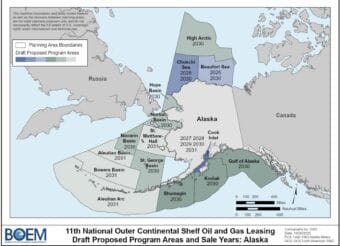
The Trump administration plans to create a new designated region for offshore oil leasing in Arctic waters off Alaska, an area where past exploration attempts have failed amid extremely high costs, logistical challenges and safety problems.
The Department of the Interior said it will soon release a new five-year national plan for offshore oil and gas leasing in federal water, and it will include a new High Arctic planning area. Details will be provided in an upcoming notice in the Federal Register and in information posted on the Bureau of Ocean Energy Management’s website, the department said in its statement.
“Launching the process to develop the 11th National Outer Continental Shelf Program marks a decisive step toward securing American Energy Dominance,” Interior Secretary Doug Burgum said in the statement. “Through a transparent and inclusive public engagement process, we are reinforcing our commitment to responsible offshore energy development—driving job creation, bolstering economic growth and strengthening American energy independence. Under President Donald J. Trump’s leadership, we are unlocking the full potential of our offshore resources to benefit the American people for generations to come.”
Further information was not provided by the department.
The Beaufort Sea coast is seen on Aug. 23, 2018, from East Dock at Prudhoe Bay on the North Slope. The Liberty oil discovery, which has languished without development, is located about 20 miles east of here. (Photo by Yereth Rosen/Alaska Beacon)
Most federal Arctic waters were previously put off-limits to oil leasing by former Presidents Barack Obama and Joe Biden.
President Trump attempted in his first term to open Arctic areas that Obama had withdrawn from the leasing program, but that attempt was struck down by a federal court.
A more recent Trump attempt to open withdrawn waters to oil leasing is now being challenged, as the first attempt was. A coalition of environmental groups sued the Trump administration in February over his efforts to overturn protections in the Northern Bering Sea and areas of the Atlantic and Pacific oceans.
Environmentalists on Friday criticized the newly announced plans for more offshore oil leasing, including in the Arctic.
“Drilling in the Arctic is a disaster waiting to happen. There’s no way to clean up an oil spill there and it will harm polar bears and bowhead whales. Oil companies should think twice about drilling in the Arctic, as it has been plagued with challenges,” Natalie Jones of the Center for Biological Diversity said by email.
The Center for Biological Diversity is one of the environmental groups that sued the Trump administration in February.
Despite some sporadic attempts to explore for oil in federal Arctic waters off Alaska, there has never been any commercial oil production there or in any federal waters off Alaska, except for a small portion of the Hilcorp-operated Northstar field, which lies mostly on state territory.
Royal Dutch Shell’s conical drilling unit Kulluk sits aground on the southeast shore of Sitkalidak Island, Alaska, 40 miles southwest of Kodiak City on Jan. 1, 2013. The Kulluk was grounded after efforts by U.S. Coast Guard and tug crews to tow the vessel to a safe harbor after it was beset by winter storm weather during a tow from Dutch Harbor, Alaska, to Everett, Wash. (U.S. Coast Guard photo by Petty Officer 1st Class Sara Francis/Released)
The field that was expected to become the first producing site located entirely in federal waters off Alaska, the Liberty project, has languished for decades without development. BP Exploration (Alaska) Inc. discovered it in the 1990s and drew up two separate development plans but wound up dropping those. Hilcorp acquired full ownership of Liberty in 2020, but its lack of progress on the project led to expiration of the leases earlier this year.
The last oil exploration attempt in federal Arctic waters was a Royal Dutch Shell campaign abandoned in 2015 after the company spent over $7 billion on it.
That campaign was beset with trouble — most notably, the wreck of a mobile drill rig that escaped its tow and grounded during a storm on Dec. 31, 2012. The rig, the Kulluk, had been used for Shell’s exploration in the Beaufort Sea, the portion of the Arctic Ocean east of Point Barrow. Shell used a separate drill ship in the Chukchi Sea, west of Point Barrow and north of the Bering Strait. That ship, the Noble Discoverer, also had numerous operational and environmental problems.
Shell wound up completing just one well, which was in the Chukchi, and the company concluded that it found too little oil there to justify further development.
Gov. Mike Dunleavy and other state of Alaska officials pose for a photo with Taiwan President Lai Ching-te, center, and other government officials during Dunleavy’s trip to Taiwan last month. (Taiwan Office of the President photo)
JUNEAU — Republican Gov. Mike Dunleavy flew to Taiwan last month to pitch business and government leaders on Alaska’s state-sponsored liquefied natural gas export project.
The same day Dunleavy and other Alaska officials arrived in Taipei on the unannounced trip, his office received an email from China’s vice consul in San Francisco, Ba Yanfeng. The consulate was aware that Dunleavy was leading a trip to the “province” of Taiwan, and Chinese government officials wanted a meeting with his chief of staff, Ba said.
Dunleavy had stepped into a simmering geopolitical conflict — an issue that China’s government describes as the most important and sensitive in its relationship with the U.S.
China claims Taiwan as its own territory and regularly conducts military drills nearby — including some that have simulated blockades and involved firing missiles over the island.
The U.S. doesn’t officially recognize Taiwan’s independence. But it’s a longtime ally, sells arms to the government and has committed in legislation to support the island’s defense.
Taipei is Taiwan’s largest city. (Nathaniel Herz | Northern Journal)
In a formal follow-up note, the Chinese government said Dunleavy’s trip “sends a very wrong signal to the ‘Taiwan independence’ separatist forces,” and it urged the governor “to correct such mistakes and avoid their recurrence.”
But Dunleavy, in an interview, said he was undeterred.
“I don’t allow myself to get pushed around by too many entities or people,” he said.
Alaska does significant trade with China, namely in seafood products, though that’s diminished since President Donald Trump began levying tariffs during his first term. Still, Alaska exports more than $500 million in seafood products to China each year.
But amid China’s broader, ongoing trade war with America, experts said it’s unlikely that the country will target Alaska with retaliatory action even if the LNG project moves forward with Taiwanese partnership.
“I think this is probably fairly low on China’s list of priorities. They have a lot on their plate,” said David Sacks, an expert on Taiwan and China and a fellow for Asia studies at the Council on Foreign Relations.
Sacks described the Chinese correspondence with Dunleavy’s office as “pretty pro forma,” even if it sounds strident. He also said there’s nothing unusual about an American governor or legislator traveling to Taiwan — and he noted that other states, like Arizona, have done robust business with Taiwanese firms without prompting a backlash from China.
“I think it would be fairly unprecedented for the Chinese to take aggressive action here that specifically targets Alaska,” he said.
Dunleavy’s trip to Taiwan last month came amid a new push by his administration to recruit investment in the $44 billion LNG development. Top Trump administration officials have also been touting the project to Asian allies, and a private firm, Glenfarne, has taken over leadership of the development from a state agency.
Dunleavy’s trip also included stops in Thailand, South Korea and Japan, where he met with politicians and corporate executives.
But his Taiwan visit garnered the most headlines. In Taipei, Dunleavy met for an hour with President Lai Ching-te and held a lunch with the vice president, according to his schedule. He also met with officials from Taipower, the country’s primary electric utility, and from the state-owned oil and gas company, CPC.
Alaska Gov. Mike Dunleavy shakes hands with Taiwan’s president, Lai Ching-te. (Taiwan Office of the President photo)
CPC has signed a nonbinding letter of intent to buy one-third of the LNG produced by the Alaska project, and the letter also contemplates investment in the development, according to a description by officials from the state’s gas pipeline agency. The letter itself is confidential, according to the agency.
Promoters of Alaska’s LNG project, including Dunleavy and Republican U.S. Sen. Dan Sullivan, say that investment in and purchases of gas from the development can provide Asian allies with a secure source of fuel — with a shorter transit time than shipments from the Middle East. Importing Alaska gas would also lower Taiwan’s trade deficit with the U.S., which could curry favor with Trump.
But it’s still far from certain that the project will be built. Alaska’s government has spent decades studying construction of a gas line, and the current iteration of the project has been dogged by projected high costs.
Taiwanese investment in the project, and any American engagement with the island’s government, also risk pushback from China.
In a prepared statement to Northern Journal, the spokesman for China’s embassy in Washington, D.C., Liu Pengyu, called Taiwan “an inalienable part of China’s territory” and urged “the relevant U.S. side” to cease all forms of official contact with Taiwan.
“China firmly opposes any form of official interaction between the United States and Taiwan, under any pretext or in any capacity,” the statement said.
Dunleavy, in the interview, said he did not know how the Chinese government became aware of his visit to the island.
They “wanted me to abort the trip, apparently,” he said.
Dunleavy would not directly say whether he recognizes Taiwan’s sovereignty, calling that “the biggest loaded question.”
“These are human beings, 23 million people. They would like to have a great relationship with the United States,” he said. “We want to sell energy. They want energy. I’d love to partner.”
Alaska has a long history of trade with Taiwan, and other state officials have traveled there in recent years, including two state senators in 2024. Former Gov. Frank Murkowski has visited more than a dozen times, including as an observer of one of Taiwan’s presidential elections.
The Chinese response to Dunleavy’s trip, first reported by conservative news site Must Read Alaska, is “pretty boilerplate,” said Sacks, the expert from the Council of Foreign Relations.
But its “ominous” language could also be an attempt by the Chinese to ward off business dealings in Taiwan by an American official who’s not well-versed in the island’s tense political dynamics, Sacks added, in comments that were echoed by a statement from the U.S. Department of State.
“Around the world, including in the United States, the Chinese Communist Party attempts to leverage economic and diplomatic pressure to try to prevent officials from interacting with Taiwan,” the statement said. “Robust cooperative activities with Taiwan, including by state leaders, are consistent with U.S. policy.”
The statement added that the letter of intent from CPC “is another example of the longstanding, deep, and growing trade and investment ties between the United States and Taiwan, which create American jobs and mutual prosperity.”
Sacks said he sees the LNG project as being in America’s interests — both because of its potential to reduce Taiwan’s trade deficit and to give its people a more reliable supply of energy.
But while Sacks described the risk of repercussions to Alaska as low, he also wouldn’t completely rule them out. He pointed to a recent move by China instructing the nation’s airlines to stop accepting deliveries of jets made by Boeing.
“The context might change now, because the Chinese are looking for ways — in a way that they weren’t before — to punish the Trump administration for the tariffs,” Sacks said. “I wouldn’t foreclose that.”
Nathaniel Herz welcomes tips at natherz@gmail.com or (907) 793-0312. This article was originally published in Northern Journal, a newsletter from Herz. Subscribe at this link.
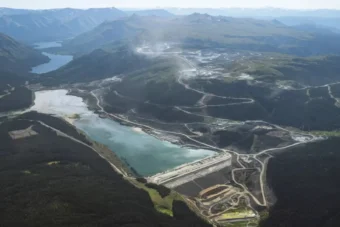
Red Chris Mine’s tailings waste facility and open pit in the headwaters of the Iskut River, a major tributary of the salmon-bearing Stikine River. (Photo courtesy of Colin Arisman)
This article is part one of a two-part series about the Red Chris Mine and its potential threat to the Stikine River.
The Red Chris Mine is already huge — at 89 square miles, it’s bigger than Wrangell Island. And the mine — which is just 25 miles from the British Columbia border on the Canadian side — could get bigger. British Columbia officials are expediting expansion plans due to the Trump Administration’s recent tariffs.
But a conservation group is raising alarms that the gold and copper mine is already leaching heavy metals into the Stikine River watershed. In a report released March 17, the SkeenaWild Conservation Trust says the mine is “releasing significantly more contaminated seepage” to the watershed than predicted.
Tribal groups downstream from the mine say the report speaks to their concerns about whether it could harm subsistence resources they rely on.
“We have long had concerns for the Red Chris Mine,” said Jill Weitz, who serves as a government affairs liaison with the Central Council of Tlingit and Haida Indian Tribes of Alaska. “Even before we knew that there was potential seepage coming from their tailing storage facility.”
Contamination found in lakes and creeks
The open pit mine extracts 11 million tons of ore per year. If it’s expanded to include an underground mine, that could increase to 15 million tons per year. Three tailings dams surround the mine to store the rock waste, which will exist in perpetuity.
Adrienne Berchtold, an ecologist who studies mining impacts for SkeenaWild, is the study’s primary author. Her team used data collected by the mine from the first seven years of the Red Chris Mine’s operation, from 2015 to 2022, to analyze environmental impacts from the dam.
Berchtold said they did not find evidence that the mine is contaminating the Stikine River or its two major tributaries, the Iskut and the Klappan. But she said toxins are contaminating lakes and creeks that are closer to the mine.
Tests at surrounding water bodies found that contaminants have seeped into the groundwater from tailings deposits since the mine began operating. The report also says contaminants have been seeping from the dam’s waste rock storage area since at least 2017.
The report says contamination levels have increased in Ealue and Kluea Lakes as well as Trail and Quarry Creeks, which flow into major tributaries of the Stikine River. Selenium and copper were the main contaminants found in the creeks and lakes, and the report says their levels were high enough to affect aquatic life.
Impacts to fish could affect human health
Berchtold’s team found that the potential impacts to fish in the area could also affect human health.
“There are rainbow trout in the lakes immediately surrounding the mine and people do fish in those lakes,” she said. “They rely on those rainbow trout for sustenance.”
Berchtold said that the area is naturally a highly mineralized environment, and selenium concentrations in fish tissues would already be elevated without the mine there.
“When you have a situation where those elements are already elevated for natural reasons, that’s even more cause to be even more cautious about how much more of those contaminants you’re putting into the system,” she said.
Berchtold said she doesn’t see risks to the transboundary right now, apart from the rare chance of a catastrophic dam failure.
“Our shared resources”
Berchtold said SkeenaWild is concerned about the province’s plan to fast-track the mine’s expansion.
“We’ve seen so much evidence of issues being overlooked,” she said. “I feel that deregulating and kind of pushing through these approvals just risks those types of issues falling by the wayside even more.”
And while SkeenaWild estimates that the mine will cease ore extraction in 13 years, tribal groups are concerned that it could last much longer.
“That mine is never going to close down,” said Guy Archibald, the Southeast Indigenous Transboundary Commission’s executive director. “It’s just going to keep going, and they’re going to keep asking for more permits and more extensions as long as they can.”
The Red Chris Mine is in the First Nations Tahltan Territory. The Tahltan Central Government has not responded to KSTK’s requests for comment.
But Weitz, of Tlingit and Haida, said she hopes SkeenaWild’s report will help raise awareness of environmental threats posed by Canadian mines in transboundary watersheds.
“With the relationship between Canada and the United States, we want to ensure that our shared resources are protected,” Weitz said. “This isn’t an ‘us versus them’. This is ‘us and the communities.’”
She said the communities near the Stikine depend on each other, as well as sharing the resources the river offers.
“The majority of these projects in Northwest British Columbia and even Southeast Alaska to date are gold interest,” she said. “What are we willing to risk for the expense of our clean water and our salmon watersheds?”
Close
Update notification options
Subscribe to notifications
Subscribe
Get notifications about news related to the topics you care about. You can unsubscribe anytime.