Energy & Mining

Record gold prices could mean a banner year for Alaska mines

Pouring gold at Kinross’ Fort Knox mine in Alaska’s Interior. (Kinross photo)

A year ago, Alaska’s miners were selling gold at what seemed like a great price: around $2,200 per ounce. Today, that number sounds like a steal.

After a historic surge in value, gold is now selling at an all-time high: more than $3,000 an ounce, or an increase of some 35% since the beginning of 2024.

That’s great news for gold miners across the state, from Nome to Ketchikan — and for businesses of all sizes, from the multi-billion-dollar Kinross Gold Corp. to mom-and-pop placer operations.

Owing partly to the hot market, the value of gold produced statewide shot up more than 60% last year from the year before, according to a recent report in the trade publication North of 60 Mining News.

“We’re in uncharted territory. And we’ve gotten here very quickly,” said Rick Van Nieuwenhuyse, the chief executive of Contango Ore, a Fairbanks-based company developing several gold deposits in the state.

The staggering rise in gold’s value, driven by global economic uncertainty and a range of other factors, is translating into a windfall for Kinross and the other multinational companies that operate Alaska’s four major gold mines, which reported huge earnings last year.

The price of gold is the “largest single factor in determining profitability,” according to financial statements from Kinross, which owns the massive Fort Knox mine near Fairbanks and the smaller Manh Choh mine, in partnership with Contango, near the Interior town of Tok.

But it’s not just the billion-dollar companies that are benefitting: Gold’s surge also could buoy Alaska’s 150 or so placer operations.

Placer mining for gold near McCarthy in Alaska’s Interior in a historical photograph. (Robert H. Thompson family papers, Archives and Special Collections, Consortium Library, University of Alaska Anchorage)

Those smaller mining businesses use water to wash heavier gold out of sand and other sediments, often along creekbeds. They tend to be family-run and have smaller profit margins than the large corporations that own Alaska’s biggest hardrock mines — meaning that the rising prices make a big difference.

“It’s good for everyone. It’s good for the big mines, small mines,” said Click Bishop, a former state senator from Fairbanks who runs a placer mine in the Interior. “The biggest thing is: It makes a lot more marginal ground minable.”

When gold was selling for less, some lower-grade deposits weren’t worth mining, Bishop added. “But at $3,000, that’s a different story,” he said.

Click Bishop, a former Alaska state senator, prospecting for gold. (Photo courtesy Click Bishop)

Gold mining has come under heightened scrutiny in recent years, as the metal has relatively few industrial applications and mostly is snapped up by banks and financial speculators, and for use as jewelry.

But gold remains a key part of Alaska’s economy, as the backbone of the state’s mining industry. The nearly 850,000 ounces produced by Alaska mines in 2024 accounted for some $2 billion — about half of the total value of minerals, including coal, sand and gravel, produced in the state, according to estimates from the Alaska Department of Natural Resources.

At Fort Knox — the state’s largest gold mine — sales rose 64% between 2023 and 2024. That was due partly to a big increase in production, with ore trucked in from the new Manh Choh mine. But the high price of gold also contributed, according to Kinross’ financial reports.

Other large gold mines, like Kensington north of Juneau and Pogo near Delta Junction, also reported increases in sales and earnings. Gold’s rising price boosted revenue at Kensington by nearly $40 million last year, according to its owner and operator, Coeur Mining.

“Anybody with an operating gold mine is in a happy spot right now,” said Van Nieuwenhuyse.

For his company, Contango Ore, which owns 30% of the large Manh Choh project, the outlook is a bit different than for bigger companies like Kinross. Contango, given its relatively small size, is still paying off debt and sells most of its gold at prices pre-set by banks that loaned the company money to build its share of Manh Choh.

It makes some money on those sales, but a lot more on the 30% of its gold that it sells at current prices, according to Van Nieuwenhuyse. “The higher the gold price goes, the more money we make, and the faster we pay off the debt,” he said.

Gold miners across the state say it’s shaping up to be a good year.

In Nome, a summer hotspot for placer mining, “things are looking shiny” for the industry, Ken Hughes, a local miner and gold buyer, wrote in an email.

Given the growing challenge of finding labor and the usual obstacles from Bering Sea storms, “it may well take the recent record price of gold to keep operators in the field,” Hughes said.

“Existing producers are licking their chops at the upcoming season’s prospects,” he added.

Northern Journal contributor Max Graham can be reached at max@northernjournal.com. He’s interested in any and all mining related stories, as well as introductory meetings with people in and around the industry.

This article was originally published in Northern Journal, a newsletter from Nathaniel Herz. Subscribe at this link.

Trump touted a ‘gigantic’ new Alaska pipeline in his address to Congress. Here’s what we know about it.

The sun sets behind Marathon Petroleum Corportation’s Kenai LNG Terminal on Thursday, Feb. 6, 2025 in Nikiski, Alaska. The former LNG export terminal is near one end of the proposed $44 billion Alaska LNG Project. (Ashlyn O’Hara/KDLL)

President Donald Trump voiced his support for a long-discussed – but unbuilt – Alaska energy project during his first address to Congress since taking office in January.

“My administration is working on a gigantic natural gas pipeline in Alaska, among the largest in the world, where Japan, South Korea and other nations want to be our partner with investments of trillions of dollars each,” he said during Tuesday night’s speech. “There’s never been anything like that one. It will be truly spectacular. It’s all set to go. The permitting is gotten.”

That pipeline is known as Alaska LNG, a massive proposed project that would send natural gas from Alaska’s North Slope 800 miles south to Nikiski, where it would get cooled to a liquid state and exported overseas — most likely to America’s Pacific allies like Japan.

Trump’s address to Congress on Tuesday wasn’t the first or even the second time Trump has touted the pipeline since taking office. And he supported the project during his first term, too. But different versions of the project have been discussed in Alaska for decades, and there are longstanding questions about how it would pencil out.

So how accurate were Trump’s statements about the project? And what else do we know about it?

Would it be ‘gigantic’? Would it be among the world’s largest?

Gigantic is a relative term.

The Alaska LNG Project pipeline would be far from the longest in the world. That title goes to Russia’s Druzhba Pipeline, which covers more than 3,100 miles in Europe. In North America, the Keystone Oil Pipeline runs more than 2,100 miles between Canada and the United states.

But at 42 inches, it would be large in diameter. A 2021 report from Global Energy Monitor puts the average pipeline diameter at 30 inches. The Keystone pipeline is 36 inches in diameter.

What about Japan and South Korea investing trillions each? 

Foreign support for the Alaska LNG Project has ebbed and flowed over the last decade.

During a press conference last month, Trump announced a joint venture for the project with Japanese Prime Minister Shigeru Ishiba. That announcement followed a similar agreement with Beijing in 2017 and trips abroad by Alaska executives to drum up support.

In 2023, the Wall Street Journal reported ambivalence about the project from prospective buyers in Japan and South Korea, who had concerns about the project’s costs, timeline and impact on climate change.

But last week, the New York Times described new interest from prospective partners in Asia as a way to placate Trump amid tariff threats.

Still, as of Wednesday, there aren’t any binding agreements with anyone to buy gas from the project, if it’s built. But the project does have what’s called a gas sales precedent agreement with Great Bear Pantheon, an Alaska-based oil exploration company, to buy up to 500 million cubic feet of gas per day. The Alaska Gasline Development Corporation says that’s “more than enough” to meet in-state gas needs.

And it’s still unclear who exactly might pay to build the project. Its hefty price tag has long stalled efforts to move work along. Current estimates put the project cost at $44 billion. A study commissioned by state lawmakers last year puts the price tag at about $11 billion for the pipeline alone.

Late last year, the state did get a $50 million pledge from state developers. That money’s meant to lower the risk for whatever company decides to take on the work of updating the project’s engineering and design cost estimates to 2025 numbers.

Tim Fitzpatrick, spokesperson for the Alaska Gasline Development Corporation, said Trump’s comment about trillions from Japan and Korea could refer to future purchases of liquefied natural gas from Alaska. But he confirmed there are no purchase agreements now.

Is the permitting really ‘gotten’?

The project received the bulk of its permits from federal regulators in 2020, which the corporation says it’s kept “up to speed.”

“If there’s any additional work efforts that are being asked of us by the agencies, we’re providing that,” Richards said. “When we take a final investment decision, we’re able to move forward.”

Some of the project’s existing federal permits have expiration dates. But Richards says the corporation can apply for extensions as long as it shows the project is being advanced.

Trump’s was the longest modern address to Congress – but how did Alaska LNG get in there?

Republican U.S. Sen. Dan Sullivan was quick to celebrate Trump’s comments Tuesday — he recorded a video from the Senate subway after the address. According to Sullivan’s office, he “personally pitched” the project to Trump in January.

“People have always been naysayers – ‘We’re not there yet,’” he said. “Gov. Dunleavy and I worked this really hard to encourage the president and his team to put it in the State of the Union. They did. That was a huge win for us.”

A prospector tried to sell his mining claims near Haines. The Alaska Mental Health Trust doesn’t want them.

The mineral exploration site sits above a tributary that runs into the Chilkat Watershed outside Haines. (Avery Ellfeldt/KHNS)

For years, a prospector who discovered a controversial mineral deposit outside Haines has offered to sell federal mining claims to a state-run trust.

That entity, the Alaska Mental Health Trust Authority, owns much of the land around the deposit and mineral exploration effort, known as the Palmer Project. But the trust decided in February it would not purchase the claims from prospector and former Haines resident Merrill Palmer.

Palmer staked the claims in the 1960s after discovering zinc and copper mineralization in the mountains north of Haines, near the village of Klukwan. The claims became the heart of the copper, zinc, gold, silver and barite exploration project, which has long divided the nearby communities.

Developing a mine could create high-paying jobs and inject a lot of investor dollars into the local economy. But the site sits above a tributary that runs into the Chilkat watershed, which supports a run of all five species of Pacific salmon. Critics worry the local environment, which is home to one of the world’s largest concentrations of bald eagles, could be harmed.

Why Palmer wants to sell his claims – and what the trust’s decision might mean for the project – remains unclear. But Jessica Plachta, the executive director of Lynn Canal Conservation, a Haines-based environmental non-profit that opposes the potential mine, says that a slew of factors make the project risky.

“The Palmer project is located in a remote and hazardous location. It’s inaccessible under deep snow for half the year,” Plachta said. “Not to mention that it’s dubious whether the deposit itself is worth mining, which is of course the bottom line for mining companies.”

The “best interest of the Trust”

The Alaska Mental Health Trust was created to fund programming and services for Alaskans who experience mental illness, traumatic brain injuries, intellectual and developmental disabilities and more. The state corporation does so using various resources – including roughly one million acres of land that it manages to make money.

The organization declined an interview request or to say how much money Palmer wanted for the claims, citing the confidential nature of the negotiations.

But a spokesperson, Allison Biastock, emphasized in an email that the organization’s resources must be used in the “best interest of the Trust and its beneficiaries.” She said the trust considered the cost of the claims and potential returns when making the decision.

The trustees notified Palmer of the decision after a closed-door session during its last regular board meeting, Biastock said. American Pacific Mining Corp., the junior mining company that owns the nearby exploration project, was also notified.

Palmer could not be reached for comment. American Pacific did not respond to a request for comment. And Constantine Mining LLC, an American Pacific subsidiary that operates the local project, declined to comment.

Questions about what comes next

The trust has considered buying Palmer’s claims since at least 2020.

The claims mean Palmer could earn royalties on minerals if a mine ever opens. But he offered to relinquish the claims for compensation to the trust more than five years ago. The state entity already owns much of the surrounding land and leases it out for exploration.

When Palmer offered his claims to the trust, Jusdi Doucet, who served as the deputy director of the trust’s land office, said purchasing them would be a risk. But Doucet said it could also pay off, if the minerals on Palmer’s claims connect to minerals under trust land.

“If we don’t do anything, if we don’t purchase the relinquishment of the claim, the Trust could have zero value on minerals beneath the ground on trust land,” Doucet told KHNS at the time. 

The trust had been weighing the offer ever since. Its decision not to move in that direction came after the news in November that Dowa Metals and Mining, a multinational metals company that had backed the project for years, was giving up its 70% stake in the project. That made American Pacific Mining – Constantine’s parent company – the sole owner.

The deal was prompted by differing visions for the project, American Pacific executives said in a November video announcement. Warwick Smith, the company’s CEO, billed it as a “fantastic move” for American Pacific shareholders that puts the company on “very solid footing.”

“If you were an America Pacific shareholder yesterday, you went to bed and the company had about $2.5 million in cash and owned about 29% of the Palmer project,” Warwick said. “When you wake up this morning, we have $16 million in cash and we own 100% of the 14-million-ton VMS Palmer project.”

Smith also noted that Republican control of the U.S. Senate, House and White House would also contribute to what he says are “very, very bright days ahead for American Pacific.”

President Donald Trump signed an executive order in January that promised to unleash what he called Alaska’s extraordinary resource potential, including as it relates to minerals.

“The feeling, in particular for Alaska, and I’ll give an example of this, is things like permitting and these projects are going to move ahead quite rapidly,” Warwick said.

Palmer project critics, for their part, say Dowa’s exit and the trust’s decision raise questions about the project’s value – and what comes next.

Mining industry optimistic about Trump administration’s energy agenda in Alaska

Hecla Greens Creek Mine spokesperson Mike Satre speaks at the third annual Juneau Mining Forum on Tuesday, Feb. 25, 2025. (Photo by Clarise Larson/KTOO)

Mining leaders from across the state had an optimistic outlook at the third annual Juneau Mining Forum on Tuesday. 

Attendees said the next four years of Trump administration policy could mark a turning point for the acceleration of resource development in Alaska. 

It’s an opportunity that Hecla Greens Creek Mine on Admiralty Island plans to take full advantage of, says Mike Satre, Hecla’s director of government affairs.

“There’s great opportunity for our industry right now. There’s great opportunity here in Alaska,” he said. “We have the resources that the nation and that the world needs. We have the opportunity with this administration to hopefully move a bunch of projects forward.”

Satre was a panelist for a federal issues discussion that considered how the new administration could change the U.S. mining industry’s permitting process to streamline development.

In his first day in office, Trump issued executive orders that called for more drilling, logging and mining in Alaska. An order called “Unleashing Alaska’s Extraordinary Resource Potential” aims to undo most of the Biden Administration’s work to limit resource development in the state.

Greens Creek is the largest silver mine in the nation and pays the most property tax in Juneau. 

Last year the U.S. Forest Service permitted a project for the mine to expand storage for its tailings — the rock leftover after digging for metals. It was a five-year process, but the approval means the mine could live on for up to another 18 years. 

Jerry Mullins with the National Mining Association said the prolonged permitting process is one of the industry’s biggest barriers, and it’s a part of the reason the U.S. is in a losing battle for mineral dominance against countries like China. He said that poses a risk to national security. 

“The permitting process itself is self-explanatory. It doesn’t incentivize mining, it disincentivizes mining,” he said. “Every day we see examples of just how important mineral production is, and every day we see examples of why it’s so difficult to gain that mineral production.”

Mullins said he’s hopeful that the new administration will find ways to expedite the process and increase opportunities for projects in the state. 

Alaska Senate leaders propose reducing oil tax credits as deficits loom

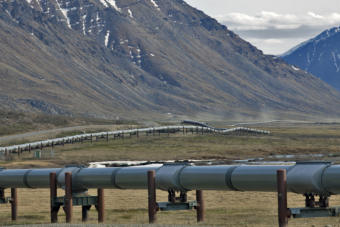
The Trans-Alaska Pipeline winds through the landscape, seen here at pipeline mile 709.7 along the Richardson Highway south of Copper Center, Alaska on August 13, 2024. (Eric Stone/Alaska Public Media)

As the state faces an estimated half-billion-dollar deficit between this year and the next, Alaska Senate leaders are reviving options for raising revenue.

One controversial bill would reduce a state North Slope oil production tax credit by $3 per barrel. It would also prevent oil producers from claiming more in production tax credits than they spend on capital investment in a given year.

Oil tax credit reform has long been a priority for Sen. Bill Wielechowski, D-Anchorage, who pitched the bills during a news conference on Tuesday. The tax changes could raise hundreds of millions of dollars per year, Department of Revenue officials told the Senate Finance Committee in 2023.

“We want to get this on the table and start to have a debate about how we’re going to close this $536 million deficit,” he said.

Wielechowski argued they’d likely have little impact on the state’s economy, referencing a 2023 presentation from the consulting firm GaffneyCline that found a similar bill would “likely not lead to material reduction of existing production.” Oil and gas companies, including ConocoPhillips, ExxonMobil and Hilcorp, however, told the Senate panel at the time that the tax changes would make the state a less attractive place to invest.

That tax credit proposal was one of several measures proposed by Dunleavy’s then-Department of Revenue commissioner, Lucinda Mahoney, to a working group of legislators in 2021. Mahoney introduced it as one of the options “the governor would support.”

But on Wednesday, Dunleavy’s communications director, Jeff Turner, said in an email that the former commissioner “misspoke.”

“The governor’s position on taxes has always been consistent. He is not favorably disposed to taxes,” Turner said, adding in a subsequent email that it’s the governor’s policy not to comment on specific bills until they reach his desk.

Some minority Republicans in the Senate also came out against the bill, including Sen. Shelley Hughes, R-Palmer.

“I think we should be increasing our tax base rather than increasing taxes, and that will grow our economy,” Hughes said. “With the man in the White House right now and the opportunity for new projects, I think it’s sending a very bad message.”

The state’s dire fiscal picture has complicated efforts to boost state funding for public schools, a top priority for leaders of the House and Senate.

In the House, leaders are lukewarm on the proposal. House Finance Committee Co-chair Andy Josephson, D-Anchorage, said changing the state’s oil tax structure isn’t a priority for the largely Democratic multiparty caucus that controls the House.

“I would say they should send it over to us, and we’ll take a look at it, but it’s not what we’re focused on,” he said.

Josephson said House leaders would “likely” be more receptive to another revenue bill that would assess corporate income taxes on S-corporations in the oil and gas industry. That would close what backers call a “loophole” allowing privately-held Hilcorp to avoid the corporate taxes paid by C-corporations like ExxonMobil and ConocoPhillips.

That’s another proposal that the revenue commissioner said the governor supported back in 2021 — but just as with the oil tax credits, the governor’s spokesman now says the commissioner misspoke.

The other revenue bill proposed Wednesday, Senate Bill 113, would subject corporations that do business in Alaska via the internet to the state’s corporate taxes. Sen. Bill Wielechowski, D- Anchorage, says prior estimates pegged the revenue boost between $20 and $65 million a year. Lawmakers from both bodies said they would examine the bill.

Juneau’s push to expand renewable power could boost the region’s mines — or cost them

Greens Creek is one of the largest silver mines in the world. It recently lost access to its supply of hydroelectric power, which its owner, Hecla, says could cost the company $5 million to replace with diesel generation. (Photo courtesy of Hecla Greens Creek Mine)

Juneau’s elected officials and a local entrepreneur have recently been pushing two major power projects that could reduce the city’s carbon pollution.

Their efforts also could boost a pillar of the region’s economy: mining.

One of the projects, a private proposal to build a new hydroelectric plant, could help one of Juneau’s two large-scale mines sharply cut its dependence on expensive, carbon-intensive diesel power.

But the other proposal, a public effort to electrify the city’s cruise ship docks, might have an opposite, unintended effect: It could force the area’s other large mine to burn more fossil fuels, potentially adding to that mine’s operating costs and climate impacts.

Both infrastructure proposals, still years from being built, are part of a broader push in Juneau and across the country to use more renewable energy as climate change, driven by the burning of fossil fuels, ramps up.

They come also as mining companies in Alaska face mounting financial and political pressure to find alternatives to carbon-based fuels.

The state’s hardrock mines — which need a huge amount of energy to crush, grind and separate valuable minerals from rock — still largely run on diesel and coal. Industry leaders have warned in recent years that Alaska’s high electricity prices and planet-warming emissions could stifle growth.

“Energy is a major cost driver at mines and anything we can do to be more energy efficient, or seek out cheaper sources of energy, adds value to our operations,” said Mike Satre, director of government affairs at Hecla, the publicly traded company that operates one of the two big Juneau area mines.

The complications around mining and power supply in the region underscore the challenge of translating lofty green energy goals into reality, even in areas like Juneau where there’s broad agreement about the need to leave fossil fuels behind.

Utilities across Alaska have struggled to advance large renewable projects even with generous tax credits offered by the Biden administration, and some projects have already experienced setbacks as the Trump administration aims to pull those incentives back.

Renewable energy advocates say obstacles include high construction costs and tricky politics among mining companies, other energy-intensive industries, electric utilities and state regulators.

“The interests do align,” said Steve Behnke, a long-time board member of Renewable Juneau, a local advocacy group. “But the nitty-gritty economic, financial issues don’t.”

Fissures between various energy players are now driving a heated debate in front of state utility regulators over a Juneau entrepreneur’s proposal to build the new hydroelectric plant. An anchor customer would be Kensington, a major gold mine some 45 miles north of Juneau.

An aerial view of part of Southeast Alaska’s Kensington gold mine. (James Brooks via Wikipedia under Creative Commons 2.0)

Kensington is off the grid and generates its own electricity by burning imported diesel. It consumed about 4.5 million gallons of fuel last year, said Rochelle Lindley, a spokesperson for the mine’s multinational owner, Coeur, which is also publicly traded.

Kensington’s burning of diesel spews some 46,000 tons of carbon dioxide into the air annually and accounts for roughly 15% of Juneau’s total greenhouse gas emissions, according to a city-commissioned report from 2021.

To limit pollution, Coeur upgraded its power plant in 2019, reducing the mine’s fuel consumption by 25%, Lindley said in an email. The company also has spent more than $200,000 to offset some of the mine’s emissions in a partnership with Renewable Juneau, which helps local residents install power-saving electric heat pumps in their homes.

But Coeur is still looking for alternative energy sources to lower its emissions, Lindley added. Companies like Coeur are facing global pressure from investors and government regulators to reduce their use of fossil fuels.

“We would be supportive of any provider that could bring clean, renewable energy to our mining operation,” Lindley wrote. She said Coeur has explored multiple options to reduce its dependence on diesel and carbon emissions, including an onsite fleet of batteries.

Kensington’s demand for cleaner power is central to the long-running hydroelectric proposal from a local businessman and energy advocate, Duff Mitchell. His company, Juneau Hydropower, wants to install a dam at a lake some 30 miles south of Juneau, build a power plant and battery storage system and run transmission lines that would connect the project to Kensington.

The company says its $170 million proposal could increase the region’s energy capacity as much as 25%.

Mitchell first announced the idea more than a decade ago but submitted a new application to state regulators in November.

Coeur has already signed a power purchase agreement with the firm, according to filings to the Regulatory Commission of Alaska, which oversees the state’s utilities.

Juneau Hydropower also says it would sell electricity to a smattering of proposed developments north of Juneau, outside the service area of the city’s existing electric utility, Alaska Electric Light and Power. The potential buyers include a new state-proposed ferry terminal, another gold mine that’s still years from construction and a private ore dock under development on land owned by a local Alaska Native corporation.

Mitchell’s project has support not only from Coeur but also from local labor unions and a Juneau economic development group.

But it still faces hurdles, including questions about financing and how the company would transmit electricity across infrastructure currently used by privately owned Alaska Electric Light and Power, or AEL&P.

AEL&P, a subsidiary of Washington state-based Avista Corp., opposes Juneau Hydropower’s proposal, arguing that it lacks evidence of financial viability and risks unintended impacts on AEL&P’s existing customers.

Mitchell said Juneau Hydropower looks forward to proving that “we are fit, willing and able,” the legal standard it must meet for regulators to approve its operating certificate.

Juneau Hydropower’s effort to increase regional energy capacity comes at the same time that city officials are, separately, pursuing a project that could increase the city’s demand for electricity — a plan that could come at the expense of Juneau’s other major mine, Greens Creek.

Eager to slash emissions from the massive cruise ships that call on Juneau in huge numbers each summer, city officials want to electrify two public docks — allowing the vessels to run on hydropower instead of burning diesel while they’re in port.

Boosters say the project, which could cost some $25 million, would cut down on air pollution from ships that Juneau residents periodically complain about.

Even with one of Juneau’s docks, privately owned by Princess Cruises, already connected to the grid, cruise ships still account for about 8% of the city’s yearly carbon emissions.

But rather than fully eliminating those emissions, connecting the city’s two public docks to the grid might just shift the burden of burning diesel to another major energy consumer: the Greens Creek mine.

A truck rumbles down a road at the Greens Creek mine. (Hecla Greens Creek Mine)

Greens Creek, unlike Kensington, is already tied to Juneau’s grid and benefits from surplus hydropower.

During rainy years, the mine can operate almost entirely on relatively affordable, renewable energy. In a typical year, it gets some 90% of its electricity from the grid, according to Hecla.

But the mine only gets renewable power when AEL&P has some to spare. And that’s not always the case.

During droughts, when the region’s reservoirs are low, AEL&P shuts off power to Greens Creek, which then must barge in and burn vast amounts of pricey diesel fuel.

Southeast Alaska is expected to experience more droughts due to climate change. And the mine is already in that position right now: Citing dry conditions, a rise in energy use and weather delays on a construction project, AEL&P cut power to Greens Creek in January.

The interruption could last six months and increase Hecla’s costs by $5 million, a company executive said in a recent call with investors.

If the city plugs its docks into the grid, and AEL&P adds more cruise ships to its customer list, Greens Creek could face new competition for an already limited supply of surplus hydropower.

The grid’s energy supply is like a balloon, said Clay Good, a Juneau-based clean energy advocate and educator. “If you squeeze it at one end, it’s going to bulge at the other,” he said.

For now, AEL&P says electricity sales to the mine would be unaffected if the city ties its cruise docks into the grid.

The utility would add cruise companies as “interruptible” customers, according to Debbie Driscoll, a spokesperson for the utility.

That means that, like Greens Creek, cruise ships would receive excess grid power only when it’s available, Driscoll said in an email. Greens Creek, because it’s a preexisting customer, would have priority over the ships, she added.

Still, a 2022 study commissioned by Juneau’s city government contemplates an array of other scenarios, including one where the utility limits power to Greens Creek in favor of cruise ships.

The study suggests that spending millions of dollars to electrifying the cruise docks won’t pencil out unless ships do have priority over Greens Creek. Putting them lower on the list would be “problematic,” says the study.

Satre, with Hecla, said the mining company keeps in close touch with AEL&P, but added that the “only assurances we have are based on our current contract to purchase surplus power.”

“If additional surplus customers come online, then yes, we have priority,” he said. “However, there is always the possibility of different arrangements.”

Increasing other uses of excess hydropower and forcing Greens Creek to generate more of its own energy with diesel would “reduce predictability and increase costs,” Satre added.

Greens Creek’s current contract with AEL&P also helps make electricity more affordable for Juneau residents. The utility uses revenue from its sales to the mine, its biggest buyer of excess power, to offset costs for higher-priority customers, said Driscoll, the utility spokesperson.

Greens Creek has saved Juneau ratepayers close to $90 million since it plugged into the grid in 2009, she said.

Behnke, the renewable power advocate, said many Juneau residents view the mine’s deal with the utility as positive for both the city and the mine. He suggested it could serve as a model for other major energy users looking to save on energy and lower their emissions, like Kensington and the cruise industry.

“We don’t see why a deal with Kensington and shore power couldn’t be just as good,” Behnke said.

Northern Journal’s work depends on reader support. Please consider a voluntary membership or encouraging a friend to join. If you’re already a member, thank you.

Site notifications
Update notification options
Subscribe to notifications