Energy & Mining

State celebrates Trump support for LNG project, some lawmakers remain skeptical

President Donald Trump signs an executive order at the White House supporting natural resource development in Alaska on Monday, Jan. 21, 2025 in Washington. (C-Span screenshot)

Within hours of returning to the country’s highest office Monday, President Donald Trump formalized his support for the $44 billion Alaska LNG Project.

Support for natural resource development in Alaska as the official policy of the United States was tucked into the flurry of executive orders Trump signed on his first day. According to Trump, that means prioritizing development of LNG for sale and transport to other parts of the country and its Pacific allies – including via the Alaska LNG Project.

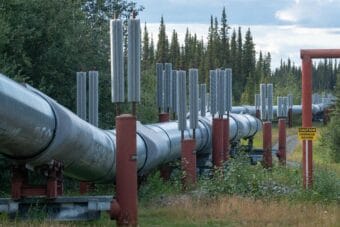
If it’s built, the Alaska LNG Project would move natural gas from the North Slope to Southcentral through an 800-mile pipeline. The gas would be liquefied at a facility in Nikiski and then shipped overseas.

The Alaska Gasline Development Corporation is the state agency overseeing the project. In a statement Monday, corporation president Frank Richards said he looks forward to working with the president on the project.

But environmental groups and some state lawmakers expressed skepticism about Trump’s energy agenda and the project’s future as the legislative session kicked off Tuesday in Juneau.

Anchorage Republican state Sen. Cathy Giessel criticized a $50 million backstop Alaska Industrial Development and Export Authority, or AIDEA, OK’d for a company to update the project’s 10-year-old engineering and design work. The money was included in the governor’s proposed budget for the upcoming fiscal year.

“We’re offering now a completely risk-free $50 million to a company,” she said. “We don’t know what the product is going to be and if it’s a nothing product, we are still paying $50 million. I question whether it was AIDEA’s authority to take the $50 million they actually owed us as a dividend and appropriate it for this.”

Bethel Democrat Sen. Lyman Hoffman co-chairs the Senate Finance Committee. He says energy is a priority this session, but called AIDEA’s backstop a “bad precedent.”

“The question has to be asked, ‘Will the federal government come up and pony up to assist – and to what level – in the construction of this gasline?” he said. “The President wants to develop Alaska resources, and to what level and to what extent will that be, for a gasline?”

Giessel says lawmakers are scheduled to take up a variety of energy issues during the first meeting of the Senate Resources Committee on Wednesday. According to the committee’s agenda, lawmakers will hear from representatives of Hilcorp Alaska and HEX/Furie.

Correction: A previous version of this story misspelled Sen. Cathy Giessel’s last name. 

Trump signs order ‘unleashing’ Alaska’s resources

Donald Trump promoted Sarah Palin for U.S. House at a 2022 rally in Anchorage. She finished second. (Kendrick Whiteman/Alaska Public Media)

On his first day back in office, President Trump signed an executive order that aims to undo most of his predecessor’s work on Alaska energy and environmental issues. The order entitled “Unleashing Alaska’s Extraordinary Resource Potential” was among dozens Trump signed.

“So we’re opening up ANWR,” Trump said at the Resolute Desk in the Oval Office.

The order calls for new leases in the Arctic National Wildlife Refuge and much more. It covers nearly every major land-use controversy in Alaska this century.

It says the government will:

  • prioritize the development of Alaska’s natural gas “including the permitting of all necessary pipeline and export infrastructure related to the Alaska LNG Project.”
  • facilitate development of a road from King Cove to Cold Bay.
  • reinstate the Trump administration’s approval of the Ambler Road.
  • reinstate his administration’s development plan for the National Petroleum Reserve-Alaska.

It does not mention the proposed Pebble Mine, at least not by name.

Alaska’s all-Republican delegation to Congress praised the natural resources order, but not another order that would restore the name McKinley to the mountain now named Denali.

Sen. Lisa Murkowski publicly objected to the name change.

“Our nation’s tallest mountain, which has been called Denali for thousands of years, must continue to be known by the rightful name bestowed by Alaska’s Koyukon Athabascans, who have stewarded the land since time immemorial,” she wrote in a post on X.

Many of Trump’s actions are certain to be challenged in court on grounds that they defy laws Congress passed.

Biden’s Interior Department, as a last act, proposes subsistence protection in NPR-A

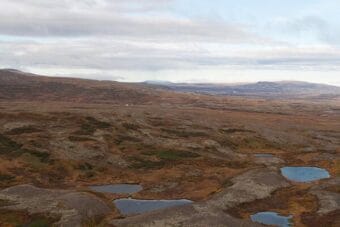
A view of the northeastern National Petroleum Reserve in Alaska. (Bob Wick/Bureau of Land Management)

WASHINGTON — The Biden administration has issued interim management instructions aimed at protecting subsistence resources in the National Petroleum Reserve Alaska.

It’s not clear anything in the guidelines from the Interior Department will survive the transition to the Trump administration.

Acting Deputy Interior Secretary Laura Daniel-Davis said Thursday that the new measures stem from more than 80,000 public comments the department received about the reserve, which she referred to as the Western Arctic.

Daniel-Davis says no matter what happens next, it was the right thing to do.

“We know we’re in these seats for a few more days, and the next team may have a different perspective on how we manage public lands, including in the Western Arctic,” she said. “But I think really, we all have to agree that we must undertake activities in this incredible area with due consideration as to how they may impact subsistence resources, and that we are today identifying as a significant resource value.”

The department is also proposing to expand the inventory of special areas in the reserve by about 3 million acres.

The National Petroleum Reserve is a tract of federal land as large as the state of Indiana. It includes important habitat for migratory birds and wildlife. It also has substantial oil and gas potential. The Biden administration approved a major ConocoPhillips project there called Willow, to the dismay of environmental groups and some subsistence users. But a long list of North Slope governments and Indigenous groups support development of Willow and want more drilling in the reserve.

Sen. Lisa Murkowski says the Biden administration has burdened the reserve with too many restrictions and she’s counting the days until the department is in new hands.

She had the opportunity Thursday to question the person nominated to be the next secretary of Interior.

Doug Burgum said at his confirmation hearing that he wants to be Alaska’s partner in resource development.

“I would view Alaska as the one of the biggest assets this country has, and one of the biggest responsibilities of Interior and look forward to working with you,” he said.

“That’s exactly what I was hoping you would say,” Murkowski responded.

Burgum appears to have enough Senate votes for confirmation. He is a former governor of North Dakota. He has some familiarity with the 49th state. He said at a 2017 press conference that in 1976 he hitchhiked to Alaska.

Murkowski lauds Trump’s Energy nominee for his views on abundance and climate change

Energy executive Chris Wright is Donald Trump’s pick to be the next secretary of Energy. (Caitlyn Kim/CPR News)

WASHINGTON — President-Elect Donald Trump’s choice to lead the Department of Energy got a warm reception Wednesday in the Senate Energy and Natural Resources Committee. Sen. Lisa Murkowski lauded his enthusiasm for affordable, abundant energy.

“I love the fact that you’re a self-described energy geek,” she said at his confirmation hearing.

Chris Wright is the chief executive of Liberty Energy, an oilfield services company. He also calls himself “a science geek,” a tech nerd and an energy entrepreneur.

Like Murkowski, Wright promotes renewable energy while also supporting continued production of fossil fuel. She praised his acceptance of climate change.

“You have said before this committee, and in other places, that climate change is real. Is that correct?” she asked.

“Absolutely, Senator,” he said.

“And I heard you say this morning that the solution to climate change is how we evolve our energy system,” she said. “Is that a correct summation?

“Absolutely, Senator,” he said again.

“So, it’s about technology. We’re acknowledging it, ” she said, referring apparently to climate change. “We’re dealing with it. We’re living it. We’re feeling it.”

She said it was cold in Washington, D.C. that day, while temperatures in Alaska were too high.

“We’re seeing changes that are detrimental to our system,” she said. “Our thermostat is out of whack, and we want to have the Arctic temperatures up north. But one of the ways that we know we’re going to get there is through our technologies that will help us adapt, mitigate, and to really help prevent.”

Outside of the committee room, some Democratic senators weren’t taken with Wright’s all-of-the-above energy approach.

“What makes Mr. Wright so troubling, however, is that he is perfectly willing to admit that climate change is happening while rejecting that we should do anything about it,” Senate Minority Leader Chuck Schumer said in a speech on the Senate floor. “He says calling climate change a crisis is pure fear-mongering.”

Wright said in a video posted on social media in 2023 that there is no climate crisis. He gained some internet fame in 2019 for another video in which he drank fracking fluid, to demonstrate its safety.

UAF to get $7.5M for research into Alaska’s critical mineral potential

UAF Critical Minerals Lab analyst Piper Kramer places a rock sample in an x-ray spectrometer on Jan. 7, 2025. (Shelby Herbert/AKPM)

The U.S. Department of Energy announced last week it was dedicating $45 million toward advancing the domestic supply of critical minerals. $7.5 million of that will go to the University of Alaska Fairbanks for research into Alaska’s critical mineral potential.

Coming in the wake of China’s new export restrictions on several critical minerals, the grant is part of the federal government’s push to become more resource-independent. Critical minerals — like gallium, antimony and germanium — are essential for most modern technology components.

Grant Bromhal, a science advisor for the DOE, says half of the United States’ critical mineral supply comes from other countries. But he says all but one of the 50 different types of critical minerals are present in Alaska.

“I think Alaska has incredible potential to support these critical mineral material needs that we know are coming,” Bromhal said. “Alaska has incredible natural resources that we’re looking to help use to support this need for cleaner, more environmentally friendly materials for our defense and national security and economic and energy security.”

The university’s Institute of Northern Engineering will use the funds to build off its ongoing survey of Alaska mines and start mapping out the Pacific Northwest for critical mineral deposits.

“This is a chance to evaluate what resources we have inside the US that can be brought in,” Bromhal said. “Particularly from secondary and unconventional sources.”

Finding critical minerals in tailings

The grant will help sustain UAF research on mine tailings, which are the leftover materials that pile up during mining activity. Some tailings contain trace amounts of critical minerals that could be extracted for commercial use.

Brent Sheets, who directs the project, says his team is sending researchers all over the state to test samples for critical minerals.

“We’ll collect the samples and then take a look at it with a handheld x-ray fluorescence XRF — it’s a screening tool,” he said. “It tells us whether or not it’s worth investigating that core through more sophisticated means.”

He says the research has already yielded interesting results for several mines across Alaska. Samples from Healy’s Usibelli Coal Mine, the state’s only operating coal mine, showed exceptionally high levels of tungsten, germanium and yttrium.

And the Greens Creek Mine, near Juneau, was flagged for having the greatest potential for extracting critical minerals from tailings out of all Alaska mines. Sheets’ team estimates the value of all metals in the Greens Creek tailings pile at $2.8 billion, with most of that coming from gold and silver. The zinc alone could be worth $395 million.

Getting minerals to marketplace

Sheets says the scope of the project is much larger than just finding the minerals. His lab is also trying to solve some of the huge logistical problems that stand in the way of extracting them.

Alaska’s size and geological diversity makes it as obstacle-rich as it is opportunity-rich for mineral development. He says the state’s remoteness and extreme terrain makes getting critical minerals out of Alaska difficult.

“What can we do to get those minerals into the marketplace?” he said. “Antimony is very big right now on the list of minerals. We’re working very closely with Alaska Range Resources down in the south central part of the state, but there’s antimony right here in the Interior too.”

UAF Petroleum Development Department director Brent Sheets holds up a sample of antimony in his office on Jan. 7, 2025. (Shelby Herbert/KUAC)

He says the next step is to tackle the first item on their laundry list of logistical problems. Researchers at the Institute of Northern Engineering will speak with communities and Tribes about ways to recruit employees and invest in local infrastructure to support critical mineral mining projects.

Disclosure: Usibelli Coal Mine is a corporate sponsor of KUAC.

State names company in talks to head LNG Project

Alaska Gasline Development Corporation President Frank Richards (left) announces an exclusive framework agreement for the Alaska LNG Project during an energy press conference with Gov. Mike Dunleavy (right) on Monday, Jan. 6, 2025 in Anchorage, Alaska. (Courtesy photo/Office of Gov. Mike Dunleavy)

The Alaska Gasline Development Corporation on Thursday named Glenfarne Group LLC as the company it’s in talks with to take over the $44 billion Alaska LNG Project. The announcement came three days after the corporation announced a framework agreement with a company not to be named until an agreement was finalized.

Corporation spokesperson Tim Fitzpatrick said Thursday they released the company name “in the interest of transparency.” He said the company will announce further developments and public updates at future board meetings and legislative presentations.

Glenfarne Energy Transition confirmed an exclusive agreement with AGDC to KDLL on Thursday. In a statement, the company said the agreement covers the 800-mile pipeline between the North Slope and Southcentral, an LNG export facility in Nikiski and carbon capture infrastructure on the slope.

AGDC President Frank Richards teased the then-unnamed company’s qualifications during a news conference on Monday, when it was initially announced that an agreement was in the works.

“The company involved brings extensive U.S. and international natural gas and LNG experience to bear to this project,” he said.

Glenfarne’s spokesperson declined to comment on whether the company has any experience with natural gas projects in Alaska. The company also owns and manages the Texas LNG Project, a natural gas export facility in south Texas.

Glenfarne said it has a second exclusive agreement with ENSTAR Natural Gas Company. That agreement is to advance a natural gas import infrastructure in the same facility as the proposed export infrastructure in Nikiski.

Enstar spokesperson Lindsay Hobson said the company’s import agreement with Glenfarne is separate from AGDC’s Alaska LNG Project agreement. The company doesn’t have a cost estimate for the import project covered by the agreement.

Hobson said Enstar’s import project envisions a land-based design for regasification facilities, meaning it wouldn’t include floating gas storage units. She said the project includes a terminal to receive liquefied natural gas tankers and facilities to regas it for ENSTAR’s systems.

In a statement provided to KDLL, ENSTAR President John Sims called their Glenfarne agreement an “important step” in bringing new gas to Southcentral Alaska.

“While we are optimistic about this progress, we are still in the early stages with a long road ahead of us before we are able to discuss project details,” Sims said.

Glenfarne’s website says the company was founded in 2011 and develops, owns and operates energy infrastructure. The company has primary offices in Houston and New York, but has eight offices around the world, including in Panama and South Korea.

Site notifications
Update notification options
Subscribe to notifications