Japanese Prime Minister Shigeru Ishiba (left) and U.S. President Donald Trump participate in a joint news conference on Friday, Feb. 7 in Washington. (C-SPAN screenshot)
President Donald Trump on Friday announced a joint venture with Japan for the Alaska LNG Project. If it’s built, the $44 billion project would move gas from the North Slope through an 800-mile pipeline to a liquefaction facility in Nikiski for shipment overseas.
In a joint news conference with Japanese Prime Minister Shigeru Ishiba, Trump said the two spoke “at length” about the project, which he called exciting.
“Japan will soon begin importing historic new shipments of clean American liquefied natural gas in record numbers,” he said. “It’ll be record numbers.”
The announcement followed talks during Ishiba’s first summit with the president. Speaking through a translator, Ishiba said his country isn’t just interested in LNG.
“As the country of Japan, we are interested in importing not just LNG but also bioethanol, ammonia,and other resources at a stable price, a reasonable price from the United States,” Ishiba said. “And we also want to improve the trade deficit that the U.S. has towards Japan.”
It isn’t the first time the U.S. has announced project progress through an agreement with another country. Former Gov. Bill Walker signed an agreement in Beijing in 2017. And before that, former Gov. Sean Parnell traveled to Japan to promote the project.
Republican U.S. Sen. Dan Sullivan celebrated the joint venture and thanked Trump for his work on the issue in a social media post shared Friday.
“With his leadership, we will get the Alaska LNG Project built, which will create thousands of good-paying jobs, reinvigorate our American steel industry, significantly reduce our trade deficit in Asia, and deliver clean-burning Alaska gas for Americans, our military, and our allies in the Asia-Pacific, like Japan,” he wrote.
But as recently as last week, Alaska lawmakers continued to express concerns about where the money to build the expensive project will come from. The project scope includes a treatment facility on the slope, the pipeline and a liquefaction plant in Nikiski. A recent study commissioned by the legislature estimated the pipeline alone would cost roughly $11 billion.
A report commissioned by state lawmakers estimates that, if the Alaska LNG Project is built, the first exports wouldn’t happen until 2031.
Tim Fitzpatrick is the spokesperson for the Alaska Gasline Development Corporation. That’s the state agency heading the project. He said the joint venture revives the two countries’ decades-long LNG partnership.
“Alaska LNG’s competitive cost, abundant supply, and close proximity to Japan make this project a vital trade and energy security enhancement for our two nations,” he wrote in an email. “We welcome further Japanese support and engagement and look forward to continuing our discussions following today’s important advancements.”
Fitzpatrick also said the federal government has committed loan guarantees that are currently valued at $30 billion. He says those guarantees reduce the project’s debt cost, make it more attractive to investors and lower the project’s energy costs.
Friday’s announcement came a day after a trio of companies announced their plans to revive and redevelop Marathon Petroleum’s LNG facility in Nikiski to an import terminal. That facility was previously used to send LNG almost exclusively to Japan.
Snow falls on the Alaska State Capitol in Juneau on Jan. 30, 2025. (Eric Stone/Alaska Public Media)
State lawmakers have tough choices ahead as they look to balance the budget while also pursuing the priorities of the House and Senate’s Democrat-dominated majority caucuses.
That’s according to legislative budget analysts, who recently told House and Senate budget writers that the same old, same old won’t cut it this year.
Back in December, Gov. Mike Dunleavy proposed his version of the budget. It came with a full, statutory Permanent Fund dividend of about $3,800 per Alaskan. It also came with a $1.5 billion deficit — which, as it happens, is about half of the balance in the state’s primary savings account.
Dunleavy’s budget director, Lacey Sanders, told the Senate Finance Committee last month that the governor doesn’t see much choice but to propose mega-dividends, given that the formula remains in state law. But even Sanders said the billion-and-a-half-dollar deficit isn’t ideal.
“The fiscal picture is not looking great when you are depleting over half of it in one year,” she said.
Senate Finance Committee co-chair Sen. Bert Stedman, R-Sitka, characteristically, put it a bit more bluntly.
“In private enterprise, it would be called a company-ending event,” he said. “In government, it’s called, I don’t know, stupidity.”
Lawmakers haven’t followed the PFD formula for nearly a decade. Since oil prices dipped in the mid-2010s, and a court case in 2017, the Legislature has set the PFD on a basically ad-hoc basis — whatever the state can afford that year.
For the last two years, though, lawmakers have settled on something of an informal formula for setting the PFD amount: 25% of the state’s annual drawdown from the Permanent Fund goes to dividends, with the other 75% going to regular state services like state troopers, roads and public schools.
This year, using that same 75-25 formula would leave the state with a $30 million surplus — basically balanced, but right on the edge. However, that’s before counting some baseline priorities for the Legislature.
After adding in status quo education funding to keep up with one-time funding last year, plus some expected increases in Medicaid expenses and labor contracts, Legislative Finance Division Director Alexei Painter said lawmakers are facing a $197 million deficit in the coming fiscal year’s budget.
“You’re going to have to either find other budget reductions, reduce the dividend further, or explore new revenue options,” Painter told the House Finance Committee last month. “You can’t just do that one thing and it’s solved, which has worked kind of the last two years.”
To be clear — this is not the situation lawmakers thought they would find themselves in when they left town last year. Legislative leaders said they had balanced the budget, and even left a small surplus.
But Alaska is a state often at the mercy of the markets, and in 2025, things don’t look quite so rosy. Oil prices and production are down slightly, and that — plus a bump in tax-deductible oil and gas lease spending — means that small surplus has turned into another deficit in the current fiscal year of roughly $179 million, including a $50 million fast-track request from Dunleavy to backstop engineering a design work for a natural gas pipeline from the North Slope to Southcentral.
And though Dunleavy and President Donald Trump have talked a lot about increasing oil and gas production, that might, paradoxically, be bad news for oil prices in future years.
“If the direction out of Washington, the new administration, is to increase oil supply across the nation, there’s a reasonable chance that oil prices will have downward pressure than upward pressure, and we could be in trouble fast in a year or two,” Stedman said.
After all, it’s expensive and difficult to drill in the Arctic — and though the winds are changing, projects have also faced numerous legal hurdles that add to the cost. Pumping more out of the Permian Basin in Texas is a lot easier. And that’s if companies even want to boost production when prices are already fairly low and global demand is moderating.
So those are the options: Reduce spending, raise revenue, cut the dividend, or draw from savings.
Senate President Gary Stevens, R-Kodiak, said the last option — drawing from savings — likely won’t get support from his caucus.
“We’re not going to do it, I don’t believe,” he said at a recent news conference.
There’s also a political dimension to avoiding tapping the Constitutional Budget Reserve — drawing on savings would require support from minority Republicans in both chambers, since it takes a three-quarters majority to spend from the account. That could give Republicans leverage that the largely Democratic bipartisan majorities would rather avoid.
As for revenue, there hasn’t been much movement on bills that could bring more money into the state.
“I hear 99 things people want to spend money on, but I’m a little shocked I haven’t seen any new revenue bills or tax bills come out of the majority, or anything like that, yet,” said Rep. Will Stapp, R-Fairbanks, at a recent House Finance Committee meeting.
That doesn’t mean major revenue bills won’t eventually emerge, but revenue is not something the majorities have said is a major priority in the same way as other things like public-sector pensions and education funding.
And speaking of education funding — that’s an area where majority lawmakers would like to see state spending expand rather than shrink. The leading House education bill, House Bill 69, would add roughly $150 million to education spending compared to the status quo.
That’s pushing budgeters like Senate Finance Committee co-chair Sen. Lyman Hoffman, D-Bethel, to tamp down expectations.
“The appetites in this building need to be ratcheted down,” he said. “Otherwise we’re not going to be able to balance the (fiscal year 2026) budget.”
But for now, some are holding out hope for a lucky break,
“I will be crossing my fingers regarding the price of oil,” said Rep. Alyse Galvin, I-Anchorage.
The Kobuk River runs through the Ambler Mining District, where a new road would be built to connect the Northwest Arctic with the Dalton Highway to Fairbanks. (Berett Wilber/Alaska Public Media)
Last June, the Biden administration rejected the Ambler Road Project, a proposed 211-mile road that would branch west from the Dalton Highway to a mining district. But the Pentagon did not give the Army Corps of Engineers a directive to revoke the road’s permitting until five days before President Donald Trump’s inauguration. Now it appears that the permits – and the project – may not be dead, but in limbo.
Major development projects need dozens of environmental permits from multiple agencies to move forward. It’s federal law. And for nearly a decade, permitting for the Ambler Road project has been a back-and-forth between presidential administrations.
Several tribes and conservation organizations say the road would cause irreparable harm to the land and subsistence resources. Mining companies and development supporters, including Gov. Mike Dunleavy and Alaska’s congressional delegation, say the road is necessary to access a region that mining companies say could contain valuable deposits of copper, zinc, lead, silver and gold.
Delayed Action?
The first Trump administration greenlit the project. Then multiple lawsuits challenged it. After a lengthy review process, the Biden administration rejected part of the project in June 2024, which canceled the entire thing.
But it wasn’t until Jan. 15 that then-President Joe Biden’s Pentagon ordered the Army Corps of Engineers to kill one set of permits that are critical to the road megaproject — the 404 permits. 404 permitting is part of the Clean Water Act. When developers need to dredge or fill wetlands, they require 404 permits from the Army Corps of Engineers.
The Ambler Road project has these permits to cover the entire length of the road corridor — which includes around 1,431 acres of wetlands, including a half-acre of open water. Corps spokesperson John Budnik confirmed in an email the timeline and the directive to revoke the 404 permits. And he confirmed that the permits instead remain suspended — not quite dead.
Rob Rosenfeld, a consultant for several tribes that oppose the project, believes the Corps dragged its feet and should have killed the 404 permitting after the Biden administration rejected the project in June. Rosenfeld said the Corps’ inaction went against the wishes of 88 tribal governments that oppose the project.
“The intent for the tribes was to have that revoked,” he said. “Finally, in the 11th hour, on Jan. 15, the assistant secretary of the Army issued the order to revoke.”
Rosenfeld said it is uncommon for a commander or his staff to ignore orders issued by a superior officer.
“It was either done intentionally or accidentally,” said Rosenfeld. “The chain of command in the Department of Defense is something that is typically unbreakable. I don’t know if I’ve ever heard of it.”
An uncertain future
On his first day in office, Trump ordered that the Biden administration’s decision on the road be thrown out and replaced with Trump’s own pro-development decision. The 404 permitting remains in limbo.
Budnik shared an official statement from the Corps:
“With the change of administrations and the new Executive Order regarding this project, we are currently pending updated guidance and will have more information as soon as it is available,” it read.
Representatives of multiple pro-road interests, including the Alaska Industrial Development and Export Authority, the state-backed economic development corporation, and three mining companies with stakes in the region, could not be reached for comment.
But the project still faces major obstacles. Nana Regional Corporation, a landowner along the road’s route, has withdrawn from the project, for now. A representative from Doyon, Limited, noted that while it is a major stakeholder for the project, Doyon does not support or oppose the road. According to Rosenfeld, permitting that was revoked under the Biden administration, like the National Historic Preservation Act Programmatic Agreement, would have to be rewritten, which could take at least a year.
“Nothing will happen quickly,” said Rosenfeld. “I can say the collective we — the environmental organizations, the tribes and those Alaskans that don’t want that road — are going to fight it in the courts.”
Bridget Psarianos is the senior staff attorney for Trustees of Alaska, an environmental law firm based in Anchorage. She said the Army Corps could still revoke the 404 permits, reinstate them or modify them.
In the meantime, though, Psarianos said the permitting is “sort of paused.”
Correction: This article has been updated to reflect that Doyon, Limited, a stakeholder for the Ambler Road, has maintained a neutral stance on the project.
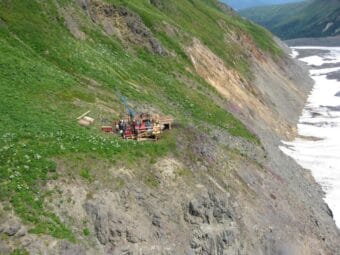
Oxidized rock colors a ridge above where one of Seabridge Gold’s KSM project’s open pit mines is being dug, from the KSM Project’s Prefeasibility Technical Report. (Seabridge Gold)
A major Canadian mining prospect upstream from Southeast Alaska is drawing legal challenges from both sides of the border, as tribal groups fear the project could pollute their ancestral waterways.
At the river’s mouth
The Southeast Alaska Indigenous Transboundary Commission, or SEITC, is worried about the region’s rivers. The commission represents 15 Tlingit, Haida, and Tsimshian nations that came together because they believe mining in British Columbia poses a threat to their spawning salmon and hooligan habitats, like the Unuk and Stikine Rivers.
The transboundary commission’s attention is currently on the Kerr-Sulphurets-Mitchell project, a proposed gold and copper mine at the foot of a glacier just across the Canadian border.
“KSM is on a whole other scale of mining, one of the world’s largest open pit mines, if it’s ever built,” said Guy Archibald, SEITC’s director. “Our tribes and communities are directly downstream. We rely on fish and the food security opportunities that the Unuk provides.”
The KSM Project is being developed by Seabridge Gold. According to the Canadian exploration company, the mine could generate nearly 1,500 jobs and over $30 billion in Canadian dollars for British Columbia and $60 billion Canadian for the nation over its projected lifespan of about 60 years.
Archibald weighs the stakes differently.
“Billions of tons of acid-generating waste rock just piled into valleys,” he said. “Valley fills in direct tributaries to the Unuk River. And so it’s almost inevitable that bad things are gonna happen.”
Mine tailings are the materials left over from the mining process, like acidic rock waste, undesirable metals, and the chemicals and discharge from processing the ore. All of this waste is stored in tailings facilities or dammed ponds until it can organically break down. According to the U.S. Environmental Protection Agency, many decommissioned mine tailing facilities are designated as Superfund sites.
Archibald cited the Mount Polley disaster, a 2014 failure at another mine in British Columbia that is widely referred to as one of the worst mining disasters in Canadian history. Canadian news outlet The Narwhal reported that KSM’s tailing ponds would be around 28 times the size of the one that failed at Mount Polley. SEITC estimated that KSM’s tailings ponds would require ongoing maintenance for at least 250 years, long after the mine shutters.
Tazia Wagner holds a pair of hooligan. (Jack Darrell/KRBD)
A voice in the process
In July, the British Columbia government issued a finding in the permitting process for the project known as a “Substantially Started Determination.” Under British Columbia’s law, environmental permits for development projects like mines come with an expiration date. According to the British Columbia Environmental Assessment Office, that’s partially because the environmental assessment process is constantly evolving – i.e. new science, new information, new regulations. Once a mine reaches a certain stage in development, though, the province can declare that it is far enough along and has met the environmental permitting requirements to move forward without its environmental “stamp of approval” lapsing.
Part of that environmental assessment process involves public comment and “a legal obligation to consult with Indigenous nations whose interests could be affected by the outcome of a substantially started determination.”
“And yet, the Alaska tribes are not really afforded any kind of voice in how this process works out. So we are trying every way possible to try to be sure that our communities are protected,” said Archibald, alleging that tribes in the transboundary commission weren’t afforded a meaningful seat at the table in that process.
In late November, the transboundary commission and SkeenaWild Conservation Trust filed a legal challenge against the British Columbia government. They’re represented by the Canadian law firm EcoJustice and are arguing that the mine was “rubber stamped” – challenging the premise of the province’s decision that the mine is “substantially started.”
The KSM mine received its environmental assessment a decade ago. EcoJustice attorney Rachel Gutman said that the process has changed since then and the province has a “deeper understanding of a rapidly changing climate” and “threats to salmon populations.”
“There are good reasons why the law has expiration dates for environmental assessments, including ensuring that mega projects like the KSM mine do not proceed based on outdated information,” Gutman said in a press release. “This is particularly important in this case due to the rapidly changing climate in Northern BC.”
The challenge also alleged that the province specifically considered whether the “substantially started determination” would help the mine in its timeline to secure outside funding when it issued the determination.
“We believe it is inappropriate for the (British Columbia Environmental Assessment Office), the agency tasked with assessing the environmental impacts of a project, to consider how their decision might support a company with project funding,” said Greg Knox, the executive director of SkeenaWild.
R. Brent Murphy is Seabridge’s Vice President of Environmental Affairs. In an email to KRBD, he wrote that Seabridge’s legal counsel are preparing to defend the validity of British Columbia’s determination. In his view, the Southeast Alaska tribal commission’s “ultimate goal is to halt all mining and exploration activities in the transboundary region.”
Murphy claimed that mining projects like the KSM aren’t responsible for declines in salmon and hooligan habitats. He chalked them up instead to “changes in ocean conditions, declines in quantity and quality of spawning habitat, and overfishing.”
Seabridge Gold’s Brent Murphy points to a valley to be dammed to hold tailings from the KSM mine during a July tour. The project has won federal environmental approval. (Ed Schoenfeld/ CoastAlaska)
“There is also a misconception that Alaskans were not engaged during the (environmental assessment) process of the KSM Project,” Murphy said about the transboundary commission’s challenge that tribes weren’t properly consulted in the process. “On the contrary, the BC Environmental Assessment Office actively receives input and feedback from Alaskan regulators, tribal groups, and the Alaskan public for any mining project undergoing the EA process within the transboundary region.”
For Archibald and the transboundary commission, though, those requests for feedback amounted to an empty promise. He called British Columbia’s consultation process for Alaskans “everything short of being meaningful or consent-based at all.”
There is Canadian legal precedent for U.S.-based tribes to be afforded the same rights to consultation as First Nations protected under the Canadian constitution. That precedent is R. v. Desautel,a 2021 Canadian Supreme Court finding. An indigenous American citizen was tried in Canada’s courts for killing an elk in British Columbia without a hunting license. The defendant lived on a reservation in Washington and argued that he was exercising his Aboriginal right to hunt in the traditional territory of his ancestors.
As Archibald put it, the case forced the Canadian Supreme Court to ask a central question: “Do indigenous, non-resident people of Canada – people who live outside of Canada but have ties to traditional lands within Canada – have any rights to those lands? And the Supreme Court said yes.”
“Given the complex nature of an ecosystem, a productive ecosystem, like the Unuk watershed, and the complex nature of one of the world’s largest mines, what the outcome of that is going to be if it moves forward, is really anybody’s guess,” said Archibald.
In a September opinion piece in the Anchorage Daily News, Murphy struck back at the legal challenge and its supporters categorizing Canada’s decision as a “rubber stamp,” saying that Seabridge had already sunk roughly $1 billion in Canadian dollars into the project which constitutes substantial progress. He also challenged what he called “widespread misinformation” surrounding the mining industry.
Murphy said that the KSM project met British Columbia’s three main criteria for a “substantial start determination” – work had begun on the mine, the company had spent significant money on construction, and it had received “the support of our First Nations partners.”
The headwaters
The Tsetsaut Skii km Lax Ha Nation is an Indigenous First Nation in British Columbia that borders the KSM site.
In November, it filed its own legal challenge against British Columbia. Ryan Beaton, who provides legal counsel for the nation, said that the KSM project’s proposed tailings facility is on the nation’s land and the province didn’t properly consult with them either before “essentially greenlighting” the project.
“If we’re going to go ahead with this permitting, and this is going forward, where’s the consultation? Where are the funds to deal with the environmental damage from this?” Beaton asked.
Beaton described Tsetsaut Skii km Lax Ha as a small tribal nation “surrounded by larger, more powerful or more connected First Nations neighbors.”
Those larger First Nations surrounding the Tsetsaut Skii km Lax Ha’s traditional territory are the Tahltan and the Nisg̱a’a. And both nations publicly support the mine.
If the KSM project is built, Seabridge envisions three open-pit mines that will feed a processing facility and a tailings facility to store mine waste. Seabridge anticipates those mines could produce at least 47 million ounces of gold and 7 billion pounds of copper over their lifespan.
“The concern is a huge amount of toxic waste flowing out onto the territory, into the waterways, destroying the fishing for the nation, affecting wildlife,” he said, explaining the nation’s concerns if one of the dams at the tailing facility failed.
The KSM project’s mine site layout during the operation phase, from its environmental assessment certificate application. (Seabridge Gold)
For Beaton and the Tsetsaut Skii km Lax Ha, even if all goes according to Seabridge’s plan, some of the damage has already been done.
“Just the construction of the project on its own terms, if everything goes well, has had a huge impact on their hunting territories, their traditional ways of life, huge swaths of forest cut down, so there’s already been major impact,” Beaton said.
The KSM project has also caused particular friction between the Tsetsaut Skii km Lax Ha and their First Nations neighbors. That’s because Beaton said if the project moves ahead, gold and copper aren’t the only things that will be flowing out of it – so will huge sums of money to the Tahltan and the Nisg̱a’a.
The Tahltan and the Nisg̱a’a both signed agreements with Seabridge over the last decade. Publicly, Nisg̱a’a Nation President Eva Clayton has said that projects like Seabridge’s KSM stand to attract investors to First Nations territories in the Golden Triangle and “improve the quality of life of our Nisg̱a’a and Tahltan people.”
Recently, the two nations announced a partnership to “maximize joint opportunities on the Seabridge KSM Project.”
“On behalf of both the Nisg̱a’a Nation and the Tahltan Nation, I would like to acknowledge Seabridge for their support and encouragement,” Tahltan Nation Development Corporation Chair Carol Danielson wrote in a statement at the time, “and their willingness to actively engage and work with our Partnership on their KSM project, the world’s largest undeveloped gold project.”
Neither Tahltan nor Nisg̱a’a leadership responded to requests for comment.
Beaton compared the tailings facility dispute to hearing there was a big construction project happening in your neighborhood and then finding out “all the toilets for the project were going to be built in your backyard while the money flowed elsewhere.”
“When the (KSM project) is over, the Nisg̱a’a and Tahltan get to go home and the Skii km Lax Ha, this small First Nation, is stuck with a huge waste facility on its territory, and that is not the way Indigenous consultation should go,” said Beaton.
The Tsetsaut Skii km Lax Ha aren’t strangers to mining, though. The tribe has worked with other mining projects in the past and recently signed an agreement with a different company for a neighboring mine.
“Our nation is certainly not anti-industry,” said Beaton, adding that the nation does see the benefits mining could have on the province and their communities. “But it’s got to be done responsibly and in a way that respects both the nation’s rights but also the environmental concerns that they have.”
“'(It’s) the ‘Asserted’ territory of the Tsetsaut Skii km Lax Ha,” said Seabridges’ R. Brent Murphy about the First Nation’s claim that it owns the land for the tailing facility. “While they have sought recognition of their ‘exclusive’ rights to this area, it is currently not recognized by the government.”
The federal government of Canada marks the site of the proposed tailings facility as traditional Tahltan territory.
In its legal challenge, the Tsetsaut Skii km Lax Ha allege that this comes from a complex history of misinterpreted treaties and shaky ethnographic accounts that essentially, as Beaton puts it, “writes the Skii km Lax Ha out of their own history on their own territory.”
This assertion is backed by a 2021 report from British Columbia’s Attorney General, as well as a 2017 environmental assessment of a different mine, that supports the Tsetsaut Skii km Lax Ha’s exclusive rights to the area where the tailings facility will be located.
“We’re not asking them to take our word for it,” Beaton said. “We’re asking the province to act on their own assessment.”
Similar to the legal challenge EcoJustice filed on behalf of Alaska tribes across the border, the Tsetsaut Skii km Lax Ha’s legal complaint is lobbied against the provincial government. According to Beaton, that’s because the small First Nation is alleging that the province officially recognized their territory but because of their size and their lack of support for the KSM project, their constitutional right to consultation was minimized.
“The province is really picking and choosing who gets rights, and that is not appropriate. It’s really colonialism in action,” said Karen McCluskey, Beaton’s co-counsel representing the Tsetsaut Skii km Lax Ha.
For Seabridge, the could-be world’s largest gold mine passed its comprehensive seven-year environmental review process and according to Murphy, the company plans to invest millions of dollars annually into ongoing water quality reviews. For him, the province’s determination just reflects that Seabridge has done its part in making sure the project is safe and sustainable. He also continuously pointed to the support of their Indigenous partners – the Tahltan and Nisg̱a’a – and how they’ve allowed the project to move forward on their ancestral lands.
“The benefits are flowing to neighboring First Nations, to the government, and to industry. You know, the Tsetsaut Skii km Lax Ha nation has said they would like to have no dump on their land. That’s their position,” Beaton said.
The ball is currently in British Columbia’s court to determine how long officials will need to respond to these legal challenges on both sides of the border. Beaton estimated the whole process could take about a year.
For the KSM mine, Seabridge is hoping to solicit a partner for the venture, another mining company big enough to build and operate a mine this scale. After that, the company anticipates construction on the mine would take about five years.
Kotzebue already gets some of its power from wind turbines. The village is working to install two more. The existing turbines are seen on July 13, 2024. (Chad Nordlum/Native Village of Kotzebue)
Over $130 million in grants allocated to clean energy projects in rural Alaska are now frozen, following one of President Donald Trump’s executive orders. The projects – which include hydroelectric dams, wind turbines and solar energy systems – aim to lower energy costs in rural communities and bring them additional revenue to support crucial infrastructure.
Trump signed dozens of executive orders during his first day in office, including one that freezes funding from the federal Inflation Reduction Act and Bipartisan Infrastructure Law. A section of that order mandated that federal agencies pause the disbursement of funds appropriated through those acts.
That’s created uncertainty for many Alaska projects — including two large wind turbines slated to be built in Kotzebue. Those turbines, along with the community’s existing renewable energy assets, would allow the community to produce more than half of their energy from solar and wind, said Chad Nordlum, the energy project manager for the Native Village of Kotzebue. He said it’s unclear now if the funding freeze will affect the project’s timeline.
“The freeze that Trump has put on the Inflation Reduction Act has definitely caused a lot of concern for Kotzebue for the wind project,” Nordlum said. “It puts a lot of questions out there. Right now, there doesn’t seem to be much we can do on our end. We’re just waiting for clarity.”
How freeze affects projects in progress
The Alaska Native Tribal Health Consortium has partnered with tribes across the state, including in Kotzebue, to receive the federal grants. In total, they’ve been awarded contracts for about $132 million, said Katya Karankevich, a project manager at ANTHC’s Department of Environmental Health and Engineering.
The contracts covered hydroelectric dams in Old Harbor and Chignik Bay; wind turbines in Kotzebue, Toksook Bay and Chevak; and solar energy systems in Ouzinkie, Brevig Mission, Elim, Koyuk, Savoonga and Teller. ANTHC also received about $32 million for their own grant program for solar, which would cover between nine and 12 additional communities.
And ANTHC has already started spending or obligating funds with contractors on 30% of the projects, Karankevich said. With the federal funding freeze, the consortium now cannot request reimbursement for the work already started, she said.
“We will have another $19 million obligated for local contractors to perform work in the next 90 days on these projects,” she said. “While this hold is an inconvenience to us, it’s a bigger burden for local businesses who want to get paid for work already completed under these contracts.”
Energy projects benefiting local economy
In addition to decreasing communities’ carbon footprints, the projects aim to support local economies.
Because energy from renewables is cheaper than transported diesel, the projects would help residents lower their bills – a welcome factor in places where fuel can cost up to $22 a gallon.
“Not being so dependent on the outside oil markets, producing our own electricity here in Kotzebue is a big benefit,” said Nordlum with the Kotzebue village. “I think it’s a big deal.”
Because the tribes would own the energy assets, they would also be able to sell power to local utilities and invest that revenue in local infrastructure.
“We’re trying to get all off-the-road-system communities on board with the idea to do renewable energy in a completely different way,” Karankevich said. “And that is to set up the communities themselves to sell power to themselves and to use the earnings for public benefit.”
Supporting clean water access
In Old Harbor on Kodiak Island, recent funds advanced a project that residents have been working on for decades: a hydroelectric dam that would power the whole community.
Cynthia Berns, a project manager for the Alutiiq Tribe of Old Harbor, said that the tribe and ANTHC restructured the project so that, after covering maintenance costs for the dam, profits from hydro energy would pay for residents’ utilities bills.
“It’ll pay for the annual water bill and half of an average residential electric bill, which will give continued access to clean water and electricity regardless of their ability to pay,” Berns said. “We’re really excited about this.”
Many rural Alaska villages lack reliable access to clean drinking water and sewer infrastructure — some still rely on honey buckets and bottled water. And when water and sewer systems are installed, maintaining them in Arctic and sub-Arctic climates is extremely costly for small communities.Karankevich said that’s why ANTHC wanted to find ways to use revenue from renewables to keep local infrastructure running.
“Now that tribe or city owns that renewable asset, and they’re selling power to their local utility,” she said. “Then that money, that kitty, now can be used for water and sewer costs to make sure that the water keeps flowing, the sewer keeps going exactly where it’s supposed to go and that any unforeseen expenses – or regular operation and management expenses – can be taken care of.”
Karankevich said all of the projects affected by the order have feasibility studies that showed them to be cost-effective options She said that despite the funding freeze, the agency plans to keep those projects moving forward
“We have deliverables to the federal government to build them for the benefit of rural Alaskans,” she said. “This federal freeze is a hindrance, but we owe it to Alaska Native people to continue our projects in all phases of design, permitting and construction.”
Gov. Mike Dunleavy speaks about President Donald Trump’s executive orders at a press conference in Anchorage on Jan. 22, 2025. (Wesley Early/Anchorage)
Gov. Mike Dunleavy on Wednesday welcomed a series of executive orders President Donald Trump issued shortly after taking office.
“Happy days are here again, to be perfectly honest with you,” Dunleavy told reporters at a news conference in Anchorage. “This is like unwrapping a gigantic sled of Christmas presents for the state of Alaska.”
Trump’s Alaska order, titled “Unleashing Alaska’s Extraordinary Resource Potential” was one of dozens the president signed on his first day in office. Among other things, the order calls for new oil and gas leases in the Arctic National Wildlife Refuge, reinstates approval of the controversial Ambler Road in Northwest Alaska, and instructs federal officials to reinstate a 2020 decision removing protections for more than 9 million acres of the Tongass National Forest.
Ahead of Trump’s inauguration, Dunleavy submitted a transition plan — something of a wish list — to the incoming administration requesting an “Alaska specific Executive Order” rolling back Biden-era decisions limiting resource development. Many, though not all, of those wishes were granted by Trump’s order.
The executive order did not directly address the Biden administration’s veto of the controversial Pebble Mine under the Clean Water Act. Dunleavy, a supporter of the copper and gold prospect whose administration has sued to overturn the veto, said he would continue to advocate for its approval.
“I see a path forward on discussions on Pebble, absolutely,” Dunleavy said. “We’re going to let the dust settle and really go through these (executive orders), but I think that conversation is going to happen.”
Whether those discussions will prove fruitful is unclear. The Trump administration denied a permit for Pebble in the waning days of his first term.
State lawmakers offered mixed reactions to Trump’s order.
Senate Majority Leader Cathy Giessel, R-Anchorage, said she thought the state should take a bigger role in managing Alaska’s land and waters, a priority Dunleavy communicated in the transition plan. But she said casting aside environmental protections could be unwise.
“We’re not a colony to be pillaged,” Giessel said. “By throwing open all of the regulations related to resource development, we could be jeopardizing our own land and waters.”
House Minority Leader Mia Costello, R-Anchorage, said she was proud of what she said was Alaska’s record of responsible resource development and looked forward to the policy changes outlined in the order.
“We’re very pleased to see that action taken,” she said. “It actually puts Alaska on the map where it should be, which is at the tip of the spear, as far as providing energy for our country.”
State lawmakers were less divided on another of Trump’s orders, one renaming the mountain known as Denali to Mount McKinley.
“We want it named Denali,” Costello said by text message.
Rep. Maxine Dibert, D-Fairbanks, invoked her own Koyukon Athabascan heritage, saying Denali is one of many place names across the state that “reflect the diverse cultures, traditions and languages of Alaska.”
“Alaskans from all backgrounds and political persuasions embrace Denali as a rightful name for the tallest peak in America,” she said. “Changing the name of Mount Denali to Mount McKinley would be costly, and if enacted, would be disrespectful to Alaskans.”
Dibert and Rep. Ashley Carrick, D-Fairbanks, each introduced resolutions on Wednesday urging the federal government to retain the name Denali. The Obama administration officially renamed the peak to Denali in 2015.
Alaska’s U.S. senators, Republicans Lisa Murkowski and Dan Sullivan, have spoken out against renaming the mountain. Newly elected Republican Congressman Nick Begich III told Politico that “what people in the Lower 48 call Denali is none of my concern.”
Dunleavy, though, declined to share his thoughts on what the mountain should be called. He said he wanted to speak with Trump before offering up his own position.
“Until I have the conversation, I’m going to refrain from saying what it should be or shouldn’t be,” Dunleavy said.
Close
Update notification options
Subscribe to notifications
Subscribe
Get notifications about news related to the topics you care about. You can unsubscribe anytime.