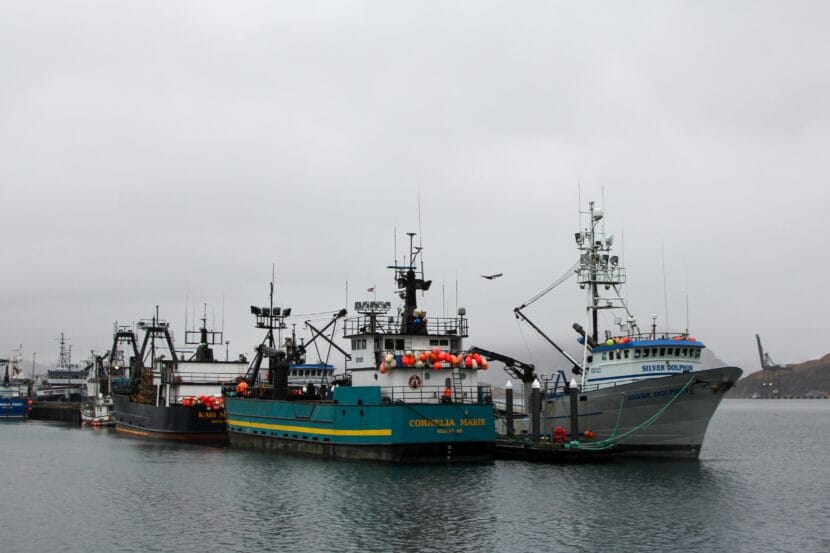
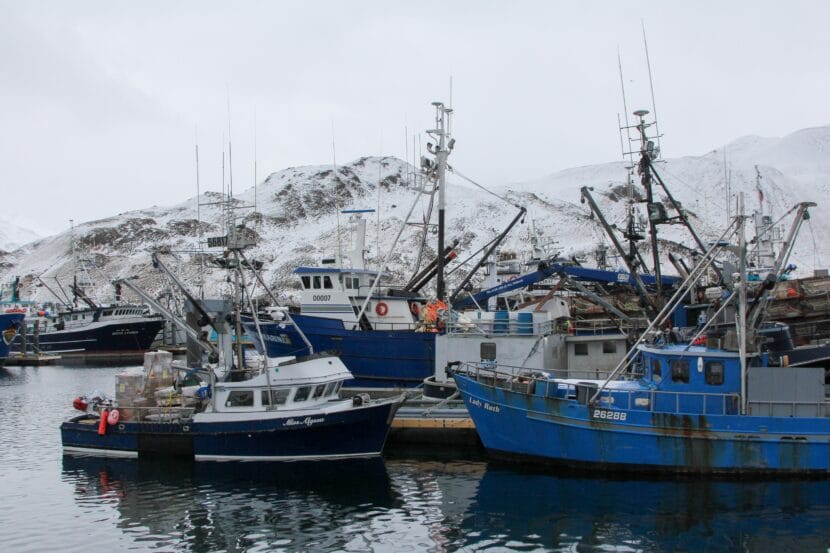
The trade group Alaska Bering Sea Crabbers coordinated with harvesters, processors and communities to ask Gov. Mike Dunleavy to request a federal disaster declaration, which the U.S. Secretary of Commerce approved in May 2023.
Relief money started going out earlier this year, first for community members and seafood processors, and now for captains and crewmembers. But Jamie Goen, the executive director of Alaska Bering Sea Crabbers, says fishermen should not have to wait years for relief.
“It needs to be within six months so that it’s useful for these families that are trying to make monthly payments,” Goen said. “Waiting four-to-six years to get your paycheck, that just doesn’t work for most families.”
Crab stocks have been recovering from the crashes a few years ago. The season that opened last month looks promising, but the rebound has been slow.
Dunleavy submitted another, separate disaster declaration for last season, which saw only minimal improvement from the previous year. But Goen says the goal isn’t more relief — it’s a stable fishery.
“We want to be fishing,” Goen said. “We don’t want to be asking for fisheries disasters.”
Eligible captains and crew have until the end of the year to apply for aid. Applications and information are available online.
Metlakatla Mayor Albert Smith exits the courtroom at the Robert Boochever U.S. Courthouse in Juneau, Alaska following oral arguments in a fishing rights case on Feb. 15, 2024. (Eric Stone/Alaska Public Media)
A lawsuit from Alaska’s only Native reservation will proceed over the objections of other Southeast Alaska tribes. A federal judge last week declined a request from a coalition of tribes, including the largest in Southeast, to throw out Metlakatla Indian Community’s lawsuit challenging the state’s authority to regulate its fishermen.
Metlakatla Indian Community asserts in its five-year-old lawsuit that the state has no right to regulate the tribe’s fishermen. Its attorneys say that’s because when Congress created Metlakatla’s reservation in 1891, Congress implicitly included a federally guaranteed right to fish in nearby waters.
The case was headed for trial when a coalition of tribes, including the Central Council of Tlingit and Haida Indian Tribes of Alaska, weighed in, arguing it should be dismissed outright.
“They felt this was something that should be resolved between the tribes and not by a federal judge,” attorney Richard Monkman said in an interview.
The tribes argued granting Metlakatla’s members the right to fish in waters near Ketchikan and Prince of Wales Island would violate their rights to their cultural property.
“We would analogize this to other cultural rights, like dances, stories, carvings, other types of rights that all sort of fall under the general category of at.oow, in the Lingít language, or cultural rights, which belong to the clans and belong to the houses within clans,” Monkman said.
Metlakatla’s attorneys, however, argued that the right to fish in those areas wasn’t legally protected — in part because of the Alaska Native Claims Settlement Act. Chris Lundberg is an attorney representing Metlakatla.
“With the exception of Metlakatla, all Alaska Natives participated in that act,” Lundberg said. “In exchange for releasing all claims to aboriginal rights-type claims and claims to land and fishing areas, the tribes received compensation.”
There’s still a long way to go, and it’s unclear when it might go to trial — for one thing, the state has filed a motion to end the case without a trial — but Lundberg said the decision from Judge Sharon Gleason puts the case back on track.
Metlakatla Indian Community Mayor Albert Smith said in an interview he was pleased with the decision and is optimistic about the road ahead.
“Now we are excited about getting back to the main issue: restoring the community’s reserved fishing rights,” he said.
Seafood harvesting jobs — which include commercial fishing but not processing jobs — dropped about 7.5% last year, about the same as the year before. That brings the industry’s harvesting jobs to their lowest count since records began in 2001.
The report’s author, Joshua Warren, says there are many reasons for the drop.
“There’s increased cost, competition in international markets, drop in prices,” he said. “A lot of different things can cause someone to choose to fish or not to fish.”
Warren says climate change is another major factor, bringing unpredictable runs and fishery closures for different species and regions of the state.
The report doesn’t reflect this year’s tariffs, but it does note that the U.S. has been losing ground in global seafood markets for years.
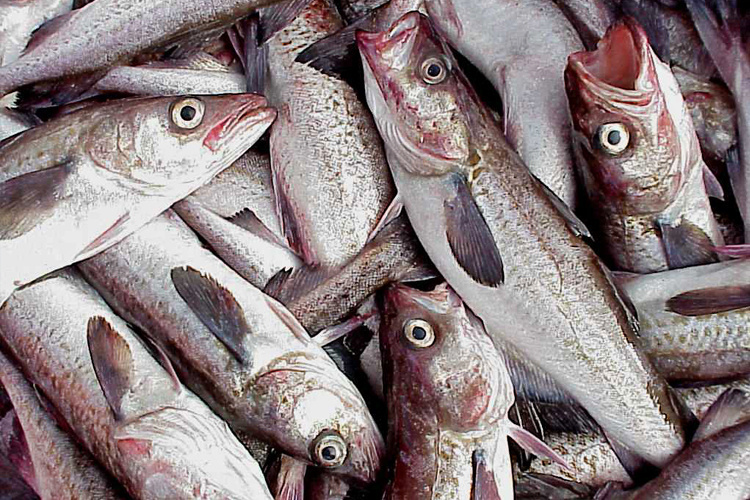
Alaska pollock, shown here from a harvest, make up the nation’s top-volume single-species commercial seafood catch. Each December, the North Pacific Fishery Management Council sets the next year’s harvest levels for pollock and other groundfish. Those decisions are based on scientific analysis that could be compromised this year by the federal government shutdown. (Photo provided by the National Oceanic and Atmospheric Administration)
For the organization that oversees commercial fisheries in federal waters off Alaska, the most significant impact of the federal government shutdown might materialize in December.
That is when the North Pacific Fishery Management Council is scheduled to issue harvest limits for Alaska pollock – the nation’s top-volume commercial harvested species – and other types of groundfish harvested in the Bering Sea and Gulf of Alaska, such as Pacific cod and sablefish.
The Bering Sea and Gulf of Alaska pollock harvests start in January.
To set the groundfish harvest levels, the council relies on federal scientists’ analysis of fish stocks in the ocean, work that is based in large part on scientific surveys conducted over the summer.
But during the shutdown, most National Marine Fisheries Service employees, including the scientists who analyze survey data to assess the conditions of commercially targeted fish stocks, are furloughed.
On Wednesday, the last day of the council’s October meeting, the members considered how to deal with scientific uncertainty if the government shutdown prevents completion of the detailed analysis that is usually provided in time for the December meeting.
Council member Nicole Kimball referred to a warning issued eight days prior by Bob Foy, director of the NMFS Alaska Fisheries Science Center, the organization that does the stock assessments. Foy said then that a shutdown lasting more than five days would compromise the ability to complete stock assessments and that a shutdown beyond 15 working days would “dramatically impact” those assessments.
The 15-day threshold is not too far away, Kimball said.
“How does the council and the public understand what to expect in December, in between the October and December meeting, relative to stock assessments?” she asked.
Diana Evans, the council’s deputy director, said impacts are yet to be determined, but the public will be notified of them as soon as possible.
“We don’t think we can answer that until we have a better sense of exactly where we land and how many days of work are remaining between the time that government workers are back and able to resume that work and the meeting,” she said.
Advocates with environmental organizations said they worry about shutdown effects on scientific information needed for harvest decisions, which would add to the effects of mass firings and retirements at NMFS and other agencies.
“I’m terrified at the prospect of flying blind into the next fishing season, especially as the Trump administration has decimated the ranks of scientists who monitor the health of our oceans,” Cooper Freeman, Alaska director of the Center for Biological DIversity, said by email. “I’m especially worried about fisheries like the massive pollock trawl fleet that has been harvesting millions of tons annually at the expense of the larger ecosystem.”
“The first challenge with this shutdown is the instant level of uncertainty it creates. Normal processes face delays that can easily impact or inhibit active fisheries. Potential staff losses will exacerbate that,” Michelle Stratton, executive director of the Alaska Marine Conservation Council, said by email.
“But beyond the concern for continuing day to day services, are those major efforts — like stock assessments and (total allowable catch) setting — that rely on substantial NMFS staff input, data processing and expert analysis. If this continues to the point where we are unable to set catch limits for the start of the 2026 seasons, we’ll be in seriously uncharted territory, and could well see massive economic impacts to our fishing communities and fleets,” she said.
The shutdown forced the council to rearrange its October meeting because federal representatives were unavailable to present information.
One major agenda item was postponed: review of a work plan for assessing essential fish habitat. Other items on the agenda were abbreviated.
The shutdown has already affected fishery management operations to some degree, said council member Jon Kurland. As Alaska regional director for NMFS, Kurland is one of a small group of agency employees remaining at work during the shutdown.
Kurland, in comments last week at the start of the meeting, said some services have been unavailable during the shutdown, such as the processing of harvest quota transfers.
NMFS is still doing basic management of ongoing fisheries, monitoring and closing them as needed, and is supported by contractors, he said. But that level of work has its limits, he said.
“If there are significant unforeseen problems, we will have limited ability to address those. Fingers crossed,” he said then.
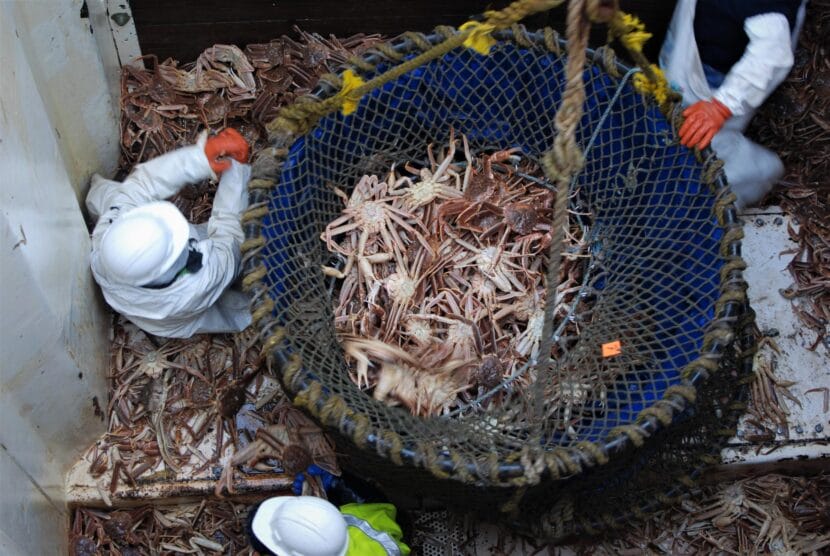
Fish and Game says survey results show increases in all sex and size groups of snow crab compared to last year. Large males remain at historic lows, but the population is showing signs of stabilization and recovery after the recent collapse. (Laura Kraegel/KUCB)
Bering Sea crabbers will see a boost in catch limits this season, after years of cancellations and small harvests due to low snow and king crab stocks.
The Alaska Department of Fish and Game announced Monday that it’s nearly doubling the harvest for the upcoming Bering Sea snow crab commercial fishing season from last year’s totals.
Fish and Game set the cap at 9.3 million pounds. That’s a low number compared to historic levels. In 1991, crabbers harvested more than 320 million pounds of snow crab.
The catch limit was set at 45 million pounds back in 2020, the year before the snow crab stock crashed. And the next year, the fishery closed for two seasons after more than 10 billion snow crabs disappeared from the region.
Fish and Game now says survey results show increases in all sex and size groups compared to last year. Large males remain at historic lows, but the population is showing signs of stabilization and recovery after the recent collapse.
Officials said a return to colder ocean conditions and increased numbers, especially in juvenile crab, are reasons to be optimistic.
And for the first time, a portion of the harvest will be reserved for a hybrid snow-tanner crab. Those are crabs that share some characteristics of both snow and tanner crabs, like eye color and tooth shape.
Regulators said recent surveys show an “unprecedented” amount of the hybrid crab. To incentivize harvest of them, Fish and Game designated about 11% of the total snow crab catch to the snow-tanner mix. According to officials, the fleet will be encouraged to harvest about a million pounds of the hybrids from the “hybrid grounds.”
Meanwhile, Fish and Game also boosted the Bristol Bay red king crab catch limit by about 16% from last year, with a total harvest of about 2.7 million pounds. Tanner crab harvests more than doubled for the western district of the Bering Sea but dropped by almost 40% for the eastern area.
All of those fisheries open Oct. 15. The lucrative Bristol Bay red king crab has the highest priority harvest, as that fishery closes shortly after the new year. Snow and tanner crab both close in the spring.
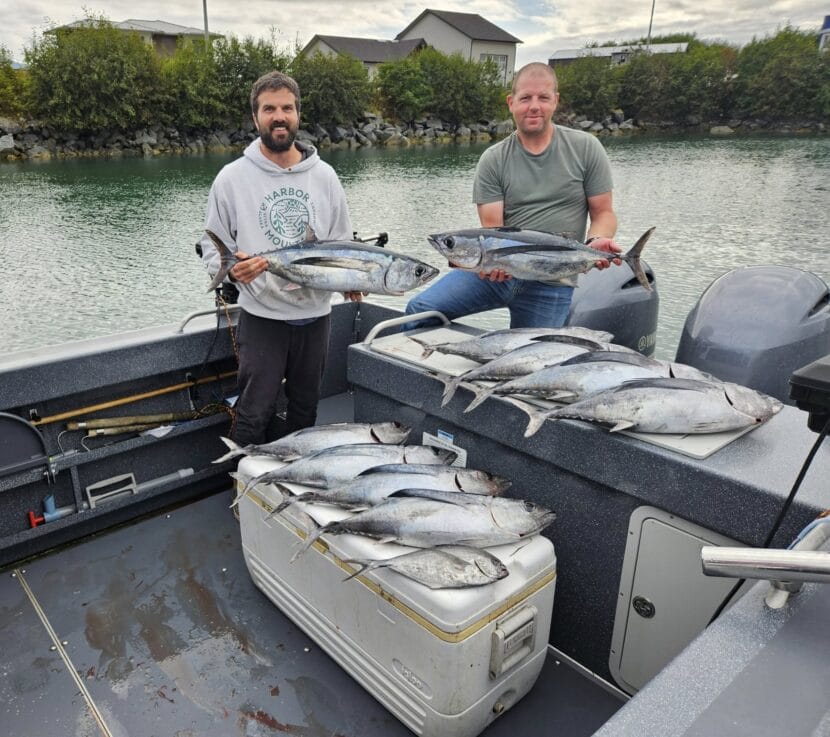
Jared Nelson, left, and Adam Olson, right, show off their haul of albacore tuna caught off the Sitka coast on Sept. 7. Waters near Sitka were warm enough to draw tuna from the south, and residents took advantage of the rare opportunity to hook a type of fish not normally seen in Alaska. (Photo by Rebecca Olson/Used By Permission)
In Alaska, a state famous for abundant salmon and huge, cold-water-loving crab, another type of fish is making a splash: tuna.
Incursion of warm waters into Southeast Alaska coastal areas off Sitka and Baranof Island created a brief tuna jackpot earlier this month for sport fishers.
One of the first of those anglers was Troy Tydingco, who happens to be the Sitka sportfish area management biologist for the Alaska Department of Fish and Game.
He took a day off from work when conditions were just right to search for tuna, a type of fish suited to more southern latitudes: beautiful weather, with calm waters and water temperatures that reach 60 degrees.
About 30 miles offshore, the search was successful. Tydingco and his six companions caught 44 albacore tuna in all. Other fishers followed.
“I think this is probably the first time sport anglers have really successfully targeted them and harvested them out of Sitka,” he said.
Another successful Sitka tuna angler was Adam Olson, operations manager at the Northern Southeast Regional Aquaculture Association.
What makes it fun, he said, is that it is “incredibly unique and unusual.” It is a big change for Sitka, he said. “We’re very salmon-centric here in Southeast Alaska,” he said.
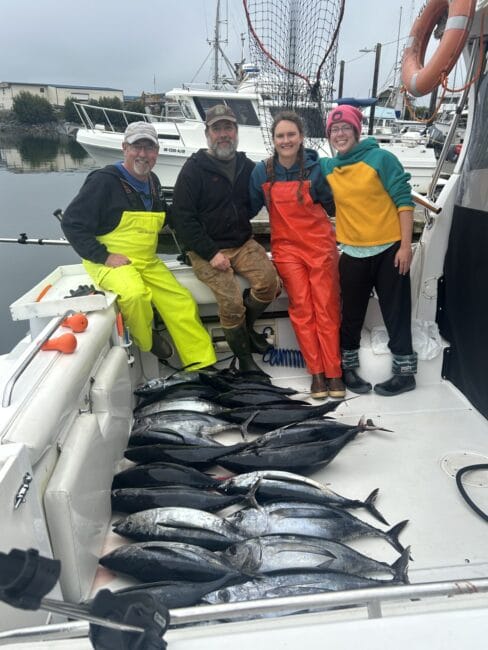
Steve Ramp, Troy Tydingco, Isabel Platten, and Alex McCarre pose on Sept. 4, 2025, with some of the albacore tuna they caught that day about 30 miles offshore from Sitka. (Photo provided by Troy Tydingco)
Olson enjoyed eating the tuna as well as catching it, grilling it with a little salt and pepper. “It was phenomenal,” he said.
Tydingco said there is no precise count for the tuna haul. Based on anecdotal reports, social media posts and general talk around town, he estimates that there were 200 caught out of Sitka.
Anyone with a sportfishing license is allowed to harvest tuna in Alaska, as long as they use legal means. Most anglers use rod-and-reel gear that would typically be used to catch salmon. It is also legal to use a spear gun, which one man employed successfully to get a skipjack tuna in the Sitka harbor.
Commercial opportunity?
The Sitka tuna flurry generated enough interest to prompt the Department of Fish and Game to issue an advisory on Friday laying out the rules for a commercial harvest.
There is no federal fishery for tuna in Alaska, so it is up to the state to regulate catches if they occur, said Rhea Ehresmann, a Sitka-based groundfish project leader for the Department of Fish and Game.
Though no one may have tried it yet, commercial tuna fishing is legal in Alaska. There are requirements for permits, gear types and record-keeping. Trolling and jigging gear, which uses hooks to catch fish, is allowable for tuna, but nets are not.
So far, the department has issued a couple of permits to interested fishers, Ehresmann said.
Any commercial catch of tuna – whether deliberate or accidental bycatch during a harvest targeting another species — is required to be reported to the state. There had been no such reports as of Monday, said Grant Hagerman, a Sitka-based troll management biologist for the Department of Fish and Game.
The Sitka tuna bounty may be new. But the occasional presence of tuna in Alaska waters is not.
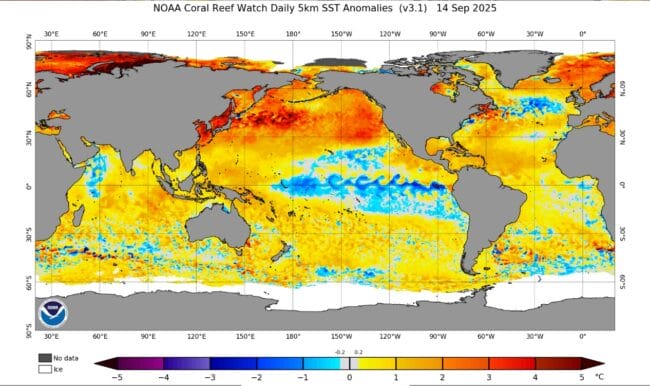
Sea surface temperature departures from normal across the oceans as of Sept.14, 2025. (Map provided by the National Oceanic and Atmospheric Administration)
Up to now, Prince of Wales Island, at the far southern tip of Southeast Alaska, has been the site of most of the state’s tuna fishing, Tydingco said.
There are also isolated cases of tuna catches farther north, such as a skipjack tuna fished off Yakutat in 2015.
History indicates that the presence of tuna in Alaska waters is ephemeral. They might linger for a few weeks if waters are warm enough, then swim south.
Excitement over tuna in Alaska and rumors of their appearances date back to the 1920s, according to a 1949 report by the U.S. Fish and Wildlife Service. There was a Ketchikan-based commercial harvest in 1948, though that tuna appears to have been caught off British Columbia’s Queen Charlotte Island, according to the report.
Whether tuna fishing will become a trend in Alaska is yet to be determined.
Tydingco said this year’s successes are likely to encourage more fishers to look for tuna, but that people should not count on having tuna-friendly conditions every year.
“That warm water temperature doesn’t even always make it up this far,” he said.
There are signs that Alaska will be more hospitable to tuna in the future, due to warming waters caused by climate change and other factors.
While sea surface temperatures have increased in almost all of the world’s marine areas, temperatures in the North Pacific Ocean are rising faster, according to National Oceanic and Atmospheric Administration scientists. That includes the Gulf of Alaska, which has had recent marine heat waves.
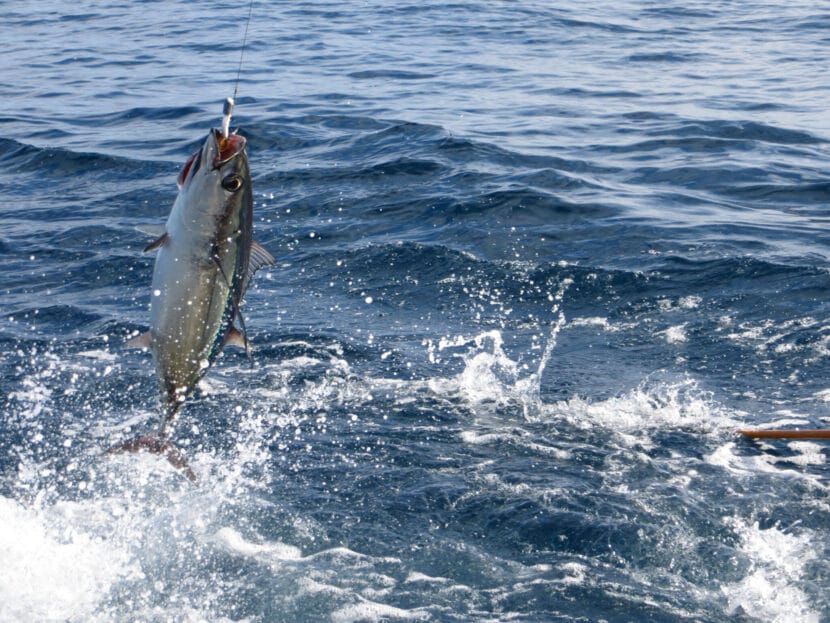
An albacore tuna is hooked on a bait pole on Oct. 9, 2012, in waters off Oregon. Tuna are normally found along the U.S. West Coast but occasionally stray into Alaska waters if tempertures are high enough. Sport anglers catch them with gear similar to that used to hook salmon. (Photo provided by the National Oceanic and Atmospheric Administration/West Coast Fisheries Management and Marine Life Protection) Offshore in Oregon
Close
Update notification options
Subscribe to notifications
Subscribe
Get notifications about news related to the topics you care about. You can unsubscribe anytime.