Fisheries

Raising the idea of salmon farms in Alaska, Gov. Dunleavy swims against a tide of skeptics

Alaska coho salmon cooks on the Crush Bistro grill on August 22, 2025. (Marc Lester/ADN)

Amid the hubbub of President Donald Trump and Russian President Vladimir Putin’s Alaska summit last week, Gov. Mike Dunleavy, posting on social media, posed a provocative question.

“Alaska is a leader in fresh caught wild salmon. We could also be a leader in the farmed salmon industry. Why not do both instead of importing farmed salmon from Scotland?,” he wrote, sharing an article about the value of fish farming in Scotland, where Atlantic salmon are raised in net pens in the ocean. “This would be a great opportunity for Alaska.”

The answer from scientists, wild salmon advocates, restaurant people and regular salmon-eating Alaskans has come swiftly, full of alarm and often along the lines of one of the early commenters on his post, who wrote, “Are you insane?”

Love for wild salmon cuts through partisan politics. No food is more important to the state’s culture, diet, identity and economy. As such, Alaskans don’t look kindly on farmed fish. It’s tough to find it in stores and few, if any, restaurants serve it. Farming salmon and other finfish has been banned since 1990 over concerns about environmental threats to wild stocks and economic competition. But Dunleavy, who has become increasingly interested in Alaska’s food security since the pandemic, is curious about bringing in fish farms.

salmon filets are arranged by gloved hands
Canadian organic farm-raised king salmon filets at a store in Fairfax, Va. (AP Photo/Alex Brandon/File)

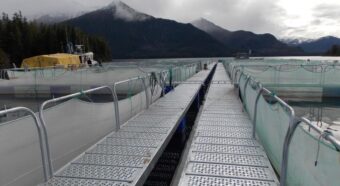
Last legislative session, his office introduced a bill that would authorize land-based farming of non-salmon species like trout or tilapia. That bill faced an avalanche of opposition in committee. But his recent post went further, signaling a shift feared by fisheries advocates, from a narrow focus on land-based farms to a broader look at farming salmon, the vast majority of which happens in net pens in the ocean.

A number of people sent the governor’s post on the social media platform X to state Rep. Louise Stutes, a Republican from Kodiak. Last session she chaired the House Fisheries Committee, which heard the fish farming bill.

Alaska’s politicians should be focusing all their energy on shoring up the state’s fishing industry, she said. In recent years the fishing sector has been upended by global politics, market fluctuations and weak runs.

“Introducing farmed salmon into coastal waters, to me, is just an unacceptable risk,” she said. “It’s outrageous to think that we could become a leader in farmed salmon.”

She said it was very unlikely the bill would find the support it needs.

Dunleavy, in an interview this week, said he is always looking for economic opportunities, including fish farms.

“The article came up, and I figured I’d post it just to see what the response is, not to irritate people, but just to see what the response is,” he said.

He anticipated it would stir criticism, he said.

“The problem is, and I’ll be quite frank, is it gets very emotional. It makes it difficult to have a conversation,” he said. “Quite frankly, it’s tough to have a conversation about a lot of topics today, it’s tough to have a conversation where facts can be the decider.”

Fish farming could be done in concert with wild salmon fishing, he said.

“Does that then mean that wild-caught is done? I don’t believe it does. I think, actually, wild-caught is an amazing brand,” he said.

Boats sit next to a salmon pen
In this Thursday, July 13, 2017 photo, workers position their boats at a Cooke Aquaculture salmon farm near Blacks Harbour, New Brunswick, Canada. (AP Photo/Robert F. Bukaty)

Dunleavy didn’t have a specific plan for how salmon in Alaska might be farmed, he said. Land-based salmon farming, something some environmental groups support, is being tried in a few markets but can be cost-prohibitive. There are concerns over open-net pens that need to be addressed, he said, as well as concerns about what species of salmon might be raised.

Salmon is the second-most popular seafood in the country, just behind shrimp, and roughly 75% to 80% of the salmon Americans eat is farmed Atlantic salmon. Atlantic salmon in the wild have almost disappeared due to overfishing and they cannot be fished commercially. Alaska provides the lion’s share of the wild salmon in the country’s fish markets. But in the world, Dunleavy pointed out, Russia provides the largest share of salmon. Farming fish might be a way for Alaska, and the U.S., to occupy a larger position in that marketplace, he said.

“What I’ve said is, basically, is the discussion worthwhile that Alaska has today, in 2025, to visit the idea of Alaska being part of that game of a new sector?” he said.

At-sea fish farming has gotten cleaner in recent decades, thanks to advances in technology and feeding practices that minimize the impacts of effluent, said Caitlyn Czajkowski, executive director of the National Aquaculture Association, a Florida-based aquaculture trade association.

“There’s a lot of things about the ocean that we know now that we didn’t know 20 years ago,” she said.

Some non-salmon operations also now farm fish that are genetically sterile, so that if they escape, they can’t mix with local populations. That technology is still under development for salmon, however. There are a number of places that used to have commercial salmon fisheries in the Atlantic region, including Maine, Canada and a number of European countries that now farm Atlantic salmon. There isn’t another place, like Alaska, where salmon farming is happening in tandem with a robust wild salmon fishery, Czajkowski said.

At Crush Bistro, a high-end restaurant in downtown Anchorage bustling with tourists this week, Rob DeLucia, owner and general manager, said he was dumbfounded by the governor’s post. Guests come into the restaurant every night and say they came to Alaska for two reasons: to see Denali and to eat wild fish, he said.

“It is crystal clear when you get a piece of salmon at a restaurant in Alaska, that thing was swimming around in the last couple of days out in the wild blue ocean, and now we’re going to have guests be like, ‘Well, is this farmed or is this wild?’” he asked.

Atlantic farmed salmon, from a culinary standpoint, is inferior in taste and texture, he said. It made no sense to promote it.

“(Dunleavy) should have his Alaskan card revoked,” DeLucia said.

A chef tops a salmon dish with sauce
Crush Bistro executive chef Rob Lewis prepares a current special, grilled Alaska coho salmon with zucchini strings, cauliflower puree, spinach pesto, smashed fingerling potatoes, smoked tomato vinaigrette and dehydrated kalamata olives. (Marc Lester/ADN)

Melanie Brown is a Bristol Bay fisherwoman and outreach director at SalmonState, an organization that advocates for wild salmon. She penned a recent editorial against fish farming and was unsurprised by Dunleavy’s post about farming salmon.

Open net pens cause pollution from fish waste and medications, which hurts wild fish, she said. The farmed fish also eat a meal made from other fish — often anchovies caught in developing countries, where there are concerns about overfishing and the local food supply.

She bristled at the way fish farming undermines the preciousness of wild fish, which are particularly important in Alaska Native culture. She often tries to explain the importance of Alaska’s fisheries in Native communities by comparing fishing to a school, where people pick up essential skills, and a church, which brings fellowship with a community and a connection to something larger, and a museum, where people learn about history and culture and craft, she said.

“It’s so much more than money and it’s so much more than food,” she said.

Michelle Stratton, a fish biologist who heads the Alaska Marine Conservation Council, which represents fishermen and scientists, was outlining a blog response to the governor‘s post Wednesday while her commercial setnet soaked off Kodiak Island.

“Farmed salmon collapsed prices once already, spreads disease and pollution, and risks erasing the Wild Alaska brand that fishermen depend on,” she wrote in an email. “Other regions are shutting fish farms down; replacing our wild advantage with farmed salmon would be a grave mistake.”

Dunleavy noted that he’s got a little more than a year left in office and may not have success with his fish farm bill in that time. He hoped his successor would convene a conversation among fishermen, chefs and others involved with salmon about how to farm fish while protecting the wild-caught brand.

“I think you can,” he said. “I think there’s ways to do it.”

This story originally appeared in the Anchorage Daily News and is republished here with permission. 

New law tackles soaring insurance rates for Alaska commercial fishermen

The small boat harbor in Haines, pictured above in May, 2025.
The small boat harbor in Haines, The small boat harbor in Haines, pictured above in May, 2025. (Avery Ellfeldt/KHNS)

Commercial fishermen in Alaska will soon have a new option to bring down a cost that has skyrocketed in recent years: crew and vessel insurance.

The state legislature passed a bill earlier this year that allows Alaska fisherman to create insurance pools, or co-ops, that typically offer lower insurance rates. The bill became law last week without a signature from Gov. Mike Dunleavy.

The new law was prompted by soaring insurance rates and reduced insurance availability, both of which are among a long list of challenges facing commercial fishermen. Driving the trend: inflation and a shrinking number of companies willing to provide coverage.

“Our seafood industry as a whole is in such dire straits,” said State Rep. Louise Stutes, a Republican from Kodiak whosits on a seafood industry-focused legislative task force that backed the bill.

“We had public hearings on how the state could help the fishermen at little or no cost to the state, because the state is in a fiscal crisis as well,” Status added. “One of the ideas that came up was these insurance pools.”

Many Alaska fishermen already participate in pools that operate out of Washington state. The new legislation gives Alaskans the opportunity to create their own pools by exempting them from costly regulations that apply to private insurers.

The pools provide fishermen an alternative to purchasing coverage from private insurers. Instead, members can contribute a smaller sum of money to the joint pool, which is later used to pay out claims when accidents happen.

The co-ops also pick and choose who joins, which proponents say should reduce both risk and future claims.

“They would choose their members based on their history and whether or not they maintain their vessels, whether they’re safe fishermen, and that type of deal,” she added. “So it will really allow a lot more flexibility insofar as just being able to get the insurance.”

The new legislation will take effect in October.

Trump’s EPA reaffirms Biden-era Pebble Mine veto

The proposed site of the Pebble Mine.
The proposed site of the Pebble Mine. (Jason Sear/KDLG)

The Environmental Protection Agency is sticking with its veto of the proposed Pebble Mine project in southwest Alaska.

Northern Dynasty, the parent company behind the Pebble project, is still suing to get the veto overturned. A document filed in that lawsuit early this month said the company and the EPA were in settlement talks, and that the Trump administration said it was open to reconsidering the Biden-era veto on the controversial mining project.

But on July 17, attorneys in the case filed another document to update the judge. It says that negotiations between the company and the EPA did not reach a resolution, and that the Trump administration will continue to back the veto.

The proposed site for the copper and gold mine is upriver from Bristol Bay, home to the world’s largest sockeye salmon fishery. The mining project is unpopular in the region, where many people believe the open-pit mine would put the salmon run at risk.

Karla Jensen is an environmental specialist from Pedro Bay. Her village is close to the proposed mining site. She says that after the veto of the project in 2023, many of the mine’s opponents felt relieved but remained wary.

“It reminded me of a cancer,” Jensen said. “Some people were like, ‘We don’t have to worry about that… I don’t have cancer anymore.’ But you always have that nagging in the back of your mind that it can always come back.”

The Pebble Limited Partnership is now asking the court to rule on whether the veto is lawful.

Alaska governor vetoes another bill, his seventh of this year

Fishing boats line the docks in Kodiak’s St. Paul Harbor on Oct. 2, 2022. (Photo by Yereth Rosen/Alaska Beacon)

Gov. Mike Dunleavy has canceled a broadly supported bill proposed by a legislative task force and intended to help commercial fishers in Alaska.

The governor issued his veto of Senate Bill 156 on Wednesday, marking his seventh veto of a policy bill this year.

Legislators will have an opportunity to call for an override vote on most of those vetoes when they meet Aug. 2 for a special legislative session.

SB 156, which was inspired by policies drafted by a joint House-Senate task force intended to evaluate the state’s commercial fishing industry, would transfer $3.69 million from a defunct state loan fund to the state-owned Alaska Commercial Fishing and Agriculture Bank, which provides loans to fishers.

In his veto message, the governor said that “in a year of limited revenues and competing needs, committing scarce public dollars to subsidize a private lender is not prudent. Until long-term fiscal policy is put into place, the state must preserve its limited resources.”

Sen. Jesse Kiehl, D-Juneau, was the lead sponsor of SB 156.

In posts on social media, Kiehl called the veto “a weird move” because the bill was based on work he did with the governor, it passed through the Capitol by a combined 59-1 vote, and he said the governor’s office declined meetings to discuss it after the Legislature passed the bill.

The June salmon harvest in the southern Alaska Peninsula was the worst in 4 decades

The fishing fleet delivering to Trident in Sand Point in June 2024.
The fishing fleet delivering to Trident in Sand Point in June 2024. (Theo Greenly/KSDP)

Last month’s commercial salmon harvest in the southern Alaska Peninsula was the lowest in four decades, according to the state’s preliminary data for the management region known as Area M.

According to the Alaska Department of Fish and Game, fishermen in the Shumagin Islands and South Unimak areas harvested about 720,000 salmon through the end of June — the second-lowest June on record since the 1980s.

Technically, the lowest harvest occurred in 2001, but Area Management Biologist Matthew Keyse said that year was an outlier due to a price dispute that kept many boats off the water.

“There was almost no fishing, so I would say, with fishing occurring, this is probably the lowest harvest in June,” he said.

Now, additional restrictions are further limiting the July harvest in an effort to conserve king salmon. A section of Area M where roughly 65% of the king harvest takes place was closed this week after the fleet harvested 1,000 fish, the limit for kings in the area.

Sockeye salmon, the primary target species, came in at under half a million fish last month. That’s less than a third of the 10-year average.

One possible factor is that the purse seine fleet has been voluntarily avoiding areas with high chum concentrations to support conservation goals. That’s because of record low chum returns in parts of western Alaska.

“They’ve been doing an excellent job of self-imposing these restrictions, and trying to avoid high, abundant chum areas, curtailing their own fisheries,” Keyse said.

Still, he said those efforts alone don’t fully explain the steep drop. The fleet has followed similar voluntary practices for the past three years, and the June harvest has never been this low.

On the other side of the peninsula, Bristol Bay is seeing a strong run that’s right on par with preseason forecasts. That contrast has Keyse scratching his head.

“Unfortunately, my fish crystal ball is pretty fuzzy,” Keyse said.

Fisheries on the southern peninsula include salmon stocks from multiple regions, so Keyse said it’s difficult to pinpoint a single cause. Factors like ocean conditions, migratory routes and stock origin could all play a role.

July numbers, so far, are looking much stronger, but Keyse said it’s still very early and didn’t make any predictions.

Sport fishing for wild kings in Southeast Alaska closed to nonresidents

Sport fishing advisory announcements hang on a dockside information board at Petersburg’s South Harbor. (Photo by Olivia Rose/KFSK)

Sport fishing for wild king salmon in Southeast Alaska is now more restricted for some people.

Nonresident anglers can no longer fish for king salmon in the region. State managers closed the sector because of harvest projections.

However, harvesting hatchery king salmon is still allowed in certain areas with special fishing regulations near Juneau, Ketchikan, and Petersburg because hatchery fish don’t count toward the amount of wild king salmon anglers can harvest. That includes the Juneau designated saltwater hatchery area, Herring Bay near Ketchikan, the City Creek release site near Petersburg and the Blind Slough-Wrangell Narrows terminal harvest area.

Patrick Fowler is the regional fisheries management coordinator for the Alaska Department of Fish and Game. He said sport fish anglers have been catching more king salmon than expected so far this season, indicating they’d exceed the allowed harvest limit by about 4,000 fish. So the department took restrictive action.

“We need to keep the sport fishery within its allocation. And following the management plan that the Board [of Fish] gave us, we have to close the nonresident fishery in order to keep the sport fishery within allocation while protecting that resident opportunity,” he said.

The Alaska Board of Fisheries gave the department new directions for managing the king salmon fishery, allowing them to change fishing rules during the season as necessary so anglers only catch the amount of wild fish they’re allowed to take this year. That allocated amount is part of an agreement between the U.S. and Canada, called the Pacific Salmon Treaty, which ensures both countries get some fish.

Alaska residents get priority for sport fishing king salmon. Fowler said it’s still unknown how the resident harvest will add up, and the nonresident sector could reopen later in the season if further projections allow.

“We’re not ruling out that the fishery won’t reopen,” he said. “But we need to watch how the resident harvest materializes.”

In other restrictive action, all anglers —including residents— are prohibited from taking wild king salmon in the zone outside of state waters, called the exclusive economic zone. Fowler said very few anglers harvest king salmon in that area, which begins just over three miles from the outer coast.

We estimate about 1% of the Chinook (king salmon) harvest happens in the exclusive economic zone,” Fowler said. “The vast majority of, you know, sport fish harvest and effort occurs within state waters.”

According to state law, sport fish violations have a base fine of $100, and there’s an added $150 fine per each fish taken illegally.

According to Alaska Wildlife Troopers, which is the agency that enforces the law, sport fishing charter businesses that retain fish in violation of the law garner heavier fines —including misdemeanor charges— and gear like rods, poles and vessels could be seized.

Any king salmon caught should be released and returned to the water immediately and unharmed, according to Fish and Game.

The regulations went into effect July 7 and will last through the end of September.

Site notifications
Update notification options
Subscribe to notifications