Fisheries

NOAA firings and cuts will reduce services used to manage Alaska fisheries, officials say

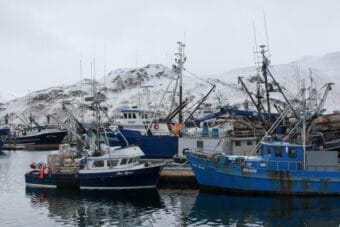
Commercial fishing vessels docked in the St. Paul Harbor in Kodiak; Feb. 6, 2023 (Brian Venua/KMXT)

Trump administration job cuts in the National Oceanic and Atmospheric Administration will result in less scientific information that is needed to set and oversee Alaska seafood harvests, agency officials have warned fishery managers.

Since January, the Alaska regional office of NOAA Fisheries, also called the National Marine Fisheries Service, has lost 28 employees, about a quarter of its workforce, said Jon Kurland, the agency’s Alaska director.

“This, of course, reduces our capacity in a pretty dramatic fashion, including core fishery management functions such as regulatory analysis and development, fishery permitting and quota management, information technology, and operations to support sustainable fisheries,” Kurland told the North Pacific Fishery Management Council on Thursday.

NOAA’s Alaska Fisheries Science Center, which has labs in Juneau’s Auke Bay and Kodiak, among other sites, has lost 51 employees since January, affecting 6% to 30% of its operations, said director Robert Foy, the center’s director. That was on top of some job losses and other “resource limitations” prior to January, Foy said.

“It certainly puts us in a situation where it is clear that we must cancel some of our work,” he told the council.

The North Pacific Fishery Management Council, meeting in Newport, Oregon, sets harvest levels and rules for commercial seafood harvests carried out in federal waters off Alaska. The council relies on scientific information from NOAA Fisheries and other government agencies.

NOAA has been one of the targets of the so-called Department of Government Efficiency, or DOGE, which has been led by billionaire Elon Musk. The DOGE program has summarily fired thousands of employees in various government agencies, in accordance with goals articulated in a preelection report from the conservative Heritage Foundation called Project 2025.

NOAA’s science-focused operations are criticized in Project 2025. NOAA Fisheries, the National Weather Service and other NOAA divisions “form a colossal operation that has become one of the main drivers of the climate change alarm industry and, as such, is harmful to future U.S. prosperity,” the Project 2025 report said.

The DOGE-led firings and cuts leave Alaska with notably reduced NOAA Fisheries services, Kurland and Foy told council members.

Among the services now compromised is the information technology system that tracks catches during harvest seasons — information used to manage quotas and allocations. “We really have less than a skeleton crew at this point in our IT shop, so it’s a pretty severe constraint,” Kurland said.

Also compromised is the Alaska Fisheries Science Center’s ability to analyze ages of fish, which spend varying amounts of years growing in the ocean. The ability to gather such demographic information, an important factor used by managers to set harvest levels that are sustainable into the future, is down 40%, Foy said.

A lot of the center’s salmon research is now on hold as well.

For example, work at the Little Port Walter Research Station, the oldest year-round research station in Alaska, is now canceled, Foy said. “We’re talking about the importance of understanding what’s happening with salmon in the marine environment and its interaction with ground fish stocks,” he said.

NOAA’s Little Port Walter Research Station is seen in this undated photo. (Photo by Heather Fulton-Bennett/NOAA Fisheries)
NOAA’s Little Port Walter Research Station is seen in this undated photo. This year’s research at the station, located south of Juneau, has been canceled. (Photo by Heather Fulton-Bennett/NOAA Fisheries)

Much of the work at Little Port Walter, located about 85 miles south of Juneau, has focused on Chinook salmon and the reasons for run declines, as well as the knowledge needed to carry out U.S.-Canada Pacific Salmon Treaty obligations.

As difficult as the losses have been, Kurland and Foy said they are bracing for even more cuts and trying to figure out how to narrow their focus on the top priorities.

Despite the challenges, Foy said, the Alaska Fisheries Science Center has managed to cobble together scheduled 2025 fish surveys in the Bering Sea and Gulf of Alaska, which produce the stock information needed to set annual harvest limits. Some of the employees doing that work have been pulled out of other operations to fill in for experienced researchers who have been lost, and data analysis from the fish surveys will be slower, he warned.

“You can’t lose 51 people and not have that impact,” he said.

It was far from a given that the surveys would happen this year, Foy said. The science center team had to endure a lot of confusion leading up to now, he said.

“We’ve had staff sitting in airports on Saturdays, not knowing if the contract was done to start a survey on a Monday,” he said.

Pressure for bigger harvests

At the same time the Trump administration is making deep cuts to science programs, it also is pushing fishery managers to increase total seafood harvests.

President Donald Trump on April 17 issued an executive order called “Restoring American Seafood Competitiveness” that seeks to overturn “restrictive catch limits” and “unburden our commercial fishermen from costly and inefficient regulation.”

Federal fishing laws, including the Magnuson-Stevens Fishery Conservation and Management Act, require careful management to keep fisheries sustainable into the future. Unregulated fisheries have collapsed in the past, leading to regional economic disasters.

Part of the impetus for the executive order, a senior NOAA official told the council, is the long-term decrease in overall seafood landings.

Prior to 2020, about 9.5 billion pounds of seafood was harvested commercially each year, said Sam Rauch, NOAA Fisheries’ deputy assistant administrator for regulatory programs. Now that total is down to about 8.5 billion pounds, Rauch said.

He acknowledged that the COVID-19 pandemic played a role in the reduction, as did economics.

At their Newport meeting, council members raised concerns that the push for increased production might clash with the practices of responsible management, especially if there is less information to prevent overharvesting.

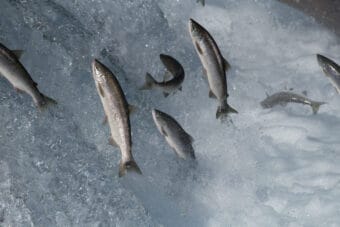
Juvenile Chinook salmon, also known as king salmon, are seen on July 12, 2006, swimming in the water in Togiak National Wildlife Refuge in Southwest Alaska. (Photo provided by U.S. Fish and Wildlife Service)
Juvenile Chinook salmon, also known as king salmon, are seen on July 12, 2006, swimming in the water in Togiak National Wildlife Refuge in Southwest Alaska. Cuts to the NOAA’s Alaska Fisheries Science Center have drastically reduced the ability of scientists there to analyze the ages of fish swimming in waters around Alaska, officials say. (Photo provided by U.S. Fish and Wildlife Service)

Nicole Kimball, a council member and vice president of a trade organization representing seafood processors, cited a “disconnect” between the goal of increased seafood harvests and the “drastically lower resources” that managers normally rely upon to ensure harvest sustainability.

The typical approach is to be cautious when information is scarce, she noted. “if we have increased uncertainty — which we’ll have with fewer surveys or fewer people on the water — then we usually have more risk, and we account for that by lowering catch,” she said at the meeting.

In response, Rauch cited a need to cut government spending in general and NOAA spending in particular. That includes the agency’s fishery science work, he said.

“We have to think about new and different ways to collect the data,” he said. “The executive order puts a fine point on developing new and innovative but also less expensive ways to collect the science.”

Even before this year, he said, NOAA was struggling with the increasing costs of its Alaska fish surveys and facing a need to economize.

The agency had already been working on a survey modernization program prior to the second Trump administration.

The Alaska portion of the program, announced last year, was intended to redesign fisheries surveys within five years to be more cost-effective and adaptive to changing environmental conditions.

Foy, in his testimony to the council, said job and budget cuts will now delay that modernization work.

“I can almost assuredly say that this is no longer a 5-year project but probably moving out and into the 6- or 7-year” range, he told the council.

Since Alaska accounts for about 60% of the volume of the nation’s commercial seafood catch, it is likely to have a big role in accomplishing the administration’s goals for increased production, council members noted.

Alaska’s total volume has been affected by a variety of forces in recent years. Those include two consecutive years of the Bering Sea snow crab fishery being canceled. That harvest had an allowable catch of 45 million pounds in the 2020-2021 season but wound up drastically reduced in the following year and shot down completely in the 2022-23 and 2023-2024 seasons because of a collapse in the stock.

Another factor is the shrinking size of harvested salmon.

Last year, Bristol Bay sockeye salmon were measured at the smallest size on record. The total 2024 Alaska salmon harvest of 101.2 million fish, one of the lowest totals in recent years, had a combined weight of about 450 million pounds.

Past years with similar sizes harvests by fish numbers yielded higher total weights. The 1987 Alaska salmon harvest of 96.6 million fish weighed a total 508.6 million pounds, while the 1988 Alaska salmon harvest of 100.6 million fish weighed in at 534.5 million pounds, according to the Alaska Department of Fish and Game.

Alaska Legislature makes progress on aid package for ailing seafood industry

Three fishing boats are on the grid in Petersburg’s South Harbor for cleaning and maintenance Thursday, May 17, 2018. (Joe Viechnicki/KFSK)

To help pull the struggling Alaska seafood industry out of its tailspin, state lawmakers passed some bills aimed at lightening the financial load on harvesters and advanced others that are intended to help businesses and fishery-dependent municipalities.

The bills stemmed from recommendations made by the Joint Legislative Task Force Evaluating Alaska’s Seafood Industry, which was created by lawmakers last year and which completed its work with a report at the start of this year’s session.

Lawmakers passed two task force-related bills, giving unanimous or near-unanimous support. One of them, House Bill 116, allows Alaska fishing organizations to establish their own insurance cooperatives. The other bill, Senate Bill 156, shores up the Alaska Commercial Fishing and Agriculture Bank with a long-term loan from the state to keep the cooperative organization in business.

The bills pose little to no costs to the state, according to legislative analysis. And they are only incremental steps toward addressing the big problems facing a major Alaska industry.

Multiple and often interrelated forces have dragged down nearly all sectors of the seafood industry: low fish prices resulting from glutted world markets, high operating costs, financial turmoil among processing companies, labor shortages and numerous stock collapses or poor returns tied to a variety of environmental conditions, including climate change.

While Alaska produces about 60% of the nation’s seafood, that volume is overwhelmed by international supplies and global economic forces, limiting lawmakers’ options to respond effectively, said Sen. Jesse Kiehl, D-Juneau.

“Our role is not as big as we imagine. That means the Legislature has only so many tools,” said Kiehl, who served on the task force. “But you see us, I think, turning the knobs.”

Beyond the bills passed this year, other bills resulting from the task force recommendations have advanced far enough to be approaching full floor votes; the Legislature works in two-year cycles, and bills introduced this year carry over to next year.

Those remaining seafood task force bills carry price tags for the state, however. They will get some extra scrutiny next year, given the state’s dire fiscal condition created by reduced investment earnings and lower oil revenues, task force members said.

“We are in new and unusual times where, you know, we have to look at every issue and try to decide if it’s worth the additional cost,” said Senate President Gary Stevens, R-Kodiak, who served as the task force’s chair.

Senate President Gary Stevens, R-Kodiak, Rep. Louise Stutes, R-Kodiak, and Rep. Bryce Edgmon, I-Dillingham, listen at a Nov. 13, 2024, hearing in Anchorage to testimony about problems facing the Alaska seafood industry. Stevens chaired the Joint Legislative Task Force Evaluating Alaska’s Seafood Industry, established earlier in the year, and Stutes and Edgmon were members. (Photo by Yereth Rosen/Alaska Beacon)

One bill, Senate Bill 135, would increase local governments’ share of seafood taxes that are currently split with the state government. Currently, fishery business and seafood tax revenues are split evenly between the state and local governments; the bill would allow the local governments up to 75% of those revenues.

Some fishing communities endured steep losses from the industry’s woes. The island community of St. Paul, for example, saw a drop of nearly 90% of its tax revenue in 2024 after key crab harvests were canceled, according to legislative information.

To Stevens, the sacrifice of state revenue through a smaller cut of fish taxes seems justified. Local governments’ troubles are likely to continue, he said. “I think that it’ll be even more apparent that we need to give those fellows a break,” he said.

High hopes for value-added product development

Another important bill that resulted from the task force’s report would broaden the state tax credit granted to companies that invest in equipment to create new seafood products, adding value to the fish they process. The two versions of the measure, Senate Bill 130 and House Bill 129, both had been sent to their respective bodies’ finance committees prior to last week’s adjournment of the session.

The annual cost to the state would range from $930,000 to $4.2 million a year, depending on different scenarios, according to the state Department of Revenue’s analysis of the Senate version.

That might be seen as considerable, Stevens conceded. “But I think it’s a fair cost,” he said.

It could improve the fortunes of the processing sector and potentially result in more revenues ultimately to the state, he said.

Kiehl has high hopes for the bill. It will encourage the development of high-end products, key to the industry’s recovery, he said.

“As much as our seafood as we can put into a premium space, that will help,” he said.

Differentiating Alaska salmon, for example, as a premium product is critical when competition comes from huge amounts of cheap Russian salmon harvested by fish traps rather than by small family businesses, he said.

At the same time, there are opportunities for Alaska fish oil and fish meal to be molded into new products like nutritional supplements, Kiehl said. Those opportunities could be explored by companies investing in equipment to add value to the raw fish they process, he said.

The budget that lawmakers passed also reflects task force recommendations for boosted state marketing efforts. The budget includes a $10 million allocation for the Alaska Seafood Marketing Institute, the state agency that promotes Alaska fish products domestically and internationally.

Gov. Mike Dunleavy vetoed a similar amount from last year’s budget but has expressed support for the ASMI funding this year.

An estimated 70 percent of Alaska’s fish is sold outside of the United States, according to ASMI. To Kiehl, that shows the importance of the organization’s international marketing.


Promotional stickers and pens touting the benefits of Alaska seafood are displayed on May 22, 2025, at the Alaska Seafoood Marketing Institute office in Juneau. (Photo by Yereth Rosen/Alaska Beacon)
Promotional stickers and pens touting the benefits of Alaska seafood are displayed on May 22 at the Alaska Seafoood Marketing Institute office in Juneau. The legislative seafood task force recommended boosted support for ASMI. (Photo by Yereth Rosen/Alaska Beacon)

“I don’t see a point in the next several decades when Americans buy all of our fish,” he said. “Americans aren’t eating salmon roe or herring roe. Americans don’t eat sea cucumbers.”

State and federal budget concerns

Not in the budget, however, is any significant increase for Alaska Department of Fish and Game fishery research, Stevens said.

That may be possible in the future if the state manages to bring in more revenue through tools like changes in oil taxes, he said.

More ominously, the Trump administration has slashed positions and fisheries research at the National Oceanic and Atmospheric Administration, with potentially dramatic impacts to Alaska.

“That’s really shocking,” Stevens said. “I am really concerned when the federal government talks about cutting science and research and all the things that they do right now to protect our fisheries.”

The state cannot replicate that work by NOAA and its National Marine Fisheries Service, he said.

“The assumption that some people make, ‘Oh, the feds can’t do it, the state will,’ However, we don’t have the money to do all these things,” he said.

Beyond fisheries, Stevens worries about deep cuts to federal social programs like Medicaid. “It’s going to be an enormous problem, maybe $1 billion, that the feds walk away from. We can’t fill that gap.”

Other fishery-related bills in addition to those recommended by the task force are also pending.

One of them, House Bill 125, would reconfigure the state Board of Fisheries by designating two seats each to the commercial, sport and subsistence sectors, with the seventh seat to represent the science community. Sponsored by Rep. Nellie Jimmie, D-Toksook Bay, the passed the House on May 17 by a relatively close 22-17 vote. It now moves to the Senate.

Hannah Scholosstein, international marketing and grants manager for the Alaska Seafood Marketing Institute, works in her office in Juneau on May 22, 2025, amid promotional materials. (Photo by Yereth Rosen/Alaska Beacon)
Hannah Scholosstein, international marketing and grants manager for the Alaska Seafood Marketing Institute, works in her office in Juneau on May 22 amid promotional materials. The budget passed by lawmakers includes $10 million for ASMI. Gov. Mike Dunleavy vetoed a similar amount last year, but he has indicated support for the funding this year. (Photo by Yereth Rosen/Alaska Beacon)

A bill introduced by Dunleavy would expand ASMI’s authority, allowing it to market mariculture products. The idea has received a mixed response from the mariculture industry; some kelp harvesters are receptive, but many key shellfish growers oppose it. The Senate version of the measure, Senate Bill 131, had reached that body’s finance committee by early May. The bodies’ finance committees are usually the last stops for bills before they put up for floor votes. The House version, House Bill 135, had not seen action since March.

Coastal Alaskans see commercial fishing limits as a ‘crisis.’ Lawmakers don’t.

Butch Laiti is president of the Douglas Indian Association, a tribal government in Juneau. The association has purchased a fishing boat and wants to buy a commercial fishing permit for its members to share, but a state law bars it from doing so. (Photo by Nathaniel Herz/Northern Journal)

For decades, an economic catastrophe has been unfolding in the Indigenous villages along the Gulf of Alaska, with lost jobs and the destruction of a traditional way of life: hauling fish from the sea.

That destruction is still playing out. More than 80% of people who responded to a recent survey sponsored by an economic development nonprofit said that Southeast Alaska and Kodiak Island villages are in a “crisis of sustainability” because of lost access to fisheries.

Indigenous leaders across the Gulf say it’s imperative that Alaska legislators pass reforms to the state law that they blame for the mess: a landmark 1973 statute that effectively prevents many residents of those coastal villages from earning a living by fishing for salmon.

New fishermen can only participate in the commercial harvest if they buy or inherit a state permit that, in some cases, can cost upward of $100,000 — putting it out of reach for young rural residents with no credit histories.

“We all have kids and grandkids that want to continue doing what their grandparents were doing a long time ago,” Joe Nelson, a top official with Southeast Alaska regional Native corporation Sealaska, said at a reception for lawmakers in Juneau last month.

a person speaking at a microphone
Joe Nelson, interim president of Southeast Alaska regional Native corporation Sealaska, spoke at a reception for state lawmakers and their aides in April. His green commercial fishing permit cards hung from his neck. (Photo by Nathaniel Herz/Northern Journal)

But just up the street from Sealaska’s offices, at the Alaska Capitol, the issue barely registers.

Many lawmakers in Juneau represent urban districts or regional population centers and aren’t aware of the crisis playing out in the state’s rural, coastal communities; instead, they’re focused on state schools funding and a widening budget deficit.

Those who do represent coastal areas say they have to balance the interests of village constituents with the interests of another, politically connected group: existing fishermen in hub towns and urban areas who depend on their harvests to feed their families — and who could be negatively affected by legislative change.

There’s also still no consensus among advocates about how, precisely, the law should be adjusted.

The result is that despite growing discontent with the 1973 law, and a widening coalition of stakeholders who support changing it, the issue has gone nowhere in Juneau. Advocates hoped for a hearing on the subject during this year’s legislative session, but one never materialized, and lawmakers have proposed no bills to address the problem.

“We’re operating under a law that’s been in place for 52 years, and it’s broke — it’s not meeting the demands of today,” said Robin Samuelsen, a Native leader from the salmon-rich region of Bristol Bay. The system needs to be changed, he said, or rural Alaska communities “are not going to survive.”

“One by one, they’re going to disappear,” he said.

a portrait of a man
Robin Samuelsen, a longtime fisherman and Alaska Native leader from the Bristol Bay salmon fishing hub town of Dillingham, posed for a photo there last year. (Photo by Nathaniel Herz/Northern Journal)

The 1973 law, known as the Limited Entry Act, was designed to make commercial fishing more profitable and sustainable by limiting the number of boats on the water.

Skippers who had been operating at the time largely qualified for permits without having to buy them. But a provision called “free transferability” meant those permits could be sold on the open market.

Over the years, rural Native communities have lost hundreds to Alaska’s larger population centers and other states as owners sold out or took permits with them when they moved.

Earlier this year, Northern Journal sent a survey on limited entry and rural fisheries access to 16 state senators and representatives whose districts border the Gulf of Alaska; none completed it. Approached by a reporter at the Capitol, several lawmakers declined to discuss the issues; some pleaded ignorance.

“We’re going to work on it, and we’ll try to do all we can,” Senate President Gary Stevens said. “But I don’t see any reason I need to meet with you on this.”

a man smiles at a meeting table
Senate President Gary Stevens has represented Kodiak Island in the Legislature for more than two decades. (Photo by Jenn Gifford/Courtesy of Alaska Senate Majority)

Stevens for 25 years has represented Kodiak Island, whose Indigenous villages were once home to proud commercial fishing fleets and a multi-generation heritage of fish-related trade.

Those communities have seen some of the state’s steepest permit losses since lawmakers approved limited entry more than 50 years ago.

One village, Ouzinkie, has a single skipper left in its harbor.

‘What’s the holdup?’

Butch Laiti started in the commercial fishing industry as a teenager in Juneau, where his family was part of a big Native fleet that harvested salmon from the Taku River outside of town.

At 76 years old, he’s watched for decades as members of his local tribe have sold off their boats and permits — making them largely bystanders as others harvest the salmon once claimed as tribal property.

Today, Laiti says he’s one of the few Native fishermen left in his area. And the Tlingit elder wants to pass his decades of maritime expertise and knowledge to a new generation.

Laiti is the president of a local tribal government, the Douglas Indian Association, and under his leadership, the tribe acquired a parcel of waterfront property in Juneau where it hopes to one day build a communally owned fish processing plant.

And, in 2022, the tribe spent $210,000 on a commercial fishing boat: a 42-foot gillnetter, which will double as a marine debris cleanup vessel.

a boat called "Ocean Gold"
The Douglas Indian Association’s F/V Ocean Gold was docked in a Juneau harbor in April. (Photo by Nathaniel Herz/Northern Journal)

Then, Laiti went to the state agency that oversees access to Alaska’s commercial fisheries to ask: Could the tribe also buy a permit to harvest salmon? That would give Laiti and other aging skippers the chance to take turns running the vessel and training aspiring young fishermen.

But the answer from the agency’s chairman was a hard no: The limited entry law only allows ownership by individuals, not by collectives such as companies or tribes. The lawmakers who designed the system in the 1970s wanted to keep fishing from being taken over corporate interests.

If the members of Laiti’s tribe want to own a permit and operate their boat collectively, they would have to change the law — a daunting proposition for an organization with no lobbyist and little muscle in Alaska’s Capitol.

But a broader network of advocates has also been readying an organized push for legislative reform. It includes the Indigenous-owned regional corporations for Southeast Alaska, Bristol Bay and Kodiak, along with The Nature Conservancy.

Those groups haven’t decided on specific legislative changes to push. But Laiti says that tribal ownership would be one straightforward fix to the limited entry law.

“This is ours. It always has been ours, and because we joined the United States of America, somehow we have lost control of everything that has belonged to us,” Laiti said. “If we’ve got to buy back our heritage, then so be it.”

He added a question for lawmakers: “What’s the holdup?”

‘Fiercely’ opposed

One reason for the holdup: the thousands of commercial fishermen who already own permits entitling them to chase a share of the harvest.

islands and boats in an ocean
Salmon fishing boats operate outside of the Southeast Alaska town of Sitka. (Photo by Nathaniel Herz/Northern Journal)

One group of such fishermen — a trade organization representing Southeast Alaska’s fleet of salmon gillnetters — ”fiercely” opposed a previous legislative proposal to allow community trusts to own permits, according to one of its leaders.

In an email, Max Worhatch, executive director of the United Southeast Alaska Gillnetters Association, rejected the idea that lawmakers should change the permit system to boost rural fishermen.

Native corporations and a regional fisheries nonprofit in Bristol Bay have plenty of capital, Worhatch said, and both can “easily afford” to support rural residents seeking state loans that are available to all Alaskans.

In fact, that regional fisheries nonprofit, Bristol Bay Economic Development Corp., already has a program that subsidizes local permit ownership. But it hasn’t stopped permits from leaving the region, and in fact, the losses have still accelerated in recent years, according to state data.

“We don’t have enough candidates from our communities stepping forward,” said Samuelsen, who served as the nonprofit’s board chair for three decades. “A lot of them say, ‘We don’t have the capital or the money to get involved.’”

Defenders of the current system say that the decline of the commercial fishing industry in remote villages is less about the limited supply of permits and more about the lack of demand for them.

“There are not tons of folks breaking down the doors to get into fishing,” Jerry McCune, a longtime Cordova-based fisherman and trade group lobbyist, wrote in a response to a Northern Journal survey of industry players.

a blue building says "Fishermen's Building" on the side
The Alaska Fishermen’s Building in Juneau houses the United Fishermen of Alaska, or UFA, one of several industry trade groups with a presence at the Alaska Capitol, which is just down the street. (Photo by Nathaniel Herz/Northern Journal)

McCune and some other industry veterans argue that factors outside the state’s control are at play: closures of processing plants in remote areas, shifts in salmon runs and reduced competition among the seafood companies vying to buy each vessel’s catch.

They also worry that even small changes to the permit regime risk upending the whole limited entry system — and, potentially, invite legal challenges.

“Limited entry is a very complicated document,” McCune said. “Change one thing and limited entry could collapse.”

Attorneys for the state have raised questions about the constitutionality of ideas like permit trusts.

But Jim Brennan, a longtime Alaska attorney who provided legal support to the attempt to create those trusts a decade ago, dismissed McCune’s concerns. The overall permit system, he said, has survived previous court challenges.

“I think that’s kind of a scare tactic,” he said. “It’s not a house of cards.”

‘Does it force the other side down?’

Lawmakers say they need to approach the issue of permit access deliberately — balancing the needs of rural communities with those of existing fishermen.

Kodiak Rep. Louise Stutes, who chairs the House Fisheries Committee, said in a statement that any legislative proposals would have to accommodate different constituencies.

“I certainly support reducing barriers to accessing fisheries for Alaskans and keeping permits in rural communities,” she said. “However, I also believe that any potential change to limited entry needs to be the result of a stakeholder-driven process with existing permit holders, rural constituents, affected communities and the Department of Fish and Game.”

a woman in a meeting room
Rep. Louise Stutes of Kodiak chairs the House Fisheries Committee. (Photo by Loren Holmes/Anchorage Daily News)

The Alaska fishing industry’s own broader economic crisis is making the policy discussion even more sensitive. Oversupply, flagging demand and growing global competition have depressed prices paid to fishermen in recent years — putting many skippers in the red.

Sitka Rep. Rebecca Himschoot, who represents multiple Southeast Alaska fishing hub towns, as well as small Native communities that have seen sharp losses in permit ownership, said that the increasingly tough outlook for the industry has complicated the task for lawmakers.

“It’s really hard to say we’re going to come in and fix this problem that’s been cooking since 1970 — when people in the fishery now can’t even make their living,” she said.

boats in a line
Commercial fishing boats sit in the harbor in the Kenai Peninsula town of Homer last year. (Photo by Nathaniel Herz/Northern Journal)

Nonetheless, Himschoot added, she’s alarmed by permit losses in villages in her district and wants to explore ways to restore them without harming current permit owners.

But she acknowledged that the issue is politically delicate.

“When we lift up one side, does it force the other side down?” she asked.

This piece was originally published in Northern Journal, a newsletter and news website. Subscribe here.

Oregon seafood company looks into buying Peter Pan’s King Cove plant

Peter Pan's King Cove facility, pictured in June 2024, has been out of operation since January of that year.
Peter Pan’s King Cove facility, pictured in June 2024, has been out of operation since January of that year. (Theo Greenly/KUCB)

Representatives from Oregon-based Pacific Seafood could be interested in buying the shuttered Peter Pan processing plant in King Cove, according to local officials from the Alaska Peninsula community.

At Thursday’s Aleutians East Borough Assembly meeting, King Cove Mayor Warren Wilson said that representatives from the seafood company had visited the plant the week before.

“They were very impressed with the plant, and they are moving forward with some talks on acquiring the facility,” he said during the public comment period, speaking as a community member. “So there is interest yet.”

Peter Pan ceased operating in King Cove in January of last year and was placed into a court-ordered receivership a few months later. After a legal dispute, the property was awarded to Peter Pan Chief Executive Rodger May. May has faced criticism over Peter Pan’s business practices, including failing to pay fishermen for the 2023 salmon season.

The plant was a major economic driver for the Alaska Peninsula community of about 800 residents. City Administrator Gary Hennigh said it generated about 70% of the city’s revenue.

“We’re not quite living on borrowed time yet, but we’re getting pretty darn close,” he said in an interview Tues.

Hennigh said he’s encouraged by the interest but cautioned that, even if there should be a deal for the plant, it is too late to restart operations for the upcoming salmon season, which opens early next month.

“Common sense just tells me it’s just not meant to happen for this summer salmon season,” he said.

Pacific Seafood has expanded in recent years. The family-owned company says it operates about 40 facilities across the U.S., Canada and Europe, including a former Trident plant in Kodiak that it acquired last year. The company did not respond to a request for comment.

Processors haven’t announced prices for the upcoming salmon season, but fishermen are expecting a higher payout for sockeye after several years that saw historic lows.

Alaska Sen. Sullivan pushes U.S. government to complete key stock surveys, fight illegal fishing amid possible NOAA funding cuts

At a Commerce Committee hearing this month, Sen. Dan Sullivan pushed for Deputy Secretary of Commerce nominee Paul Dabbar to make sure a contract was signed so the Oscar Dyson — a research vessel from Kodiak — could perform important fish stock surveys. The Oscar Dyson sits at Kodiak's Pier 2 on April 15, 2025.
At a Commerce Committee hearing this month, Sen. Dan Sullivan pushed for Deputy Secretary of Commerce nominee Paul Dabbar to make sure a contract was signed so the Oscar Dyson — a research vessel from Kodiak — could perform important fish stock surveys. The Oscar Dyson sits at Kodiak’s Pier 2 on April 15, 2025. (Brian Venua/KMXT)

The U.S. Senate Committee on Commerce, Science and Transportation unanimously passed a seafood bill on April 30 to fight illegal fishing. The legislation would rely on efforts from the National Oceanic and Atmospheric Administration, which Sen. Dan Sullivan said is already struggling to complete key fisheries surveys.

Sullivan co-sponsored the Fighting Foreign Illegal Seafood Harvest, or FISH, Act with seven other senators, including Republican Sen. Lisa Murkowski. Sullivan said he hopes it will help fight unfair trade practices and give a boost to Alaska’s fishing industry.

Sullivan said the act takes aim at foreign illegal, unreported and unregulated, or IUU, fishing.

“It would blacklist foreign vessels and owners that have engaged in IUU fishing — it’s mostly Chinese,” Sullivan said. “And it would provide much more enforcement with regard to our Coast Guard’s ability to increase at-sea inspections.”

Any blacklisted vessels would be prohibited from accessing U.S. ports, traveling through U.S. territorial seas, except in accordance with customary international law, making deliveries in U.S. waters, or receiving services from American vessels.

According to Sullivan, the U.S. Coast Guard would largely be responsible for the enforcement of IUU fishing violations. Still, NOAA would be required to build and maintain the “blacklist” of vessels.

At a separate Commerce Committee hearing the following day, Sullivan pushed for the Deputy Secretary of Commerce nominee Paul Dabbar to give government signoff for key fisheries surveys. He told Dabbar that while the Biden Administration was given increased funding for NOAA, they missed out on the “blocking and tackling” of their job, failing to complete stock assessment surveys.

“You guys came in, ‘Hey, we’re not going to be like Biden,'” Sullivan told Dabbar at the confirmation hearing. “But you’re not — I’m getting really worried that you guys aren’t doing this either. When you don’t do stock assessment surveys, you know what happens? My fishermen can’t fish.”

He pushed Dabbar to make sure a contract was signed with the Oscar Dyson — a research vessel from Kodiak — so that it can head out to perform important fish stock surveys.

I kind of was kicking him in the rear a little bit,” Sullivan told KUCB after attending the nomination hearing for Dabbar. “His staff was watching. And I’m saying, ‘Go do your job.'”

According to a spokesperson with Sullivan’s office, the Commerce Department approved the contract for the Oscar Dyson to undergo scheduled maintenance. They say it should ensure that future surveys are not delayed.

Sullivan said he told the Trump Administration that NOAA needs the staff and funding to complete those surveying tasks.

“The federal government has two responsibilities: one is to do the surveys and one is to make sure they have the regulatory approvals to open fisheries,” Sullivan said. “That’s not a lot to ask.”

However, it could be with proposed funding cuts to NOAA. And NOAA would play a major role in enacting Sullivan’s FISH Act.

But Sullivan said more funding doesn’t necessarily generate a more productive outcome.

“Even when you give a federal government, in this case, the Biden administration additional funding, that doesn’t mean they’re doing the blocking and tackling of what NOAA is supposed to do — and that is basic fish surveys, species surveys, data surveys — so our fishermen can go fish,” he said.

A large chunk of the Trump Administration’s proposed funding cuts would take aim at climate-dominated research and grant programs. That wouldn’t necessarily affect any stock assessments. However, the National Marine Fisheries Service — also referred to as NOAA Fisheries — is responsible for the management, conservation and protection of marine resources off the U.S. coast. They predict fish stock status, set catch limits and ensure compliance with fisheries regulations. NMFS is facing a possible cut of around 30% to its operational and personnel budget.

Similarly, climate-based research helps scientists and fisheries regulators make educated and sustainable decisions for Alaska’s fisheries.

Sullivan said while the key is to do the surveys, “We need to look at all components of the science, including what climate change has done with regard to our fisheries.”

He said the government has a duty to allow fishermen to fish, under any administration. And at the moment, he is focused on making sure legislation helps fight unfair foreign trade practices, like forced labor and threats to maritime security.

What I’ve been trying to do is encourage this administration, the last administration, through executive action and through my legislation to go on offense, to protect our fishermen — fishing communities like Unalaska — and enable them to have stronger markets in America, stronger prices, and not to have to compete against fishing fleets that have practices that are unfair,” Sullivan said.

Among Alaska industry partners, though, there is a more pressing concern right now about how tariffs might directly affect things like dock prices. Sullivan didn’t have an answer for how the tariffs might hit the state’s fishing industry. He says the ultimate goal of the Trump Administration’s threat to increase tariffs is to see them reduced.

“They are undertaking trade negotiations to actually — that will hopefully have the end result of not retaliation, but lower tariffs across the board that will actually help our seafood industry,” Sullivan said.

A large amount of the state’s seafood is processed overseas. Sullivan said the majority of that should be protected from any retaliatory tariffs.

For Alaskan seafood exporters, when they are catching fish and then that’s getting processed overseas, there’s an exclusion of 20% or more of a product from tariffs if 20% of the more that product is domestic and was sent overseas for processing,” he said.

Customs and Border Protection has excluded products from reciprocal tariffs as long as they meet that 20% limit for U.S.-originating product.

While Sullivan’s Fish Act has been unanimously approved by the Commerce Committee, it will have to be heard on the House and Senate floors before heading to the President’s desk to be signed into law.

Alaska oyster farmers refine growing techniques to meet high demand

Canoe Lagoon oysters ready to be shipped to processing plant in Wrangell on April 27, 2025. (Colette Czarnecki/KSTK)

A charter cabin cruiser’s engine quiets down on the approach to Canoe Lagoon Oyster Farm about an hour and a half from Wrangell. The tide isn’t high enough to pass through the inlet right next to the farm though, so farm owner Brian Herman pulls over to wait.

“I’m not going to sneak in there, because of all these freaking logs,” Herman said. “We have oysters staged on that beach.”

Herman said there’s a huge demand for his product. But the shellfish isn’t native to the state and that makes it difficult to grow oysters that are hearty enough to reach dinner plates in state and Outside.

Herman bought the business in 2020 and has been refining his techniques through a lot of trial and error.

He buys the Pacific oysters as seeds to grow on his farm. He has a few different brands, including small Beach Bums and medium-sized Rose Islands. He said it’s not hard to find buyers.

“Every Alaskan oyster is in high demand. There’s not enough oysters in the market,” he said. “Cold water oysters are considered a premium oyster. And Alaskan oysters are so unique because there’s so few of them here.”

According to the McKinley Research Group report, Alaska’s oyster harvest was forecast to triple between 2023 and the end of 2025.

Canoe Lagoon is one of 16 active oyster farms that are part of the Alaska Shellfish Growers Association. The association, which represents oyster farms from all over coastal Alaska, from Ketchikan to Kodiak, has doubled the number of active farms it represents over the last decade. President Weatherly Bates said she thinks there’s room for a lot more.

“There’s not enough oysters produced even in the state to fulfill the state’s demand for oysters during the summer and cruise ship time,” she said. “Oysters are brought in from other places.”

She said that the oyster industry in Alaska consists mostly of small family farms, which makes it difficult to keep up with the demand, especially during tourist season at Alaska restaurants.

“I feel like the sky’s the limit since there’s a huge demand because oysters are growing in popularity,” Bates said. “And with fisheries worldwide declining, there’s more and more of a need to have aquaculture species available.”

She said Alaska’s oysters are in high demand in part because of the cold and pristine waters, since that can help lower risks of illness caused by oysters.

Newer growing methods

To take advantage of the demand, Herman has to get better at growing oysters. And he is improving. He’s found they grow better when they’re closer to the water’s surface with fewer oysters in float bags, the mesh bags oysters grow in that rest close to the surface.

“You’re trying to force something to grow that doesn’t really want to be here, but we’re proving that you can do it, and you can do it fast,” Herman said.

Canoe Lagoon Oyster Farm employee Matt Lemma (left) and owner Brian Herman (right) discuss farming techniques on April 27, 2025. (Colette Czarnecki/KSTK)

When the tide rises high enough to get to the farm, Herman’s full-time employee, Matt Lemma, gives a tour. He’s excited to see last year’s oysters growing so fast.

“All those brand new black bags there, this entire set, and that entire set, every single one, is the June ‘24 plant that I’ve been babying,” he said. “It’s crazy. It’s crazy.”

“They look better than the 2022’s,” Herman replied.

Matt Lemma tends to oysters at Canoe Lagoon Oyster Farm on April 27, 2025. (Colette Czarnecki/KSTK)

“No two oysters are the same.”

Many of the oysters will be harvested in a couple months, after a year of growing.

Herman said he’s expanded the business a lot over the last five years and that’s eaten into profits. He thinks the business will do much better this year though.

He said Canoe Lagoon’s oysters have more of a vegetable flavor to them, like a fresh cucumber.

“That’s what’s so cool about oysters is, yes, everybody on the West Coast is growing Pacific oysters, right? But no two oysters are the same,” Herman said. “So even the ones on Prince of Wales will taste completely different than ours, and they’re 20 miles away.”

If all goes well, he expects to ship oysters both in state and out of state. As of right now, he ships in state and to one restaurant in Arizona. He said some restaurants in New York have contacted him, but he needs to produce more and he thinks this year might be the year.

Site notifications
Update notification options
Subscribe to notifications