Fisheries

Seafood industry urges US to ease trade tensions

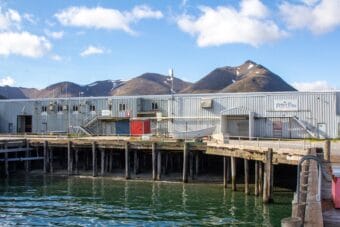
The At-Sea Processors Association represents most of the catcher-processor vessels in the Bering Sea pollock sector, including the Northern Hawk, seen here in Unalaska’s Port of Dutch Harbor in February 2025. (Theo Greenly/KUCB)

Two of Alaska’s leading seafood trade groups are urging the federal government to back off aggressive trade policies, warning that new tariffs could trigger international retaliation and deepen the state’s seafood industry crisis.

The At-Sea Processors Association and the Pacific Seafood Processors Association sent a letter on March 11 to the U.S. trade representative, a cabinet-level official in the Trump administration, which said the industry is already under pressure from foreign tariffs and what they call unfair competition from overseas producers.

The groups argue that new tariffs imposed by the U.S. could prompt the European Union or nations like China or Japan to strike back, which could further strain Alaska seafood exports.

At-Sea Processors Association CEO Matt Tinning said in an interview that retaliatory tariffs could jeopardize the industry, which relies heavily on trade.

“We really do live and die by fair access to those export markets,” he said.

The trade group represents most of the large catcher-processor vessels that fish pollock in the Bering Sea — a major segment of the state’s commercial seafood industry.

Tinning said U.S. producers face mounting challenges from Russian seafood, which has flooded global markets in recent years.

“We face unfair competition in global markets,” he said. “Unfair competition from low-cost producers who aren’t held to appropriate labor and environmental standards. In the seafood space, the worst offender is Russia.”

While the Biden administration closed a loophole that allowed Russian fish into the U.S., American producers still struggle to compete overseas.

Existing tariffs are part of that struggle. During the 2018 trade war with China, China imposed varying degrees of tariffs on American seafood, reaching as high as 35%. The tax stabilized at 30% until this month, when China announced an additional 10% in response to the new tariffs Trump announced March 4.

The European Union, one of Alaska’s biggest export markets, also continues to levy tariffs from the previous trade conflict, even as its own products enter the U.S. duty-free.

The At-Sea Processors Association said it isn’t necessarily opposed to reciprocal tariffs, but warned that Alaska’s seafood sector is particularly vulnerable. About two-thirds of the state’s seafood production is exported, and processors fear any retaliation could further erode their competitiveness.

The groups also raised concerns about European labeling rules, which allow pollock caught and processed in Russia or China to be sold as “Alaska pollock.” While technically a species name, U.S. producers argue the label misleads consumers and damages the brand identity of wild Alaska seafood.

In their letter, the groups said the combination of foreign tariffs, labeling confusion and global overproduction has left the industry in a fragile position. If retaliatory tariffs target U.S. seafood, they warned it could “bring about an end to the economic lifeblood we provide to rural communities across Alaska.”

Silver Bay Seafoods announces buyout of OBI

The Petersburg Fisheries seafood processing plant (shown) has changed hands multiple times in recent years, from Icicle to OBI to Silver Bay. (KFSK file photo)

Sitka-based Silver Bay Seafoods is buying out the international seafood processing giant OBI.

Silver Bay announced the acquisition on Tuesday, stating that it is partnering with the Bristol Bay Economic Development Corp.

In a press release, Silver Bay says it plans to manage all OBI facilities and operations, including processing plants in Petersburg, Seward, Kodiak, Larsen Bay, Egegik, Wood River, Cordova, and Naknek, as well as a warehouse and labeling facility in Kent, Wash.

The processing plants produce salmon, whitefish and crab products.

The takeover has long been rumored, with visits by Silver Bay officials to some of the plant sites.

Silver Bay is a fishermen-owned company that operates 13 plants in Alaska and on the West Coast.

OBI was created in 2020 when two large seafood companies merged – Icicle Seafoods and Ocean Beauty Seafoods. Silver Bay is acquiring Icicle’s stakes in OBI. Bristol Bay Economic Development Corporation acquired half the stakes in Ocean Beauty Seafoods back in 2007 before it became OBI.

Federal fisheries employees in Alaska have been reinstated, but most are not allowed to work

The NOAA ship Okeanos Explorer visits Dutch Harbor in August 2023 while on a trip to map the ocean floor. (Andy Lusk/KUCB)

Employees who were fired last month from the agency that oversees federal fisheries in Alaska were reinstated on Monday morning. That came in response to a federal judge’s ruling that the Trump administration’s mass layoffs of thousands of workers were unlawful.

Most of the probationary employees fired from the National Oceanic and Atmospheric Administration have been reinstated. But most have been put on “non-duty” status, which prevents them from actually returning to work.

“They have basically placed us in a paid status, but we’re not returning to work necessarily,” said Rebecca Howard, one of 13 employees at NOAA’s Alaska Fisheries Science Center who were fired last month. She received an email Monday morning saying that she had been reinstated.

In Alaska, the agencies that were hit by the layoffs also include the National Park Service and U.S. Forest Service.

But two separate rulings came down Thursday that called the across-the-board firings unlawful. In one of them, U.S. District Judge James Bredar of Maryland ordered the reinstatement of probationary employees at 18 federal departments, including the Department of Commerce, which oversees NOAA. The decision places a temporary stay on the terminations.

The department complied, but some within NOAA say communication has been lacking.

“My supervisor wasn’t informed. I had to inform her, as was the case for everybody up the chain at the Alaska Fisheries Science Center,” Howard said. “I don’t think that anyone was told when these would be coming out.”

The U.S. Office of Personnel Management, which directs human resources within the federal government, lays out protocols for layoffs that are due to things like budget cuts or agency restructuring. Employees terminated under these circumstances receive protections, including priority for reemployment, severance pay or retirement benefits.

But last month’s mass terminations cited poor performance, essentially stripping those employees’ protections. And the reinstatement notices tell employees that the Department of Commerce “may revert your prior termination” if the department prevails in the Marland litigation.

“It’s kind of harsh because it basically tells us that they may retroactively fire us later if they win in this court case,” Howard said.

The temporary order expires March 31, and a hearing is scheduled March 26.

Decades after commercial fishing limits gutted Native fishing fleets, advocates call for change

Angoon on Sunday, Oct. 27, 2024. (Clarise Larson/KTOO)

Listen to this story:

A half-century ago, Angoon’s harbor was packed with small, family-operated fishing vessels. Salmon and halibut fed mouths and bank accounts.

Peter Duncan, Mayor of Angoon, remembers those days. But it’s not the same anymore. Fisheries limitation regulations have caused “devastating changes,” he said. “You just don’t find a troller in our harbors anymore.” That’s caused his village to depend more on government assistance programs, including food stamps, he said. 

Duncan grew up fishing on his father’s seiner in the small Lingít village on Admiralty Island. He graduated to his own troll boat and commercially fished until the early 1990s, when he said he couldn’t make a living that way anymore.

He said the opening date for the king salmon fishery was pushed later in the season, when most fish had already gone further into the inside waters and up rivers to spawn. Folks weren’t catching enough salmon to make money, so permits became more valuable to sell. 

“A lot of boats, you know, they just sold out, and they, they couldn’t do it anymore, and they’ve tried,” he said. 

Many of those fishing permits left the island, and with them went the means for the village to sustain itself.

“It’s sad to know that at one time, we used to be a strong fishing fleet that took pride in going out and going fishing and making something for ourselves,” Duncan said. 

Aerial view of Angoon in 2017. The Southeast RAC is recommending making lower Admiralty Island off-limits to sport hunters during deer season. (Emily Russell/KCAW Photo)

Duncan’s story isn’t unique. This reality has unfolded in most rural villages throughout the Gulf of Alaska, as first reported by Northern Journal. In part, it’s an unintended consequence of a state law that took effect in 1975, called the Limited Entry Act, which allowed the state to issue a set number of permits for each fishery. The goal was to address a sustainability problem. At the time, salmon populations were plummeting while commercial fishermen multiplied. The idea was simply to cap the number of people fishing, so there would be enough to go around. 

But that’s not what happened in Native villages. Courtney Carothers, an environmental anthropologist at the University of Alaska Fairbanks, led a survey of 3,024 Sealaska Corporation shareholders and descendants about the community impacts of fisheries limitation policies. 

She found that Sealaska villages owned half as many fishing vessels in 2019 than they owned in 1978, and held 38% fewer commercial salmon permits than they held in 1975. 

“This is not good public policy if our communities in the Gulf of Alaska — surrounded by the ocean with thousands of years of fishing knowledge and history — within one generation, are cut out,” Carothers said. “I mean, this is an absolute crisis.”

Joe Nelson is interim President of Sealaska Corp., representing Lingít, Haida and Tsimshian interests in Southeast Alaska. His airy corner office in downtown Juneau looks out over Gastineau Channel. On a recent afternoon, clouds trundled into the snowy peaks of Douglas Island. Glossy magazine copies of Carothers’ study were spread out on a table.

The report points to a loss of fishing access as one of the main reasons people leave their rural villages. Nelson has watched this happen. 

“It’s all been going one way, and that’s migration out of most of the fleet and most of the permits,” Nelson said. 

That’s caused families to leave and village populations to dwindle, he said, which in turn leads to schools and other services closing down. And those who stay behind are aging out of the industry without enough young people to pick it up, he said.

“So the whole economy just shrinks. It’s much bigger than a single fisherman that decides not to show up anymore,” Nelson said. 

He’s calling for the state to adjust the limited entry system so that native communities can fish commercially “without going bankrupt.”

Today, a seine permit in Southeast is worth about $140,000 and a drift permit is worth about $44,000 for the salmon fisheries, according to Reid Johnson, the research and planning project leader at Alaska’s Commercial Fisheries Entry Commission. Those numbers vary, depending on how well a fishery is doing.

Johnson says that while the Limited Entry Act helped make Alaska’s fisheries more sustainable, it created this new problem for rural villages. Now, the Commission is talking internally about potential solutions.

“There have been ideas that have been floated, such as making it administratively easier to transfer a permit to another rural resident in the same area that you live in,” Johnson said. 

Carothers suggests there could be room for creating a new class of permit, such as an entry-level or small-scale permit, to get people started. But any such changes would have to come through the state Legislature. 

There’s also a potential federal pathway for guaranteeing Indigenous fishing access, which was not compensated for through the Alaska Native Claims Settlement Act that distributed roughly 45 million acres and $1 billion to tribes in 1971.

“That act preceded any limitation of fisheries, and there was compensation for land, but not for fish,” Carothers said. “So I personally think there should be a repatriation of rights, because they’ve been taken away, dispossessed, in ways that I don’t think were fair.”

Sealaska is not advocating for specific policy changes just yet. Nelson says there must be open, public discussions that look at a slew of ideas for how to restore fishing access to Native villages. But first, he wants state officials to recognize that there is a problem. 

Alaska fisher gets six months in federal prison for attempting to kill endangered whale

A sperm whale is seen in an undated photo published by the National Oceanic and Atmospheric Administration. (NOAA photo)

A federal judge in Juneau has sentenced a Southeast Alaska fisher to six months in federal prison after pleading guilty last year to one count of misreporting a fish catch and one count of violating the Endangered Species Act for directing his crew to kill a sperm whale.

Dugan Paul Daniels had previously agreed to the sentence as part of a plea agreement, and Judge Timothy Burgess confirmed the imposition of sentence in a hearing Monday morning.

The six-month sentence was at the top of the sentencing range allowed by the plea deal and in line with what prosecutors had requested.

While it isn’t clear whether Dugan Paul Daniels’ crew successfully killed the whale after Daniels ordered them to shoot it, federal law prescribes the same punishment for an attempted kill and an actual one.

In addition to the prison sentence, Daniels will pay a $25,000 fine and be banned from commercial fishing for one year. He also must perform 80 hours of community service.

According to court filings by prosecutors, Daniels was fishing in Southeast Alaska waters in March 2020 when a whale began taking fish from his fishing gear, damaging it. Similar behavior has been seen up and down Alaska’s coast, but prosecutors believe this is the first time that a fisher has tried to kill a whale in retaliation.

According to messages sent via his GPS unit, Daniels directed a crew member to shoot the whale, tried to ram it with his fishing boat, then tried to kill it by reeling in his fishing gear while the whale was trapped in it.

In a written statement about the sentencing, newly appointed Alaska U.S. Attorney Michael Heyman said, “Let this sentence serve as an example that these violations will not go unpunished.”

Alaska hunters, researchers say whales and fish are changing their migration patterns in the warming climate

Two humpback whales feed in Beaufort Sea, northeast of Point Barrow. (Kate Stafford)

Catching salmon in the North Slope village of Kaktovik was unheard of not too long ago. But resident Robert Thompson says some fishermen now see salmon more regularly. About five years ago, he caught a dozen salmon – a small but noticeable number.

“Before it was unusual, and people would talk about it, that somebody got a salmon,” Thompson said. “Now it’s fairly common.”

Fishermen, hunters and researchers gathered at the Alaska Marine Science Symposium in Anchorage in January to discuss how several fish species and marine animals are changing their migration patterns in the warming climate. That includes humpbacks gaining new ground up north, bowheads expanding their diet and salmon observed in the Arctic.

Salmon are spawning in the Arctic

Elizabeth Mik’aq Lindley is a graduate student from Bethel who grew up fishing for salmon. Now she studies Pacific salmon in the Arctic.

In 2023, she and other researchers installed temperature loggers at the depth of salmon nests in several rivers – including the Anaktuvuk River, which runs through Gates of the Arctic National Park and Preserve.

“If it gets too cold, the stream can freeze straight through to the bottom, into these nests, and embryos will freeze and die,” Lindley said.

Anaktuvuk River is seen from above On Sept. 14, 2023.
Anaktuvuk River is seen from above On Sept. 14, 2023. (Peter Westley)

Temperature also influences incubation and when embryos will hatch and start making their way to the ocean.

But in a year of tracking the water temperature, the researchers never saw it get below freezing. They also estimated that salmon emerged around August. That’s later than in other parts of the state, but it’s the optimal time for the Arctic. While more data is needed to see if salmon populations are growing in Arctic rivers, the conditions seem survivable.

“Salmon are spawning in the Arctic,” Lindley said, “and it does seem like it’s thermally survivable, thermally possible and plausible that they can incubate and emerge at the right time, given these temperatures.”

Bowheads are expanding their foraging grounds

The warming environment has also been affecting bowhead whales.

Traditionally, bowheads travel south to spend their winters feeding on krill in the Bering Sea. But with ice conditions reshaping the zooplankton community, the animals have been delaying that migration — or even staying in the Chukchi and Beaufort Seas all winter.

Marine ecologist Clarissa Ribeiro Teixeira looked at the whales’ baleen plates to better understand the change. Elements that make up baleen plates – stable isotopes of nitrogen and carbon – can offer a window into an animal’s diet and movements. Each plate grows continuously and has information from about 20 years of the whale’s life, she said.

Marine ecologist Clarissa Ribeiro Teixeira speaks during the Alaska Marine Science Symposium on Jan. 30, 2025.
Marine ecologist Clarissa Ribeiro Teixeira speaks during the Alaska Marine Science Symposium on Jan. 30, 2025. (Alena Naiden)

Teixeira and her colleagues sampled baleen sections from 11 whales harvested on the North Slope over two decades. They also looked at the ice conditions during those years. What they discovered was that after 2016, when there was very little ice, bowheads shifted their behavior.

“The reduction in the sea ice cover may have influenced the prey availability distribution for these animals, motivating bowhead whales to explore new foraging habitats or include a wider composition of their prey sources into their diet,” she said. “That’s amazing, because it shows how resilient these individuals are, right?”

Humpbacks are frequenting the Arctic

Less ice might also mean new territory for humpback whales.

Kate Stafford, who is an oceanographer and a professor at the Marine Mammal Institute at Oregon State University, studies bowheads in the Arctic. But in 2021, she and her late colleague Craig George saw a whale that, to their surprise, turned out to be a humpback – a species that was once rare in the Utqiaġvik area.

“You just never know what you’re going to find,” she said. “We all need to take our eyes off of our phones and watch the water.”

Birds surround a humpback whale in Beaufort Sea.
Birds surround a humpback whale in Beaufort Sea. (Kate Stafford)

Stafford says data from local whalers and aerial surveys points to more humpbacks visiting the area.

In Utqiagvik, humpbacks were sighted only twice before 2021 and two or three times in years after that. Then, last fall, researchers saw more than 25 whales feeding close together for two days in a row.

“We came across what I would call Humpback Palooza,” Stafford said. “Just dozens of humpback whales, which was crazy.”

Researchers took photos of whales and uploaded them to Happywhale, a citizen science project that helps identify whales using a technology similar to face recognition. Several of the whales seen near Utqiaġvik matched whales seen in Hawaii breeding grounds.

Young humpbacks usually follow the migration patterns they learn from their mothers, Stafford said. Because researchers observed multiple mother-calf pairs, the whales might return to the area.

“This does suggest, at least to me, that humpbacks are here to stay near Utqiaġvik, at least so long as there’s something to eat,” she said.

Kate Stafford speaks during the Alaska Marine Science Symposium on Jan. 30, 2025.
Kate Stafford speaks during the Alaska Marine Science Symposium on Jan. 30, 2025. (Alena Naiden)

Utqiaġvik whaler Michael Donovan said he did not witness Humpback Palooza, but he has seen a few humpbacks during his fall hunts. He said that he and other whalers are worried the humpback whales might be competing with bowheads — a staple subsistence resource for his community — for krill and copepods.

“They’re an invasive species, you know. They come in and eat the same food that our bowheads eat,” Donovan said.

Donovan and other hunters say they support scientists studying species that are growing their presence in the Arctic’s warming waters. Meanwhile, Stafford said scientists rely on people like Donovan for their research.

“The hunters and whalers, they’re really good naturalists, they’re really good observers and biologists,” she said. “They need to understand the seasonality of animals, the behavior of animals, how the environment impacts animals.”

Stafford says that local hunters contribute so much to her research, she’s grateful when her work can help them, too.

Site notifications
Update notification options
Subscribe to notifications