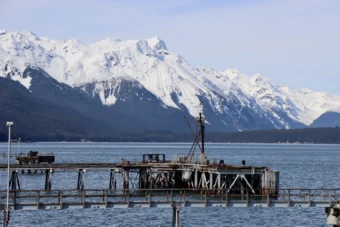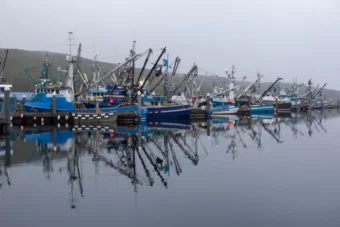
Douglas Island Pink and Chum Inc., or DIPAC, on Jan. 6, 2025. (Photo by Yvonne Krumrey/KTOO)
The Juneau Assembly voted this week to formally oppose an Alaska Board of Fisheries proposition that would limit Southeast Alaska hatchery production of pink and chum salmon by 25%.
The proposition is intended to address the effects of hatchery salmon on wild salmon. Studies show that hatchery fish that return to other spawning areas may be competing for resources with wild fish.
The Assembly’s resolution says that more than half of Southeast Alaska’s 2024 commercial harvest value came from hatcheries, and a reduction would negatively impact the region’s economy.
Assembly member Alicia Hughes-Skandijs objected to the resolution, saying she felt the city lacks the scientific expertise to weigh in on this issue, and that she would rather the Board of Fisheries use their knowledge to rule on the proposition.
“I care about our wild stock tremendously, and I want to make sure fish are going to be here,” she said. “And if there’s any question that the hatchery fish are impacting wild fish and affecting genetic diversity, then I wouldn’t want to jump in and say, ‘Don’t do that.’ I would want them to review the data and make an informed decision, which I can’t do with this.”
The head of Juneau’s local hatchery attended the meeting to answer questions about the resolution. When asked about the impact of the Assembly not adopting it, Douglas Island Pink and Chum (DIPAC) Executive Director Katie Harms said the city would be out of alignment with other Southeast communities whose municipal governments already opposed the resolution.
“And then if this proposal at the Board of Fish were to pass, it would lead to significant economic harm in the Juneau community,” she said. “A 25% reduction in chum salmon production would lead to a likelihood of potential for the two seafood processors in town to be unable to operate year round.”
Harms said that a reduction in hatchery fish would impact DIPAC’s future, and a “worst case scenario” would be DIPAC closing.
The Assembly passed the resolution seven to one, with Hughes-Skandijs opposing.
An Ocean Beauty Seafoods sign in Naknek. (File/KDLG)
Two major Alaskan seafood processors have agreed to settle a class-action lawsuit alleging wage violations during the COVID-19 pandemic.
OBI Seafoods and Ocean Beauty Seafoods were ordered to pay a total of $2.1 million as part of a settlement approved last week by Judge Marsha J. Pechman in the U.S. District Court for the Western District of Washington.
The case, brought by former employees Marija and Dusan Paunovic on behalf of processing facility workers, accused the companies of delaying wage payments and underpaying workers during mandatory quarantine periods.
OBI has 10 facilities in the state and was formed in 2020 through a merger between Ocean Beauty and former Alaskan processor Icicle Seafoods. Ocean Beauty currently owns a stake in the company as part of the new ownership group.
In email correspondence with KDLG, OBI’s chief executive officer John Hanrahan said that all workers at the company’s processing facility in Naknek were paid a daily stipend during the quarantine period, and were provided with free housing, meals, and laundry services.
“OBI Seafoods values its employees, pays competitive wages, and complies with all federal, state, and local wage laws and regulations,” Hanrahan said.
The plaintiffs, however, contended that the stipend was insufficient for extended quarantine periods. They argued the companies failed to adequately compensate employees for time spent in isolation as required by Alaska’s Wage and Hour Act and the federal Fair Labor Standards Act.
As part of the settlement, each of the more than 2,300 class members will receive $536, with some payouts exceeding $3,100, after deductions for legal fees and administrative costs.
The agreement also includes $630,000 in attorney fees, $100,000 for litigation costs, and $20,000 in service awards for the two lead plaintiffs. Administrative costs of up to $32,000 will be deducted from the settlement fund. The remainder will be distributed pro rata based on workers’ quarantine periods and delayed wages.
According to court documents, the settlement financially covers roughly three-quarters of the damages cited by the lawsuit’s class members. A court website contains more information about the settlement for class members, as well as options to opt out of it.
A killer whale, also known as an orca, swims in Alaska waters on July 25, 2013. (Photo by Kaitlin Thoreson/National Park Service)
King salmon, or chinook, are a critical part of the diet of Southern Resident killer whales. The population of Southern Residents has been dangerously low for decades, at around 75 members.
But no one has ever gone out and counted the chinook in the Southern Resident habitat – until now.
“And what we found was the opposite of what we expected, what was predicted,” said Dr. Andrew Trites, “the prevalence of chinook was double in the Southern Resident Killer Whale habitat.”
Trites is the director of the Marine Mammal Research Unit at the University of British Columbia. He expected his research to confirm the premise that Southern Residents lacked a readily available supply of chinook – not upend it.
“I think it undermines the premises for a lot of that research,” said Trites, “and I think it undermines how quickly some people have jumped to conclusions. They’ve connected dots that should not be connected, and they’ve had huge leaps of faith in doing that.”
Trites’s study was conducted over three years (2018-2020), and was funded by Fisheries and Oceans Canada (DFO), the Canadian equivalent of the US National Marine Fisheries Service. His credibility, or the integrity of his project, isn’t in question. But in science, one study is never definitive. Misty MacDuffee is the Director of Salmon for the Raincoast Conservation Foundation, who specializes in chinook. She considers Trites’s paper a valuable contribution to understanding the availability of chinook in a particular area in summer and fall, but she doesn’t think the study solves the entire puzzle, when it’s only just a piece.
“I think the concerns start with extrapolating that [Trites’s paper] means that Southern Resident killer whales aren’t prey-limited,” she said.
Because there is no baseline study of the availability of chinook in the Salish Sea, as the waters between Washington state and Vancouver Island are known, Trites decided to compare the numbers of fish in the southern part of the Salish with numbers in the northern part, where the killer whale population is actually growing. MacDuffee, however, believes the study misses the big picture.
“[To captur] the level of abundance that Northern Residents have access to in that time period in the Salish might be adequate for Southern Residents – but that the study wasn’t set up to answer that question,” said MacDuffee. “So extrapolating that from what the study methods were and the study design were, is just too much of a stretch.”
MacDuffee was one of many scientists whose research supported a lawsuit brought in 2020 by the Wild Fish Conservancy, a Washington state conservation organization, against the National Marine Fisheries Service. NMFS carefully regulates certain commercial fisheries, like the Southeast Alaska chinook troll fishery, when they have an impact on endangered species.
“Yeah, we feel vindicated,” said Matt Donohoe, former president of the Alaska Trollers Association, which filed a brief in support of NMFS. Donohoe feels Trites’s paper is confirmation of his industry’s position: the problem for Southern Residents is not in Alaska.
“The fish that don’t come up here, that are vital to killer whales,” he said, “the troll fishery was responsible for those killer whales’ decline? I mean it [the premise of the suit] was absurd on the face, even if the nutrition issues were correct.”
Donohoe believes the lawsuit was a fundraising tactic, and deflected attention from the genuine threat of marine contaminants in Puget Sound.
Andrew Trites is aware that his work doesn’t unravel the problem of why Southern Residents seem to be at capacity, when their Northern neighbors are growing. If anything, his study suggests that more answers about the health of Southern Residents may lie outside of Puget Sound and the Salish Sea, and along their likely winter range on the Oregon and California coasts.
“Part of our message from this paper is that we want people to, yes, protect your backyard, but you need to also consider protecting the other areas that the whales use when you don’t see them,” said Trites. “And almost no research attention or management attention is being given to what they need when they’re not in the Salish Sea.”
Trites uses an analogy of a bird feeder in Alaska: If one summer you notice that you have far fewer birds returning to your feeder, he says “do you assume that there’s something wrong with your backyard?”
Sockeye salmon at Tazimina Lake. NPS Photo / D. Young. 2013
The number of Alaska salmon harvested by commercial fishers was the third smallest since all-species records began in 1985, and the value to harvesters, when adjusted for inflation, was the lowest reported since 1975, state officials said.
Additionally, the 450 million pounds of salmon that the total harvest contained was the lowest on record, officials said.
The totals come from a preliminary recap of this year’s salmon season issued on Nov. 18 by the Alaska Department of Fish and Game.
Only 101.2 million salmon were harvested this year, less than half the 232.2 million harvested last year, the department reported. The money paid to fishers for their catches, known as ex-vessel value, totaled $304 million, down from $398 million last year, the department said,
The poor results from this year’s salmon harvests are part of a multitude of troubles in Alaska’s seafood industry, a key economic sector in the state.
“The numbers speak for themselves,” said Forrest Bowers, acting director of the department’s Division of Commercial Fisheries.
In some ways, a low total harvest was expected, Bowers said.
The preseason forecast anticipated a smaller overall return of pink salmon, also called humpback salmon, the most plentiful and lowest-priced of Alaska’s five salmon species, he said. Pink salmon have a two-year life cycle, and the returns in even-numbered years are usually smaller than those in odd-numbered years, he noted.
The difference between even- and odd-numbered years is only one of many factors considered when state biologists make preseason salmon forecasts. Among the other factors are past runs’ performances, specific areas’ spawning needs and the successes or difficulties experienced by different age groups of fish.
This year’s pink salmon return was much weaker than anticipated, even for an even-numbered year, Bowers said.
The pink salmon harvest wound up being only 58% of what had been expected at the start of the season, according to the department.
Sockeye salmon fillets are displayed for sale on Friday at New Sagaya, a specialty grocery store in Midtown Anchorage. Sockeye provided some relatively bright spots in this year’s poor Alaska commercial salmon season. (Photo by Yereth Rosen/Alaska Beacon)
While harvests of sockeye and Chinook salmon turned out to be a bit higher than what was forecasted at the start of the season, the poor pink returns, along with lower-than-expected harvests of coho salmon, also called silver salmon, and chum salmon.
In all, the 2024 salmon harvest was 25% lower than the 135.7 million fish anticipated in the preseason forecast, according to the department.
The statewide sockeye salmon harvest provided some brighter spots in the mostly dim state picture.
Sockeye salmon, also known as red salmon, accounted for about two-thirds of this year’s total value to fishers and 42% of the total harvest, according to the department’s information. In most of the salmon-harvesting regions, the catch of sockeye was the most valuable species harvested, according to the information.
In the Bristol Bay region, site of the world’s biggest sockeye runs, this year’s return was well above projections and 7% higher than the 20-year average, though the amount commercially harvested was a bit below the average. In that region, the average fish size this year was the smallest on record, part of a long-term trend toward smaller fish sizes for Pacific salmon.
Bowers said the size of Alaska’s 2024 salmon harvest should be kept in perspective, even if the numbers “are seen as a shock to many folks.”
Big harvests have been common in recent years, he noted. Of the 10 years in which Alaska had salmon harvests exceeding 200 million fish, six have been since the record year of 2013, when commercial fishers caught 280 million salmon, he said.
“We’re in a period of relatively high salmon abundance,” he said. “I sort of view 2024 as a bit of an outlier.”
There have been some recent small-harvest years, too, he said. The 2016 total commercial salmon harvest was only 111 million fish, and the 2018 harvest was 114 million fish, he said. Those were both even-numbered years, meaning years with lower pink salmon runs, he noted.
He expects improvements next year, he said. Early indications are that the total will be between 150 million and 200 million fish, he said.
The recently released preseason forecast for next year’s Bristol Bay salmon season is somewhat upbeat, at least when it comes to fish quantity. The 2025 sockeye run there is expected to be more than a third above the long-term average.
Gulls flock to the Trident Seafood plant in Kodiak on Oct. 3, 2022. Job and wage data indicates that seafood processors faced difficulties in finding enough workers in 2023. (Photo by Yereth Rosen/Alaska Beacon)
Alaska seafood processors hired fewer people in 2023 but paid them more and relied more on nonresidents to fill the jobs, a state analysis shows.
The employment trends are what would be expected in an industry struggling to find workers, said Dan Robinson, the state economist who wrote the analysis for the Alaska Department of Labor and Workforce Development’s monthly magazine.
“I do think the reason for that is just they’ve had to work harder to get workers and to pay workers more to come there,” said Robinson, the department’s research chief and author of the article in the November issue of Alaska Economic Trends.
A graph from Alaska Economic Trends November 2024 issue shows the divergent trends of seafood processing jobs and earnings. (Graph from the Alaska Department of Labor and Workforce Development Research and Analysis Section)
The number of Alaska seafood processor jobs totaled 8,495 in 2023, about 20% lower than the total in 2014, the analysis shows. At the same time, according to the analysis, total pay to processing workers of $626 million last year was about 30% higher than the aggregate pay in 2014, calculated in 2023 dollars, of $482 million.
The average monthly wage for seafood workers in 2023 was $6,100, exceeding the statewide average of $5,700 for all workers, the analysis found.
Processing workers made more money, despite myriad woes afflicting the Alaska seafood industry, including market erosion, low fish prices and rising costs.
It is not clear whether the inflation-adjusted increase in processor workers’ earnings was from higher base pay or from increased overtime pay, Robinson said. The department does not have the information needed to make that distinction.
Increased earnings of either type, along with the smaller jobs total, point to the same underlying cause, he said.
“Lower employment, higher wages, that smells strongly of difficulty finding enough people and having to pay them more,” he said.
A graph from Alaska Economic Trends November 2024 issue shows the increase in nonresident employment in seafood processing. (Graph from the Alaska Department of Labor and Workforce Development Research and Analysis Section)
Nonresidents made up 82.3% of the seafood processing workforce in 2023, according to the department’s analysis. Nonresidents have long made up the majority of seafood processor workers, but the proportion has crept up in recent years, from about three quarters from 2014 to 2018 to over 80% since 2021, according to the analysis.
Workers from outside the United States have also been important to the industry, but the numbers who are employed through a special visa program vary by year. In 2023, the U.S. Department of Labor’s Employment and Training Administration certified Alaska employers to hire 825 workers under the federal H-2B visa program, which is commonly used for the seafood industry. Of the authorized positions, 554 were for seafood processing workers, according to the state analysis.
It is unclear whether all 554 spots were used by the seafood industry, Robinson said.
In some years, there are far fewer seafood processing workers hired through these visas. In 2014, for example, the federal Department of Labor granted only one company’s request to hire workers under the H-2B program, and only 20 workers were authorized, Robinson’s analysis said.
Yet to be determined by the state Department of Labor and Workforce Development is the full impact of seafood plant closures that have roiled some coastal communities.
A particularly devastating closure came this year at the seafood plant in King Cove. The plant has operated for more than a century and has long been critical to that Alaska Peninsula community’s economy and its main source of local tax revenue.
Robinson said the Department of Labor and Workforce Development does not yet have all the information needed to analyze this year’s seafood processing employment.
The Icicle Seafoods plant is Seward is seen from a harbor dock on June 22, 2024. Icicle Seafoods and Ocean Beauty Seafoods merged in 2020, a move the companies said at the time was needed to maintain competitiveness. (Photo by Yereth Rosen/Alaska Beacon)
Low clouds hang over Kodiak’s St. Paul Harbor on Oct. 3, 2022. Kodiak is a hub for commercial fishing, an industry with an economic impact in Alaska of $6 billion a year in 2021 and 2022, according to a new report commissioned by the Alaska Seafood Marketing Institute. (Photo by Yereth Rosen/Alaska Beacon)
State officials and industry leaders trying to rescue the ailing Alaska seafood industry are facing daunting challenges, recently released numbers show.
The industry lost $1.8 billion last year, the result of low prices, closed harvests and other problems, according to the National Oceanic and Atmospheric Administration.
Direct employment of harvesters last year fell by 8% to the lowest level since 2001, when counts of harvesting jobs began, the Alaska Department of Labor and Workforce Development said. The monthly average for seafood-harvesting jobs fell below 5,900 in 2023, down from a peak of about 8,500 in 2015, according to a newly published analysis in Alaska Economic Trends, the department’s monthly research magazine.
Local ownership of fishing permits has eroded over several years. In the Bristol Bay salmon fishery, for example, from 1975 to 2023, locally owned setnet permits declined in number by 54% and locally owned driftnet permits declined by 59%, according to experts at the University of Alaska Fairbanks and elsewhere.
State Rep. Bryce Edgmon, I-Dillingham, part of a task force charged with making recommendations on ways that lawmakers can help rescue the industry, said the solutions will be difficult and will require the full attention of his colleagues next year.
“I think this next session is an opportunity for us to really take that sort of hard look at the industry — where it is today where it could be tomorrow, where it may not be if we don’t take action,” Edgmon said on Thursday, the second of two days of hearings held last week in Anchorage by the Joint Legislative Task Force Evaluating Alaska’s Seafood Industry.
The task force is due to produce a report, with recommendations for action, at the start of the 2025 legislative session.
Myriad causes and a ‘perfect storm’
As described by experts who testified at the task force’s most recent hearings, the causes of the crisis hitting nearly all sectors of Alaska’s seafood industry are myriad.
One is climate change. The stock crashes that prompted cancellation of recent and formerly lucrative Bering Sea crab fisheries, for example, have been blamed by scientists on a marine heat wave, part of a series of heat waves connected to climate change.
There is no question that climate change is impacting the fish in the ocean environment, said Florence Kargi, regional affairs manager at the Coastal Villages Region Fund, a Western Alaska regional organization that holds Bering Sea harvest shares through the federal Community Development Quota program.
“We see it. Every year. This time of year in the ’90s, when I was growing up, the ocean would be frozen” and winter conditions would have swept in, Kargi, who is from the Yup’ik village of Hooper Bay, told legislators on Thursday. “But now we’re in mid-November, and the ocean isn’t frozen.”
There are plenty of other causes of the economic turmoil, however.
Joe Bundrant, chief executive officer of Trident Seafoods, described how Russian fish production is part of a “perfect storm” of low prices, devaluation of Alaska’s product and a geopolitical landscape “like I’ve never seen anything close to it.”
In a panel discussion at last week’s Resource Development Council for Alaska annual conference in Anchorage, Bundrant pointed to the recently announced Russian decision to increase its allowable catch of pollock by 7% to 2.46 million metric tons. The Russian quota decision ran counter to advice from some scientists and pleas from some Russian fishing groups worried about low prices in a glutted market.
“This hurts me to even say,” Bundrant told the conference audience. “When the fish swims across the dateline, it’s harvested, it’s sold around the world as Alaska pollock. That is the species’ name. So even though we can put together a great marketing campaign in South America, we put together a great marketing campaign in Germany or Japan, the Russians come in and say, ‘Well, we have Alaska pollock too. It’s just cheaper.’”
Alaska Department of Fish and Game Commissioner Doug Vincent-Lang, speaking at the RDC conference, said booming supplies of salmon from new sources are among the many headwinds the Alaska seafood industry faces.
That includes increasing hatchery releases from Asia that are crowding the ocean that Alaska fish use, he said. And it includes pen-reared salmon, he said.
“We’re seeing increased fish farming worldwide,” Vincent-Lang said. “That’s having an impact on our wild salmon and our ability to sell those wild fish.”
Farmed salmon is produced not only in cold-water places like Norway and Chile but also in some less-likely locations, now including Florida.
Luke Fanning, head of a nonprofit that supports fishery development and partipates in Community Development Quota harvests in the Aleutian-Pribilof region, cited aged infrastructure as another challenge.
“So much of the Alaska seafood infrastructure was built in the 1970s and 1980s, and it’s all getting old. At the same time, we need to have the retained earnings, we need to have the support, we need to have the capital investment to continue to make those investments to revitalize the industry or we’re going to lose all those community benefits,” Fanning, who is chief executive office of the Aleutian Pribilof Island Community Development Association, told the RDC audience.
Five seafood plants have closed in the past four years, dealing devastating blows to those communities, Fanning said.
A modernization in the works?
There was some consensus among speakers at the two-day task force hearing, as well as panel speakers at the RDC conference, about certain solutions.
They want more rigorous fishery and environmental science and the funding it would require.
They want continued and enhanced federal trade policies to counter what they say are unfair practices by Russia and other players. Last year’s executive order barring imports of Russian fish processed in other countries is an example of desired trade policies, Bundrant said.
Legislative task force members have zeroed in on the Alaska Seafood Marketing Institute, an industry-funded state agency, as critical to any solution.
Senate President Gary Stevens, R-Kodiak, the chair of the task force, noted that lawmakers approved increased funding for ASMI last year, but that Gov. Mike Dunleavy vetoed the increase.
“I think it’ll be added back into the budget this coming session,” Stevens said during the second day of last week’s hearing. “We realize how important it is, that marketing is an important issue.”’
ASMI’s role in fixing the industry problems may require more than funding, some task force members suggested. There could be a need for restructuring the agency or expanding its authority, they said.
The task force heard ideas about investment projects and technological innovations, like an energy efficient, at-sea fast-freeze system used by fisher sin Iceland.
The first task is better data collection, which has already started, Clement said. The foundation has contracted with McKinley Research for a detailed seafood processor business model and cost analysis, expected to be completed early next year, she said.
Other elements of the initiative include new product development and enhanced marketing. To that end, the foundation has expanded its Alaska Symphony of Seafood event to give it a more global focus, she said. The event showcases new products and menu items made with Alaska seafood, with awards given to winning entries. This year, a Symphony of Seafood event was held in February in Juneau, but an encore event is scheduled for Tuesday in Seattle.
The initiative also has a workforce development component — targeting processors as well as harvesters — and a technology innovation component, Clement told lawmakers.
“Our expected outcomes are really to increase efficiencies across the board, to streamline operations, to reduce waste and to ultimately be able to achieve higher yields and profitability for harvesters and processors,” she said.
Task force members said their own work is unlikely to be done when the group finishes its recommendation report at the start of the 2025 legislation session.
One member, Rep. Sarah Vance, R-Homer, floated the idea of another bill to create a two-year task force.
While the current task force was created to produce some quick and immediate legislative responses, it may take more time to address the broader problems, Vance said at the close of Thursday’s testimony.
“I think all of us are in agreement that we’re going to have to make a significant change in how we are doing our fisheries. Because we have communities that are in peril,” she said.
Close
Update notification options
Subscribe to notifications
Subscribe
Get notifications about news related to the topics you care about. You can unsubscribe anytime.