Fisheries

At U.S. House debate in Kodiak, candidates differ on future of Alaska fisheries

Nick Begich, Republican candidate for U.S. House, speaks during a Tuesday, Oct. 8, 2024 debate in Kodiak. At center is Alaskan Independence Party candidate John Wayne Howe, and at right is Rep. Mary Peltola, D-Alaska. (Photo by James Brooks/Alaska Beacon)

A two-hour debate on Alaska fisheries issues turned contentious in its final moments as Republican U.S. House candidate Nick Begich criticized incumbent Democratic Rep. Mary Peltola over an ad stating that a Begich victory would mean “our fish are gone.”

The exchange was the lone heated issue between the two frontrunners in Alaska’s U.S. House election, which will decide one of only a few tossup races in the 435-seat House of Representatives. With the House closely divided between Republicans and Democrats, the winner of Alaska’s race is likely to help decide control of the House overall.

Tuesday’s debate was largely cordial and included an at-times-technical discussion of fisheries policy.

Alaska supplies 60% of America’s wild-caught seafood, and the maritime industry — including fishing, processing and servicing fishing boats — is the state’s No. 1 private-sector employer.

Since her inaugural run for Congress in 2022, Peltola has advertised herself as a “pro-fish” candidate, a line that occasionally draws laughs in the Lower 48, she said.

“There’s nothing funny about fish,” she said. “This is our livelihood. This is the way we feed our families, and this is our identity, and we need to make sure that we’re preserving this, whether it’s the bycatch issue or the myriad of other issues that are presenting challenges to our fisheries today.”

Begich said fishing is absolutely critical to the state’s economy and its cultural makeup.

“Fish is not a Democrat or Republican issue. This is one of a few issues, I would say at the moment, that we should be able to work on in a bipartisan fashion,” he said.

Begich calls ad ‘shameful,’ Peltola says she’s standing up for self and Alaska after attacks

Peltola said that during her time in the House, she helped create a bipartisan “fish caucus” to advance fisheries legislation, a fact that Begich countered later by saying that Peltola hasn’t been able to get support from that caucus for her own fisheries bills.

“We need to have a fish caucus that is bipartisan, and I think that’s important. I think it’s also important that we be honest in politics. And you know, I’m seeing ads right now from, again, one of my opponents up here on stage that says, ‘If you elect Nick Begich, there’ll be no more fish,’” Begich said.

“Well, that is ridiculous, and that is shameful, and for her to maybe run ads like that that she approved from her campaign, lying to the people of Alaska, that’s wrong,” he said.

The ad, as of the end of the debate, was on Peltola’s campaign website, and Begich said he wanted to bring it up because he was frustrated and he needed to bring it up at the fisheries debate.

“This is the kind of thing that gets thrown around in a campaign, and I understand there’s ads that come from super PACs, but when it’s coming directly from the campaign, it really needs to be truthful and honest,” he said. “And it’s frustrating to me when people are putting things out suggesting that somehow Alaska wouldn’t have fish because I get elected, that’s absolutely wrong, and everyone knows that and she knows that.”

Peltola wasn’t allowed an immediate rebuttal but later said, “I came here tonight excited to talk about fish and fishermen and fishing families and the fishing industry. And I think it’s pathetic that it’s devolved a bit into petty backbiting. I am not interested in that. I don’t know what attack ad is being referred to. I know nothing of this. That was not my ad.”

Peltola went on, saying of advertising criticizing her, “There are a lot of ads out there. I know I’ve had $7 million in attack ads over the last few weeks, and it’s time that I stand up for myself and stand up for Alaskans and say enough is enough. I’m not here to do any petty bickering. I’m here to talk about fishing, fishermen and fishing families and the fishing industry.”

That drew the night’s only round of applause from the audience.

Kodiak residents listen to the U.S. House fisheries debate on Tuesday, Oct. 8, 2024, at the Gerald C. Wilson Auditorium in Kodiak. (Photo by James Brooks/Alaska Beacon)

As frontrunners face off, Howe offers bigger contrast

Tuesday night’s debate was just the second time that Peltola and Begich have shared the stage since the August primary election, and it may be the only time before Election Day that they also share a venue with John Wayne Howe, the Alaskan Independence Party candidate in Alaska’s top-four general election.

Under Alaska’s election system, the four highest vote-getters in the August primary election, regardless of party, advance to the general election.

“I am the third-party candidate in here; some would call it the third wheel,” he told the crowd at Kodiak’s Gerald C. Wilson Auditorium.

Two other debates are scheduled this week — one in Fairbanks and one broadcast statewide from Anchorage — but Howe was not invited to either.

The fourth candidate in the November election is Democratic candidate Eric Hafner, a non-Alaskan who is imprisoned in New York state and unable to attend debates.

Howe, a machinist from the Fairbanks area, spoke frankly to the Kodiak crowd and acknowledged his unfamiliarity with commercial fishing. At times, he intentionally drew laughs — when the candidates were asked to hold up “yes” or “no” signs stating whether they supported fish farming in Alaska, Howe made a show of looking at Begich’s “no” sign before joining Peltola and Begich in a “no” of his own.

When asked how Congress should deal with climate change’s effects on Alaska fisheries, Peltola discussed her support for renewable energy and Begich talked about programs to deal with eroding shorelines. Howe said it should be dealt with “on a personal level,” and that rising carbon dioxide levels in the atmosphere may not be bad because plants and plankton need carbon dioxide to live.

“We need more in the atmosphere,” he said.

Several times Tuesday night, Peltola emphasized her willingness to listen to all sides of an issue and said that reaching consensus on fisheries issues is important.

Begich spoke more aggressively, reminding the audience that Alaska has just one member of Congress.

“When you think about that one member, who do you want down there fighting for you? Do you want somebody who’s going to be tough, who’s going to get involved in the discussions, who’s going to encounter people in the hallway, grab them by the neck, like Don Young did? He was tough, and he was there for 49 years. We need that toughness again.”

Bycatch draws fire from all candidates

Begich and Peltola both said they support legislation that would accelerate relief payments during disastrously low fish harvests and emphasized that the farm bill under consideration in Congress should provide more equitable treatment for Alaska seafood when compared to agricultural products that come from land.

Howe said he also supports the relief legislation — something he wasn’t familiar with until recently — but thinks payments should come in silver or gold, rather than American dollars, which he predicted would collapse in value.

Begich and Peltola each advocated measures to reduce bycatch, the unwanted fish caught while fishers target another species.

The state of Alaska has repeatedly closed or limited subsistence and sport salmon fisheries due to low salmon returns, but commercial fishing trawlers are permitted to catch significant numbers of salmon as bycatch in federally regulated fisheries, an issue that has caused conflict between fishing communities. In September, two Kodiak trawlers accidentally caught 2,000 king salmon, hitting a federally mandated limit and closing a valuable groundfish season.

Peltola and Begich each said they support additional research and technology development to limit bycatch. While bycatch has become a target for criticism in the state, scientific research has not yet settled on it as a primary cause of Alaska’s low salmon returns.

Peltola said she would support the creation of a reserved seat on the North Pacific Fisheries Management Council — which regulates federal fisheries offshore — for a member of an Indigenous tribe. Begich and Howe said they oppose the idea.

Begich and Peltola differ on the use of foreign workers in Alaska’s fishing industry. Seafood processors frequently bring in seasonal labor under the H-1B visa program, and Peltola said she supports continuing the practice. Begich opposes it.

“There’s a 4% unemployment rate in Alaska. I want to make sure that we’re prioritizing Alaskans who want to work first, before we start prioritizing people from outside of our nation to come in and take those jobs,” he said.

In 2022’s four-way U.S. House race, Peltola won just under 50% of the vote within Kodiak city and its suburbs. Begich was third in the city, behind fellow Republican candidate Sarah Palin.

On Tuesday night, attendees appeared to favor Peltola marginally over Begich. During an intermission, a group of high school students rushed to take selfies with Peltola.

“She seems like a really nice person, and with her being the only woman up there, it’s really nice to see a female up there to represent,” said Jhade Luna, one of the students.

As attendees left the auditorium, many said they felt Peltola and Begich were evenly matched, with Howe trailing.

“They seemed actually informed on what the fisheries here entail and the struggles that fishermen throughout the state are facing currently and in the future,” said Clifton Ivanoff, a fisherman.

“I think Begich answered some of the early questions maybe a little bit better than Peltola, but I think she just showed she’s got more knowledge of fisheries toward the end,” said Ryan Burt. “And John Wayne Howe is something else.”

In surprising move, Bering Sea snow crab fishery to reopen after 2-year closure

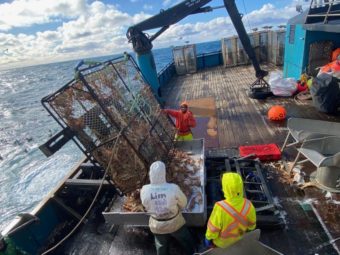
Fishermen load Alaska snow crab in the hold of a crabbing vessel. (Courtesy Tacho)

The Alaska Department of Fish and Game announced Friday afternoon that Bering Sea fishermen will be allowed to harvest a total of about 4.7 million pounds of opilio, also known as snow crab, for the first time in two years.

According to Fish and Game, estimates of total mature male biomass are above the threshold required to open the fishery.

The announcement comes as a surprise to many fishermen, after roughly 10 billion snow crabs disappeared from the Bering Sea over a span of four years, prompting Fish and Game to close the fishery in 2022. Recently, scientists have learned that the disappearance was likely due to ecological shifts, and there’s been little hope within the industry that stocks would recover anytime soon.

Still, the National Marine Fisheries Service and Fish and Game have analyzed the results from this year’s bottom trawl survey and agree that the volume of male crabs is at a safe limit for fishing. Fish and Game’s decision to open the fishery is based on the recommendation of the North Pacific Fishery Management Council, which met Friday morning to determine sustainable harvest limits for Alaska’s big three crab stocks.

Fish and Game has set the total allowable catch, or TAC, for snow crab at 4.72 million pounds, including Individual Fishermen’s Quota and Community Development Quota. The last time the fishery was open, harvesters were allotted 5.6 million pounds, although the year before they had a harvest of 40.5 million pounds.

The department also opened the Bristol Bay red king crab fishery, which closed for two years in 2021 and reopened last year. Fishermen will have 2.3 million pounds to catch this year, just above last year’s humble but welcome harvest.

Both the red king crab fishery and snow crab open Oct. 15.

What happened to those king salmon caught as bycatch?

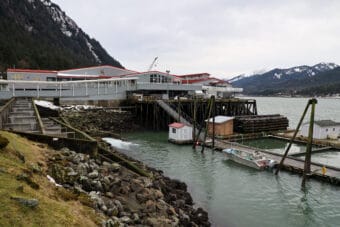
A trawl vessel sits at the dock in Kodiak in July. (Photo by Nathaniel Herz/Northern Journal)

Northern Journal last week published a story on how Kodiak-based pollock trawlers unintentionally caught 2,000 king salmon — forcing the closure of a major Gulf of Alaska fishery.

Afterward, a number of readers responded with similar questions: What happened to those salmon? Were they sold? Donated? Thrown back into the water?

The short answer, according to a federal management official: The salmon were “discarded.”

Some additional context: Salmon bycatch is “prohibited from entering commerce,” Josh Keaton, a top management official at the National Marine Fisheries Service, said in a brief call Friday.

“Nobody gets paid,” he said. “The fishermen can’t take them home.”

The salmon caught by the trawlers were small, he said — four pounds, on average, compared to the 10 pounds that the smallest recreationally harvested salmon weigh.

When bycatch is of “marketable size” and suitable for food quality, Kodiak seafood companies will often process the fish and donate them to an Alaska nonprofit group, SeaShare, Keaton added. But in this case, they were probably too small, and also sat in containers for two days as independent fisheries observers took genetic samples of each one, he said.

Meanwhile, the fallout from the closure of the central Gulf of Alaska pollock fishery, in response to the salmon bycatch, continues. The Kodiak Daily Mirror reported Thursday that one of the city’s processing companies, OBI Seafoods, is laying off some 50 workers, with an executive telling the newspaper that remaining workers would see “significantly fewer hours,” as well.

The closure strands about $9 million of raw pollock in the Gulf of Alaska, which would have been processed into $50 million or more of headed and gutted fish, fillets, meal and oil, according to a preliminary analysis by Garrett Evridge, an Alaska fisheries economist.

The state and local government will also lose hundreds of thousands of dollars in fisheries tax revenue, according to Evridge’s analysis.

Nathaniel Herz welcomes tips at natherz@gmail.com or (907) 793-0312This article was originally published in Northern Journal, a newsletter from Herz. Subscribe at this link.

Peter Pan creditors, investors feud over sale of Alaska seafood company assets to May

Skiffs sit on shore in the Southwest Alaska fishing town of King Cove. (Photo by James Brooks)

An array of businesses, fishing companies and investors are objecting to a pending proposal to sell the assets of a struggling Alaska seafood company to Rodger May — one of the original investors in the company before it entered a bankruptcy-like process called receivership.

The financial firm that’s overseeing Peter Pan Seafood’s receivership proposed last week to sell the company’s three processing plants and an array of other assets to May, an entrepreneur and fish trader who narrowly outbid another processing company, Silver Bay Seafoods, in an auction.

A hearing on the proposal is set for Thursday in a Seattle courtroom, where a judge will consider the wide-ranging objections filed in court last week by opponents of the sale.

Those opponents include the investors who originally partnered with May to buy Peter Pan from a Japanese seafood conglomerate in 2020.

The investors — including affiliates of Los Angeles-based Renewable Resources Group and Anchorage-based McKinley Management — split with May in their filing, calling him an “insider whose inequitable conduct has both depressed the market for, and eroded the value of, Peter Pan’s assets.”

Read some of filings in the receivership case from the investors, fishing companies and Silver Bay Seafoods.

They say that Silver Bay is a better fit to buy the assets given opposition by the “Alaskan fishing community” to May’s continued involvement in Peter Pan.

They also argue that May shouldn’t be allowed to apply $12 million in credit to his bid based on money he loaned Peter Pan. That’s because another businessman, Los Angeles-based John Ketcham, also loaned $10 million to the company last year on the condition that he would be repaid before May, according to the investors’ filing, which Ketcham also signed onto.

Ketcham has teamed up with Silver Bay and wants to use his loan as credit to buy one of Peter Pan’s three plants, in the remote Alaska Peninsula area called Port Moller.

May didn’t respond to a request for comment this week.

Nathaniel Herz welcomes tips at natherz@gmail.com or (907) 793-0312. This article was originally published in Northern Journal, a newsletter from Herz. Subscribe at this link.

Southeast Alaska king salmon sport fishery is closed for month due to international treaty limits

A king salmon. (Photo by Ryan Hagerty/U.S. Fish and Wildlife Service)

Sport anglers with a king salmon permit in Southeast Alaska must wait a month to keep their catch after the state’s Department of Fish and Game closed the fishery on Monday.

Department commissioner Doug Vincent-Lang said the closure is not cause for concern about the king salmon population, but because he must ensure that the state stays within its catch limits under the Pacific Salmon Treaty.

“To be honest, we’re a little frustrated,” he said.

He explained that the state has to close the fishery because Alaskans are catching too many fish relative to the limit the state set, which was based on preseason models that showed there would be fewer king salmon. That is an indication that king salmon are more abundant than those models predicted — a “good thing,” he said, “except if you’re an angler that wants to go out fishing for king salmon.”

He said an in-season look at salmon abundance would likely show that king salmon stocks are doing better than those models predicted.

That would be better news if the state wouldn’t be penalized for going over catch limits set in the treaty. Sport anglers are only allowed to catch 20% of the state’s allowed take of king salmon.

“When the abundance of fish is higher than the preseason forecast, these guys go out and catch fish. And if there’s a lot for them to catch, they’re catching more, so they’re going above their 20% allocation,” Vincent-Lang said.

The closure comes seven weeks after the August king salmon season was closed for commercial troll fishers.

In Alaska, the treaty mandates a catch limit for all the commercial and sport fisheries. The total, all-gear catch limit for Southeast Alaska king salmon this year is 211,400 fish.

The state’s Board of Fisheries then allocates the allowed number of fish among different users. First, the seine and gillnet fisheries get a take. This year, that is nearly 9,000 kings for seiners and roughly 7,000 kings for gillnetters. The remainder is split 80%-20% between the trollers and the sport fishery. That leaves the limit for sport anglers at roughly 39,000 fish this year.

(Alaska Department of Fish and Game map)

So, when in-season projections showed the sport fishery could exceed the limit by 14,500 fish, or nearly 40%, Vincent-Lang said, he had to decide whether to pump the brakes on that fishery or risk going over the treaty limit for all gear types.

The actual number of overage was calculated by the department on Wednesday. The sport fishery exceeded its catch limit by more than 13,926 fish, although that number is still considered preliminary, according to Patrick Fowler, the Southeast Alaska Management Coordinator in Petersburg. If the total state catch of king salmon is over its limit, the fishery is penalized with a lower limit in the next year.

For the last three years, the catch limits under the treaty have been determined by preseason projections, under what is called the “Chinook model.”

“We establish sport fishing regulations at the beginning of the season, and then we just let them roll,” Fowler said. “The management plan is built on the idea that if the sport fishery goes over, it comes out of the commercial troll quota, and if the sport fishery is under, then (trollers) get the opportunity to harvest those fish.”

He described it as a “give and take.” But this year, since trollers have already stopped fishing for this part of the season, that mechanism cannot absorb as much from the sport fishery.

Fowler said the preseason projections that determine the treaty limits were lower than the in-season reality last year, too.

“We’re following a very similar pattern this year, where we had our indicator of preseason abundance that is not really aligning with how many fish we’re seeing on the fishing grounds,” he said.

Previously, the treaty limits were determined by a model with multiple variables, which allowed managers to make in-season adjustments.

Last year, the sport fishery exceeded its quota by more than 17,100 fish, but the state did not exceed its allocation or go over its all-gear limit because the excess was absorbed by other gear groups.

Sport anglers are catching fish, but overall king salmon abundance has been declining for more than a decade. Last December, when the department issued its 2024 Southeast Alaska Chinook Salmon forecasts, seven of the region’s 11 wild king salmon runs were listed as “stocks of concern,” which means the stock is continuously unable to maintain a harvestable surplus after enough fish have returned to spawn. Those regions have more restrictive management.

There are 130,000 sport anglers in Southeast Alaska, Fowler said, and king salmon are the most sought after species. But this next month is not the peak of the king salmon run; it’s closer to the end before the winter season starts.

“The timing of the season was beneficial in that it’s not prime time for king salmon,” he said. “So hopefully this had minimal disruption, especially those folks that are like traveling to the area to fish.”

Clinton Cook, a vice president with the Central Council of Tlingit and Haida Indian Tribes of Alaska and the president of the Craig Tribal Association, said the closure affects tribal members.

“It’s the one salmon we can rely on year round for nutrition,” he said, adding that he’s mostly concerned that trollers had to stop fishing king salmon this August.

“Most of the trollers look forward to that second opening in August to balance out their season,” he said.

This is the first time under the current management model that the sport king salmon fishery has closed in Southeast Alaska, Fowler said. Vincent-Lang said that while there have been closures to the seine fishery, there hasn’t been a closure for the sport fishery like this one in the last six years since he has been fish and game commissioner.

“We’re going to be working with the (Pacific Salmon) Commission to try to adjust that model, so that if, in fact, we see higher levels of runs in the middle of summer, that maybe our catch limits increase or something,” he said.

The Alaska Board of Fishery will work to revise its entire king salmon management policy at its January meeting in Ketchikan.

Orcas challenge the Bering Sea’s black cod industry

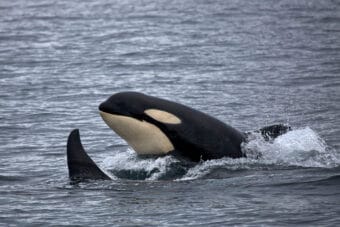
Orcas spotted in the Bering Sea in August 2023. (Courtesy Dustin Unignax̂ Newman)

Black cod fishermen in the Bering Sea have reported an increase in orcas taking their catch off their fishing lines in recent years. Orca depredation isn’t just a costly headache for fishermen — it can be dangerous for orcas, too.

Jeb Morrow has been long-lining for black cod around Alaska for most of his life. The process includes baiting hundreds or even thousands of hooks to catch oily fish on the ocean floor. When he started fishing in the 1990s, he heard stories from elders about orcas regularly stealing their catch, but he said it was only within the last few years that it became a reality for him.

“I can tell you without question these orcas are geniuses,” Morrow said. “They just adapt and conquer at a level that is like nothing we’ve ever seen.”

The problem is so bad that Morrow has decided to skip fishing for black cod this year. He said it’s not worth the hassle. Morrow and his crew have to be careful to protect their catch. For instance, they have someone whose only job is to look out for killer whales with binoculars in the wheelhouse. Once an orca is spotted, the crew immediately cuts and anchors the line, leaving the area as quickly as possible.

“Because you don’t want to be known as a boat that feeds the whales,” Morrow said. “If they establish you as a boat that will feed them, you’re (expletive) for life.”

Morrow said orcas are so intelligent that they’ll follow the boat for the rest of the season. And once the opportunity strikes, the orcas will continuously approach the vessel and take caught fish.

Asia Beder, a biologist with the Alaska Department of Fish and Game in Dutch Harbor, has seen the behavior herself and said stories of orca depredation in the Bering Sea have increased in the last few years.

“Seeing it in person, I was shocked at how quickly they found us, how smart and fast they were at pulling the fish off,” Beder said.

As a management biologist, Beder finds this behavior puzzling. She said that when orcas are around a fishing boat, it doesn’t always mean they are trying to steal the harvest — they also like to play with gear. However, when fishermen aren’t catching fish, it could mean there are orcas around quietly taking caught fish.

Beder said it’s challenging to manage the amount of black cod in the fishery when fishermen can’t accurately count how many they’ve caught, knowing that the orcas are also a factor. So, in the state survey, she said fishermen have a box to check if they saw orcas around while fishing.

“I feel both sides of the equation,” said Beder. “I feel for the orcas, and I also feel for the fishermen.”

Federal agencies also manage the black cod fishery in the Bering Sea.

According to the National Oceanic and Atmospheric Administration, orcas aren’t just going after catches from small boats. They’re also going after large commercial vessels, which has resulted in a recent spike in orca deaths from gear entanglement in Alaska.

Suzie Teerlink, a marine mammal specialist with NOAA, said orcas are starting to show new feeding behaviors around large trawler nets. They’re trying to steal fish caught in nets that are typically being hauled back. Scientists aren’t sure why orcas are doing this, but it’s dangerous for them because it increases their chances of getting caught in the net and dying.

Depredation can also be pod-specific. Killer whales are cultural learners — the elders teach the young survival skills particular to their hunting area. They’re also opportunistic.

“They’re looking for calories that aren’t difficult to get,” Teerlink said, “using as little energy as possible to get as much energy, calorie gain as possible.”

Teerlink said orcas have been following fishing boats for food for ages. Orca depredation isn’t just a Bering Sea problem; it also affects fishermen in other parts of the world. She emphasized that fishermen try to avoid orcas. For instance, many black cod fishermen are transitioning to pot gear to prevent the fish from being stolen off the hooks.

“When it comes to killer whale depredation, they’ve [fishermen] been innovating ways to reduce this since the onset and have already come about with lots of different tools and ideas,” Teerlink said.

Morrow believes it’s only a matter of time before the orcas can outsmart the latest fishing gear. For example, a few years ago, fishermen created a new kind of pot called the slinky pot, which worked for only a couple of seasons.

“It was like the answer to all our problems fishing black cod in the Bering Sea,” Morrow said. “And then the orcas figured it out, like in two years, they had it figured out, and they were shredding our pots, and it was done.”

Even if the orcas can’t get the fish out of the pots, Morrow said they’ll smash onto it, so the fish aren’t good anymore. So fishermen are trying heavier, more durable pots — but only time will tell if they’ll work.

As for Morrow’s black cod fishing future, he’s not optimistic.

“If it’s just me versus the whales, they’re gonna win every time out there,” Morrow said.

So, Morrow said he might invest more time and money in other fisheries.

Site notifications
Update notification options
Subscribe to notifications