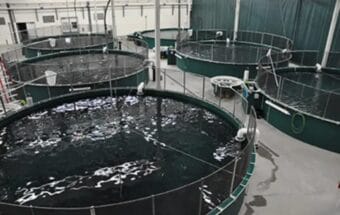
Peter Pan Seafoods’ processing plant in Dillingham in November 2024. (Margaret Sutherland/KDLG)
Silver Bay Seafoods will acquire processing plants in Dillingham and Port Moller, along with fishery support sites in Dillingham and North Naknek.
Silver Bay announced the acquisition from Rodger May, the former co-owner of Peter Pan Seafoods, in a press release Wednesday. The Dillingham and Port Moller plants are Silver Bay’s fourth and fifth plant acquisitions this year. It also took over Peter Pan’s plant in Valdez last spring, and Trident Seafoods plants in Ketchikan and False Pass.
Silver Bay said for the latest deal, both parties agreed to immediately transfer control of the facilities while the actual transfer of ownership is finalized. Silver Bay says this will “ensure a seamless transition for fisherman, communities, and employees.”
In past years, the former Peter Pan Seafoods processing facility in Dillingham employed roughly 320. Its affiliated fishing fleet included 180 drift fishing boats and 110 set netting boats. The Port Moller plant employed 140 people during its peak, and supported a fleet of 105 drift gill netters and 30 set netters.
Peter Pan’s assets went to auction after financial trouble earlier this year. May won these facilities, among others, at auction in September.
May narrowly outbid Silver Bay Seafoods in a bidding war over the facilities. Local fishermen and investors disputed the outcome, but a judge eventually upheld the results in early October.
The particulars of the deal aren’t public and little is known on what caused the reacquisition of Peter Pan’s assets following Rodger May’s successful bid. Reached by email Thursday morning, May said he wasn’t ready to comment yet. Silver Bay also declined to comment for this story.
But Cora Campbell, president and CEO of Silver Bay Seafoods, made a statement thanking May for “prioritizing certainty for fishermen and communities in making this transition.”
Silver Bay operated the facilities in Dillingham and Port Moller during the 2024 fishing season. Campbell said the season was successful, which lends itself to a smooth transition.
“By permanently adding these facilities into the Silver Bay Seafoods network, we not only stabilize processing in these communities, we also create synergies, efficiencies and product form diversity that benefit our fishermen,” said Campbell.
The fate of the former Peter Pan facility in King Cove, which has been closed since before the 2024 fishing season, is still uncertain. However, according to the press release, Silver Bay agreed to participate in a working group May established to address its future.
Cole Hockema captains the Pacific Storm, a 100-foot trawler based out of Kodiak, which his father owns. (Davis Hovey/KMXT)
Cole Hockema has been fishing since he was a teenager growing up in Oregon. For 12 years now he’s been trawling for pollock in the Gulf of Alaska, but today he’s sitting at home with his young daughters in Kodiak.
“We had lots of projects and stuff scheduled that we wanted to do at the end of the year and now we have a lot of time to do those, but we’re putting those on hold now until next year just because of a lack of money,” Hockema explained.
Hockema captains the Pacific Storm, a 100-foot trawler based out of Kodiak, which his father owns. The vast majority of the Central Gulf of Alaska trawl fleet is made up of local boats like his.
According to the trade group Alaska Groundfish Data Bank, 19 boats were fishing in the Central Gulf of Alaska when the pollock fishery closed on Sept. 25. 15 of those are homeported in Kodiak.
Normally, fishermen like Hockema would be out on the water until early November, when the Gulf of Alaska’s pollock B season typically closes. But this fall season ended just three weeks into fishing, when two vessels incidentally hauled in approximately 2,000 Chinook salmon, which exceeded the fishery’s annual bycatch limit. Hockema said the Pacific Storm was offloading its catch on Sunday, Sept. 22 when they first got the news about the bycatch and he knew the fleet would need to stop fishing immediately.
Since the closure, the Central Gulf of Alaska trawl fleet has separated out into a few camps – some are trying to switch into rockfish and or flatfish to make up lost revenue, others are doing a couple trips for Pacific cod, and a few like Hockema are done fishing for the year.
“Yeah we just can’t invest in nicer, better gear to go get this one [Pacific] cod trip,” Hockema said. “And then we just don’t want to take the risk of going backwards out there, messing up gear, ripping up gear, costing us more money.”
Hockema estimates his boat missed out on roughly $250,000 due to the fishery being closed so early. Hockema said the Pacific Storm does technically have a permit to fish for rockfish, which is a cooperative program, but they do not have any quota and would have to pay a lease fee which would not make sense economically for them to do so.
The ex-vessel price for rockfish in Kodiak right now is anywhere from 9 cents to 12 cents a pound. Chelsae Radell with Alaska Groundfish Data Bank told the City Council earlier in October, “We have approximately 16 million pounds of rockfish available, but at this time, I think, just based on who we have here and how much time, we’ll only probably harvest about eight to ten million pounds.”
Overall, there were still at least 100 million pounds of Central Gulf pollock left unharvested in the water when the season ended. The fleet is thought to have lost out on $9 million total in dockside revenue, based on current market prices of 9 cents per pound for pollock.
Local fishermen still have to cover loan payments on boats, insurance, which fishermen told KMXT has increased significantly this year, repairs, maintenance, and other expenses. And of course, paying wages to deckhands and crew.
Alaska Groundfish Data Bank estimates that up to 70 mostly Kodiak-based crew were employed by the local pollock trawl fleet. A third or 30% of that ex-vessel revenue was expected to go to crew if the fishery had gone on until November.
Another longtime Kodiak pollock trawl fisherman, Paddy O’Donnell, said he feels lucky to still have crew after the pollock fishery closure.
“We go through a lot of crew. We got two new crew for the fall season [B season] here that are different from the crew I had during the A season,” O’Donnell stated. “Guys move around, get into either herring in the spring, salmon in the summer. This year now, there is a crab fishery happening in the Bering Sea so I’m sure some of them are shifting towards that.”
O’Donnell, who is also the President of the Alaska Whitefish Trawlers board, told KMXT on Oct. 17 that his 85-foot boat, the Caravelle, was likely going to switch over to Pacific cod soon but the fishery is only open until November 1. The season opened on Oct. 4 in the Central Regulatory Area of the Gulf of Alaska, after the fleet agreed to a voluntary catch share plan. And so far, cod fishing is reportedly slow this year and may not be very economical for a variety of reasons, such as the fish being more spread out this time of year, boats having to burning more fuel which are at higher costs, and poor prices from processors.
The fishermen aren’t the only ones affected by the Central Gulf of Alaska pollock trawl fishery closure.
An initial, informal analysis from one Alaska-based fisheries economist, Garrett Evridge, pointed to at least 100 workers that would be let go from the four major Kodiak processors that handle pollock. The Kodiak Daily Mirror reported that OBI Seafoods laid off 50 of its employees at the local plant in response to the pollock fishery shutdown.
In an email to KMXT, OBI Seafoods CEO John Hanrahan wouldn’t call them layoffs. He said the processing season ended early for some employees and schedules were reduced for others.
Hanrahan said, “The unexpected closure of the Gulf of Alaska pollock fishery resulted in a significant decrease in the fish that we process in Kodiak at this time of year. Unfortunately, we had to end the season earlier than usual for some of our employees and have reduced schedules for some of our remaining employees as a result. The closure is also negatively affecting Kodiak fishermen and the community by reducing their revenue during very difficult times. OBI will continue to provide as much support as we can to our fishermen and employees during this unprecedented closure.”
The early closure also means many fishermen can’t afford to pay for boat work they’d typically have done in the shipyard this time of year.
Kodiak’s Highmark Marine Fabrication handles repairs on many of the local pollock trawl boats. Owner Cooper Curtis said a good portion of their winter work starts in November and lasts until January, while the trawlers are typically dry docked or not fishing.
“And with the recent closure, we’re probably looking at about, collectively, at least a $1 million impact to our business,” Curtis said.
That’s not to mention the impacts on the other local marine services like refrigeration, hydraulics, and the Kodiak shipyard, which Highmark operates.
Pollock is Kodiak’s largest fishery by volume, also known as the local bread and butter fishery. So state, borough and city tax revenue are also taking hits – Alaska Groundfish Data Bank estimates a projected loss of $500,000 in taxes to the municipalities of Kodiak as a whole. That includes Borough severance tax, state fisheries business, fishery landing tax, and City sales tax.
During a recent city council work session on Oct. 8, Radell with AGDB said it’s very unlikely the other fisheries will be able to cover the losses in revenue created by the pollock fishery closure.
“Combined rockfish, flatfish and cod landings since the time that the closure went into effect through November, would probably be about 17.5 million pounds of harvest with an ex-vessel value of approximately $2.5 million and we think that might be a little optimistic,” Radell told the council.
Despite limited options and a small chance of breaking even this year, Hockema, the sidelined fisherman, is holding out hope that pollock fishing will get better.
Curtis with Highmark shares a similar point of view. He said that all the small businesses in Kodiak that benefit from the pollock trawl fishery have to be flexible, just like the fishermen.
“At the end of the day we’re all in this together, this community. Every vessel, every service provider, we all need each other. So we’ll be flexible and we’ll all make it,” Curtis stated.
Meanwhile, Hockema will have to wait until next year, when the “A” pollock season opens in January.
Crab pots in King Cove in September 2024. (Eric Stone/Alaska Public Media)
Five months ago, King Cove Mayor Warren Wilson wrote an opinion piece in the Anchorage Daily News. The headline was stark: Fighting For Our Lives in King Cove.
Peter Pan Seafood Co., the owner of a plant that had served as the economic engine of the Southwest Alaska town of about 800 for more than a century, had just announced it would cease operations.
The Peter Pan plant, which had run year-round for the past five decades, had already been closed all winter. That it would stay closed — indefinitely — was a shock. Wilson wrote that he worried King Cove was on the edge of becoming a ghost town.
“As King Cove’s mayor,” he wrote at the time, “it hurts my heart to say that it has taken only a few short months for me to no longer recognize my world. Events have conspired to threaten our very existence.”
The seafood industry around the world has been devastated by low fish prices, high interest rates, oversupply in some markets and poor fish returns in others. In Alaska, according to a recent report from NOAA Fisheries, profits fell by half between 2021 and 2023.
Few Alaska communities have felt the pain of the seafood industry crisis more than King Cove. With the plant’s owner out of business, residents are left to wonder if their community has a future.
Fishing boats on land and in a harbor in King Cove in September 2024. (Eric Stone/Alaska Public Media)
Driving in his distinctive yellow Ford pickup on a tour of town this summer, Wilson said even his earlier grim assessment might have been a bit too rosy.
“If I had to write that story again now, there would be a little more gloom and doom in it,” he said. “But we’re still fighting for our lives, for sure.”
Aside from the occasional passing car and boat, much of King Cove is quiet. The bar just outside the plant’s chain-link fence is closed.
The shuttered Peter Pan plant is sprawling. It dominates the gently sloping waterfront, rivaled only by the boat harbors just down the road. Fishermen used to unload salmon, crab, pollock, cod, halibut and more on the four piers that jut into King Cove’s namesake waterbody. Steel-roofed bunkhouses once housed hundreds of staff who processed the catch.
The idled Peter Pan Seafood Co. plant in King Cove shows little sign of activity. (Eric Stone/Alaska Public Media)
Today, blue steel containers emblazoned with the logo of Samson Tug and Barge Company block the plant’s main entrance. Little activity can be seen from outside.
This weekend, all of the action is up the road. Cross-country running teams from Sand Point and False Pass are in town for a regional meet. There’s an all-community volleyball game at the King Cove School.
“Peter Pan was the heart of our community for many, many years,” Agdaagux Tribe of King Cove President Etta Kuzakin said during a break in the action.
King Cove has always been something akin to a company town. It didn’t exist until 1911, when Unangax̂ people relocated from nearby villages to fish for and work at the new Pacific American Fisheries plant. People in King Cove talk about fishing for Peter Pan for decades, or their whole lives. And with the plant idled, Kuzakin says life just feels different.
“A great example is driving down the road at 7 a.m. to go to work, and it’s peaceful,” she said. “There’s no humming, there’s no boats in the bay, there’s nothing.”
A Peter Pan Seafood Co. logo adorns a plaque in a trophy case at the King Cove School. (Eric Stone/Alaska Public Media)A sign in the King Cove School offers encouragement. (Eric Stone/Alaska Public Media)
“I’m born and raised here. I’m 47 years old, and I’ve never not heard those noises before,” Kuzakin said. “The silence is deafening.”
The hum is gone, but King Cove’s fishermen are still fishing. Many have no other choice. They’re fighting low fish prices and rising costs and doing everything they can to stay afloat. Many are sailing hours out of their way to deliver their catch to plants that offered to buy fish from some King Cove fishermen left in the lurch after Peter Pan folded.
But it’s not easy. And some are thinking about leaving.
In King Cove’s Harbor House, a blue-and-white corrugated metal building near the community’s boat yards and harbors, fishermen sat on overstuffed recliners and couches watching college football, drinking coffee from Styrofoam cups. A gale-force storm was about to roll in, so it was more crowded than usual.
If the plant doesn’t reopen, “[I’m] not staying here,” said Ken Mack, a fisherman who recently purchased land in a nearby community.
Mack has been fishing out of King Cove for decades. With no fish plant to support the primarily small-boat fleet, he said, fishermen are forced to sail hours out of their way to supply their boats and deliver their catch.
“Right now we’re running six hours to False Pass to get fuel and bait, and we’re running nine hours to Sand Point to get rid of the crab, or halibut, or whatever you catch,” he said. “You have to cut off that expense. [The] only way you cut that expense up is [to] move someplace.”
That’s not to mention the unpaid bills that fishermen say they were left with when Peter Pan unexpectedly closed its doors. Ken Mack says he’s still owed money from tendering. Many have filed liens, some in the six figures, for unpaid debts.
Fisherman Ben Ley speaks at King Cove’s Harbor House. (Eric Stone/Alaska Public Media)
But even so, some of the fishermen are optimistic.
“You have to be,” said Ben Ley, who runs three boats out of King Cove. Otherwise, he said, “I don’t know how you’re doing the next tow, or set, or anything.”
At the same time, he said, there’s only so long fishermen and the businesses they support can hang on.
“I’m worried that by the time it does get good again — which I am optimistic about — the damage is going to be done,” he said. “There’s going to be some businesses here that don’t make it.”
There are other practical considerations, too — until the city put in a gas station shortly before the plant closed, Peter Pan was the only place to buy gas and diesel. And this summer, it still wasn’t clear whether there’d be enough fuel oil to heat residents’ homes for the winter. It all used to come from Peter Pan.
The plant closure is also taking a toll on the city’s finances.
Some 70% of the city’s general fund revenues come from fish taxes and sales taxes connected to the fishing industry, and King Cove has put millions of dollars in public money towards supporting the plant’s needs — water, power and garbage system upgrades aimed squarely at meeting the needs of the Peter Pan plant.
King Cove Mayor Warren Wilson poses with his yellow Ford pickup during a tour of the area. (Eric Stone/Alaska Public Media)
Mayor Warren Wilson said that so far, the city itself has been able to hang on with savings it squirreled away during years when the fishing was good. Grants have come from the state and federal governments to prop up projects in the meantime. The city hasn’t had to make serious cutbacks in services. But that can’t go on forever, Wilson said.
“If it’s not up running next year,” he said, “the cuts will be happening.”
Whether the plant will ever reopen is an open question. Peter Pan, partially owned by a state-backed investment fund, is being sold off for parts in a Seattle court. Rodger May, one of the investors who bought Peter Pan from a Japanese conglomerate recently won an auction to purchase the plant, along with a wide swath of other former Peter Pan assets.
But the community is still waiting for an announcement about the plant’s future.
The Star of Kodiak facility is right between the city’s downtown harbor and the ferry dock. Photo taken Dec. 11, 2023. (Brian Venua/KMXT)
The federal government published an “economic snapshot” in October that said Alaska’s commercial fishing industry in 2023 was about half as profitable as it was in 2021. Last year in particular marked one of the worst years for commercial fishermen in modern history.
Alaska Public Media’s Ava White talked with KMXT’s Brian Venua, who’s kept a close eye on commercial fishing, to break down the report.
This script has been lightly edited for clarity and length.
Ava White: So Brian, it’s not a secret that there has been a major crash in fisheries in the last few years. What’s new about this report in particular?
Brain Venua: National Oceanic and Atmospheric Administration economists estimated that industry-wide profits have plunged in the last few years. As a whole, commercial fisheries in Alaska were estimated to be worth $1.8 billion dollars less in 2023 than in 2022.
That’s split between wholesale values being down by about a quarter year over year – about $1.2 billion dollars. Vessel revenues were also down by over $600 million, according to the report.
NOAA is the government agency that manages a lot of Alaska’s fisheries. According to data linked in the report, people in the industry asked NOAA for a sort of independent snapshot.
I think the big thing is that it helps put numbers to things that a lot of people already know – that commercial fishing has had a really tough time.
Ava White: That’s huge for the industry, did the report point to any particular reasons why there was such a large drop?
Brian Venua: One of the biggest contributing factors for the reduced profits is that a lot of these businesses are facing higher costs.
For example, one issue the report outlined is that Alaska seafood processing workers wages increased substantially from 2022 to 2023, although it didn’t say by how much. While higher pay can be good for workers, that money has to come from somewhere.
Higher interest rates for loans played a role in lowering profitability according to the report. Several processors took on loans because they had a hard time selling inventory, like the huge sockeye harvests in Bristol Bay. There’s also higher energy prices.
Ava White: So what about on the demand side of things? A lot of the seafood harvested around Alaska is exported – what’s going on with markets?
Brian Venua: The state’s seafood products’ ability to compete on an international stage has been a huge problem for the industry.
Russia is a huge competitor against Alaska products. A lot of seafood harvested by Russia is also processed in China and while the report didn’t list exact numbers, workers in those nations are paid less than their American counterparts. That means they’re able to undercut the prices of Alaska products.
That’s on top of trade barriers, especially with Russia. That country banned American seafood over a decade ago, but was still importing fish to the U.S. until President Biden banned it in an executive order late last year. The ban is taking effect this year, but doesn’t do anything for other countries with large seafood markets – like Japan. That country’s traditionally been a bigger buyer, but their economy has been a bit shaky recently.
There’s been a lot of push from Alaska’s federal delegation to encourage foreign allies to establish similar bans, but it’s also unknown when, or if, that will happen.
Ava White: Speaking of the federal government, how have policies affected the situation?
Brian Venua: I’ve heard Sens. Murkowski and Sullivan, as well as Rep. Peltola all say fisheries need some sort of revenue insurance, similar to the crop insurance farmers have. And this report listed that could be a major factor in competing on the international stage as well.
Murkowski said she hopes to incorporate fisheries when the government renews the federal Farm Bill, but said at a meeting with reporters in August that she doesn’t see that happening this year.
Ava White: So obviously fishermen are feeling this market crunch here, but are there bigger ramifications for this? Is Alaska the only state feeling the pressure or are other areas struggling too?
Brian Venua: Alaska produces the most seafood in the country by far. The Alaska Fisheries Science Center’s director, Robert Foy, said in the report that the losses in Alaska have “reverberated down the West Coast and across the country.”
The report included that Alaska losses turned into a $4.3 billion loss nationally, with nearly over 38,000 people losing their jobs.
State and local taxes alone were down $269 million between West Coast states like Washington, Oregon and California, in addition to Alaska.
This species-wide crash and its effects could be compared to the salmon market crash of the early 2000s, when farmed salmon started being sold on the global seafood market.
Ava White: So what does all of this mean for fishermen and fishing communities then?
The NOAA report acknowledged that both the Bering Sea and the Gulf of Alaska have faced major challenges over the last decade. In that timeframe, the number of fishing vessels in the Bering Sea was reduced by nearly a third from what its fleet once was. The gulf saw a 20 percent reduction across fleets there too.
The October edition of Alaska Economic Trends, a state-sponsored magazine, projected fisheries will recover in the next 10 years, but it’s hard to say when or what that recovery will look like.
Our Children’s Trust attorney Andrew Welle argues that the Alaska Constitution protects the right to a livable climate in an Anchorage courtroom on Oct. 15, 2024. (Matt Faubion/Alaska Public Media)
The state of Alaska is asking a court to dismiss a lawsuit by eight young Alaskans arguing that efforts to build a North Slope natural gas pipeline violate the state constitution.
The lawsuit is the latest effort by young Alaskans to establish a right to a livable climate. The lawsuit was filed by the Oregon-based nonprofit Our Children’s Trust, which has pursued climate-related litigation against the federal government and in states across the country, including Montana, Utah and Hawai’i, with mixed results.
The case, known as Sagoonick v. State of Alaska II, zooms in on one specific state policy: the law creating the Alaska Gasline Development Corp., the state agency pursuing investment in a pipeline that would bring liquefied natural gas from Prudhoe Bay to Southcentral Alaska for in-state and out-of-state use.
Attorney Andrew Welle argued that the eight youth plaintiffs between the ages of 12 and 23 are already suffering the effects of climate change, ranging from faltering salmon runs to flooded homes. He told Anchorage Superior Court Judge Dani Crosby that the Alaska LNG project would exacerbate the harms of climate change.
“Yet, with full knowledge of these dangers, their government has enacted and is actively carrying out a statutory mandate to advance and develop the Alaska LNG project, which, in the face of the climate emergency that is harming these plaintiffs, would more than triple Alaska’s greenhouse gas emissions of climate pollution for decades, locking in irreversible and escalating harms for these youth,” he said.
Attorneys for the state say even if it is built, the impacts of the project are speculative. They say natural gas produced by the project may displace other, dirtier fuel sources, or it may have too small an impact on its own to have a meaningful impact on global average temperatures.
“To get where the plaintiffs are going in this case, the impact of that project on the access to fish and wildlife resources in the future, involves predictions upon predictions upon predictions,” said Assistant Attorney General Margaret Paton-Walsh. “Looking into a crystal ball and trying to determine how present-day decisions will shape the future is the work of policymakers, not courts.”
The state argues that the governor’s administration and the Alaska Legislature should be tasked with balancing the costs and benefits of the state’s climate policies — and that like the previous lawsuits, this one should be dismissed.
The latest Alaska lawsuit follows two earlier court challenges dating back to 2011 that were dismissed as overbroad and ill-suited for the court system.
Judge Crosby did not set a timeline for a decision on whether the case should be allowed to go forward.
The American Triumph — a 285-foot factory trawler with an onboard processing plant — sits in the Port of Dutch Harbor. (Hope McKenney/KUCB)
The international advocacy organization Oceana is pushing for the North Pacific Fishery Management Council to take action on trawling. The nonprofit released a statement Oct. 7 calling on the council to limit trawling in the Bering Sea and Alaska fisheries, saying it is a threat to sensitive seafloor habitats.
Trawling involves dragging a large fishing net behind a boat to collect fish. It’s big business: the trawl fishery targeting Alaska pollock in the Bering Sea is the largest fishery in the nation. Critics say trawl gear used in the Gulf of Alaska and Bering Sea makes contact with the seafloor, damaging marine ecosystems.
Ben Enticknap, a scientist and campaign director for Oceana, expressed concerns about the practice, saying trawling “risks damaging sensitive habitats.” He called on the council to impose measures to ensure the gear stays off the bottom.
Another hot-button issue in the trawl fishery is bycatch, which is when non-target species like salmon are unintentionally caught and often discarded. Pollock trawlers operating in the Gulf of Alaska recently caught more than their annual bycatch limit of Chinook salmon — over 2,000 fish.
Oceana has also taken legal action, filing a lawsuit against federal fishery managers for “failing to protect Alaska’s seafloor habitats.” The lawsuit argues that fishery management plans in the region have not fully considered the best available science or implemented adequate conservation measures.
Fishing groups and coastal communities have pushed back against many criticisms of the trawl fishery. Industry representatives argue that calls for tighter restrictions are unnecessary and could place undue burdens on the fishing sector. The Groundfish Forum, a trade group representing 17 catcher-processor vessels, says the criticisms are often based on misperceptions.
Stephanie Madsen, executive director of the At-Sea Processors Association, warns that recent legislative proposals aimed at curbing trawling would introduce “unworkable and burdensome new federal mandates.”
The North Pacific Fishery Management Council will take up the bycatch issue at its February 2025 meeting in Anchorage.
Close
Update notification options
Subscribe to notifications
Subscribe
Get notifications about news related to the topics you care about. You can unsubscribe anytime.