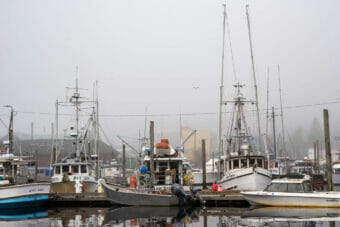
Trollers wait in Ketchikan’s Thomas Basin on Oct. 8, 2022. (Eric Stone/KRBD)
A resolution to protect the Southeast Alaska troll fishery passed in the state Legislature on March 20 by a unanimous vote in the Senate. House Joint Resolution 5 calls on state and federal governments to defend Alaska fisheries from a lawsuit filed by the Washington State-based environmental group, the Wild Fish Conservancy.
The suit seeks to stop the Southeast troll fishery over what the group sees as a threat to the Southern Resident killer whales in the Puget Sound. The organization’s position is that terminating Southeast’s king salmon troll fishery might allow chinook salmon to migrate back down the coast through key hunting grounds of the Southern Resident killer whales.
The Southern Residents exclusively eat fish. They are also genetically, behaviorally, and even culturallydistinct from other groups of killer whales. But according to NOAA Fisheries, the population has been in decline for decades, now numbering in the 70s.
The resolution to support the troll fishery was introduced by freshman Rep. Rebecca Himschoot of Sitka, who sits on the House Special Committee on Fisheries. It received support across party lines in the Alaska Senate. Himschoot lauded the resolution’s overwhelming bipartisan support in the latest vote. “I hope the Wild Fish Conservancy reconsiders pursuing this misguided lawsuit and instead starts addressing the factors impacting the Southern Resident Killer Whales in their own backyard,” she said.
The Senate also heard from stakeholders from the troll fishery. Tim O’Connor is the Mayor of Craig and a commercial troller. He said the closure of the fishery would “devastate the troll fleet and have a significant economic impact on the region.”
Many local governments in Southeast Alaska have passed resolutions opposing the lawsuit, including Petersburg, Wrangell, Ketchikan, Sitka and Juneau.
The Sitka Sac roe herring fishery in 2018. (Heather Bauscher/KCAW)
The Sitka Sound Sac Roe herring fishery will go on two-hour notice on Thursday morning, March 23. That means at any time after that, the Alaska Department of Fish and Game can announce a fishery opening with two hours warning.
The Alaska Department of Fish and Game on Monday conducted aerial surveys of Sitka Sound from Cape Burunof to St. Lazaria Island. According to a press release from the department, no spawn or herring schools were observed during their flights.
Herring predators were widely dispersed, but groups of humpback whales were observed near Inner Point, north of Middle Island, and south of Galankin Island. Groups of sea lions were observed near Inner Point, Mountain Point, and Bieli Rock. Department and industry vessels surveyed from Indian River to Deep Inlet and from Inner Point to Mountain Point.
From boats, several herring schools were observed from Indian River to Deep Inlet and from Inner Point to Mountain Point, as well as southeast of Big Gavanski Island.
Two test sets were conducted from department and industry vessels to assess the maturity of the fish. The fishery targets the herrings’ eggs, known as roe, which are sold internationally. A test set of herring pulled from South Galankin Island showed fish with around 3 and a half percent mature roe, at an average weight of 129 grams. Mature roe for a test set pulled near Mountain Point was much lower, at point two percent, with the fish weighing around 90 grams on average. In order to open the fishery, state managers want to see fish with at least 10 percent mature roe.
The state’s research vessel, the Kestrel, will arrive in Sitka on Wednesday morning and immediately conduct a vessel survey.
Last year, the guideline harvest level for the fishery was 45,000 tons, but fishermen only caught around 25,000. That was still the highest harvest on record. The guideline harvest level for this year’s fishery is set at 30,000 tons.
The Alaska Department of Fish and Game will hold a fishery meeting from 5 p.m. to 7 p.m. Tuesday on Zoom. The meeting is open to the public. Find a link to attend the meeting here.
Around 1 p.m. Saturday, Coast Guard responded to a vessel that had overturned at the entrance to Crescent Harbor. The F/V Ocean Cape was refloated Monday morning. No injuries were reported in the accident. (USCG Photo)
A fishing vessel that overturned just outside of a Sitka harbor this weekend was refloated early Monday morning.
Around 1 p.m. on Saturday, the Coast Guard responded to a vessel that had capsized at the entrance to Crescent Harbor in downtown Sitka. Coast Guard Marine Science Technician Allysia Helton was at the scene. She said all four passengers on the F/V Ocean Cape managed to quickly get off the boat. No injuries were reported.
“There were quite a few members of the community that were there on scene immediately after it happened, and they helped the crew get off the vessel and make sure everything was okay,” Helton says. “And throughout the response we had lots of community members that came to the site to help out where they could. It was a really good show of small town support.”
By the time the Coast Guard arrived, the crew of the Ocean Cape was already working with a local marine salvage operator. Helton says Hanson Maritime worked to secure the boat’s fuel vents and contain spilled fuel and oil with floating booms.
“The crews continued throughout the day to remove fuel from the tanks at low tide, and they were able to recover approximately 800 gallons of oil and oily water from the vessel between Saturday and Sunday,” Helton says.
The boat was refloated early Monday morning and returned to its stall at Crescent Harbor, with some damage to its hull that’s still being assessed. The cause of the accident is still under investigation, but Helton said weather conditions likely played a role.
“Saturday was pretty windy,” Helton says. “From what we’ve been told it sounds like the wind played a pretty significant role in the vessel rolling over to its side.”
The F/V Ocean Cape is owned by fisherman Chris Ystad, who also serves on the Sitka Assembly. In an email to KCAW, Ystad expressed his appreciation for everyone who offered assistance at the scene and with the salvage operation.
Sen. Lisa Murkowski and Rep. Mary Peltola addressed attendees virtually for the kickoff forum of ComFish on Thursday, March 16, 2023. (Brian Venua/KMXT)
Alaska’s congressional delegation says species collapse in Alaska’s fisheries is nearing crisis levels. Sen. Lisa Murkowski and Rep. Mary Peltola discussed the monumental challenges faced by Alaska’s fishermen and coastal communities during their legislative update on the opening day Thursday of Kodiak’s annual commercial fishing trade show, ComFish.
Murkowsi and Peltola kicked off ComFish’s federal legislative update with a brief acknowledgement of the Willow project’s recent approval — calling the $8 billion oil development a win for the state of Alaska. Sen. Dan Sullivan was not at Thursday’s forum due to a scheduling issue. He’ll speak on Saturday instead.
But much of their time was spent detailing the uncertainties caused by species collapse in the waters off Alaska’s coast. Murkowski said the declines in salmon, crab and halibut fisheries across the state are at crisis levels.
“I don’t like to use the word ‘crisis’ lightly, but I think crisis is the appropriate word here. I wish that we could tell you the exact causes, I wish there was one single thing to explain everything,” she said.
Population declines that were once “acts of God are becoming trends of nature,” Murkowski said, adding that current fisheries management doesn’t always reflect what’s happening in the water.
“Our management systems are not inherently nimble. And that’s a challenge for us,” Murkowski said.
Alaska’s congressional delegation has been pushing for more funding to study the effects of ocean variability caused by climate change.
Murkowski said that includes money for more bottom trawl surveys, and programs through the Pacific Salmon Treaty. Murkowski said nearly $3 million had been allocated for the research in the Bering Sea through the Bering Sea Fisheries Research Foundation. And money from the Bipartisan Infrastructure Law will also help coastal communities facing reduced revenue streams from crashing fisheries.
Peltola took time to call out bycatch, which is the incidental catch of a non-target species, saying not enough is being done to understand and address the issue.
“I just really want to be clear that I personally feel like we can be doing better. Progress has been made, but we can’t settle for the status quo, we need to make changes at a much faster pace than we are today,” Peltola said.
In a followup forum later that day, members of the state’s Bycatch Review Task Force detailed some of what those changes might be.
The group published a series of recommendations late last year, including the development of a statewide bycatch policy — bycatch is currently regulated federally under several federal policies, including the Magnuson-Stevens Act – and updating the types of gear and how much bycatch is allowed for certain vessels.
But according to the task force, shifting distribution patterns of marine species as ocean temperatures change also presents a hurdle to developing effective solutions.
Murkowski said there needs to be a collaborative approach to address the whole problem.
“We need to be working together to find these solutions because the challenges really are too great for anybody to face alone,” Murkowski said.
That process will take time, although Peltola noted that probably wasn’t satisfying for anyone in the room.
“Even if we do everything right starting today, it still could take 30 years for our fisheries to fully recover, and we really need to be clear about the timeline that we’re looking at. But we can’t let the perfect be the enemy of the good, we can’t hold ourselves back from making every marginal improvement that we can,” she said.
Peltola and Murkowski spoke for about an hour including a question and answer session. Both also addressed the lawsuit against Southeast Alaska’s king salmon fishery brought by a Washington-based environmental group, saying it was an effort to bully the fleet, and they would stand united in fighting it.
Small businesses that were impacted by the crab crashes between Oct. of 2022 and May of this year are eligible to apply. (Maggie Nelson/KUCB)
The U.S. Small Business Administration is offering special disaster loans to some businesses hurt by the recent red king crab and snow crab closures.
The federal agency announced last month that certain entities, like small agricultural coops or aquaculture businesses, as well as most private nonprofit organizations are eligible for low-interest loans of up to $2 million. Interest rates range from below 2% to about 3%, depending on the type of organization.
The SBA declared a disaster following a relief request from Gov. Mike Dunleavy for the crab fisheries closures in the Bering Sea and Bristol Bay. Along with U.S. Rep. Mary Peltola, Dunleavy requested a total of nearly $290 million from the federal government last year — the estimated total exvessel loss for both fisheries since 2021. It generally takes years for that kind of money to reach the hands of fishermen and others affected by similar disasters.
“We’re committed to providing federal disaster loans swiftly and efficiently, with a customer-centric approach to help businesses and communities recover and rebuild,” said SBA Administrator Isabella Casillas Guzman.
Small businesses affected by the crab crashes between October of 2022 and May of this year are eligible to apply.
The loans can be used to cover debts, payroll and other bills that couldn’t be paid because of the recent crashes. The deadline to apply is Nov. 9.
Business owners and nonprofit organizers interested in applying can do so online. The Alaska Small Business Development Center is also offering help with applications. Email rural@aksbdc.org for more information.
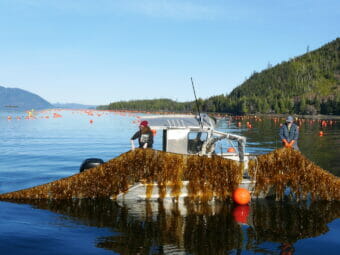
Tiffany Stephens, left, works at the Seagrove Kelp farm in Doyle Bay near Craig on April 14, 2021. Seaweed farming is seen as a promising new industry in Alaska, with both economic and environmental benefits. But seaweed cultivators face several challenges. (Photo by Jordan A. Hollarsmith/NOAA Fisheries, Alaska Fisheries Science Center)
To optimists, the plants that grow in the sea promise to diversify the Alaska economy, revitalize small coastal towns struggling with undependable fisheries and help communities adapt to climate change – and even mitigate it by absorbing atmospheric carbon. Cultivation of seaweed, largely varieties of kelp, promises to buffer against ocean acidification and coastal pollution, the promoters say. Seaweed farms can produce ultra-nutritious crops to boost food security in Alaska and combat hunger everywhere, and not just for human beings.
“Kelp is good for everybody. It’s good for people. It’s good for animals,” Kirk Sparks, with Pacific Northwest Organics, a California company that sells agricultural products, said in a panel discussion at a mariculture conference held in Juneau in February by the Alaska Sea Grant program.
But before it achieves these broad benefits, Alaska’s mariculture industry must first address significant practical issues, including an American consumer market that has yet to broadly embrace seaweed.
Seaweed farming is a bright spot in an Alaska coastal economy roiled by climate change, habitat disruptions and uncertain fish returns.
It is part of an expanding mariculture industry in Alaska that, until recently, was almost exclusively about oyster farming. Commercial seaweed production in the state has grown in volume from virtually zero in 2016 to about 650,000 wet pounds in 2022, according to the Alaska Fisheries Development Foundation.
High hopes
Ambitions for seaweed cultivation and other forms of mariculture are high.
“I want to make Alaska the mariculture capital of the world,” Gov. Mike Dunleavy said at the Juneau conference, an applause-generating line he has used elsewhere.
Varieties of kelp are seen underwater. (National Marine Sanctuary photo provided by NOAA)
A task force established by Gov. Bill Walker and continued by Dunleavy set a goal for an Alaska industry generating $100 million a year in revenue; in contrast, the nascent Alaska industry was worth only about $1.5 million as of last year, according to the National Oceanic and Atmospheric Administration.
Along with the lofty ambitions, there are high levels of new investment. Through the Democratic-backed American Rescue Plan Act, the U.S. Department of Commerce awarded $49 million to a “mariculture cluster” of Southeast Alaska organizations for projects that include seaweed farming. The Exxon Valdez Oil Spill Trustee Council, the federal-state panel that administers money paid by Exxon Corp. to settle government claims over the massive oil spill, has devoted nearly $32 million to mariculture research and development, focusing on the spill-affected Prince William Sound. Other investments range from $500,000 from the U.S. Department of Agriculture for a mariculture incubator and processing facility to several million dollars appropriated by the Legislature to the University of Alaska for mariculture research and training.
Alaska is currently a long way from being the world’s seaweed-producing capital. The global commercial industry, with an estimated value of $14 billion in 2020, is heavily dominated by Asian countries. Harvested seaweed from Asia goes into a variety of products – for industrial and agricultural use as well as well as for food.
Within the United States, producers in Maine dominate the seaweed-cultivation industry, holding 80% of the market, according to Liz MacDonald of Maine-based Atlantic Sea Farms, who spoke at the Juneau conference.
Products coming from Maine include kelp flakes, kelp seasoning and kelp burgers. A Maine company called Rootless sells bite-sized kelp squares made in five fruity or nutty flavors and marketed as nutrient-packed superfood snacks with slogans like: “Seaweed: The healthiest thing you’re not eating enough of,” and “The mightiest plant on earth comes from the sea.”
Potential benefits aren’t just commercial
While Alaska seaweed farmers are looking to Maine for practical lessons, they are also pointing to potential environmental benefits at home.
Lia Heifetz, co-owner of Barnacle Foods, holds up her company’s best-selling product on Feb. 17 during a reception that capped a three-day mariculture conference in Juneau. The product, Bullwhip Kelp Hot Sauce, is among the numerous kelp-based food products sold by the Juneau company. (Photo by Yereth Rosen/Alaska Beacon)
The Walker administration’s 2018 climate action plan invoked mariculture in general and seaweed cultivation, in particular, as a climate adaptation. Mariculture, the plan said, is “an in-place diversification opportunity for small-scale fishermen affected by ocean warming or acidification and communities forced to relocate.”
For Dunleavy, seaweed farming is part of this vision for Alaska to become a leader in the new carbon-sequestration industry, a broad-ranging goal he is pursuing through state legislation. “It’s a new approach, it’s a new process,” the governor said at the Juneau conference. “It’s going to be tremendous in our contribution to that initiative.”
On a local level, farmed kelp appears to reduce pollutants in the water, according to a recent University of Alaska Fairbanks-led study.
There is encouraging scientific evidence that seaweed cultivation buffers acidification locally, as described in studies from various projects, including some from China, California and New York. Seaweed farming “could serve as a low-cost adaptation strategy to ocean acidification and deoxygenation and provide important refugia from ocean acidification,” said the study from China, published in 2021 in the journal Science of the Total Environment.
But does seaweed farming result in absorption of atmospheric carbon and prevention of it streaming back into the atmosphere? The answer is complicated, according to the science. It depends on what happens to the kelp. If dead and decomposing bits are on land or in shallow waters, they would likely release carbon back into the atmosphere, scientists say.
Another environmental consideration involves wild stocks of bull kelp, one of the prime commercial species.
Stocks are so depleted in U.S. West Coast waters that an environmental group, the Center for Biological Diversity, has petitioned for an Endangered Species Act listing, which would be a first for any marine plant. Abundance trends for wild bull kelp vary a lot by location, with numerous problems documented in California, but Alaska’s Aleutian Island region is another trouble spot for wild bull kelp. There, a population crash among sea otters is linked to the kelp decline. Sea otters normally eat sea urchins, and without being held in check by otters, the kelp-eating urchins have been mowing down the underwater forests, according to several scientists.
While climate change, pollution and other problems are considered bigger threats, overharvesting also puts wild kelp at risk, according to the listing petition, currently under review by NOAA’s National Marine Fisheries Service.
Barnacle Foods’ kelp-based sauces and condiments are displayed on Feb. 16 in Juneau’s Foodland grocery story. (Photo by Yereth Rosen/Alaska Beacon)
Kelp farming, however, might help restore wild populations, according to some experts. A project in Puget Sound is investigating that possibility.
Several potential environmental downsides to seaweed farming are described in a report published in 2021 in Scotland – another part of the world where seaweed aquaculture is seen as a promising new industry. Among them, according to the report: shading that reduces sunlight needed by other organisms within the water column, possible introduction of invasive species, underwater entanglements of marine mammals and obstructions to travel in the water.
“Whilst there are many socio-economic benefits to be gained from the sustainable development of the seaweed industry, there are also significant risks if the industry is allowed to expand without taking sufficient account of the potential effects on marine ecosystems or the consequences for other legitimate uses of the marine environment,” said the report, which calls for careful planning and impact studies.
Big hurdles
For businesses, there are plenty of economics-related challenges.
One is logistics. Unless companies are manufacturing specialty products, like the kelp-based salsas sold by Juneau’s Barnacle Foods, the project has to be dried; wet plants in bulk are too heavy and thus too expensive to ship from Alaska.
Weatherly Bates, co-owner of Alaska Shellfish Farms, and Juneau chef Maylin Chavez prepare dishes made from cultivated oysters, mussels and and kelp to serve during a Feb. 17 reception at a mariculture conference in Juneau. The conference was hosted by Alaska Sea Grant. (Photo by Yereth Rosen/Alaska Beacon)
The labor squeeze that is affecting the economy as a whole can also make it difficult for aquaculture operators to attract workers, especially considering the physical rigors of harvesting.
“A lot of the job is pretty wet and cold. It’s definitely one of the hardest parts of this job, we’ve heard from workers,” Weatherly Bates, who owns Alaska Shellfish Farms with her husband Greg, said at the Juneau conference.
Workforce issues aside, the family operation, located in Halibut Cove, has been extremely successful. In 2020, Weatherly and Greg Bates and their two children were named Alaska Farm Family of the Year by the Alaska Division of Agriculture. Local goodwill is such that the family is able to stock a tied-up, unmanned boat in summer to serve as a floating farm stand that gets brisk business – all on the honor system.
Marketing is a big challenge.
Kelp is “a wonderful differentiating ingredient” and “really wonderful for grabbing the attention,” but not everyone is open to eating it, said Matt Kern, co-founder and co-owner of Barnacle Foods, which sells a variety of kelp sauces, condiments and other products.
“We can tell you that there’s not a tidal wave of customers knocking on doors for kelp products,” he said at the Juneau conference. Typical consumers “aren’t necessarily going to choose a kelp product over a non-kelp product, which makes our job a little more challenging. We kind of have an uphill battle to persuade people to give this product a try and include that in their diets.”
The Alaska Seafood Marketing Institute, the state agency that promotes Alaska fish, is unable to help, at least for now.
State law limits ASMI’s promotional work to traditional fish products, said Rep. Dan Ortiz, I-Ketchikan. He has been trying to change that with legislation, but so far has fallen short.
Rep. Dan Ortiz, I-Ketchikan, stands in a Capitol hallway on Feb. 17. A mariculture bill he sponsored passed last year, but a section allowing the Alaska Seafood Marketing Institute to promote mariculture was removed before passage. Ortiz said he hopes that ASMI will get that authority in the future. (Photo by Yereth Rosen)
State law limits ASMI’s promotional work to traditional fish products, said Rep. Dan Ortiz, I-Ketchikan. He has been trying to change that with legislation, but so far has fallen short.
A bill he sponsored that the Legislature passed and Dunleavy signed into law last year, House Bill 41, expanded the scope of mariculture projects eligible for state permitting and grant funding. But in a late change in the Senate, a provision that would have granted ASMI authority to promote mariculture products was removed.
While ASMI itself supported expanding its mission to include mariculture, there were objections from parts of the fishing industry, Ortiz said. The issue was funding, he said. ASMI’s operations are paid for, in part, by revenues from a tax levied on harvested fish, and some current donors – from traditional fisheries like salmon – were worried that money promoting mariculture products would be at the expense of the traditional seafood promotions, like notably those for salmon, he said.
“We felt like we tried to alleviate their concerns,” he said, pointing out that the intent was for ASMI to find some federal grants to do the mariculture promotions. Still, it was more important to get the rest of the bill passed than to fight for that particular provision, he said. He is now working with people in the mariculture sector to try to find a future path for product promotion, which might mean future legislation, possibly as soon as this year, he said.
Ortiz admits to being a relatively recent seaweed convert himself and someone who needed a little marketing-type persuasion.
“Five years ago, I thought that was weird. ‘How’s that going to taste?’” But then he tried kelp. “It tasted great.”
Others have followed a similar path, embracing seaweed cultivation for both economic and environmental reasons, he said. “There’s a growing acceptance that, hey, there’s a lot of potential out there in the ocean for a variety of foods,” he said. “The sky’s the limit.”
Success involves getting more converts like himself, he said. “Part of that is being able to get mariculture products marketed worldwide through ASMI and other venues.”
Indigenous food and rights
Seaweed is a traditional Alaska Native food, with no such marketing outreach needed. That leads to some wariness in Indigenous communities about the proliferation of kelp farms.
Jim Smith, restoration manager for the Cordova-based Native Conservancy, expressed some of those concerns at last month’s conference.
“Be mindful of what you’re asking kelp to do for you. Be mindful of the water you’re asking your permits to occupy before you ask Indigenous people to share their knowledge,” he told the conference audience.
Tostadas with topped with kelp and kelp salsa are arrayed on a platter on Feb. 17 at a reception capping a three-day mariculture conference in Juneau. The tostadas were prepared by Juneau chef Maylin Chavez. The conference was hosted by Alaska Sea Grant and explored the opportunities and challenges of mariculture in Alaska, including seaweed farming. (Photo by Yereth Rosen/Alaska Beacon)
The land trust organization, which is affiliated with the Eyak Preservation Council, was established 20 years ago with the goal of permanently protecting and preserving endangered habitats in the Eyak ancestral region – a region heavily impacted by the Exxon Valdez oil spill. Among its programs is kelp farming: It is already underway, as are numerous research projects. The Native Conservancy has a goal of creating or helping to create 100 20-acre Native-owned kelp farms in the region, with potential to grow 30 million pounds, to serve as a model for other regions in Alaska.
Native ownership and Native control are crucial, Smith said in an interview.
There are worries that what has happened with limited-entry and quota-share fishing will be repeated with seaweed farming, he said. He has watched over time as Eyak tribal members were crowded out of Prince William Sound fisheries, leaving him as one of the last remaining Eyak permit-holders fishing in the Copper River Delta.
Kelp is wonderful, with almost “magical” qualities of nutrition and healing, Smith said. But it has its limits.
“It doesn’t solve the problems that got us here, the exploitation, the colonization,” he said. While seaweed farming may be the “latest cool development” among the general public, high hopes could backfire on Indigenous people if the development is not done correctly, he said.
“It’s a lot of pressure on kelp. It’s a lot of pressure on Indigenous people,” he said.