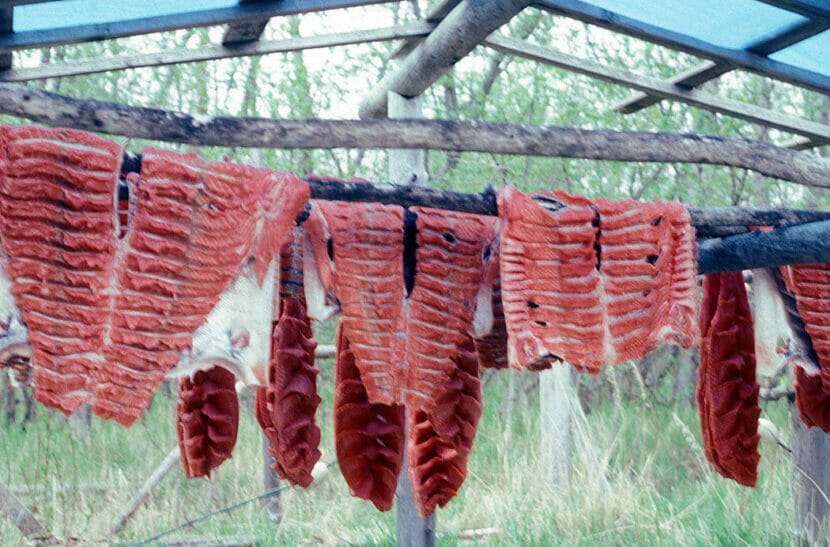
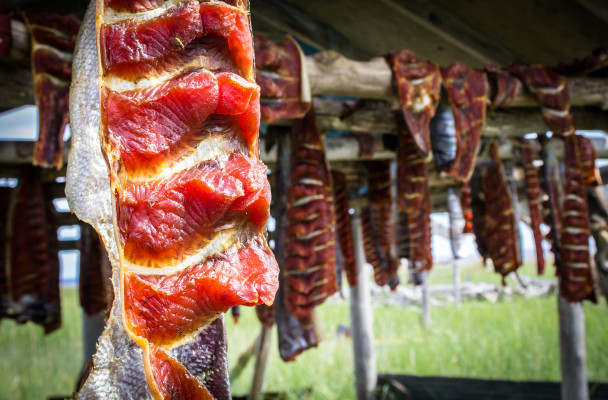
Kuskokwim River Chinook salmon dries on a rack near Bethel in 2001. (Photo courtesy of U.S. Fish and Wildlife Service)
A Superior Court judge in Bethel has dismissed a lawsuit accusing state officials of unconstitutionally mismanaging Yukon River and Kuskokwim River salmon fisheries, leading to a crisis on those rivers.
Judge Nathaniel Peters, an appointee of Gov. Bill Walker, said in a 16-page ruling on Thursday that plaintiff Eric Forrer failed “to identify any specific policy or action on the part of the Board (of Fisheries) or Commissioner (of the Alaska Department of Fish and Game) that could in any way be viewed as a violation of the sustained yield principle.”
That principle requires the state to manage its resources sustainably, and Forrer — represented by Juneau attorney Joe Geldhof — had argued that salmon declines in Western and Interior Alaska were evidence that the state was failing to meet its constitutional obligation.
Peters further concluded that Forrer, a Juneau resident, was asking the courts to direct the management of fisheries.
“The Alaska Constitution has delegated the management of this State’s natural resources to the legislature, not the judiciary,” Peters said.
Geldhof said during courtroom arguments last month that he intended to appeal any unfavorable decision to the Alaska Supreme Court. He did not immediately respond to a text message seeking confirmation of that intent.
In a prepared written statement, the Alaska Department of Law noted that Peters concluded that the state “engaged in reasoned decision-making” when considering the fisheries.
“The state’s inseason management, area management plans, and statewide regulations reflect the department’s world-renowned science-based fisheries management,” said Fish and Game Commissioner Doug Vincent-Lang in the statement. “Over the last two years, the Yukon and Kuskokwim fisheries have faced historically low salmon runs and the department has managed the fisheries to preserve the stocks in the face of this crisis.”
Summer chum salmon drying on a fish rack. (Matthew Smith/KNOM)
Proposals to limit chum salmon bycatch in the Bering Sea are moving ahead, but slowly. After reviewing recommendations over the weekend, the North Pacific Fisheries Management Council asked for further analysis to help develop possible chum bycatch limits or additional regulations on the Bering Sea pollock industry.
It’s a small step in a slow federal fishery management process.
Supporters of bycatch limits say reducing the accidental catch of chum and chinook salmon in the Bering Sea could help improve runs along the Yukon and Kuskokwim Rivers, which have seen record-low returns in recent years. But the pollock industry is pushing back.
Mellisa Johnson is government affairs and policy director for the Arctic-Yukon-Kuskokwim Tribal Consortium and a member of the council’s advisory panel. She said while the council is moving in the right direction, the motion doesn’t immediately address villages along the Yukon and Kuskokwim that have been hit hardest by the chum and chinook crash.
“Indigenous people … have provided testimony [that] they have not been able to fish for three years,” she said. “There’s a high possibility that they may not be able to fish with 2023 being the fourth year.”
Salmon is central to life in Western Alaska. Residents, environmentalists and other pro-subsistence advocates spent hours testifying in favor of bycatch limits last week, describing the devastating impacts to food security and Indigenous culture without it.
“Hopefully there’s enough other salmon species runs that will work to accommodate the food security issues, but it’s really hard to say … that [Western Alaskans are] going to get their needs met,” Johnson said. “More than likely, that’s not going to happen.”
The Western Alaska salmon crash is likely driven by a number of factors, including climate change. It’s not certain new bycatch limits would improve the runs, since only about 10% of chum intercepted in the Bering Sea are headed for Western Alaska, according to genetic studies.
But the council’s motion acknowledges that the Bering Sea pollock trawl fishery is responsible for keeping some proportion of chum salmon from returning to Alaska rivers.
Chinook bycatch limits are already in place in the Bering Sea, and the number of chinook accidentally caught remains low. Brent Paine, executive director of United Catcher Boats, said the idea of adding chum bycatch limits is “scary” for the groundfish trawlers he represents.
He said the impact to trawlers depends on what the council ultimately decides, but a constraining hard cap could close the fishery.
“The Bering Sea pollock fishery is one of the largest, valuable fisheries in the world,” he said. “So there will be huge losses, huge revenue losses, and lots of jobs loss.”
The Bering Sea and Aleutian Island pollock fishery was valued at $448 million in 2019, according to a NOAA Fisheries report.
Paine noted that the fishery supports coastal communities with processing plants like Dutch Harbor, Akutan and Sand Point. Sixty-five Western Alaska villages also participate in the Community Development Quota, or CDQ, program, which allocates a percentage of pollock and other species for those communities to harvest.
Tim Bristol, executive director of the pro-subsistence advocacy organization SalmonState, said he’s disappointed with the council’s process, which he said prioritizes the pollock fishery above subsistence harvesters.
“You have this industry that I think the government, via the council, sees as too big to fail. And I just worry that that has really disturbing implications for everybody else who counts on that ecosystem for their livelihood and their way of life,” Bristol said.
Meanwhile, last week, Tanana Chiefs Conference and the Association of Village Presidents, represented by Earthjustice, filed a lawsuit against the National Marine Fisheries Service, arguing that current federal fishery management plans are outdated and don’t adequately prioritize the needs of subsistence users.
Kate Glover, senior attorney at Earthjustice, said they’re pushing for the agency to consider different ways to approach fisheries management.
“That might include things like looking at changes in bycatch, or what could be done as far as catch limits go and how that affects other fish that are not being targeted by the fisheries but are important to subsistence users,” Glover said.
The analysis the council requested over the weekend will go through a series of reviews and public comment periods. Its first review is scheduled for the council’s October meeting. Brian Ritchie, chair of the council’s advisory panel, said final action on the proposals is scheduled for June 2024. If a bycatch limit does pass, it won’t be active until the 2025 season.
“It’s a complicated process,” Ritchie said. “Sometimes effecting real change and actions like this — it can take time.”
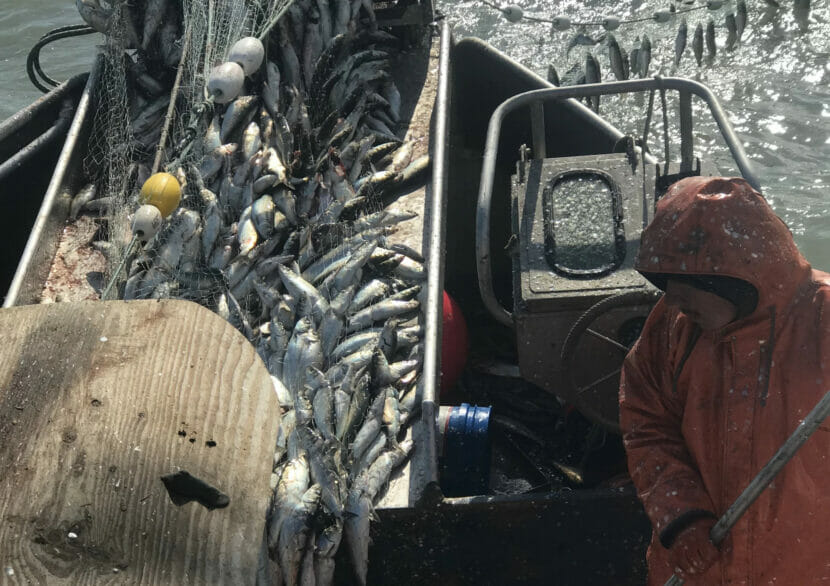
The season’s only gillnet boat harvests Togiak herring in 2018. (Courtesy of Frank Woods)
The Togiak sac roe herring fishery used to draw hundreds of fishermen.
“It was like a gold rush,” said Frank Woods, who lives in Dillingham and started fishing for Togiak herring in the mid-1980s. “The whole bay would fill up with industry. It would be a buzz, everybody would gear up to go. And everybody had not only fun doing it but made money at it.”
“Going from that huge industry to down to one boat, I never imagined that even possible,” he said, referring to the gillnet fleet. “Let alone like now, no fishing at all, to where there’s no market for it and nobody’s targeting and changing that for us.”
Togiak is Alaska’s largest herring fishery. But as the market for roe has shrunk, the remote fishery has become financially unfeasible. This spring, no commercial fishing will take place.
Processing companies in Alaska primarily sell herring to Japan, which used to have a big market for the roe. But as Japanese tastes shifted, that market shrank, and the price for herring dropped.
For years, the Alaska Seafood Marketing Institute has worked to increase demand for herring in the U.S. The state bought a herring fillet machine for processors to use. It’s also tried to promote the culinary delights of the fish, hosting Alaska Herring Week three years in a row and working with chefs to develop recipes. But the demand for Alaska herring hasn’t budged significantly, and this year, processors opted out of Togiak.
“You can only lose money for the fun of it for so long,” said Bruce Schactler, a longtime herring fisherman who now directs the institute’s food aid program. “We’ve continued, over time, to lose more and more buyers out of Togiak, and herring buyers in general across the state,” he said. “So what that really tells you is there isn’t very much money in it.”
That’s why last year, Schactler and others at the institute published a report, the Alaska Herring Market Recovery Project. It said the goal was to bring new perspectives to an industry “stuck in the 1980s.”
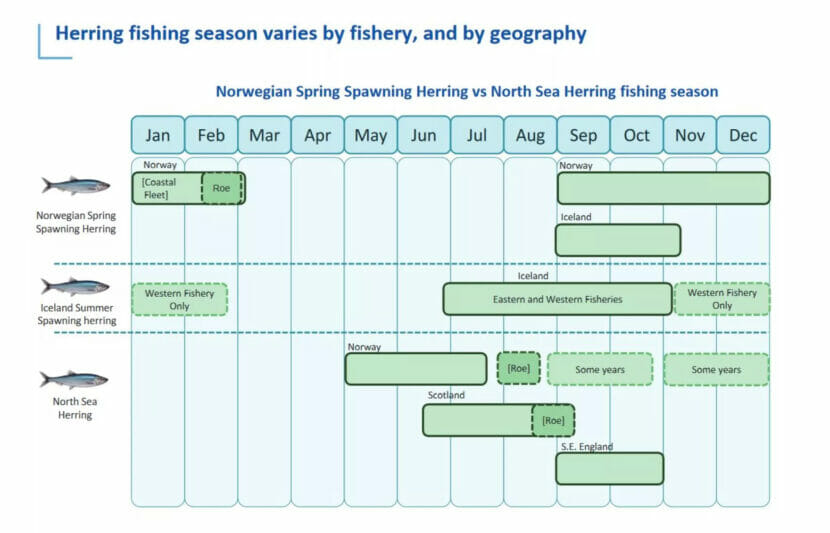
Examining European fisheries in the North Atlantic, Schactler found that fleets fish for herring throughout the year, so processors get a lot of different products based on when the fish are caught, unlike in Alaska, where most fisheries target runs during the spring spawning season. Among the key findings, it reported that some customers will pay more for specific products, like fish with a certain percentage of fat.
Herring from the North Atlantic are used to make fish meal and oil, but also for canning, pickling and smoking.
“They catch the fish in Norway, they ship it to Germany or Denmark. They smoke it, they can it, and next thing you know you’re buying it in Trader Joe’s in Seattle,” he said. “My question has always been, ‘Well, could we catch these big herring in Alaska? Can we catch ‘em in the wintertime in some of these other places when they have a different meat quality from the spawning phase, and then can we do something with them?’
Courtesy Of The Alaska Seafood Marketing Institute
Schactler said in order to market herring successfully, the American fishing industry needs to figure out a new way to sell it. But he said so far, they haven’t seen strong interest in doing so. And there aresome key differences between herring fisheries in Alaska and in the Atlantic. For one, the European fisheries are closer to a big slice of their market than Alaska processors, which have to ship fish much further away. And he said herring fisheries in the North Atlantic are bigger.
“Some of the boats they’re fishing will bring in 10 million pounds aboard,” he said. “They’ll have a big week up there fishing and they catch 35,000 tons in just a week.”
The report highlights opportunities in the industry as well; some European herring stocks lost their sustainability certification from the Marine Stewardship Council in 2020, and the report says that creates openings for other fisheries to win new customers.
And even in Europe, the drive for herring has declined, as the customer base has aged. One expert said, “the challenge, which we are facing very soon, is that the herring eating population will die out.” So companies are trying to get younger people to be more enthusiastic about herring, like a Danish marketing campaign called “Vild med Sild,” or “Crazy about herring.”
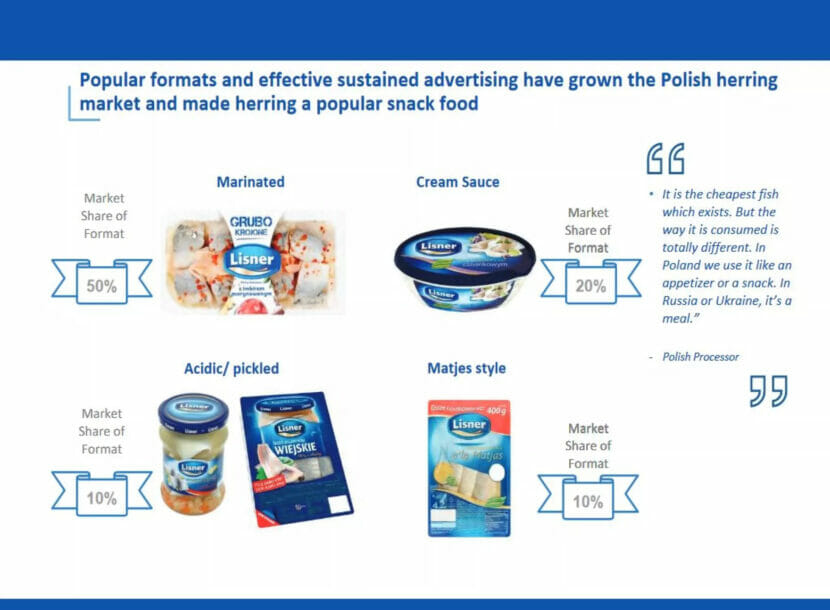
Others say the demand is there in Eastern Europe, where Poland has successfully marketed herring as a snack food. But geopolitical factors like Russia’s war in Ukraine contribute to the “volatile” nature of the herring market, and it likely means those countries will turn to cheaper herring products.
“What’s happening in Ukraine will change the market totally for herring. I don’t think they will have the money to pay for it,” said one United Kingdom source in the report. “Poland is a big market, everybody wants it. The trouble is, herring is perceived as cheap. Everybody is trying to undercut everybody else.”
Courtesy Of The Alaska Seafood Marketing Institute
Back in Alaska, President and CEO of OBI Seafoods Mark Palmer said they couldn’t process herring this year because of plant renovations in Dillingham and Naknek ahead of the salmon season. And Japan’s floundering demand for herring is just one more reason not to pursue Togiak’s fishery more forcefully. Palmer said OBI has looked at alternative customer bases for herring before, but it’s hard to compete because unlike fisheries in other parts of the world, they mainly target roe-bearing herring. And he said they haven’t hit on the right product yet.
“I think once there’s a product out there, then it would be, you know, can we compete? Can we go out and produce and compete in the global marketplace?” Palmer said. “There’s been efforts to work on fillets, at one point we had equipment in our Kodiak plant, we were filleting herring, we’ve canned, we’ve made samples of canned.”
Schactler said that in order for things to change, management has to shift; Alaska’s herring fisheries are largely managed to harvest sac roe, but to get fish with higher oil content, for example, they would have to harvest them in the fall.
“If you don’t change — [the Alaska Department of] Fish and Game doesn’t change — management, then you don’t have access to those fish for those particular products that you’re going to try to address in some section of the market,” he said. “Management has to change if anything else is going to change in any significant manner.”
For this spring, Togiak’s herring run will return to spawn, unharvested by a commercial fleet.
Chinook Salmon swim up a fish ladder at the California Department of Fish and Wildlife Feather River Hatchery just below the Lake Oroville dam during the California drought emergency in 2021. (Patrick T. Fallon/AFP via Getty Images)
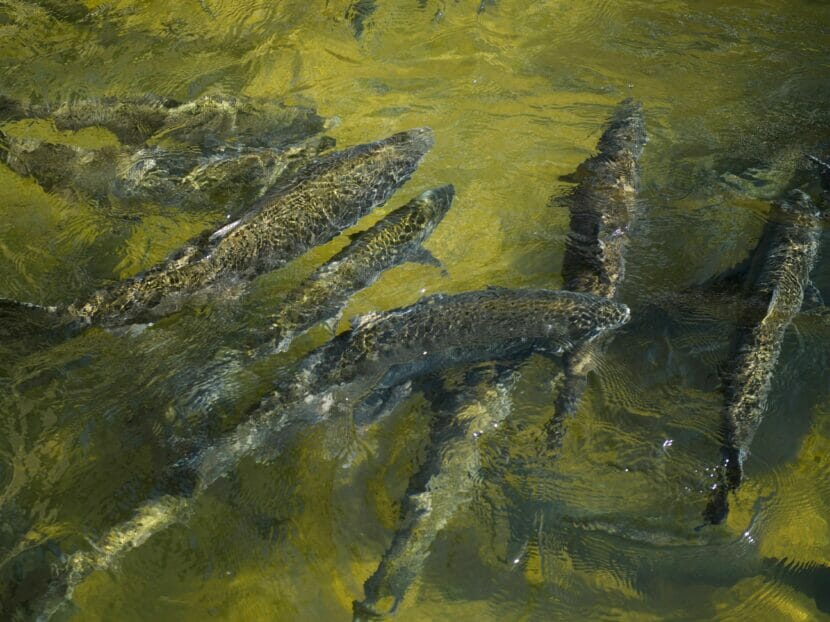
Chinook salmon fishing off the California coast will be called off until next spring in anticipation that a near-record-low number of fish will return to the state’s rivers to spawn.
The recommendation was made by the Pacific Fishery Management Council, a federal commission that oversees West Coast fisheries. It will need to be approved by the National Marine Fisheries Service by May 16.
The measure, unseen in 14 years, would temporarily ban both commercial and recreational salmon fishing in the state. Much of the fishing off the coast of neighboring Oregon would also be canceled until 2024.
Chinook salmon are the “largest and most highly prized” of all the salmon in the Pacific ocean, according to the council. But over the years, the species has become increasingly endangered as a result of drought, heat waves and agriculture.
The decision to cancel the salmon fishing season is expected to take a toll on the $1.4 billion fishing industry, which supports 23,000 jobs in the state.
“The economic impact of closing a good portion of the west coast ocean salmon fishery will negatively impact the people that participate in the fishery, and the small businesses in coastal communities that rely on the salmon fishery,” Merrick Burden, the council’s executive director, said in a statement.
2009 was the last time salmon fishing was halted in the region
Salmon depend on clean and cold water, particularly in rivers and streams where they migrate and spawn. But there is less of it as a result of California’s extreme drought. Farming and grazing, which tend to contaminate waterways with sediments and chemicals, have also taken a toll on fish.
Federal researchers predict that fewer than 170,000 adult fall chinook salmon will return to the Sacramento River this year — which is one of the lowest forecasts recorded since 2008. Similarly, fewer than 104,000 are expected to reach the Klamath River — which is the second lowest estimate since such research began in 1997.
The last time that the region shut down its salmon fishing season to help the population recover was in 2009. At the time, about 122,200 adult fall chinook salmon were forecast to return to the Sacramento River.
The Klamath River fall-run chinook salmon were declared overfished in 2018. According to federal researchers, the Sacramento River fall chinook salmon are also approaching an overfished condition.
“This is a decades-long trend, and the past few years of record drought only further stressed our salmon populations,” Charlton H. Bonham, the director of the California Department of Fish and Wildlife, said in a press release about the findings.
At large, about 23 out of the 31 genetically distinct kinds of salmon and trout in California are at risk of going extinct sometime in the next century, according to a 2017 report published by the University of California, Davis, and the conservation group California Trout.
The recent wetter weather in California has been “good news,” fishery scientists described earlier this week. Federal and state agencies are also working on the largest river restoration and dam removal project in the country’s history at the Klamath Basin in California to help recover the salmon population.
Amy Souers Kober, a spokesperson for American Rivers, which monitors dam removals and advocates for river restoration, estimates that more than 300 miles of salmon habitat in the California river and its tributaries would benefit.
Copyright 2023 NPR. To see more, visit https://www.npr.org.
Tlk’ Un Yeik Paulette Moreno arrives to the Fishermen’s Quay with a boat overflowing with herring eggs on hemlock branches on April 3. (Katherine Rose/KCAW)
Herring season in Sitka is a study in contrasts. Each spring for the last 45 years, large seiners land tons of herring, whose egg sacs are stripped and sold as a delicacy on the international market, often for millions. But the frenzy and money around the commercial sac roe fishery overshadows a far quieter Indigenous fishing tradition that’s taken place for millennia. KCAW recently accompanied a pair of subsistence harvesters in search of one of Sitka Sound’s most valued food resources – herring eggs on hemlock branches.
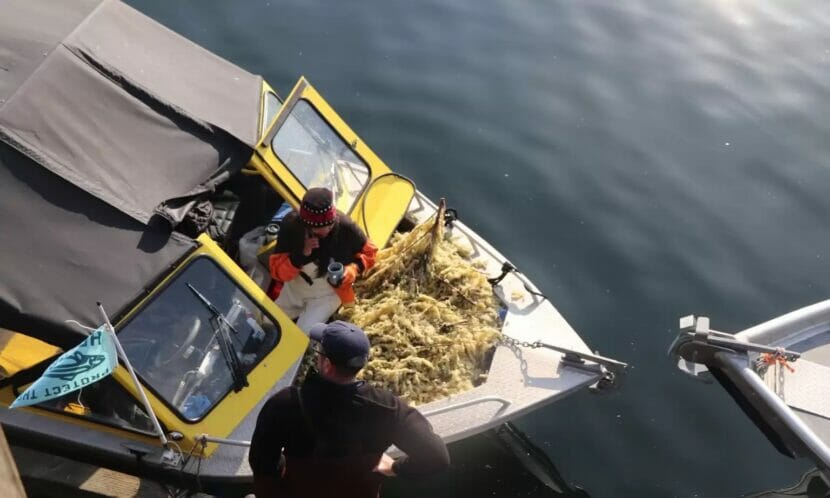
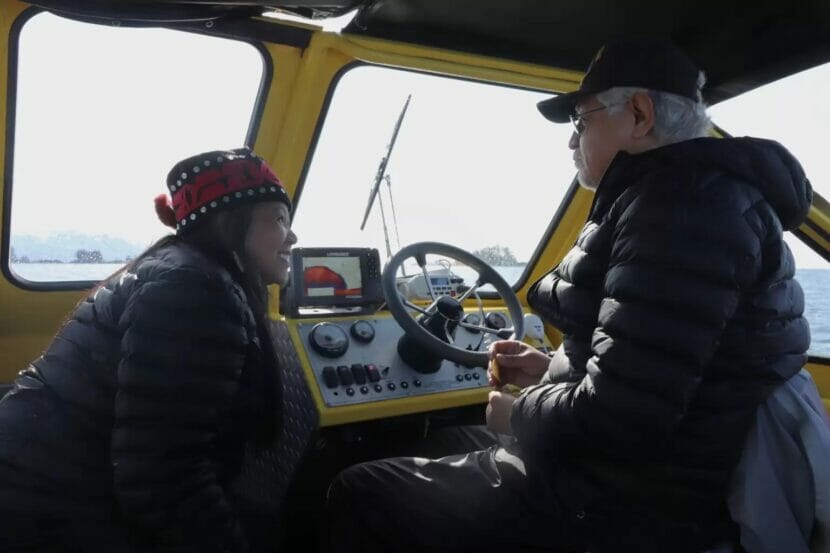
It’s a clear Sunday morning in March, and the herring are on the move. Tlk’ Un Yeik Paulette Moreno and Goos’ shu Andrew Roberts are slowly motoring north through Sitka Sound. Their 16-foot yellow boat, nicknamed Tweetybird, is loaded up with five hemlock branches to set today. The traditional Lingít herring egg harvest has begun.
Moreno has been harvesting roe on branches for around 15 years; Roberts has been doing it for most of his life.
“This is usually a pretty good spot, where that boat is, right in that little gut, there,” Roberts points to a rocky area on the western side of Middle Island that has been productive in the past.”
“Traditionally, when they start spawning in here, there’ll be 50 to 100 sets in there,” he adds. “This is real popular place.”
They’re cruising along when an announcement from the Alaska Department of Fish and Game comes over VHF radio. The big story of the morning? The first signs of spawn this spring, around two nautical miles, have been spotted near Shoals Point.
The sun is out, but the water is a bit choppy, so Moreno and Roberts may not make it out to Shoals Point, which is about nine miles of open water away from where we are now, on the southeastern tip of Kruzof Island. But they’re not worried, they’ve already set some trees in that area. Moreno says for the last three years she and the Herring Protectors, a local advocacy group, have been setting “protection trees” to call attention to traditional fishing grounds that should be avoided by commercial seining vessels.
“They’re complete sets, and we put them in strategic locations, and then we call Fish and Game and tell them where they’re at,” Moreno says. “We can set where and when we want, and these protection sets are to remind people who pass that area that there are sets out there. And sometimes those sets do really good, but the idea of a protection tree is to do that, to protect the herring and the area.”
Tlk’ Un Yeik Paulette Moreno and Goos’ shu Andrew Roberts smile as they realize their boat is passing over a school of herring, shown in their sounder radar (Katherine Rose/KCAW)
They slow their boat down in the lee of Middle Island to wait for the wind to die down. Roberts breaks out a rod and reel and begins to troll for salmon. It’s a delicate waiting game. The window to set branches at just the right time has shrunk in recent years.
“Instead of seeing the spawn for three or four days, we literally are seeing it pass through in four hours,” Moreno says. Unheard of. Unheard of.”
Roberts, who was born and raised in Sitka, says it didn’t used to be that way.
“I have witnessed when it spawned, it was on both South and North end, there was just nothing but solid herring, it was so thick,” Roberts says.
“I’ve seen, as a toddler, when the tide went out, herring would be stuck in the tide pools, because…the sound was so full, there was no place to fish to go,” he continues. “I’ve seen, just in my generation, how plentiful the herring were, and it’s not that way anymore.”
He believes that’s due to years of mismanagement of the commercial fishery. 2022 saw the biggest commercial harvest in Sitka’s history– 25,000 tons, which was just over half of the 45,000 tons the Department of Fish & Game allowed that year. In 2019 and 2020 the market crashed, and there was no commercial fishing at all. Moreno remembers how good those years off were for traditional harvesters.
“It was a year that COVID had just started, and we came through Middle Island. And it was a very calm, beautiful day. It was Native heaven again,” Moreno says. “There were boats and skiffs, and it was calm, it was peaceful. There was spawn everywhere. There was no competition with the commercial fleet, whatsoever. Everybody’s waving and smiling, we’re all putting down our branches.”
Moreno yearns for that undisturbed time on the water. While she’s called for all-out moratoriums of the commercial fishery in the past, and would still like to see that, she suggests a year on and a year off could be a place where traditional harvesters and commercial fishermen could find compromise.
“It would give us as harvesters, a chance to go out undisturbed and be in that Native heaven, you know, that we experience when there are not obstacles and we are closest to our spirit and our way of life. And then it would give the herring a chance to replenish those different years,” Moreno says.
“So yes, every other year I think would be good,” she adds. “But we need help in pursuing it, because the organizations that we have to go to, to try to just bring these things forward, are not always receptive.”
These herring eggs, harvested by Moreno and Roberts on April 2, will be donated to the Yaaw Koo.éex’ Herring Ceremony on Saturday April 15 (Katherine Rose/KCAW)
That time out on the water is important to Moreno because traditional harvesting is much more, much deeper than the word “subsistence” suggests.
“And our core is something that we need as a people to survive in the best way possible, because this feeds our spirits. And not only our spirits…there are Alaska Native and Native Alaskans who share this with us, who are hungry for balance in this world, who are hungry for things that matter the most, and this is one of them,” Moreno says. “We need that to be uninhibited. The closer that we are to less barriers and challenges and obstacles just to get the food that we have always eaten…the closer we are to our core.”
“Every barrier that’s put up, that we need to deal with, brings us further from our very soul and our very way of life. And it’s a sacred, beautiful way of life,” she says. “And that’s all we’re asking is to be able to practice that.”
As Roberts and Moreno troll back towards town, over the VHF radio, commercial fishermen let each other know where they’re going next to look for schools of herring. Roberts and Moreno laugh. They can see a big school of herring on their depth sounder just below the boat. But they’ll keep it to themselves today.
“The herring were right there with us,” Moreno said later, as we got off the boat in Sealing Cove. “That’s communication.”
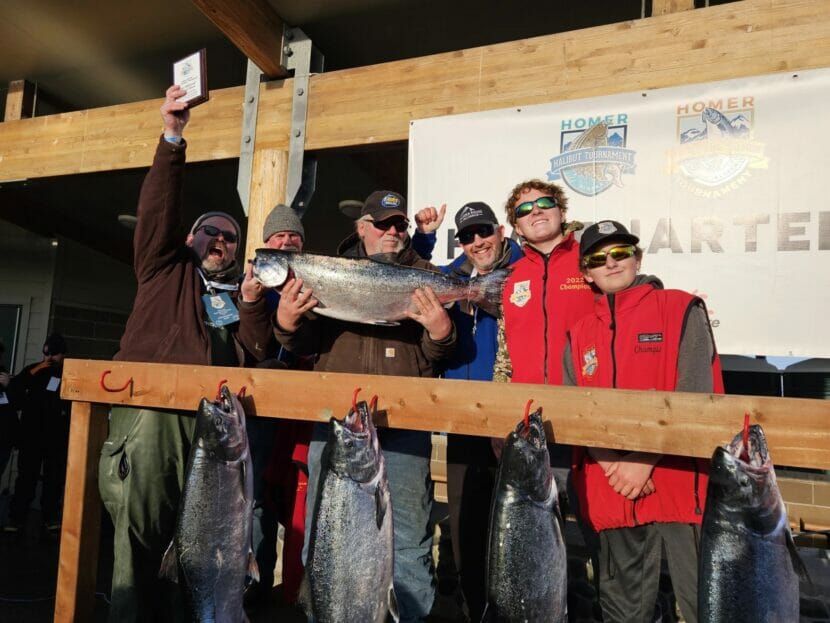
This year’s first-place Homer Winter King Salmon Tournament winner, Gail Bilyeu, (center) holds up his 26.12-pound catch surrounded by his boat crew. His total winnings, including side tournaments, were over $62,000. (Corinne Smith/KBBI)
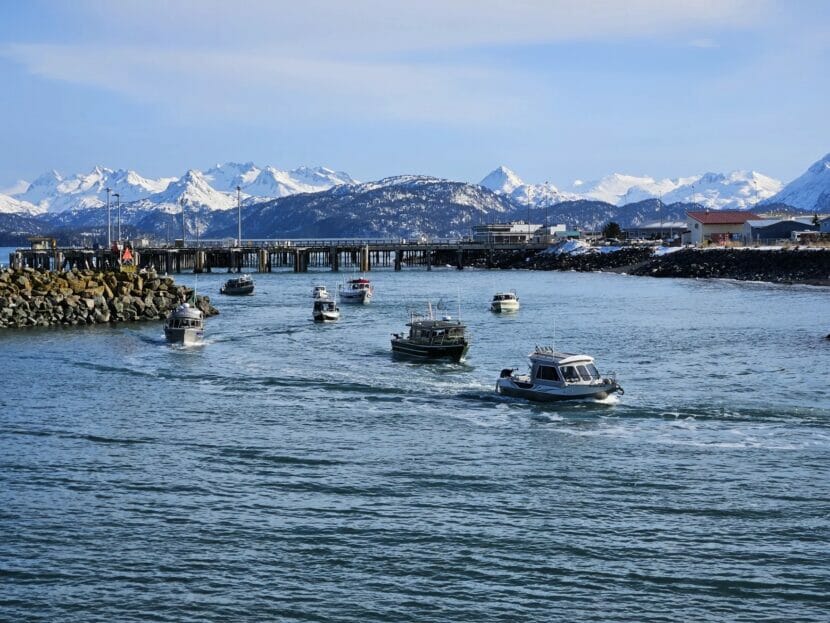
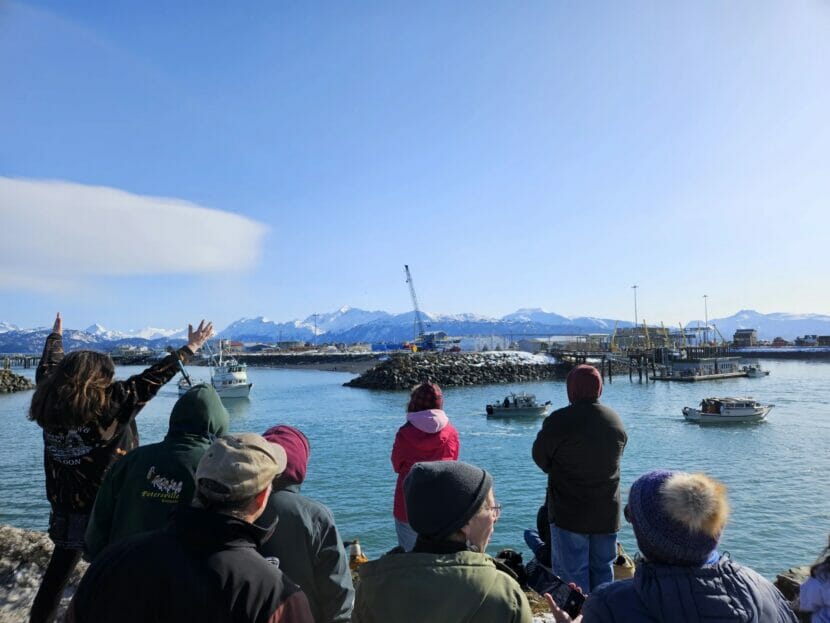
A crowd of onlookers gathered onshore Saturday as dozens of boats streamed past into the Homer Harbor to weigh in their catch.
Some yelled, “Show us your catch!” and anglers laughed and obliged, holding up their fish to the crowd.
Homer’s Winter King Salmon Tournament has seen record participation in recent years. This year, the event was postponed one week due to winter weather but still drew 818 participants and 273 boats from all over the state for one day of king salmon fishing on Kachemak Bay, and a chance at nearly $200,000 in tournament prizes.
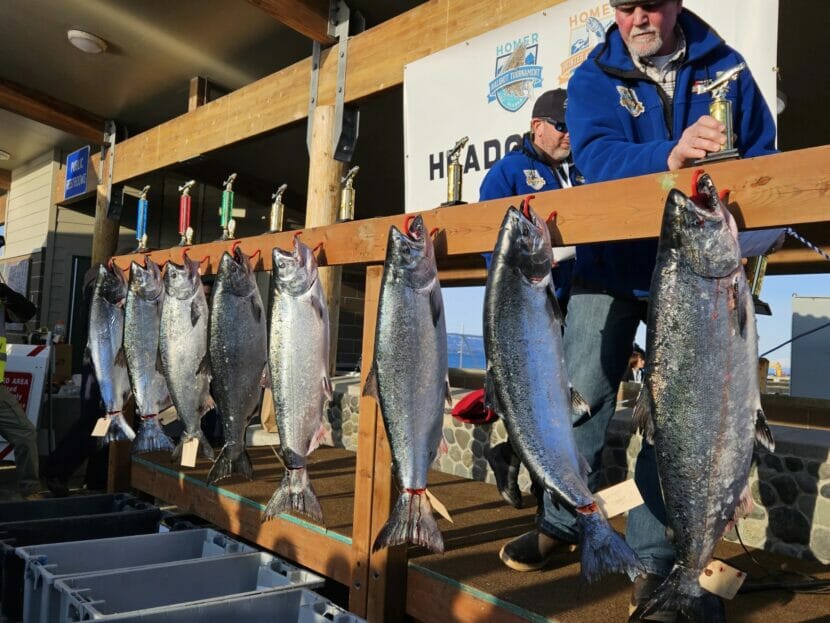
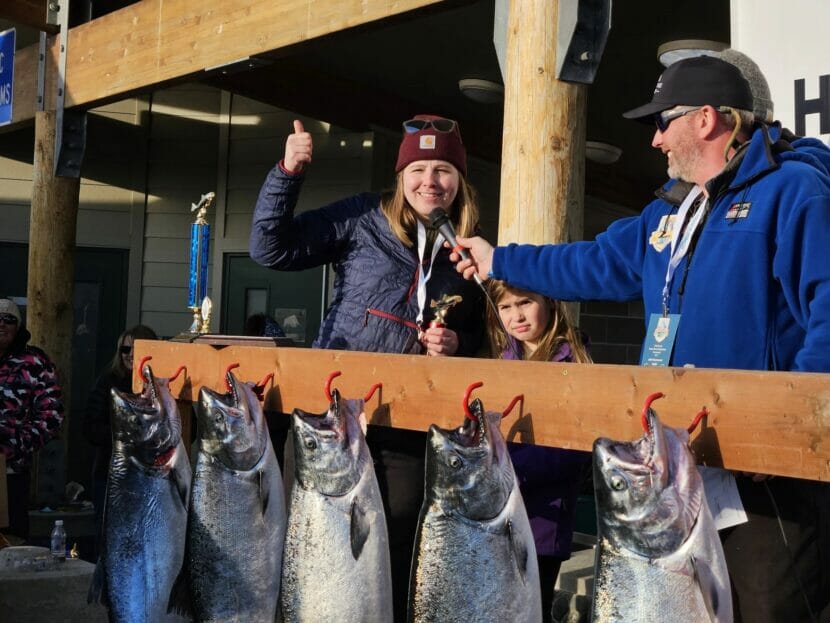
The top 10 biggest kings were displayed on hooks before a large crowd, silver skin glistening in the sun, and the winner was announced at 26.12 pounds.
“Total winnings of the first-place prize, $62,036.75, goes to Gail Bilyeu!” said an announcer. “Congratulations, this is your champion!”
The top ten kings displayed during the award ceremony. (Corinne Smith/KBBI)
Another winner was the City of Homer, which got a much needed economic boost at a time when Cook Inlet king salmon runs are in decline.
Brad Anderson is executive director of the Homer Chamber of Commerce, which hosts the annual tournament. He said the economic impact for the town is huge.
“Typically, it’s a very slow time of the year. And typically this event fills up all of our local hotels, so it’s a great opportunity,” Anderson said. “The last time we did our survey, I believe about 60% coming out here were staying [in hotels]. They weren’t local. So it’s exciting to see that impact.”
Last year, the winner took home over $82,000 with total tournament winnings. With over a thousand anglers participating, the cash prizes totaled over $200,000. With more registrants, and side tournaments, the winnings increase. This year, the total tournament prizes were estimated at over $132,000, along with merchandise prizes of over $32,000.
Boats coming into the Homer harbor. (Corinne Smith/KBBI)
Gunnar Knapp is a retired University of Alaska Anchorage economist who has studied Alaska salmon fisheries for decades. Though difficult to quantify, he said sport fishing has multiplying impacts for local economies.
“In general, sport fisheries, and including things such as a big fishing tournament, have a really dramatic economic impact, in terms of spending and income and jobs created, in the community or in the region,” Knapp said.
Knapp points to spending on fishing guides, lodging, restaurants and local stores as boosting local businesses and tourism opportunities. In addition, he said sport fishing can attract people to live or retire in fishing communities around the Kenai Peninsula.
“It’s not just the money that is created in all these different businesses where people engage in sport fishing and spend money,” Knapp said. “It’s also that for a huge number of Alaskans, sport fishing is a big part of their life. That’s a big part of what they enjoy.”
Second-place winners were cousins Alivia Erickson (left) and 8-year-old Elyanna Tutt of Homer, who caught a 23.26-pound king and took home over $22,000. (Corinne Smith/KBBI)
Knapp said it doesn’t just contribute to local tax revenue. In general, people often relocate or retire and create a quality of life centered around a unique resource like salmon fisheries.
“If you’ve got a good quality of life because you’ve got fun things to do like sport fishing, that helps deal with one of the major economic problems that we have in Alaska and actually, across the country, which is just a labor shortage,” Knapp said. “It’s sort of hard to find cops, it’s hard to find teachers, it’s hard to find restaurant workers, and so on. And so sport fishing is part of what you might generally call the quality of life. And quality of life really matters if you’re going to get people who will live in a community and take jobs in that community.”
While derby participants were successful on Kachemak Bay, other Kenai King salmon runs haven’t been doing well. This year, the Cook Inlet king salmon fishery is being closely watched, as declining runs and low harvest projections triggered state fisheries managers to close the king sport fishery on the Kenai Peninsula earlier this month.
Matt Miller is a Cook Inlet sport fisheries manager with the Alaska Department of Fish and Game. He said king salmon stocks across the state have been doing poorly and Cook Inlet is no exception.
“We’ve been doing restrictions in season and preseason for the last several years going back ten years in some of these systems,” Miller said. “And there’s no easy decisions when it comes to closing these fisheries. But we take the responsibility to manage these resources pretty seriously.”
“Show us your catch!” (Corinne Smith/KBBI)
But Miller said the ocean Cook Inlet king salmon — those fish caught in the tournament — are part of a mixed stock. That means those king salmon return to spawn all over coastal Alaska and British Columbia, not necessarily to the Kenai Peninsula rivers, though some do.
“Some of those fish are adult fish maturing and bound for Cook Inlet streams. And some of them are younger fish that are still growing, and are going to return to other systems outside of Cook Inlet,” he said.
Miller said it’s a good sign that anglers did well in Saturday’s tournament, weighing in over one hundred kings in a single day. But it doesn’t necessarily reflect the health or sustainability of the local king salmon stocks.
Knapp — the economist — said the closed king salmon sport fisheries will certainly have an economic impact for the Kenai Peninsula this summer — though again, it’s difficult to quantify. He said the last statewide study of Alaska sport fisheries was in 2007. And with all the uncertainty about the fisheries’ future, he said the region could benefit from an updated study on local economic impacts.
Close
Update notification options
Subscribe to notifications
Subscribe
Get notifications about news related to the topics you care about. You can unsubscribe anytime.

9(MDEwMjQ0ODM1MDEzNDk4MTEzNjU3NTRhYg004))