Housing

Homeless survey finds at least 70 in Juneau sleeping outside

The Glory Hole, Juneau
The Glory Hole, Juneau’s emergency homeless shelter and soup kitchen, organized this year’s Vulnerability Index Survey. (Photo by Casey Kelly/KTOO)

Volunteers and staff from Juneau’s shelter and soup kitchen went to the streets and interviewed 70 homeless people over the course of a few days in September. It’s been three years since the vulnerability index survey was done in the capital city.

The surveys can connect people to services, help The Glory Hole keep track of where people are sleeping, and social service agencies can use the data to guide practices and apply for funding.

It’s around 4:30 on a Wednesday morning. At The Glory Hole, groups of volunteers sip coffee and discuss plans for a second morning of surveys. Each group is assigned to search a different area of Juneau. The goal is to find homeless people who are sleeping outside and interview them.

The morning before, Brad Correia’s group didn’t find anyone in the Mendenhall Valley or out the road.

“We walked on a lot of beaches where they have shelters, like in the summer it would be really nice. We thought people would be sleeping in there, like they have fireplaces. But there was nobody,” Correia said.

Brad Correia and his group searched for people sleeping outside in the Mendenhall Valley area and out the road. (Photo by Lisa Phu/KTOO)

The group searched behind Safeway, looked around all the stores in the valley.

“Just everywhere and we didn’t find anybody.”

Correia thought they might find people sleeping in cars out the road.

“‘Cause I thought, if I was homeless and had a car, that’s where I would go to where there wouldn’t be people bothering me, like troopers,” he said.

Correia has been homeless. When he first got to Juneau about a year ago, he didn’t have any money and stayed at The Glory Hole. He remembers another man at the shelter who talked a lot.

“I ignored him. I just acted like I was reading when he would come and talk to me. Just talk and talk and talk,” Correia said.

Days later, that man, Gregory Dockery, was found dead, submerged in water in a ditch near Twin Lakes.

This was last November. Correia is afraid Dockery died thinking nobody cared, “Last time I saw him, he was crying, ‘Nobody likes me, nobody cares about me.’”

This is why Correia is volunteering to do the homeless survey. He thinks there’s a better solution than dying in the cold.

Data from the 2012 survey has been used to apply for funding for Juneau’s Housing First Project.

Clyde Didrickson was part of that survey and was just interviewed again. He was walking to the Glory Hole with his wife when a group of interviewers found him.

“They let us know who they were and what they were up to asked me if I cared to be interviewed,” Didrickson said.

Didrickson felt fine answering personal questions about substance abuse, race, health history, mental health, money, education, how long he’s been homeless. There was one question he found intrusive and didn’t answer: What’s your social security number?

Didrickson won’t say where he and his wife spend their nights for fear of being harassed.

Clyde Didrickson says he's been homeless since 1981. (Photo by Lisa Phu/KTOO)
Clyde Didrickson says he’s been homeless since 1981. (Photo by Lisa Phu/KTOO)

“We found a dry spot,” Didrickson said.

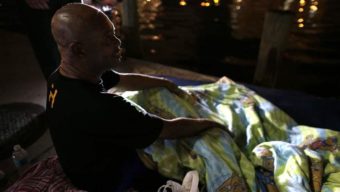
Didrickson is 63, originally from Sitka and a veteran. Didrickson said he’s been homeless since the early 1980s when he was arrested for a felony. His wife is 62. He carries their bedding around in a suitcase – an old tent they use as a tarp and blankets.

“Usually after everybody closes up, basically when people stop moving around, we lay out the tarp to give us something dry to lay on and then we lay our bedding out on top of that and then the excess tarp we put over ourselves,” Didrickson said

The couple wakes up around 5 a.m. They put everything back in the suitcase and begin their day.

“Hardest part for us, especially at our age, is finding a facility to use,” Didrickson said.

Some public bathrooms lock up for good after the tourist season ends. Others don’t open until later in the morning. Didrickson said he sometimes goes to the bathroom in the woods.

At 7 a.m., he walks to The Glory Hole for coffee and warmth. The rest of the day, “Look for some place dry and warm to sit around. A lot of times wait for the library to open,” Didrickson said.

At the moment, he’s sitting with his wife, 27-year-old son, and brother-in-law at a table at The Glory Hole.

Didrickson says he’ll likely be back at the shelter for lunch and dinner before spending another night outside.

CHOICES program takes new approach to housing people with severe mental illness

About 30 percent of people who are chronically homeless in the United States suffer from severe mental illnesses. These individuals more frequently require emergency services and can cost the city of Anchorage up to $60,000 per year. A new program in the city is trying a new tactic to help them, by meeting them where they’re at. Literally.

In August, substance abuse specialist Delroy Duckworth and his colleagues received a call from someone who needed help.

“The first thing we did was went out to find him,” Duckworth recalls. “And we went to the mall to look for this person and we did not know who he was. So we called him on the phone. We heard a phone ring, we saw a man answering his cell phone, I said, ‘Mary that’s him!’”

Leo Tondreault recently moved into his own place at Safe Harbor after four years on the street. (Photo by Anne Hillman/KSKA)

The man with the phone was 60-year-old Leo Tondreault, tall and bulky with a graying beard, joints achy from rheumatoid arthritis. He’s distrustful in general but knows he needs help.

“I’ve been homeless off and on for four and a half years. And nobody cares about you out there. And people that say they understand? How can they have no idea where I’ve been. Everyday is survival. How I’m going to eat, where I’m going to be for the night. Most of the times I just walk all night, drink coffee.”

Part of the reason he never stayed still was to help cope with his anxiety and bipolar disorder – a severe mental illness.

“I just stayed away from people. Because not a lot of people understand what bipolar is. And the worst part for me is the mania. The hyper vigilance.”

Tondreault says he went to see a case worker at Providence Hospital in August and he learned about the CHOICES program. It’s short for Consumers Having Ownership in Creating Effective Services. Unlike other service providers, CHOICES does everything — mental and physical health care, housing, substance abuse treatment, job skills training.

“We are like a one-stop shop,” says Duckworth of the ten-person team that uses hyper individualized care tailored to each client.

They’re using a model called Assertive Community Treatment. It was developed in the 1970s, but this is the first time it’s being tried in Alaska. Research shows it’s more effective than standard case management models, where an individual meets with many different organizations. It costs more up front, but saves money in the long run because clients are less likely to use expensive services, like emergency rooms and hospitals.

The CHOICES program has a budget of $1.8 million for the next three years. It’s funded mostly through the state’s Department of Behavioral Health and specifically targets people who have severe mental illnesses and are homeless. The team is mobile and adaptable. They carry tablets and keyboards and meet people on their own terms.

“We don’t want to overwhelm them,” says housing specialist Mary Abraham. “If they become angry we say, it’s okay, we’ll meet later on. And usually it works out.” They’ll work with people who are still using substances, too.

Abraham’s goal is to get people into housing first. That’s what she did for Tondreault at Safe Harbor at Merrill Field.

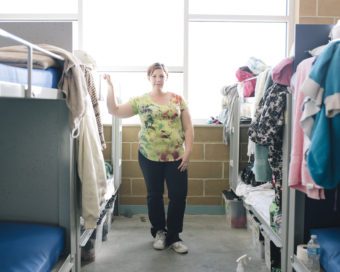
He sits on the edge of his twin bed in a sparsely furnished former hotel room. He has a microwave and a mini-fridge, but shares the kitchen. He often runs into other tenants in the hall, who he says offer him alcohol, but he’s resisting. He’s been sober for nearly two months. Tondreault says he’s tried other programs and received some help, but he’s never felt supported the way he does with CHOICES.

“I’m pretty peaceful today. Delroy came over today and said, ‘Man, you look well rested.’ Well, yeah. You change my situation and give me the things I need to help me survive, I’m a different person.”

Tondreault hopes the CHOICES staff can help him accomplish his goals, like staying sober and going back to school in the spring. He knows he needs to put forth his own effort, but he says now he has support to get there.

‘I thought he was safe,’ brother says of man found in wetlands

At The Glory Hole, James Knudson, 57, cries intermittently while talking about his brother, John Knudson, who died last month. (Photo by Lisa Phu/KTOO)
At The Glory Hole, James Knudson, 57, becomes emotional while talking about his brother, John Knudson, who died last month. (Photo by Lisa Phu/KTOO)

There are moments when James Knudson forgets his younger brother, John Knudson, is dead.

“Riding on the buses, I start looking out where we used to see him, around Switzer or A&P or down at the bus barn, places you know he hung out. I catch myself looking for him,” Knudson says.

His brother’s body was found in the Mendenhall Wetlands in mid-September. Juneau Police said he had likely been in the water and exposed to the elements for at least several days. His body was sent to the state medical examiner.

John Knudson, 56, is one of at least eight people who have died outside in the past three years. These are just the ones we know about based on the 2012 Juneau Homeless Coalition survey.

John Knudson during his younger adult years. (Photo courtesy Jennie Knudson)

Juneau Police still don’t know what caused Knudson’s death. His brother James Knudson doesn’t either, but he has a theory: “My suspicion is that he was by either Switzer Creek or Lemon Creek and fell in there and then got washed out.”

Knudson says his brother was staying with a friend in the Lemon Creek area. He assumed he was safe, even though he hadn’t heard from him in a few weeks. The two brothers had always looked out for each other.

“If somebody got in a little scrap with somebody else, somebody would show up and help out. But this time I didn’t have any feeling. I thought he was safe,” Knudson says.

Knudson is staying at the Bergmann Hotel at the moment. He says he’s been homeless for 10 years. He says his brother became homeless when he split up with his girlfriend.

“He had his issues with alcohol, like other people, like I do at times,” Knudson says. “It’s a tough life living on the streets. I’d been there and we’d both lived on the streets together at different times.”

Just one year apart, the two brothers — of seven children total — were close growing up and as adults. They were both born in Juneau but spent their early years in Hoonah.

John Knudson's school picture. (Photo courtesy Jennie Knudson)
John Knudson’s school picture. (Photo courtesy Jennie Knudson)

James Knudson’s favorite story about John is one their mom used to always tell.

“My dad had just gotten back from deer hunting, had a couple deer hanging out in the shed. That night my brother came up to me. He had a butter knife in his hand, goes, ‘Jer, let’s go hunt some deer.’ That’s what they called me, ‘Jer.’ I looked at my brother and go, ‘What if we run into a bear?’ Holding a butter knife, he goes, ‘We’ll jump on his back,'” Knudson says, laughing.

Knudson says his brother fell into the wrong crowd at a young age, got in trouble and paid for it the rest of his life. Knudson says his brother went to a mining trade school.

“The instructor thought he would be a good mine worker, but with his felony, he couldn’t get a job at the mine. I tried to talk to him about it. I guess some people can work around a felony as far as working in the mine, but my brother just wouldn’t look into it,” Knudson says.

Instead, John Knudson went into construction and mechanical work.

“He’s a real good worker. It’s just alcohol got the best of him,” Knudson says.

Knudson continues to struggle with alcohol. He’d been sober for two months, but started drinking again while planning his brother’s memorial services. He says John’s body will be cremated, his ashes spread over their parents’ graves.

John Knudson would’ve been a candidate for Juneau’s Housing First project. If the remaining $2.4 million in funding is secured by January, the project could be complete as soon as 2017.

“In the meantime, we should just not accept this as an acceptable reality, because it’s not acceptable. It’s not acceptable to have people die on the street,” says Glory Hole Executive Director Mariya Lovishchuk.

If you see someone laying outside, ask if they’re OK. If they’re not, call for help.

“We just need to treat people like human beings,” Lovishchuk says.

A memorial service will be held for John Knudson on Sunday, Oct. 4 at 6 p.m. at the Tlingit-Haida Community Council Building on Hospital Drive.


Affordable senior housing project in limbo with broken partnership

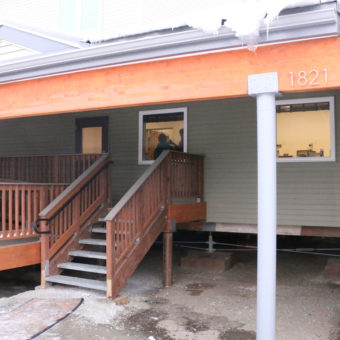
Juneau's St. Vincent de Paul Society and Seattle-based GMD Development were supposed to break ground on low-income senior housing on this land near the airport. With the partnership over, the land remains untouched. (Photo courtesy St. Vincent de Paul Society)
Juneau’s St. Vincent de Paul Society and Seattle-based GMD Development were supposed to break ground on low-income senior housing on this land near the airport. With the partnership over, the land remains untouched. (Photo courtesy St. Vincent de Paul Society)

A partnership that was going to bring 41 units of low-income senior housing to Juneau has ended, leaving a Seattle-based developer with $9 million in funding and no land to build on.

Dan Austin, general manager of St. Vincent de Paul Society in Juneau, called the housing project the Home Run. When the nonprofit and its partner GMD Development were awarded the financing in December, Austin had been working on the project for 10 years.

The plan was to break ground this summer.

“We put in a lot of time, effort, money, blood, sweat, tears into this project and it’s very disappointing, very disappointing,” Austin said.

Both entities say it was the other that withdrew from the partnership.

Austin said St. Vincent de Paul and GMD Development weren’t able to agree on things like the administration of the project and the role of the housing’s thrift store.

“It’s mainly differences in management philosophy and mission between the two organizations. One is not necessarily better than the other, but we got to a point where it appeared that they were incompatible,” Austin said.

The proposed project targeting low to moderate income seniors was to be a mix of studio, one-bedroom and two-bedroom units with a thrift store on the ground floor. The plan was to build it on a lot adjacent to the nonprofit’s current property near the airport.

Alaska Housing Finance Corporation awarded the $9 million in financing to the project. With the broken partnership, director of planning and program development Mark Romick said the award contractually stays with GMD Development.

The Seattle-based company has until Dec. 31 to find another partner for the proposed Juneau housing.

“The project has to be exactly the same as it was proposed — same units, same energy efficiency, techniques, same design, same everything,” Romick said.

Romick hopes the proposed project can still happen.

“We want to see the units developed in Juneau and we’re hoping that this whole thing can work itself out,” Romick said.

If GMD Development doesn’t use the financing, AHFC gets it back. Romick says there’s a possibility it could be restricted to a Juneau project.

GMD may still have the financing, but it doesn’t have the land. That belongs to St. Vincent de Paul.

Project manager Emily Breidenbach said GMD is looking for new development sites and a new nonprofit partner. It’s been in discussions with a few agencies in Juneau, including Tlingit-Haida Regional Housing Authority, but doesn’t have anything concrete.

“Certainly because these are going to be seniors, we are looking for a site that’s well connected that has access to buses and sidewalks so that seniors can get out and be connected to the community,” Breidenbach said.

GMD and St. Vincent de Paul are still partners on a current renovation to Channel Terrace apartments in Douglas, and have funding applications in for other projects.

As GMD looks for another partner and land to build on, St. Vincent de Paul continues to pursue developing its land for low-income senior housing. Austin says he’s meeting with a potential partner in a few weeks.

House Calls To The Homeless: A Doctor Treats Boston’s Most Isolated Patients

As a doctor who provides medical care to Boston’s homeless population, James O’Connell and his colleagues are used to working in unusual locations. “We are basically visiting them in their homes, which are often under bridges, down back alleyways [and] on park benches,” O’Connell tells Fresh Air‘s Terry Gross. “It’s been an education for us over these years.”

O’Connell is president of the Boston Health Care for the Homeless Program, which provides health care services at over 65 sites, including adult and family soup kitchens, detoxification units and corrections facilities. He writes about his practice in a new memoir, Stories from the Shadows: Reflections of a Street Doctor.

O’Connell has been caring for Boston’s “rough sleepers,” or homeless, since 1985. He says that homeless patients suffer from the same chronic and acute illnesses as the general population — with one crucial difference. “What we see … frequently, are regular issues that have been neglected for years and years,” he says. “So we see the natural history of illness that is usually interrupted by good preventive care.”

Over the years, O’Connell has seen the ravages of untreated frostbite, AIDS and diabetes, as well as the effects of profound isolation and extreme loneliness. But he has also witnessed a courage and resourcefulness in his patients.

“These are people who are nameless and faceless when they are sitting out in the street,” he says. “But when you get to know them, they are stories of great courage, of struggles against unbelievable adversity. … I think I probably would’ve been a broken person had I lived through what they lived through.”


Interview Highlights

On suspending judgment

I remember what came across is that whatever I thought of someone, when I first met them or first walked by them, it rarely panned out once I got to know them, and the stories that emerged from these people, what they have lived through and as you learn, each one is very different from another, but each one has a remarkable story. … I hope in these stories what emerges is the real resilient spirit of people who have really, really been dealt a bad hand in life and suffer from all those social determinants of poverty.

On the result of homeless people not receiving good preventive health care

We … see the end stage of many things. We often see pneumococcal pneumonia, for example, which probably should’ve been treated on Day 1 or Day 2; by Day 7 or Day 8 it can be very, very devastating. …

As we learned the hard way … these are people who were struggling to survive outside on the streets. They’re interested in just being safe today or just getting the next meal or just getting a bed for the night. Taking care of an infection in their foot or diabetes or their hypertension is way down the list of priorities, which, of course, is really difficult for us doctors who think that should be the top of the list.

On the extreme illnesses he’s seen

We see dramatic things that I never saw in medical school or often even in the textbooks. During this past year [we] have watched a man who had been outside for a very long time who has a pretty difficult psychotic disorder who got frostbite on both feet, really severely, came into our respite facility where we cared for him and he elected to not do surgery, and we spent the past year watching his feet fall off from auto-amputation, which is what happens at the end stages of frostbite. Most of our staff, including our nurses, had never seen anything as dramatic as that.

We will also see tuberculosis, things that you would be used to seeing in a Third World country much more than an inner city of a very medically rich world. We see all of the end stages of AIDS neglected because people were not able to get to treatment. … If you are caring for a homeless population, you are really seeing the really both exotic illnesses as well as the end stages of chronic, common illnesses.

On hidden homeless communities

Even after I had been doing this job for almost 15 years thinking I knew every nook and cranny of the city of Boston, somebody pointed out to me that there were 20 people living in a tunnel under Copley Square. …They came out only at nighttime; they spent their days down in the tunnels. And I remember going down there and meeting all these people for the first time and being stunned that most of them had been there the whole 20 years that I had been out. We always think we know a lot, but we keep our minds open to finding there’s always a new place where someone can be.

On trauma homeless women face

For women to get to the streets we know that the journey is one that is very complex and almost always full of unspeakable trauma — sexual, physical and emotional trauma — and, so, by the time women are on the streets, they are really suffering, and those who become pregnant often feel despair, discouraged, feel they have no place to go, and feel very attached to having the baby safely and in a good way.

So we found that pregnancy often is not only alarming for the women, but it’s a place where they can actually take stock of their lives and try to come in, so we always try to provide as much service … gentle service as we can to anyone who is pregnant on the street, so they can deliver a good baby and hopefully hang on to that baby.

Unfortunately, many of the women, if you speak to them on the street, have had many children, all of whom they’ve lost to social services, because they were unable to stop using or they had no place to bring the baby once the baby was born. There’s an awful lot of trauma among the women on the streets about the children they have lost and mourn.

Copyright 2015 Fresh Air. To see more, visit http://www.npr.org/programs/fresh-air/.
Read Original Article – Published SEPTEMBER 29, 2015 2:35 PM ET

Assembly ambivalent about Gastineau Apartments redevelopment pitch

Bauer Clifton - Gastineau Apartments redevelopment concept art
Bauer/Clifton Interior Design concept art for a redeveloped Gastineau Apartments.

Bauer/Clifton Interior Design has big ideas for redeveloping downtown Juneau’s biggest eyesore, the burnt out Gastineau Apartments.

“It would include a small, contemporary boutique hotel, high-rise condominiums, long-term apartment rentals, a restaurant and lounge as well as other amenities that would be a part of the hotel and made available to the residents of the condominiums,” said Jason Clifton. “And lastly, a parking garage or parking facility.”

Clifton, partner Jeremy Bauer, and a California real estate developer on the phone were pitching a public-private partnership with the city to the Juneau Assembly on Monday.

There were a lot of moving parts in that pitch: property tax breaks, hotel tax breaks, building new public parking spaces as an in-kind repayment for the city’s demolition costs and more. And a possible legal problem the city attorney flagged. That made members of the assembly ambivalent about jumping in.

Assemblyman Jerry Nankervis said he loved the idea. But, “There are so many variables out there right now that are so variable — I have some concerns about this. And it’s not about necessarily your project, it’s about how it’s gonna happen with us.”

The assembly was noncommittal, and asked city staff to continue exploring the proposal and negotiations as a way to recoup its demolition expenses.

Site notifications
Update notification options
Subscribe to notifications