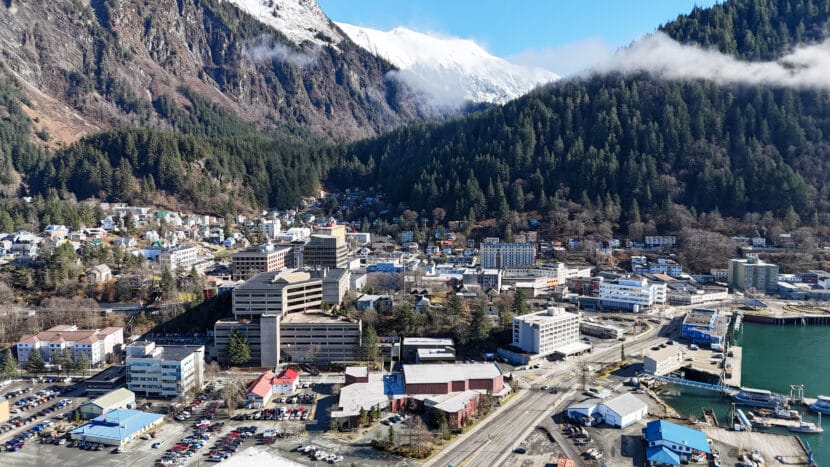
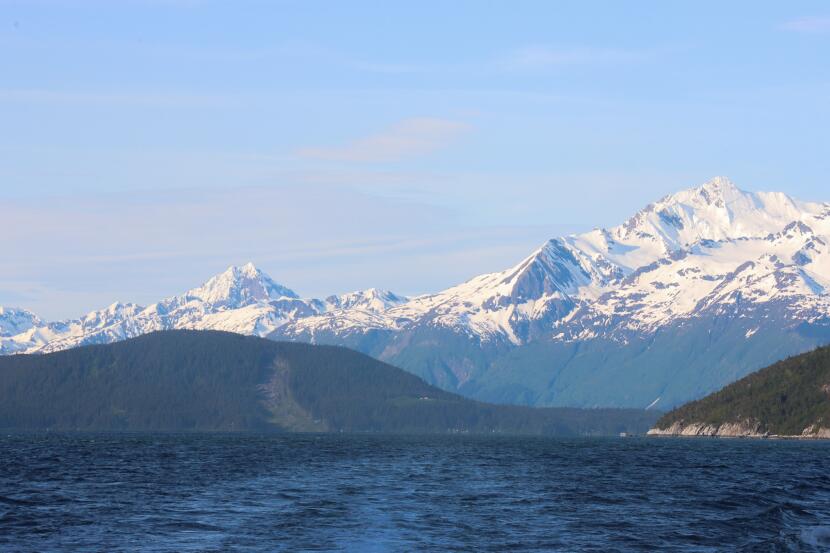
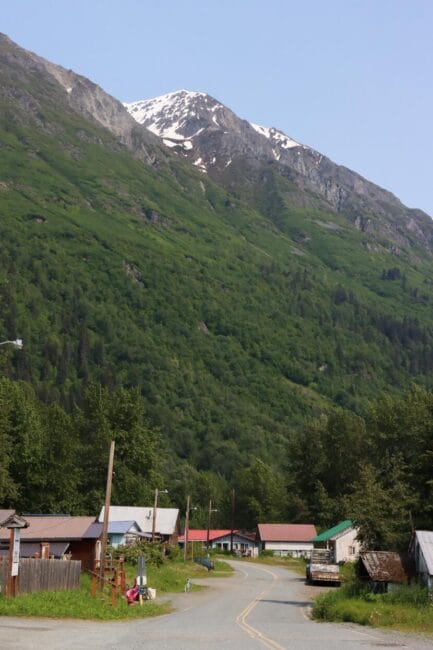
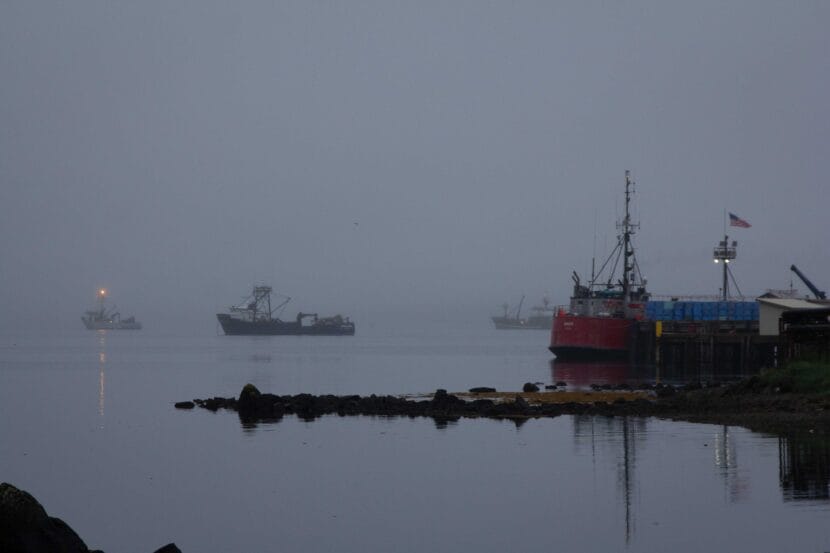
Downtown Juneau on Wednesday, March 26, 2025. (Photo by Clarise Larson/KTOO)
Juneau is inviting developers, nonprofits and tribal governments to apply for grants or loans from its affordable housing fund.
The city created the fund five years ago to address the city’s lack of housing — specifically, low and middle-income rentals. There is $2.5 million available in the fund this year. The application period opened last week and runs through Aug. 22.
“Things are getting more challenging with the landscape for housing on the federal level,” said Joseph Meyers, the city’s housing and land use specialist. “I’m really hopeful that we get a lot of people applying for these funds, and get more units on the grounds.”
The city then uses criteria like proximity to public transportation and long-term affordability to decide which projects get funding and how much.
The city has awarded nearly $13 million in grants or loans from the fund since its establishment. But not all projects funded in the past have been required to offer affordable units. In 2022, the Juneau Assembly approved a $1.2 million loan from the fund for a development called Ridgeview.
The Assembly initially approved the loan for the project with an affordability requirement, but later stripped those requirements after input from city leadership. The developer listed the units as condos available for purchase at market price to the dismay of many Juneau residents. Some testified at public meetings and others posted hundreds of comments on social media.
“If the application doesn’t meet that requirement, they’d have to go back to the drawing board,” he said. “We really do want to focus on providing some affordability, at least with all these projects.”
The application period closes on Aug. 22. Then, a committee will review them and make recommendations to the Assembly for final approval.
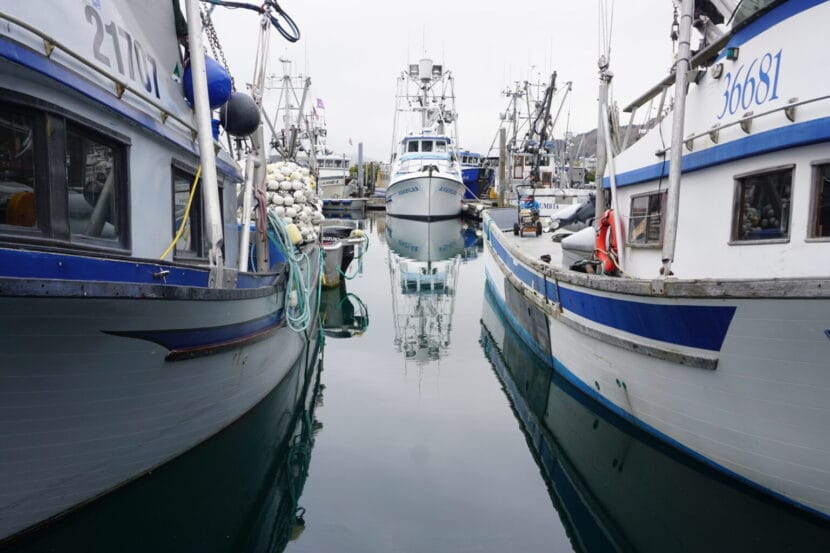
Fishing boats line the docks in Kodiak’s St. Paul Harbor on Oct. 2, 2022. (Photo by Yereth Rosen/Alaska Beacon)
Gov. Mike Dunleavy has canceled a broadly supported bill proposed by a legislative task force and intended to help commercial fishers in Alaska.
The governor issued his veto of Senate Bill 156 on Wednesday, marking his seventh veto of a policy bill this year.
Legislators will have an opportunity to call for an override vote on most of those vetoes when they meet Aug. 2 for a special legislative session.
SB 156, which was inspired by policies drafted by a joint House-Senate task force intended to evaluate the state’s commercial fishing industry, would transfer $3.69 million from a defunct state loan fund to the state-owned Alaska Commercial Fishing and Agriculture Bank, which provides loans to fishers.
In his veto message, the governor said that “in a year of limited revenues and competing needs, committing scarce public dollars to subsidize a private lender is not prudent. Until long-term fiscal policy is put into place, the state must preserve its limited resources.”
Sen. Jesse Kiehl, D-Juneau, was the lead sponsor of SB 156.
In posts on social media, Kiehl called the veto “a weird move” because the bill was based on work he did with the governor, it passed through the Capitol by a combined 59-1 vote, and he said the governor’s office declined meetings to discuss it after the Legislature passed the bill.
Several Alaska Airlines planes are parked at Seattle-Tacoma International Airport gates on Jan. 5, 2022. (Jeff Chen/Alaska Public Media)
An IT outage that grounded all Alaska Airlines flights Sunday night led to cancellations Monday at airports in Alaska.
Seven flights out of Alaska had been canceled as of 10 a.m. Monday: three flights between Fairbanks and Seattle and four between Anchorage and Seattle. Several flights departed late early Monday, according to the website FlightAware.
“A critical piece of multi-redundant hardware at our data centers, manufactured by a third-party, experienced an unexpected failure,” Alaska Airlines said in a statement. “When that happened, it impacted several of our key systems that enable us to run various operations.”
Terry Haines, producer of the Alaska Fisheries Report and a radio host at KMXT, lives in Kodiak and was heading home from Redding, California when the outage hit. His flight was supposed to leave SeaTac at 5 p.m. Sunday, he said.
“They rerouted me. They had me flying from Seattle to Chicago, and then from Chicago to Anchorage, and then from Anchorage to Kodiak. And I said, ‘Well, maybe I can get on the phone and change this,'” he said.
He was able to change his flight to continue to Anchorage through Seattle, but by the time he was expected to get home, it was likely to be over a day late.
According to Alaska Airlines, the outage was not caused by a cybersecurity breach, and passenger safety was not jeopardized.
Over 200 flights nationwide had been canceled since Sunday evening because of the outage, the airline said.
Alaska Airlines grounded its fleet in April 2024 for about an hour because of an issue with a system that calculates weight and balance of planes.
“We appreciate the patience of our guests whose travel plans have been disrupted,” the airlines’ Monday statement said. “We’re working to get them to their destinations as quickly as we can. Before heading to the airport, we encourage flyers to check their flight status.”
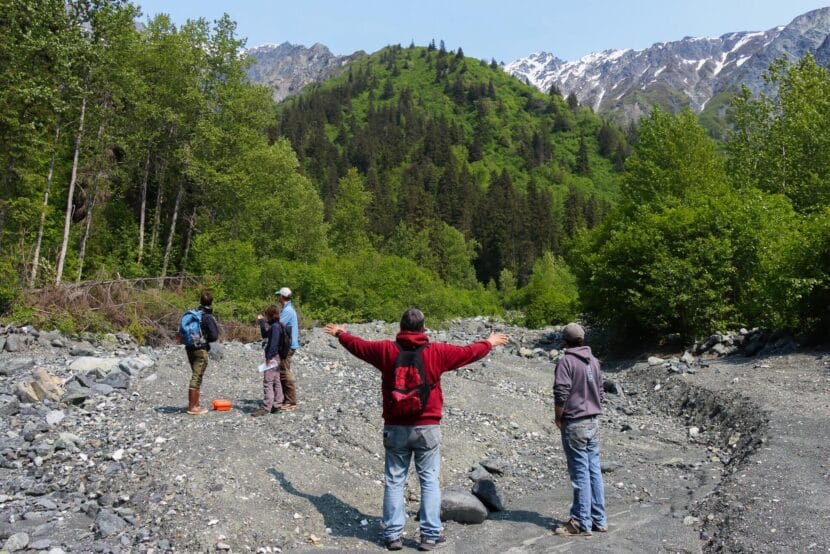
Chilkat Indian Village environmental staff and outside researchers stand on the 23 mile slide area during a site visit in June. (Avery Ellfeldt/KHNS)
Decades ago in the Chilkat Valley, heavy rains would spark mudflows that tumbled down the Takshanuk Mountains, over an international highway and into the Native village of Klukwan.
Dan Hotch remembers it well. The slides in the late twentieth century that flooded and damaged buildings would routinely deposit a slurry of rocks and mud under his family’s home.
“Growing up as a kid, we hated August and September weather because we knew the rains were coming, and we knew the water was coming down. And there was no way to really stop it,” said Hotch, who is now an environmental specialist with the Chilkat Indian Village.
Then, about 25 years ago, a community member built a berm high in the foothills to divert the debris down another slide path and away from the village.
For decades, it worked. But now that’s starting to change. As the slide path evolves and sediment builds up, rocks and mud have started surging out of that channel – and heading in a concerning direction.
“That migration has caused it to start to point debris flows more towards the village again,” said Josh Roering, an Oregon-based geologist researching geohazards across Southeast Alaska.
The situation has major implications for the village’s safety – and long-term future.
The tribe wants to build more housing not only for current residents, which the 2020 census put at 87 people, but also to make it possible for tribal members who don’t live in the village to move there.
But that’s complicated by the fact that Klukwan is sandwiched between two geohazards that are intensifying with climate change: to the east, landslides from the Takshanuks, and to the west, erosion and flooding from the Chilkat and Tsirku Rivers.
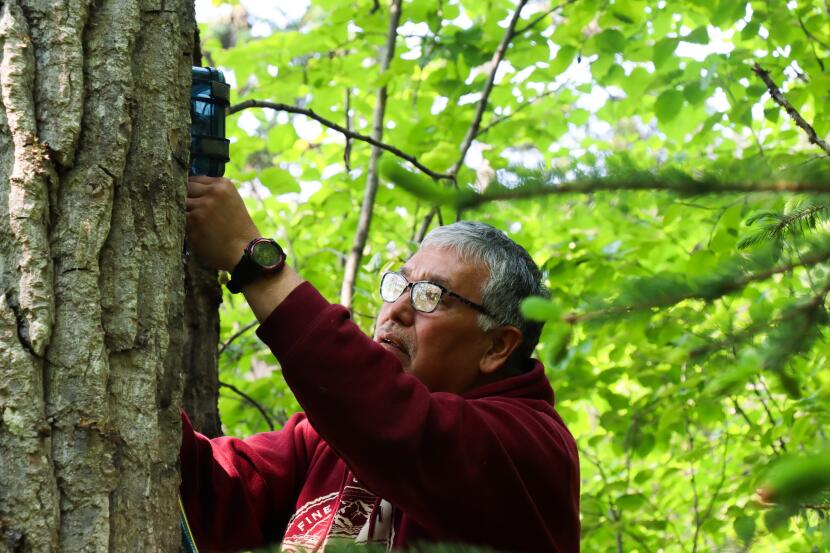
Dan Hotch swaps the SD card out of a infrasound sensor that’s monitoring wind, rain, rockfall and more as part of a regional geohazard research initiative. (Avery Ellfeldt/KHNS)
“With these extreme high temps in the summers, and then the atmospheric rivers in the fall and winters, a lot more flooding is happening here,” said Jess Kayser Forster, who has consulted for the Chilkat Indian Village on environmental issues for more than a decade.
That means the village has two options for development: further north, up the valley, or east, across the highway and into the foothills — which would mean building in areas with intensifying landslide risk.
In response, the tribe has joined a region-wide research project to better understand the threat and develop accordingly.
“It’s kind of hard to expand this way if we wanted to, knowing the fact that (mudflows) could come and take out everything that you’re trying to do,” Hotch said.
Studying the risk
It’s an issue playing out across the region, state, country and world. Communities are expanding into wilderness at the same time as rising temperatures are fueling less predictable and more severe wildfires, floods and landslides.
“You can see it all over Southeast Alaska, my home included,” Kayser Forster said. “We’re all built in these areas where these hazards are.”
That reality is top of mind in Klukwan. In 2018, the tribal council kicked off a climate resilience planning process. Then, in 2020, an atmospheric river triggered a devastating landslide that killed two community members in Haines.
The 2020 Beach Road landslide, pictured above in June 2025. (Avery Ellfeldt/KHNS)
“We realized that we were underprepared if an event like that were to happen in Klukwan. It highlighted a lot of our needs, and a lot of our risks. But it also highlighted the community’s desire to build those capacities,” said Shawna Hotch, who serves as the tribal liaison for Klukwan’s Tribal Emergency Operations Center.
By 2022, the village had joined a regional research project that aims to help tribal governments to do just that.
The effort is called the Ḵutí Project, which means “weather” in Tlingit. The project, which is run out of the Sitka Sound Science Center using a five-year federal grant, is fueling research in Klukwan, Skagway, Hoonah, Yakutat, Craig and Kasaan.
The main goal is to ensure communities have the data and tools they need to grapple with – and prepare for – weather events that are typically sparked by heavy rains. Roering, the University of Oregon-based researcher, emphasized that the geography, geology and risk are unique in each community. That means on-the-ground research is, too.
Planning for the future in a changing landscape
Klukwan, for its part, sits in the shadow of fractured cliffs further weakened by rain, frost and snow that are crumbling into a catchment below. During heavy rains, water and gravity carry the material downhill.
“When the debris flows get too big to stay in the current channel, they’ll do what’s called an avulsion,” Roering said. “That means they basically jump out of the banks, go over the banks, and follow a new path.”
The village of Klukwan sits alongside the Takshanuk Mountains, north of Haines. (Avery Ellfeldt/KHNS)
Particularly interesting is that state geologists have recently discovered permafrosthigh up on those mountains. Roering said it’s too soon to say whether melting permafrost – another climate impact – could be contributing to instability. But research in other parts of the world suggests it’s possible.
Studying and addressing those processes has taken several forms. First, the project is funding the installation of a brand-new weather station, to ensure more accurate local forecasting.
The project has also funded lidar collection and analysis, which provides insight into existing slidepaths and how they’re changing. Finally, it made possible the installation of cameras and sensors high up in the mountains.
On a recent field visit to Klukwan, Roering walked through a dense patch of forest, and pointed them out.
“These are called infrasound sensors,” he said. “They’re recording things that we are not hearing but are happening in the environment.
Think: wind, rain and rockfall. That data, combined with camera footage, provides crucial context about what triggers rockfalls and mudflows, and when those flows are more likely to avulse out of the main channel – and potentially surge toward the village.
For now, Roering said the goal is to develop a baseline of what exactly is happening on the hillside, and why. But even that is complicated.
“This is going to be a long term project,” Roering said. “That channel is going to keep changing, regardless of a berm that gets built next summer, or the summer after.”
Even so, the tribe will ideally be able to use the information for a few purposes. First, planning new berms to divert the slides away from the village, and supporting grant applications to fund the work.
And second is safe community development. Hotch, of the tribe’s environmental staff, said that could encourage tribal members to move home. He himself moved back to Klukwan about a decade ago after spending years in Oregon, first for boarding school and later for work.
“It’s great to be home,” he said. “We need more people back at home.”
The fishing fleet delivering to Trident in Sand Point in June 2024. (Theo Greenly/KSDP)
Last month’s commercial salmon harvest in the southern Alaska Peninsula was the lowest in four decades, according to the state’s preliminary data for the management region known as Area M.
According to the Alaska Department of Fish and Game, fishermen in the Shumagin Islands and South Unimak areas harvested about 720,000 salmon through the end of June — the second-lowest June on record since the 1980s.
Technically, the lowest harvest occurred in 2001, but Area Management Biologist Matthew Keyse said that year was an outlier due to a price dispute that kept many boats off the water.
“There was almost no fishing, so I would say, with fishing occurring, this is probably the lowest harvest in June,” he said.
Now, additional restrictions are further limiting the July harvest in an effort to conserve king salmon. A section of Area M where roughly 65% of the king harvest takes place was closed this week after the fleet harvested 1,000 fish, the limit for kings in the area.
Sockeye salmon, the primary target species, came in at under half a million fish last month. That’s less than a third of the 10-year average.
One possible factor is that the purse seine fleet has been voluntarily avoiding areas with high chum concentrations to support conservation goals. That’s because of record low chum returns in parts of western Alaska.
“They’ve been doing an excellent job of self-imposing these restrictions, and trying to avoid high, abundant chum areas, curtailing their own fisheries,” Keyse said.
Still, he said those efforts alone don’t fully explain the steep drop. The fleet has followed similar voluntary practices for the past three years, and the June harvest has never been this low.
On the other side of the peninsula, Bristol Bay is seeing a strong run that’s right on par with preseason forecasts. That contrast has Keyse scratching his head.
“Unfortunately, my fish crystal ball is pretty fuzzy,” Keyse said.
Fisheries on the southern peninsula include salmon stocks from multiple regions, so Keyse said it’s difficult to pinpoint a single cause. Factors like ocean conditions, migratory routes and stock origin could all play a role.
July numbers, so far, are looking much stronger, but Keyse said it’s still very early and didn’t make any predictions.
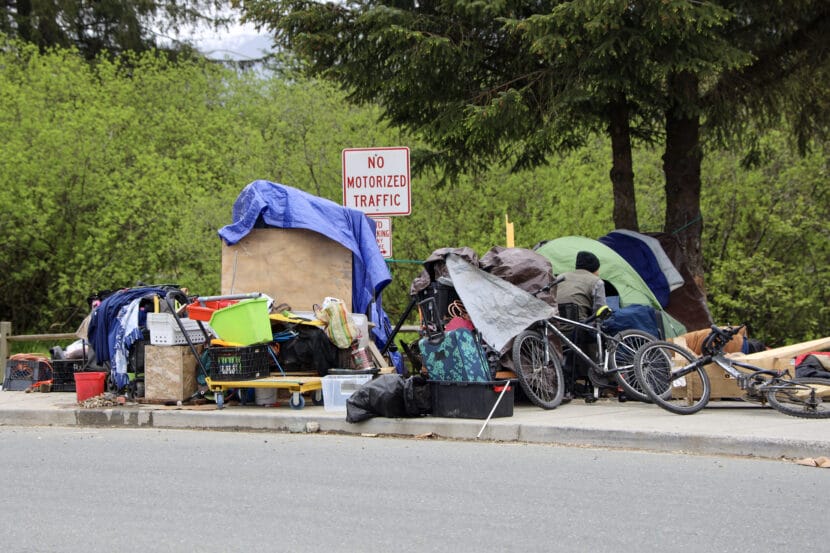
Tents line the sidewalks along Teal Street in Mendenhall Valley on Tuesday, May 27, 2025. (Photo by Clarise Larson/KTOO)
The Juneau Assembly is considering changing city code to make it easier for police officers to arrest people without housing who are camping in public spaces.
At a committee of the whole meeting on Monday night, Assembly members advanced a proposed plan to change the city’s disorderly conduct code.
The discussion on the proposed policy changes comes as city leaders say they’ve received a growing number of complaints from residents and businesses about the problems that people without housing are causing for surrounding neighborhoods where they camp.
“This would give our officers a tool that they could quickly deploy when they’re seeking to address camping impacts on public paths, sidewalks, rights of way, garages, bus stops, those sorts of areas,” said Deputy City Manager Robert Barr at the meeting.
That tool is arresting people.
The changes would make it easier for Juneau Police Department officers to arrest people who are obstructing public spaces by camping.
The proposed disorderly conduct code change would add standing, walking or camping to the list of actions that could prompt an arrest if someone is blocking public areas. It also adds public paths, parking lots and garages and stairwells to the list of locations it applies to.
Barr said that right now, arresting people without housing in these specific situations is complicated. Most of the time, officers arrest people for trespassing instead of disorderly conduct. But that requires additional steps.
“It is simply more challenging, takes more time, is more burdensome,” he said.
Barr said the amendments would essentially get rid of some of those hurdles to arrest people.
Assembly Members also moved forward with a plan to draft an ordinance to establish a “shelter safety zone” surrounding the Teal Street neighborhood and Juneau’s Glory Hall homeless shelter after repeated reports of staff being threatened on the site.
But the proposed ordinance is still very preliminary. Details like the potential boundary of the area and what protections would be in place have not yet been decided.
Assembly member Ella Adkison reluctantly agreed to move forward with the changes, but said they’re merely a stopgap for a larger issue.
“It’s not going to make the core of the issue any better. I do not think it will in any way help our unhoused population,” she said. “What I see the use for this is to make it a little easier for our police department to do something they’re already doing.”
Last year, the U.S. Supreme Court ruled that cities can ban people from sleeping and camping in public places. Right now, Juneau city policy allows for dispersed camping but prohibits it on places like sidewalks or roads. In general, the city allows people to camp on unimproved public land as long as they keep their impact low on the surrounding community.
However, Assembly member Wade Bryson said he thinks the city’s current status quo is not working and it’s putting people at risk. He said the Assembly needs to take action.
“The sooner we get tough on this situation, the sooner we crack down or the sooner we say this is how you have to behave in our community, the sooner we will have less of these problems,” he said.
Assembly members also briefly discussed reestablishing a summer campground designated for people without housing, like the one the city closed last year, but that idea didn’t move forward. The city closed the campground after an increase in reported illegal activities and complaints from the surrounding neighborhoods.
Assembly members will take public testimony and vote on the proposed code changes at a regular meeting later this summer.
Close
Update notification options
Subscribe to notifications
Subscribe
Get notifications about news related to the topics you care about. You can unsubscribe anytime.