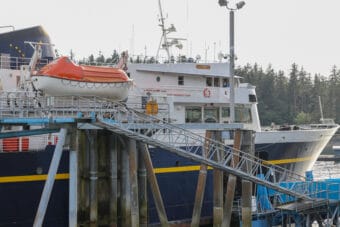
The company’s former CEO, Rob McKinney, left his role last year, and Tom Hsieh — the president of Ravn Alaska’s parent company, FLOAT Alaska LLC — stepped into the top leadership position. Around the same time, the company announced it would cease flights to the Aleutians, including to Unalaska and Sand Point.
Hsieh did not respond to requests for comment Thursday.
Ravn Alaska had previously taken over service to the Aleutians from RavnAir, purchasing its license but operating as a distinct company.
Several regional airlines have stepped in to fill the gaps in rural Alaska communities. Aleutian Airways began serving Dutch Harbor and Sand Point in 2023. Last month, Kenai Aviation was accepted as the Essential Air Service provider to St. Paul, though it recently announced that service would begin about six weeks behind schedule due to aircraft maintenance.
Correction: This story has been updated to correct the years in which Ravn’s layoffs occurred.
U.S. Sen. Dan Sullivan speaks at an aviation roundtable at Ted Stevens International Airport in Anchorage on Aug. 12, 2025. (Matt Faubion/Alaska Public Media)
Alaska is set to receive around $120 million from the federal government for improving aviation safety through new weather stations and updates to telecommunication systems.
That’s according to U.S. Sen. Dan Sullivan, who spoke at an aviation roundtable at Ted Stevens International Airport in Anchorage this week. Rep. Nick Begich and officials from the U.S. Department of Transportation and the Federal Aviation Administration attended the event as well.
“These are historic investments that our state needs,” Sullivan said. “We have the highest by far of any state in the country – 2.3 times higher – crash rates.”
The funding comes from the federal budget reconciliation bill, or the Big Beautiful Bill, which was signed by President Trump last month. The bill includes more than $12 billion for aviation improvements across the country. In Alaska, some of the improvements will also be paid for by an investment from the Federal Aviation Administration that was announced back in April.
The funding is only one step toward addressing the state’s longstanding challenges, but people in Alaska’s aviation industry say they’re encouraged.
“We’ve been fighting for years and advocating for weather reporting stations,” said Dan Knesek, the vice president of commercial operations at Anchorage-based Grant Aviation
More reliable flights for villages off-the-road system
Grant provides air service to communities across the state, delivers cargo and sends medevac planes. But Knesek said it is hard to make those flights between October and April.
Accurate weather information is crucial for pilots. When visibility is low, it helps them to decide whether they should fly. And carriers that fly relying on their instruments are required to have certified weather reports to take off.
But a lot of places in Alaska don’t have reliable – or any – weather reporting, which means that fewer planes make it in.
Knesek said there are times when flights can’t reach communities for a week.
“These communities are very dependent on our services,” he said. “They need to go to the doctor, or any of the basic services they need to fly to get.”
Alaska has about 160 aviation-specific weather stations. Adam White, with the Alaska Airmen’s Association, said that’s far from the density of weather stations in the lower 48. The Federal Aviation Administration is set to install an additional 174 weather observer systems for Alaska.
White said that still might not be enough, but any addition will help pilots and forecasters.
“We’ve got some parts of Alaska that there’s more than 100 miles to the nearest weather station in any direction. And that’s kind of crazy to think about,” White said. “So anything we can get is a huge increase in the information that we’ve got available to us.”
The FAA is now working with carriers and experts to prioritize places that need new stations most.
“We’re looking primarily at off-road system locations that (are) completely reliant on air service for the life and health and safety and well being of the community, and the typical weather patterns and the success rate of flights making it in and out of that community,” said White with the Airmen’s Association, one of the organizations advising on that process.
Questions remain about staffing and maintenance
Rick Thoman, a climate specialist at the University of Alaska Fairbanks, agrees that installing more weather stations is important for public safety and for weather and climate reporting. But he said it’s only one step.
“More stations are great, but they’ve got to work, and they got to report to the whole world reliably,” Thoman said.
Thoman said that on any given day, 10-15% of the aviation weather stations across Alaska are down or not fully reporting, He said the biggest issue is telecommunication infrastructure, which helps get information from the weather station out to the people who need it. Many Alaska villages still rely on copper wires for transmitting signals, and Thoman said sometimes people can’t even get parts to repair the antiquated systems.
The bill does include funding for improving telecommunications infrastructure.
At Tuesday’s conference, FAA administrator Bryan Bedford said the agency is still mapping out the details, but they are leaning toward updating stations to satellite technology and are now testing Starlink units.
Staffing to maintain the stations is another requirement for them to operate successfully – and to get certified, Thoman said.
“People have to go there to do the maintenance. Even if the FAA is contracting with local people, a human being has to go and do stuff,” Thoman said. “If money to support that is not included in that bill, then this is a big problem.”
Bedford said maintenance and staffing are not included in the bill. He said the agency still needs significantly more funding to improve aviation facilities and to look for workforce solutions, for example, through scholarships for technicians.
The Glory Hall homeless shelter on Teal Street in the Mendenhall Valley on Thursday, Aug. 7, 2025. (Photo by Clarise Larson/KTOO)
Juneau’s homeless shelter is reducing its services due to what staff say is a deteriorating and unsafe environment in the neighborhood.
The shelter has seen an increase in homeless people camping nearby compared to other years. Shelter officials say the reduction may cut down on campers – and chaos.
In a letter shared with patrons this week, Glory Hall Executive Director Kaia Quinto said the Glory Hall homeless shelter will stop offering daytime services — including meals — to people who are not sleeping there beginning Aug. 26.
Quinto said continuing assaults, a lack of security, criminal activity and general chaos are some of the reasons for the decision. She said the decision to reduce access to the shelter’s services was not an easy one — but necessary for the safety of staff, patrons and neighbors.
“The situation around the neighborhood is pretty untenable right now,” she said. “It’s just really important that we focus on keeping as peaceful an environment as we can.”
Quinto said patrons will still be able to receive services inside the facility during office hours after the changes go into effect later this month. But their time inside will be limited to when they are actively meeting with service providers.
She said she can’t say how long the reduction will last, but hopes it won’t be permanent. She said the current situation is affecting her staff’s mental health and wellbeing.
“It’s having a major toll,” she said. “It’s hard to recruit and keep staff when every other employer can provide better and safer working conditions. This job is hard enough.”
The announcement comes just days after the Juneau Assembly narrowly rejected a plan to create a shelter safety zone that would have tightened restrictions on camping in the area around the shelter. Shelter staff, patrons and neighbors asked the Assembly for the safety zone.
“The vicinity has become an epicenter for sales of illegal substances and stolen merchandise,” the letter stated.
This summer, the shelter has seen an increase in camping nearby. That’s in part due to the closure of the city-run campground near downtown two years ago.
Tents line the sidewalks along Teal Street in the Mendenhall Valley on Thursday, Aug. 7, 2025. (Photo by Clarise Larson/KTOO)
City leaders say the shelter safety zone was intended to increase protection for staff and people using the shelter’s services. But Assembly members who voted the plan down argued it would only be a stopgap solution for the larger issue of homelessness in Juneau.
“I just can’t see how it takes us forward as a community on this issue, more than just whack-a-mole on the next piece of the problem,” said Assembly member Neil Steininger.
On Monday, the Assembly asked the city to look into other potential safety measures for the Teal Street area, like hiring private security to patrol the area or establishing a city-sanctioned summer shelter.
Brittany Fuhr was outside the shelter on her lunch break Thursday. She was sitting with her friends by one of the more than a dozen tents that lined the sidewalk on Teal Street. She said it seems like there are a lot more people camping and in need of the shelter’s services than in previous years.
“There are definitely more people, like bodies, as far as people walking around, people crossing the road, which is always scary,” she said.
She said that uptick in people might be adding to the increase in issues staff say they are seeing. Though Fuhr worries that the change to services will only add to the chaos.
“Closing a door doesn’t make the problem go away,” she said.
Until the problem is resolved, the shelter is working with partner agencies to establish a meal program at an alternative location.
A drill site at the Palmer Project north of Haines. (Constantine Metal Resources)
A company that owns a controversial mining exploration effort outside Haines says work will continue at the site despite plans to sell some or all of the project.
The so-called Palmer Project is a zinc, copper, gold, silver and barite exploration site that has long divided Chilkat Valley residents over its potential economic benefits — and environmental impacts.
American Pacific Mining said in May that it planned to distance itself from the development. That news came several months after the project’s biggest investor backed out and American Pacific took full ownership of the project.
The company didn’t give much insight into its plans in a press release Thursday beyond saying that merger and acquisition talks are ongoing – and that some work will happen this year. American Pacific said it started tearing down one worker camp at the site in July, a move the company says will save money.
American Pacific plans to use a different camp to support mineral exploration and construction crews. The company says those crews will tackle three different efforts as part of the broader project this year.
That includes surveys using drone and laser technology to investigate what the company called “key prospects” in the area, which sits above the Chilkat River, about 40 miles north of Haines.
Mapping and sampling work will examine copper and cobalt prospects on the west side of the Little Jarvis glacier and gold prospects in the Porcupine-McKinley Creek area.
As of Thursday afternoon, Constantine Mining LLC, which operates the project locally, declined to comment before press time on the exploration efforts or the decision to shut down one camp while using another one.
The small boat harbor in Haines, The small boat harbor in Haines, pictured above in May, 2025. (Avery Ellfeldt/KHNS)
Commercial fishermen in Alaska will soon have a new option to bring down a cost that has skyrocketed in recent years: crew and vessel insurance.
The state legislature passed a bill earlier this year that allows Alaska fisherman to create insurance pools, or co-ops, that typically offer lower insurance rates. The bill became law last week without a signature from Gov. Mike Dunleavy.
The new law was prompted by soaring insurance rates and reduced insurance availability, both of which are among a long list of challenges facing commercial fishermen. Driving the trend: inflation and a shrinking number of companies willing to provide coverage.
“Our seafood industry as a whole is in such dire straits,” said State Rep. Louise Stutes, a Republican from Kodiak whosits on a seafood industry-focused legislative task force that backed the bill.
“We had public hearings on how the state could help the fishermen at little or no cost to the state, because the state is in a fiscal crisis as well,” Status added. “One of the ideas that came up was these insurance pools.”
Many Alaska fishermen already participate in pools that operate out of Washington state. The new legislation gives Alaskans the opportunity to create their own pools by exempting them from costly regulations that apply to private insurers.
The pools provide fishermen an alternative to purchasing coverage from private insurers. Instead, members can contribute a smaller sum of money to the joint pool, which is later used to pay out claims when accidents happen.
The co-ops also pick and choose who joins, which proponents say should reduce both risk and future claims.
“They would choose their members based on their history and whether or not they maintain their vessels, whether they’re safe fishermen, and that type of deal,” she added. “So it will really allow a lot more flexibility insofar as just being able to get the insurance.”
Assembly member Wade Bryson speaks during a committee meeting on Monday, Aug. 4, 2025. (Photo by Clarise Larson/KTOO)
Juneau Assembly members have rejected a plan to create a shelter safety zone with tightened restrictions on camping in the area around the Glory Hall homeless shelter in the Mendenhall Valley.
The narrow vote came during a committee meeting on Monday night, but members may reconsider the proposal in September.
The city outlined a loose plan for the zone after staff, patrons and neighbors of the shelter asked the Assembly to take action to protect the Teal Street area. They say it has become unsafe because of threats from some unhoused people camping in the vicinity.
The topic generated a lot of tension at the meeting. That was between Assembly members who supported what they saw as a public safety measure and those who saw it as a stopgap solution for the larger issue of homelessness in Juneau.
Assembly member Wade Bryson voted in favor of the plan. He argued the Assembly’s inaction is putting people’s safety at risk.
“We haven’t protected the patrons. We haven’t protected the staff. And we’re not talking about allowing people to camp near this property. That’s not really what the issue is,” he said. “We’re talking about protecting those very vulnerable, the most vulnerable of us, from the predators of our community.”
City leaders say the shelter safety zone is intended to increase protection for staff and people using the shelter’s services. It would likely make the rules for camping or loitering in public spaces stricter in the zone than they are citywide.
The City of Bellingham, Washington, created a protection zone surrounding a shelter last year following similar safety concerns. It added harsher restrictions on camping or loitering in the zone.
Some Assembly members who voted against the zone said they worried it would unlawfully target unhoused people and could open the door for possible lawsuits. Assembly member Neil Steininger argued it wouldn’t solve any issues, but merely move them somewhere else.
“I just can’t see how it takes us forward as a community on this issue, more than just whack-a-mole on the next piece of the problem, without actually trying to address anything beyond one symptom of a much broader, much more difficult issue,” he said.
Assembly members asked the city to look into other potential safety measures, like hiring private security to patrol the area or establishing a city-sanctioned summer shelter.
Close
Update notification options
Subscribe to notifications
Subscribe
Get notifications about news related to the topics you care about. You can unsubscribe anytime.