Economy

Trump administration announces offshore lease sales in Alaska’s Cook Inlet

aerial view of water with drilling rigs
Oil and gas platforms in Cook Inlet in 2021, as seen from a floatplane. (Liz Ruskin/Alaska Public Media)

The Trump administration has announced plans to hold six oil and gas lease sales in Cook Inlet over the next six years, starting next March.

The plan “ensures Alaskans benefit from new jobs, stronger local economies and long-term investment in their communities,” the Interior Department said in an emailed statement.

Southcentral Alaska depends on natural gas from Cook Inlet for heat and electricity generation, but industry has shown only mild interest in the area in recent years.

It takes more than a lease sale to boost production, said Larry Persily, a former Kenai Peninsula Borough official for oil and gas matters.

“ That’s the first step. But there’s not really a shortage of opportunities in Cook Inlet. There’s more a shortage of capital and interest,” he said. “So I guess the first test we’ll see is who bids in March of 2026.”

Hilcorp is the primary producer of Cook Inlet gas. It has been the only bidder in the last two federal offerings. The company has warned that it may not be able to supply enough gas by 2027 to meet Southcentral’s demand.

Persily said the newly announced lease schedule doesn’t solve the near-term problem.

“Because by the time you have a lease sale and you get permits and you explore and you find something to turn to production, it’s probably not going to come in time,” he said. “So dealing with the Southcentral gas shortage is going to have to come from existing leases” or outside the region.

The offshore oil and gas leasing plan announced this week was mandated by Congress in the reconciliation bill it passed in July.

Seawalk extension connecting all of Juneau’s cruise ship docks crosses major hurdle

Cruise ship passengers walk on a sidewalk from the AJ Dock to get to downtown Juneau on Thursday, Aug. 21, 2025. (Photo by Clarise Larson/KTOO)

Cruise ship passengers who arrive at Juneau’s farthest dock may not have to trek as far to get to downtown in the coming years.

On Monday, the Juneau Assembly approved leasing a downtown waterfront property and tidelands near where the seawalk currently ends by the port. Petro Marine Services owns the property. City Manager Katie Koester says the lease is needed to finally connect all of Juneau’s cruise ship docks. 

“This ordinance is a really important piece in extending the sea walk all the way to the AJ dock,” she said.  

Right now, the AJ dock is isolated from the rest of the other cruise ships. So, visitors who get dropped off there have to shuttle into town or walk roughly 10 minutes through an industrial area to get there. The proposed seawalk extension would allow them to walk directly to downtown along the waterfront.

A cruise ship berths at the AJ Dock in Juneau on Thursday, Aug. 21, 2025. (Photo by Clarise Larson/KTOO)

The city has long planned to develop a continuous, mile-and-a-half-long path from the Douglas Bridge to the AJ dock. The city has extended the seawalk in sections over the years, and this new section will stretch a quarter mile south towards Thane. 

Plans are underway to eventually build a fifth cruise ship dock next to the U.S. Coast Guard station on Egan Drive. The Assembly approved a tidelands lease for that development in April, but a few more hurdles need to be cleared before construction can begin. 

The city will pay $75,000 annually to lease the property, which will be paid for using marine passenger fees  – the tax the city collects from cruise ship passengers who arrive in port. The lease was approved for 35 years. 

At the meeting, some residents testified in support, but not everyone was on board with the plan. Auke Bay resident Heather Marlow questioned whether the extension was needed, given the high cost. She suggested widening the sidewalks that visitors currently use instead. 

“Keep the long-term vision of extending the seawalk to the rock dump as a long-term vision. We’re not there yet,” she said. “If you get another cruise ship and you have true demand at the Rock dump, we can fulfill the vision later. We do not need that expense now.”

City officials estimate the total price tag of the extension project will likely cost $20 to $25 million and construction is still likely a few years out. The city already has more than $7 million set aside for the project from marine passenger fees, but the Assembly will need to decide how to pay for the rest. It’s likely passenger fees will pay for most of it.

Far fewer Canadians are visiting the U.S. this year, new numbers show

A vertical black line on the inner wall of the Detroit-Windsor Tunnel marks the border between Canada and the United States. On the left side of the line is a Canadian flag, and on the right side of the line is an American flag.
The demarcation line marking the border between Canada and the United States is seen in the Detroit-Windsor Tunnel in May. (Dominic Gwinn/Middle East Images/AFP via Getty Images)

On a typical day at Bluff Point Golf Resort in Plattsburgh, N.Y., you used to be able to spot around 20 or 30 cars from Quebec or Ontario in the parking lot, according to owner Paul Dame.

But over the last several months, at the business just 25 minutes from the U.S.-Canada border, it has been more like one or two cars.

“It’s tough, because we’ve developed this relationship with the cross-border economy,” Dame said. “And now here we are, the rug getting pulled out from underneath us.”

New data confirms that far fewer Canadians are making trips south. Canadian residents made just 1.7 million return trips by motor vehicle back into their country from the U.S. in July, a nearly 37% drop from the same month in 2024, according to a report published this month by Statistics Canada.

The dip comes as relations are strained between the U.S. and Canada after President Trump vowed to make Canada a U.S. state earlier this year and imposed steep tariffs on his northern neighbor. Some worried that the tough political rhetoric — combined with a strong U.S. dollar — would damage an important source of U.S. tourism.

Data released by the U.S. government confirms a similar slide in Canadian travel. Canadians made just over 7 million visits to the U.S. between January and May, according to statistics published by the International Trade Administration. That’s a nearly 17% decrease compared with the same period in 2024, data shows.

The U.S. Travel Association said in an emailed statement to NPR that its “latest view continues to show a decline in travel from Canadian residents to the United States, consistent with the recent Canadian data released.”

Leah Mueller, vice president of sales and services at Visit Buffalo Niagara, said tourism companies in her region have been feeling the impact of a drop in Canadian travel too, from smaller tour groups to tour boats with fewer passengers.

“It’s a decline that’s not stopping things from happening, but it is affecting the revenue that people are collecting,” she said.

The U.S. saw 20.4 million visits from Canadians last year, making Canada the top source of international tourists to the United States, the U.S. Travel Association reported. The group said in February that those visits generated $20.5 billion in spending and supported 140,000 U.S. jobs.

There have been some efforts to soften the blow of the tourism slump.

In June, Maine Gov. Janet Mills made an official visit to Canada to urge Canadians to visit her border state. Maine, which saw nearly 800,000 Canadian visits in 2024, also installed new road signs welcoming travelers from the north, reading: “Bienvenue, Canadiens!”

Dame, the golf resort owner, said he has redirected some of his marketing efforts to other parts of New York and Vermont. But he said he hopes the U.S. and Canada can repair their relationship, and in the meantime he doesn’t blame his longtime Canadian customers for skipping their trips following the political attacks.

“It’s a very personal situation. They’ve been attacked personally, and it’s emotional,” he said. “It’s something that we would react [to] the same way if the opposite was happening to us.”

Juneau Assembly kills ordinance that would have made it easier to arrest people without housing

Tents line the sidewalks along Teal Street in Mendenhall Valley on Thursday, Aug. 7, 2025. (Photo by Clarise Larson/KTOO)

The Juneau Assembly voted to kill a proposed ordinance on Monday that would have made it easier for police officers to arrest people who are camping in public spaces. 

The Assembly made the decision unanimously. It came at the recommendation of City Manager Katie Koester, who asked members to table the ordinance, which means the proposal is dead and they can’t reconsider it. A similar ordinance could still arise in the future under a new Assembly. 

“I think that the ordinance in itself, both from an internal perspective, can really use some improvement,” she said. “From management’s perspective, we really would like to not take this up at this time or in the near future.”

Assembly members originally considered the change earlier this summer after escalating complaints from residents and businesses in town about the problems caused by homeless people who camp in neighborhoods. 

Recently Juneau’s homeless shelter announced it would reduce its services later this month due to what staff say is a deteriorating and unsafe environment in the neighborhood. 

Right now, city code allows Juneau police officers to arrest people for trespassing if they’re obstructing public spaces by camping — but that requires several steps. The proposed code change would have allowed officers to skip those steps by expanding what could be considered disorderly conduct. Therefore, it would make it easier to arrest people for obstructing public spaces by camping.

The city’s Systemic Racism Review Committee considered the ordinance earlier this month and formally asked the Assembly to reject it. They cited concerns that the change would disproportionately impact marginalized communities — and could be discriminatory.

Ephraim Froehlich chairs the board. He testified at the meeting on his own behalf. 

“The fact that it’s even being considered this far and up to this point is extremely concerning to me,” he said. “I think the proposed ordinance and the code changes therein demonstrate a lack of constitutional legal understanding, a lack of interest in real solutions for the issues that it’s attempting to address, and a clear lack of compassion for our neighbors.”

Martin Stepetin, Sr. is a former school board member and the brother of a man who has been missing since late June. At the meeting, Stepetin commended the Assembly for tabling the ordinance and encouraged them to focus on solutions that help people out of homelessness and into stable housing. His brother Benjamin was homeless when he went missing. 

“Those are the most vulnerable people in the community, my brother would have been one of them,” he said. “I think that you have heard from a community that in my language it means Wax̂talix. It means we hold something of high value or love. We Wax̂talix our homeless people. We hold them high and Juneau has shown up to defend those people.”

In an interview on Tuesday, Police Chief Derek Bos said he thinks the Assembly made the right call. He said he will continue to work with the city to find other solutions. 

“Our goal is not to make it easier to arrest people. Our goal is to make it easier to address specific problems as they relate to homelessness,” he said. “Making an arrest is our last resort solution in these circumstances.”

Last year, the U.S. Supreme Court ruled that cities can ban people from sleeping and camping in public places. Juneau city policy allows for dispersed camping but prohibits it on places like sidewalks or roads. In general, the city allows people to camp on unimproved public land as long as they keep their impact low on the surrounding community. 


Alaska Marine Lines will no longer ship electric vehicles due to fire risk

In June, an international cargo ship, the Morning Midas, caught fire and ultimately sunk off the coast of Alaska. The ship was carrying around 3000 vehicles, including around 70 EVs and nearly 700 hybrids (U.S. Coast Guard Photo)

Alaska Marine Lines will no longer ship electric vehicles or plug-in hybrid vehicles to Alaska or Hawaii.

Last week, the barge company announced the policy change in a statement due to the fire risk associated with shipping large lithium ion batteries.

AML’s decision to stop shipping electric vehicles means reduced access for communities off the road system in Southeast Alaska, where EVs have become an increasingly popular option.

Alaskans can still bring electric vehicles up by ferry, though it can take longer. The Alaska Marine Highway System limits its policy to two electric vehicles per sailing. Once electric vehicles catch fire, they’re challenging to put out, according to Alaska Department of Transportation Spokesperson Sam Dapcevich.

“EV fires, I believe, kind of burn until they go out, and so you have to kind of contain them. Each vessel has two specialized blankets on board that can be thrown over a vehicle, and it sort of smothers it,” Dapcevich says. “We also have a policy to park those vehicles in a specific location on the ship, and we provide extra room around them for the possibility of needing to fight the fire.”

In June, a cargo ship southwest of Adak caught fire in the open ocean. It was carrying over 3000 vehicles, including nearly 700 hybrid vehicles and around 70 fully-electric vehicles. All crew members were rescued, but the U.S. Coast Guard could do little to contain the blaze due to the risks associated with lithium ion batteries. The ship burned for days before ultimately capsizing and sinking.

Dapcevich says it’s not just the fire that makes EVs high risk, especially on a passenger vessel like a state ferry.

“It’s the toxic fumes, and you’re in an enclosed space, and they can travel into through the ventilation system in the vessel,” Dapcevich says. “They can travel into passenger spaces, and so it’s just a very dangerous situation to have an EV fire on a boat. And that’s part of why we limit it.”

Dapcevich said Alaskans looking to bring up electric vehicles from the Lower 48 should flag that information when they’re making a ferry reservation.

In an email to KCAW, Alaska Marine Lines spokesperson Ryan Dixon said the barge company would continue to reassess its decision to stop shipping electric vehicles as industry safety standards improve. Hybrid vehicles that do not plug in will still be allowed on the company’s cargo ships, as well as smaller electric recreational vehicles, like e-bikes and 4-wheelers.

The new policy is effective immediately for Central and Western Alaska and Hawaii, but the change doesn’t go into effect for Southeast until September 1.

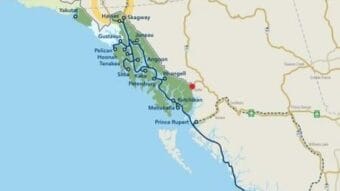
Juneau flooding sparks days-long cell service outages in Haines and Skagway

Water rushes past a house along the Mendenhall River on Wednesday, Aug. 13, 2025. (Photo by Clarise Larson/KTOO)

Haines and Skagway residents have been dealing with weak or no cell service for several days this week. At least two carriers – AT&T and Verizon – say the outage is due to Juneau’s glacial outburst flood.

The service interruptions have affected AT&T, GCI, Verizon and Visible, according to Upper Lynn Canal residents.

Among them is Garrett Shively. He lives in Haines, and as of Friday morning, hadn’t had cell service since early Wednesday. He uses Visible, which piggybacks off Verizon’s network.

“I haven’t had signal at all. I tried calling customer support,” said Shively. “I spent probably two hours on the chat with them because I thought it was my phone that was broken. And I don’t have Wi-Fi, I use my phone as a personal hotspot at my house.”

A GCI user commented on a Haines community Facebook page that they have had “horrible service.” Verizon users in Haines seem to have some service, but it’s not great.

“It’s like being in Canada,” Haines resident Nicole Horton Holm said in a Facebook message Friday afternoon. “Every group message [that] comes in has to be downloaded manually and then it pops into the chat. I’m getting emergency calls only even in downtown.”

In Skagway, AT&T users seem to be having the most issues. Skagway resident Juliene Miles says she spent hours communicating with AT&T on Friday. According to screenshots shared with KHNS, a customer service representative said the company plans to have service restored by Aug. 28.

An AT&T spokesperson said in an email exchange earlier this week that service disruptions were related to flooding in Juneau and a fiber cut caused by a third party contractor. She said the network is working to restore service as quickly as possible but did not provide a specific timeline for repairs, or clarify where the fiber cut took place.

A Verizon spokesperson also said severe flooding caused the service interruption and that the company has enabled roaming on a partner network while repairs are in progress.

Meanwhile, a GCI spokesperson said that testing indicates the company’s sites in Haines and Skagway are functioning normally. Visible could not be reached for comment.

Site notifications
Update notification options
Subscribe to notifications