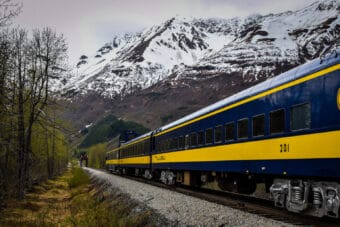
A Sitka-based cruise line is closing its doors. Alaskan Dream Cruises announced Wednesday that it has ceased operations and cancelled all future sailings.
In a post on its website, the cruise company said since 2011, it’s had the “privilege of sharing the wonders of Alaska and the richness of our Alaska Native heritage with incredible guests from across the globe.”
The company is owned by Allen Marine, a local maritime business that’s been offering wildlife and sightseeing tours in Southeast Alaska for about five decades.
“We’re really proud that we were a homegrown and Indigenous-owned line right here in Sitka,” said Allen Marine spokesperson Zak Kirkpatrick. “And that grew into world class cruises and winning national awards and appearing in worldwide publications, which was really something we’re proud about.”
Alaskan Dream Cruises operated four overnight cruise vessels that each held between 40 and 80 passengers, according to Kirkpatrick. Cruises lasted between five and eight nights, and offered a comprehensive look at the Inside Passage, with activities like hiking, kayaking and paddle boarding.
Kirkpatrick said the decision to get out of the overnight cruise business was “intentional and necessary” for the sustainability of the company.
“When you just kind of boil it down, the company is just planning to refocus 100% of our resources on what we consider our founding strengths and roots, which are the day tour excursions and the shipyard operations and marine services,” he said.
In 2025, Alaskan Dream Cruises employed 95 seasonal workers and about 10 year-round workers, and Allen Marine employed 305 seasonal workers and about 100 year-round workers for its other services, according to Kirkpatrick. With the closure, he said Allen Marine won’t be hiring for the overnight boats this cruise season.
The company said it’s directly communicating with all guests about reservations and processing refunds.
Actors Ben Brown, Travis Clark Morris, Kristen Rankin and Lauren Parkinson perform a scene from “The Thanksgiving Play” at Perseverance Theatre. (Photo Courtesy/Joshua Lowman)
Alaska’s largest professional theater indefinitely postponed a run of its show in Anchorage this spring due to financial concerns.
Perseverance Theatre had originally planned to bring its newest production, opening in Juneau later this month, to Anchorage. For the past decade, the theater has regularly run productions in both the capital city and Anchorage. But staff say the decision to postpone the latter leg came after a period of financial pressure on the national and local level.
Artistic Director Leslie Ishii said Juneau has been feeling the impacts of federal job cuts and economic strains, so less people have money for entertainment.
“Many, many jobs are gone, besides just being laid off,” she said. “So we’re feeling the effects of that as we all look around and see some shops are no longer there, or restaurants are having to cut back hours.”
The nonprofit – which relies on a number of funding streams for its budget, including support from the city, state and federal governments – considered other factors as well. That includes an upcoming $10 to $12 million budget shortfall at the city level, plus ongoing instability with the Trump administration’s efforts to cut arts spending. All of this informed the decision to not take its upcoming show, “Pueblo Revolt,” to Anchorage. Ishii said it would have cost about $60,000.
“The good news is we’ve been able to say we want to produce this show here,” Ishii said. “We were able to keep that funding in place. But just the added cost of transferring it to Anchorage is what made it difficult to say we can still do this.”
She said so far, the theater has only seen minimal reductions in their current grants. Moving forward she is expecting that funding from all government levels will be greatly diminished.
On a positive note, she said the Mellon Foundation – a private funder of arts and humanities programs – just renewed a two-year $500,000 grant to Perseverance. And Ishii said theater leadership is working with a financial management company that specializes in helping arts organizations budget and plan for the future.
The theater hopes to take “Pueblo Revolt” to Anchorage later this year instead.
Kylie Ferguson manages community partnerships with Perseverance. She said postponing the show’s run in Anchorage was a decision to maintain the theater for the future.
“Sometimes the play doesn’t have to go on,” Ferguson said. “Sometimes it gets delayed by a few months, but it’s in service of keeping this wonderful organization around for the next generation.”
Ferguson said the Juneau community — which values its performers and the work they do — will be here to appreciate it. In 2024, Juneau was ranked third of small cities nationwide for having a vibrant arts community by SMU DataArts.
Alaska Department of Revenue officials listen to questions from lawmakers about Gov. Mike Dunleavy’s fiscal plan during a House Finance Committee meeting on Feb. 5, 2026. (Eric Stone/Alaska Public Media)
If you ask Gov. Mike Dunleavy, a lot of the state’s problems come back to the budget process.
Every year, lawmakers gather in Juneau for four months and spend much of that time debating how the state should spread around its limited funds: how much for education, how much for public safety, and for the last decade or so, how much the Permanent Fund dividend should be.
Meanwhile, much of the state’s revenue depends on the constantly swinging price of oil. Dunleavy says investors who might otherwise bring jobs and new residents to the state have noticed.
“We know that this volatile budgetary process has negatively impacted our ability to recruit investment to the state. It has retarded our GDP growth. It has caused deep fractures within this body and within other relationships, and it leads to uncertainty in funding for critical programs,” Dunleavy told lawmakers and Alaskans in his State of the State speech.
Gov. Mike Dunleavy delivers his final State of the State speech at the Alaska State Capitol in Juneau on Jan. 22, 2026. (Eric Stone/Alaska Public Media)
In the days after his speech, Dunleavy filed a series of bills outlining a fiscal plan that he believes would make the budget more stable by boosting revenue and cutting expenses.
It’s a problem Alaska has wrestled with for years: the state spends more than it takes in. Since oil prices crashed in the mid-2010s, Alaska has drawn down billions from its savings accounts, cut government spending and reduced residents’ Permanent Fund dividends in an effort to ensure schools, state troopers, highways, ferries and fish and game management are funded.
Most of the money Dunleavy’s multifaceted plan would raise would come from a sales tax — 4% in the summer, 2% in the winter. The plan would also hike oil taxes, add a new per-barrel surcharge for pipeline corridor maintenance, and capture more money from Outside businesses. It would all be temporary, roughly five to seven years — and in 2031, corporate income taxes would vanish entirely.
On the expense side, it would put a 1% cap on state spending growth every year. That’s not adjusted for inflation. So if inflation runs more than 1%, state spending shrinks. (For reference, the Federal Reserve targets 2% inflation each year; in 2025, inflation was 2.7%, according to the Bureau of Labor Statistics.)
An additional check on expenses in Dunleavy’s plan is what’s known as a sunset review — lawmakers would periodically have to vote to reauthorize various pieces of government.
Dunleavy’s plan would also take Permanent Fund dividends out of the state’s annual budget debates by putting it — and a new formula — into the state Constitution.
“At no point do any of these things add up to get to a balanced budget,” said Neil Steininger, a former Dunleavy budget director who crunched the numbers for the Alaska Political Report, a subscription newsletter.
For one thing, Dunleavy’s plan would fully drain the state’s $3 billion rainy day fund by the end of the 2033 fiscal year, according to Steininger’s analysis — not exactly resolving the state’s budget issues.
For another, Steininger said, the effect of the changes would ultimately make the state’s revenue just as volatile, if not more — exactly what Dunleavy is trying to avoid.
That’s a result of Dunleavy’s proposed formula for dividends, which would take half of the state’s annual draw from the Permanent Fund and split it 50-50 between state services and dividends.
The fact that so much “stable, reliable” investment revenue would be tied to dividends would make the state more dependent on the price of oil, Steininger said.
“That’s a position we’ve been in already,” Steininger said. “That’s actually nothing new. It’s just really cementing that into the Constitution.”
The governor has not held a news conference or granted interviews to discuss his plan since the bills were released, but his office’s projections are substantially rosier.
An updated 10-year plan from his Office of Management and Budget shows a surplus in the early 2030s, peaking at roughly $300 million, before returning to large deficits in the 2035 fiscal year. But the governor’s office still projects the plan would draw down half of the rainy-day fund over 10 years, including a $1.4 billion withdrawal in the coming year.
Dunleavy has argued revenue from things like a boom in oil drilling or a new gas pipeline would help the budget balance in the long term.
“We’re going to be going into what I believe is going to be a more revenue-prosperous era,” he said at a Cabinet meeting before the plan was released.
But that future revenue is speculative, and thus doesn’t show up in state economists’ “cold and sober” revenue projections that lawmakers build the state’s budget around, Steininger said.
“Part of it is because a lot of that stuff will take a long time before it impacts state revenue,” Steininger said. “Even though 10 years feels like a long time … it’s not that long when it comes to trying to get a project permitted, moved and actually delivering revenue to the state coffers.”
Dunleavy’s Department of Revenue presented a newer fiscal model to lawmakers on Thursday, which accounts for revenue from the proposed Alaska LNG project and a new split of oil revenue from the federally-owned National Petroleum Reserve Alaska in the Western Arctic enabled by President Trump’s signature tax- and spending-cut bill.
“That modeling does roughly balance” even after the taxes expire, Department of Revenue Chief Economist Dan Stickel said to lawmakers on Thursday.
“The early analysis that we’ve done … would suggest that the governor’s plan, in its totality, would actually increase our problem, it would not lessen it,” Edgmon said.
Even Dunleavy’s traditional allies are skeptical — the Republican House minority leader, Palmer Rep. DeLena Johnson, called his plan “incomplete.”
“I think it’s very difficult to ask your average, hardworking Alaskan to increase their grocery budget” without a serious analysis and reduction of government spending, Johnson said.
But where does that leave state leaders’ search for a solution?
Edgmon and his Senate counterpart said they were intrigued by what they recently heard from a panel of University Alaska Anchorage economists who studied a variety of options at the request of the governor.
“It’s much more stressful on folks to have a sales tax or an income tax,” Stevens said. “(It’s) easier to accumulate a little higher tax on the industry.”
But in the last year of Dunleavy’s term, Stevens said, it might be too late for this governor to solve the problem.
Chilkat Forever placed ads on digital screens and in three major newspapers to target Vizsla Copper, the new owner of the Palmer Project. (Photo courtesy of Kim Strong)
Representatives from the mining industry gathered in Vancouver, British Columbia last week for an annual conference.
But opponents of a mineral exploration project outside Haines seized on the opportunity for their own purpose. They wanted to send the industry one key message: “Leave our valley.”
In 2024, the Chilkat Indian Village launched an effort, dubbed Chilkat Forever, to lead public opposition to the Palmer Project, a zinc, copper, gold, silver and barite exploration site upstream of the Native Village of Klukwan.
The project has changed hands a number of times since then. That included in November, when Vancouver-based mineral exploration company Vizsla Copper acquired the project and declared its intent to earn community approval.
In response, Chilkat Forever has ramped up its messaging.
“We just want to make it very clear that there isn’t social licensing here in the Chilkat Indian Village,” said Kimberley Strong, the president of the Chilkat Indian Village.
The effort entailed placing ads on large digital screens around the conference, which was put on by the British Columbia Association for Mineral Exploration. That included a billboard fastened to Canada Place, a convention center in Vancouver. They also placed print and digital ads in newspapers including the Vancouver Sun, the Seattle Times and the Anchorage Daily News.
In bold, all-caps text, the ad read: “No means go.” Below that, in orange, it said “leave our valley.” The group communicated the same message in a video released in January.
The campaign came the same week that Vizsla announced plans for the project for this year – and touted a formal letter of support from Gov. Mike Dunleavy.
Dunleavy pledged his “full support” for the project in a letter dated Jan. 22, according to a copy obtained by KHNS. He added that the project stands to “strengthen Alaska’s role” in meeting federal mining objectives while also benefiting the state.
During a public speech in Vancouver last week, Vizsla CEO Craig Parry said Dunleavy had requested a meeting with him in Juneau.
“I’ve never seen such great access to government and to the permitting authorities. So the fact that we’ve been on the ground here a month now, and the governor in Alaska has asked for a meeting in Juneau is an extraordinary outcome to my mind.”
A Dunleavy spokesperson said in an email that the governor “supports responsible resource development in Alaska.”
The company is still finalizing the details of its plans for the summer, but it has brought on several contractors, Vizsla said in a release last week. That includes a $600,000 contract with a marketing company it says will carry out a “comprehensive media marketing campaign.”
As to this summer’s exploration efforts, the company plans to conduct up to 10,000 meters of diamond drilling focused on copper, zinc, silver and gold. The company also plans to focus more on barite and for the first time will include the mineral in the project’s overall value estimate.
An aerial view of Berners Bay, where the state is proposing to build the Cascade Point Ferry Terminal. (Photo by Alix Soliman/KTOO)
More than 90% of the comments submitted to the state reject the Cascade Point ferry terminal proposed in Juneau. Many of the comments opposing the project suggest the purported benefits to ferry passengers are disingenuous, and the project looks instead like a fast-tracked subsidy for mining companies.
Dozens of commenters said that the public process to approve this project is lacking, with the comment period and a highly criticized economic analysis coming after the state already signed a $28 million contract for the first phase of construction, set to begin this summer.
The plan includes developing an access road from the end of Glacier Highway north to the site — roughly 30 miles north of the existing Auke Bay Ferry Terminal — and a staging area for future construction.
Leaders in Skagway and Haines oppose the project. Members of the Alaska Marine Highway Operations Board have also questioned the motives behind it and said it doesn’t fit into their long-range plan for the Alaska Marine Highway System.
Public funds for private industry
The Juneau Assembly hasn’t taken an official stance on the state’s plan, but Assembly Member Maureen Hall wrote a comment objecting to it.
“I oppose the use of public funds to construct a remote State of Alaska ferry terminal when the facility’s apparent primary purpose is to function as an ore dock for private industry,” Hall wrote. “This represents a blatant misuse of public resources and raises serious concerns about the appropriateness and legality of such expenditures.”
Of the more than 500 comments opposing the project, a majority said the project would mainly benefit mining companies with holdings nearby and Goldbelt Native Corporation, which owns the land where the terminal would be built. Thirty-three commenters called the project a “boondoggle” outright, including Juneau resident Bjorn Wolter.
“There is just no reason at all to build a new terminal,” Wolter wrote. “This project has all the potential to be another South Mitkof or Coffman Cove boondoggle.”
Those ferry terminals on Mitkof Island and Prince of Wales Island cost millions of dollars. They were built far from the population centers they were meant to serve and close to logging sites 20 years ago. Two years after they were built, the Inter-Island Ferry Authority stopped running routes to them, and both have since satunused.
The Cascade Point ferry terminal stands to benefit the New Amalga gold mine proposed near the face of Herbert Glacier by Grande Portage Resources Ltd., a Canadian company. In December, Grande Portage announced that it is working with Goldbelt to design an ore barge dock alongside Cascade Point.
Ian Klassen, president and CEO of the company, was one of the 49 people who commented in favor of Cascade Point. He wrote that the plan will “create possibilities that currently do not exist north of Juneau for the reliable movement of cargo and commerce.”
Steve Ball, general manager of Coeur Alaska’s Kensington Mine, located across Berners Bay from the proposed site, also wrote in favor.
“The twice-daily boat trips to the Kensington Mine would depart from the new Cascade Point Ferry Terminal, resulting in reduced risk for our workforce, contractors, and visitors by shortening the distance of the boat run and exposure to the Upper Lynn Canal,” Ball wrote.
Coeur Alaska contracts with Goldbelt to transport miners to Kensington, mainly from Yankee Cove and from Echo Cove during inclement weather.
Ferry users weigh-in
The state has been pushing for the new terminal for several years and has said it would benefit travelers in Southeast by reducing operating costs and travel time between Juneau, Haines and Skagway.
But hundreds of commenters said building a second terminal in Juneau doesn’t solve the problems that the Alaska Marine Highway Service faces, including an aging fleet, crew shortages, reduced sailings and a lack of funding to address those issues.
Robin Ross is treasurer for the Organized Village of Kake, the tribal government for the village, and secretary for the Kake City School District. She commented that the project fails to address ongoing transportation needs in Southeast. She said a ferry cancellation disrupted a mammogram van service that provides cancer screenings for women there, and while flights were arranged for some women, not all were able to travel.
“The unfortunate reality is that a recent breast cancer diagnosis in October may have been
detected sooner had the ferry service not been canceled in May,” Ross wrote. “The ferry service serves as a critical lifeline.”
DOT’s FAQ page says, “terminal projects like Cascade Point are a critical step toward a stronger, more resilient system while new vessels are planned and funded through separate processes.”
But members of the Alaska Marine Highway Operations Board told the Anchorage Daily News that the project has been foisted upon AMHS and will create operational challenges they have to deal with. Last year, Gov. Dunleavy vetoed state legislators’ plan to divert funding from Cascade Point.
Southeast residents said that while a ferry ride from Juneau to Haines might be shorter, the burden will be placed on drivers and walkers to get to and from the new terminal, which is much farther from the city center. The city bus system already does not extend to the Auke Bay ferry terminal — it’s about a two-mile walk along the highway shoulder from the last stop.
Sean Powell, a current AMHS crew member, commented that commuting to Cascade Point would be much more difficult. “The increased distance, combined with weather conditions and other unforeseen disruptions, would add unnecessary challenges for crew members,” he wrote. “I believe funding would be better spent improving our existing infrastructure.”
Emily Mesch drives for rideshare services in Juneau during the summer and commented that it’s already difficult to make money driving people to the Auke Bay ferry terminal since it’s not centrally located. “I would never pick up a passenger there,” she wrote of the Cascade Point location, “unless the fares were about as high as a ferry ride, itself.”
According to the Alaska Department of Transportation, Goldbelt has committed to running a shuttle service from Cascade Point to Auke Bay and the Mendenhall Valley, but hasn’t set a ticket price yet.
DOT said that increasing snow plow service along Glacier Highway would cost about $30,000 if ferries operate out of Cascade Point in the winter. But after back-to-back snowstorms slammed Juneau this winter, some commenters said they’re not confident that plow service would be reliable.
“DOT and the city are both overwhelmed when we get snow, let alone the storms that have hit at the end of December and into January,” wrote Morgan Ramseth. “Placing necessary services at the end of a poorly maintained road seems completely out of touch with reality.”
Others said increasing traffic farther out the road would stretch the city’s emergency services thin.
The comment period for the first phase of the project ended on Jan. 9. The Alaska House Transportation Committee will hold a hearing with the Alaska Marine Highway Operations Board and DOT on Thursday, Feb. 5 at 1:30 p.m.
Prep begins for new construction on the corner of 8th Street and K Street. (Adam Nicely/Alaska Public Media)
A round of vetoes by Gov. Mike Dunleavy last summer have Alaska’s construction industry on edge. Industry groups are pushing state lawmakers to quickly pass an appropriations bill that they say would unlock hundreds of millions of dollars in federal matching funds.
The problem started last year, when lawmakers searched for funds to plug holes in the state budget. To fund the state’s share of a variety of new federal projects, lawmakers voted to take millions from older, stalled-out or completed projects — tens of millions from the Juneau Access Project, $138,000 from the so-called Bridge to Nowhere in Ketchikan, even $766 lawmakers found left over from efforts to explore a bridge over Knik Arm from Anchorage.
“At the end of the day, we’re really just pulling out of the couch cushions the little pennies we can find here and there,” said Rep. Ashley Carrick, a Fairbanks Democrat, during debate on the budget last year.
But then, after lawmakers adjourned, Gov. Mike Dunleavy vetoed those transfers. His office said a lot of the money lawmakers identified had been spent, committed to contracts or was otherwise unavailable.
“We don’t want to put ourselves as a state in a position where we don’t have the match because those funds have already been obligated or are no longer available because they’ve already been spent,” budget director Lacey Sanders told lawmakers last month.
To make up for the vetoes, Dunleavy has requested state lawmakers send him a budget bill that would fund the state’s match with $70 million in unrestricted funds to enable some $700 million in total spending, 90% of which would be covered by the federal government.
But for now, state officials say they have only enough money on hand to meet the state’s share of federal projects through about the end of the fiscal year on July 1.
That has contractors ringing alarm bells.
“You are introducing unnecessary risk and disruption to this process,” the head of the Associated General Contractors of Alaska, Alicia Kresl, said to the House Finance Committee.
For now, Transportation Commissioner Ryan Anderson appears less alarmed. He told lawmakers the state has its match covered for the current fiscal year, though that money runs out around the end of June.
“It’s after July 1, that additional, that we’d be missing out on, so we’re really right now focused on that,” Anderson said.
But not knowing for sure whether that money will materialize after July 1 makes it hard for construction contractors to gather the right supplies and equipment, assemble their workforce and be ready to hit the ground running, Kresl said. So any further delays getting the money out the door could risk much of the progress crews would otherwise make in the 2026 construction season, she said.
“When funding comes late, the construction industries and agencies can shift from planning mode into scramble mode,” she said.
Lawmakers have so far appeared receptive. Leaders of the House and Senate finance committees say they plan to move quickly on a supplemental budget that would provide the matching funds. They have said they’ll likely draw from state savings to do it, requiring a three-quarters supermajority in both the House and Senate.
And Sen. Bert Stedman, the Sitka Republican who orchestrated much of the couch-cushion-shaking last year, says the state’s tight budget this year means they’re looking for more spare change floating around state government.
“Last year was not some aberration, it was not some off-the-cuff idea. It was methodically sought out and well-researched by (the Legislative Finance Division) and both finance committees, and this year will be the same,” he said.
But this year, he said, he’s hoping for a different result.
Close
Update notification options
Subscribe to notifications
Subscribe
Get notifications about news related to the topics you care about. You can unsubscribe anytime.