Economy

Tustumena replacement project out to bid, new ferry to sail in 2029

A computer-generated mockup of the new Tustumena replacement vessel, which will be bigger, carry more people and vehicles as well as be more efficient.
A computer-generated mockup of the new Tustumena replacement vessel, which will be bigger, carry more people and vehicles as well as be more efficient. (Alaska Marine Highway System)

After years of delays, the build contract to replace the Alaska Marine Highway System’s ferry Tustumena is out to bid. The state’s project notice calls for the new mainliner ferry to be completed by the beginning of 2029 with an estimated price tag of more than $300 million.

The new ferry will be a more efficient, diesel-electric vessel with capacity for 250 passengers and 58 cars at a time.

“It is really delightful, even just to talk about. You can probably hear the smile on my face,” Louise Stutes said.

State Representative Stutes, a Republican from Kodiak, is a longtime advocate of the Alaska ferry system. Especially the more than 60-year-old Tustumena, which regularly sails from Homer to Kodiak Island communities.

Captain John Mayer (left) of the M/V Tustumena presented Rep. Louise Stutes (right) a hand painted piece of the Tustumena’s hull for her longtime support of the Alaska Marine Highway System in August of 2024. (Brian Venua/KMXT)

She commended Craig Tornga, the head of the state ferry system, for getting the Tustumena replacement project to this point.

“And there are several shipyards that are interested in it as opposed to the first time it went out where no shipyards were interested,” she said.

Gov. Mike Dunleavy first announced the project in 2021. The initial build contract went out to bid in 2022 – and no bids came in.

“So, they kind of had to reassess it, redesign a few things and we’re good to go,” Stutes said.

Tornga went back to the drawing board on the ferry’s design and overhauled the contract over the last several years. Tornga has previously said that one of the hurdles that delayed the project so long was a requirement that 70% of the money spent on the Tustumena replacement has to go to American companies.

Bidding closes May 28 according to the state’s public notice for the project.

Dunleavy introduces sales tax, new dividend formula and other pieces of fiscal plan

Man in grey suit standing behind microphones
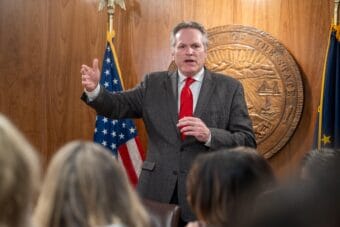
Gov. Mike Dunleavy speaks to reporters during a news conference on May 19, 2025. (Eric Stone/Alaska Public Media)

Gov. Mike Dunleavy introduced a series of bills on Friday and Monday that he says would stabilize the state’s finances. The most prominent pieces of Dunleavy’s plan are a statewide sales tax and a new formula for Permanent Fund dividends.

“I want to stop our fights over the PFD and the Permanent Fund, and I want to minimize arguments over how much we’re going to spend each year and how we’re going to control the growth of government,” Dunleavy said in his State of the State speech on Thursday, before the bills were unveiled.

The governor did not take questions on the plan on Monday. His press office declined requests to interview members of his administration and did not respond to questions sent by email Monday afternoon.

Debates over the state budget have routinely dominated legislative sessions in Juneau in recent years. Alaska has not followed a formula in state law specifying the amount of the dividend since 2015, after a crash in oil prices sharply reduced the amount of money flowing into state coffers.

The new dividend formula would split the state’s annual Permanent Fund drawdown 50-50 between state services and dividends. If the 50-50 formula were in effect this year, next year’s PFD would cost the state roughly $2 billion and provide each eligible Alaskan with about $3,200.

The new formula would be amended into the state Constitution. The amendment would also combine the Permanent Fund’s two accounts, responding to calls from Permanent Fund managers who say the current structure creates unnecessary risk, and constitutionally cap the state’s annual draw from the fund at 5% of its value.

A constitutional amendment requires a two-thirds majority in both the House and Senate. If lawmakers approve, voters would be asked to ratify it.

Dunleavy also proposes a variety of tax changes, most of them temporary. As a whole, they’d raise more than $900 million in annual revenue from mid-2027 through mid-2032 as the measures begin to phase out.

“Alaska has prosperous years ahead,” the governor wrote in a letter sent alongside the tax bill. “Starting in (mid-2032), Alaska is projected to see higher revenue due to expected increases in pipeline throughput and the Alaska LNG Project.”

The sales tax, proposed Monday in Senate Bill 227, would be set at 4% from April through September and 2% for the remainder of the year. As written, the sales tax would expire in 2034. That would provide the majority of the revenue from the tax package, between $735 million and $815 million each year.

“All who benefit from Alaska’s public services — residents, workers and visitors — will share in supporting those services,” Dunleavy wrote.

The bill would also seek to extract additional revenue from the North Slope’s oil and gas industry by raising the minimum tax companies must pay on each barrel of oil for as many as five years. The tax would end sooner if North Slope oil production increases to 650,000 barrels a day, roughly 40% more than current volumes.

It also includes elements of a bill the governor vetoed last year that seek to bring in more revenue via corporate income taxes from out-of-state companies that sell to Alaskans. It would eliminate the state’s corporate income tax in 2031.

A separate piece of the plan, laid out in House Bill 274 and Senate Bill 222, would require legislators to periodically vote on whether to continue various government programs, known as a “sunset review.”

Another element of Dunleavy’s plan would set a stricter limit for the growth of government spending in state law, reducing the allowable increase in state spending from 5% to 1% . A sunset review and a spending limit have been priorities for some of Dunleavy’s Republican allies in the state House and Senate.

The tax bill would not take effect unless the constitutional amendment, spending limit and sunset review bill each pass.

Anchorage Democratic Sen. Bill Wielechowski expressed reservations about the plan on Monday. He said he’d rather the state lean more heavily on the oil industry and Outside tech billionaires to raise revenue.

But Wielechowski said Dunleavy’s proposal will get “serious consideration” in the Senate.

“I’m glad the governor put something out. I think it’s the basis for discussion,” he said. “It’s hard to pass any of these major bills without the governor actively engaged, and this shows that he’s actively engaged.”

The new statewide sales tax would mean big changes for local governments, many of which already collect a sales tax.

The head of the Alaska Municipal League, Nils Andreassen, said on a video call Monday that Alaska’s local governments broadly support a plan to stabilize the state’s budget. But a statewide sales tax could have a variety of “unintended consequences,” especially for communities that already have a local sales tax, he said.

“The addition of a state-level (tax) is definitely a burden that some communities will feel more than others,” he said. “There will be calls from those residents to lower not the state’s rate, but the local (rate), which will diminish revenues at the local level.”

Dunleavy’s plan would also do away with so-called “tax caps” that limit sales taxes in some communities and set a statewide list of sales tax exemptions, Andreassen said. For example, it would likely override a local ballot measure in Juneau exempting most groceries and utilities from sales taxes.

Medical care, rent, groceries purchased with federal SNAP or WIC benefits, jet fuel, insurance premiums and business purchases would be among items exempt from sales tax under Dunleavy’s proposal.

It’s too soon to say if the governor’s plans will pass the Senate this year, Wielechowski said. Leaders in the House said earlier this month they’re not optimistic Dunleavy’s plans will pass this year, his last as governor.

Editor’s note: This story has been updated with additional information about the revenue the tax package would raise.

Investigation continues over massive oil rig toppling on North Slope as Nuiqsut residents raise concerns

Doyon Rig 26 after it toppled over on Jan. 23, 2026.
Doyon Rig 26 after it toppled over on Jan. 23, 2026. (Photo from the Alaska Department of Environmental Conservation situation report.)

The oil rig that crashed into the frozen ground on the North Slope near Nuiqsut Friday remains too unstable for responders to access the scene, state officials said. While no serious injuries were reported, days after the incident, there were still many unknowns for the companies involved and the nearby community.

Doyon Rig 26 was commissioned in 2016 by ConocoPhillips and built, owned and operated by Doyon Drilling, a subsidiary of Doyon, a regional Native corporation based in Fairbanks. The 10-million-pound machine, also known by the nickname “The Beast,” was being moved on a gravel road on Friday afternoon, when it suddenly toppled over, 6 ½ miles from Nuiqsut, an Iñupiaq village of about 500.

ConocoPhillips said in a statement that no one was seriously hurt. Two workers, who were on the rig when it crashed, as well as six responders, were taken to nearby clinics, treated and released.

The company also said there was no damage to community infrastructure, with no impact to oil pipelines and fuel deliveries.

The Department of Environmental Conservation said in a situation report that the rig had a capacity of 8,400 gallons of diesel on board. But DEC said it has been unable to get close to the wreckage, due to worries that metal from Rig 26 might fall on response team members.

“Structural hazards continue to limit access,” the report said. “A safety team has been dispatched to evaluate concerns.”

The cause of the accident remains unknown, officials said. According to the DEC report, the wreck happened near a tributary to the Colville river.

ConocoPhillips said Doyon is in charge of a unified command that is managing the response. Neither company agreed to an interview about the incident.

Neither ConocoPhillips nor Doyon have said what can be salvaged from the wreckage – or whether it’s a total loss. It is believed to be one of the largest mobile land drilling rigs in North America.

Community concerns and a lawsuit

The North Slope Borough released a statement about the incident, and a local tribe, Inupiat Community of the Arctic Slope, sent out an alert about it to residents.

But Nuiqsut resident Colleen Sovalik said she did not receive any official communication about it for many hours, and when she did, it did not bring her reassurance.

“Unfortunately, that was not any information that allowed community members to feel at ease and only heightened concern because we didn’t know if there was more that was happening, and nobody told us about it, or what to expect,” she said. “Also, it didn’t give us any reassurance with any information provided that they were going to do any assessments, independent of what industry was reporting.”

Sovalik said she was also concerned about whether the conditions were too warm to move the rig. The temperatures in the area were around and above freezing on the day of the incident.

“The weather was real warm,” Sovalik said. “I don’t know where that rig was headed… If it was moving (on) the ice, it was not a good decision.”

Rosemary Ahtuangaruak, a former Nuiqsut city mayor and a long-time environmental activist, lives in the community. She said the event highlights the worries some have had about the development in the area.

“We’re very concerned about what this means to our community and whether or not we’re safe in our lands and waters where they’re developing,” she said.

Last month, an environmental law organization Earthjustice filed a lawsuit, challenging the winter-exploration program near Nuiqsut. The lawsuit centered around concerns over how the project will affect subsistence activities and ecological resources, especially near Teshekpuk Lake.

Ian Dooley, an attorney with Earthjustice, said the Doyon rig was being moved for the exploration program.

“One thing that this points to is a concern that we’ve raised from the very beginning about the agency rushing to permit this project without proper or adequate process, without considering the comments and the concerns that have been raised,” Dooley said.

The plaintiffs requested a preliminary injunction to halt the program and are awaiting a legal ruling.

Dooley also said there were also immediate concerns about contamination because the wrecked rig, with diesel on board, is so close to the Colville river tributary.

Record-setting oil rig

In 2022, ConocoPhillips and Doyon set a new long distance drilling record of almost seven miles with Rig 26. Tim Bradner, publisher of the Alaska Economic Report, said both companies were proud of the rig, which they designed and built especially for the Arctic drilling. Bradner said the module was a huge success story for both companies.

“It was significant because it was very specialized for the drilling of these long-distance extended reach wells,” Bradner said. “That enabled a lot of pockets of oil and reservoirs that were difficult to teach from the surface.”

Bradner said Drill 26 was an important milestone for Doyon, capping decades of hard work.

In a court filing over the pending environmental lawsuit, ConocoPhillips said the accident wouldn’t impact its winter drilling plans. It said it would use a substitute drilling rig from Doyon.

Editor’s note: The link to the DEC incident report has been updated with a more permanent webpage. 

The Pentagon is reviewing a program that helps Alaska Native corporations get federal contracts

Secretary of Defense Pete Hegseth on April 9, 2025.
Secretary of Defense Pete Hegseth on April 9, 2025. (Senior Airman Madelyn Keech/U.S. Air Force Senior Airman Madelyn Keech | Department of Defense)

The federal government is reviewing a business program that brings contracting opportunities to Alaska Native corporations and tribes.

U.S. Secretary of Defense Pete Hegseth said in a video posted on X Jan. 16 that his department will review the 8(a) Business Development Program. The program falls under the federal Small Business Administration and supports businesses owned by socially disadvantaged individuals or tribal entities, including Alaska Native corporations.

Hegseth said in the video that the program promotes diversity, equity, and inclusion framework and race-based contracting.

“We are taking a sledgehammer to the oldest DEI program in the federal government,” Hegseth said. “Our goal is to spend your money to build our defense industrial base with businesses, large and small, that share our mission.”

Quinton Carroll, the executive director of the Native American Contractors Association, originally from Utqiaġvik, said that Native participation in the program is not a diversity, equity and inclusion initiative.

“It is grounded in the unique political and legal status of tribal nations under U.S. law and fulfills longstanding federal trust and treaty obligations to tribes, Alaska Native Corporations and Native Hawaiian Organizations,” Carroll said.

Tribal participation in the program

Alaska Native Corporations rely heavily on federal contracts, which they often secure through the 8(a) program.

In 2021, corporations received more than $11 billion from federal contracts, which were their primary source of revenue, according to data from the Federal Reserve Bank of Minneapolis. More than a half of that revenue came through the 8(a) program, and the majority of those contracts were with the Department of Defense, according to that research.

Christopher Slottee, an attorney who ‎works with Alaska Native villages, regional corporations and tribal governments, said that makes the Pentagon’s review of the program “a significant concern” for tribes and corporations.

“They often rely on those contracts to generate the revenue that lets them provide the benefits to their shareholders and tribal members,” he said.

Slottee said that tribal entities are subject to the same standards, reviews and compliance requirements as everyone else, but they do have a few advantages in the program.

Slottee said tribal entities, unlike individuals, don’t have to prove their social disadvantage. They can also have multiple companies in the program, while individuals can only have one. Plus, tribal entities have significantly higher limits for certain awards, he said.

Slottee said a government agency also might want to contract with an Alaska Native organization because they often have more experience than some of the traditional small businesses. And there are treaty obligations to fulfill, he added.

“There is a general, government-wide encouragement for agencies to contract with entities owned by tribes and ANCs, as part of the government’s responsibility to Alaska Natives and Native Americans,” he said.

The DoD review of the program 

Hegseth ordered a line-by-line review of 8(a) contracts that are over $20 million in value. He said in a memorandum to the Pentagon leadership that the department would get rid of contracts that don’t make the country’s military more lethal.

“We have no room in our budget for wasteful DEI contracts that don’t help us win wars,” he said in the social media video.

Carroll, with the Native American Contractors Association, said that Native federal contractors have been partners of the Department of Defense, working to strengthen readiness and the military industrial base.

Hegseth also said the department would make sure that the businesses with contracts were actually doing the work. He claimed that small businesses often receive a contract, take a fee and then pass the job on to a larger firm that’s not eligible for the program.

In June, the Small Business Administration ordered an audit of the 8(a) program following a fraud investigation. The Treasury Department has also been looking into potential misuse of the program.

Carroll said Native contractors support the elimination of fraud and waste within the program.

“It is critical that oversight efforts preserve a program that has proven its value — strengthening national security, reinforcing the defense industrial base, and supporting economic growth in Native and surrounding communities,” Carroll said.

Other threats to the program

The 8(a) program has faced recent scrutiny from other directions as well.

President Trump signed an executive order in April directing the rewriting of federal contracting regulations. Slottee, the attorney, said the revision has been completed, but it’s not clear yet how the changes will affect tribal entities.

He said that there is more focus now on the use of larger contracts, which can be harder for smaller corporations and tribes to access.

“It’s going to take a little bit for folks to actually see the kind of on-the-ground downstream impact, but we definitely anticipate seeing that in the course of 2026,” Slottee said.

Earlier this month, the Small Business Administration issued an announcement that, among other things, described a massive reduction in how many applications were approved for the program.

“The Trump SBA accepted just 65 new 8(a) firms into the program last year – compared to over 2,100 who were accepted during the Biden Administration,” it said.

Slottee said that the many Native-owned businesses felt that reduction.

“There is a concern that ANCs and tribes will have to start looking for alternatives,” he said. “If the SBA is not going to be approving new 8(a) applications, even though they should be under the rule established by Congress, that’s going to be a downstream impact on ANCs and tribes.”

Alaska lawmakers fail to override Dunleavy’s veto of corporate income tax bill

Legislators watch during an vote seeking to override Gov. Mike Dunleavy's veto of a bill that would have expanded Alaska's corporate income taxes to capture more revenue from Outside businesses.
Legislators watch during an vote seeking to override Gov. Mike Dunleavy’s veto of a bill that would have expanded Alaska’s corporate income taxes to capture more revenue from Outside businesses. (Eric Stone | Alaska Public Media)

Alaska lawmakers failed Thursday to override Gov. Mike Dunleavy’s veto of a bill that backers said would have modernized Alaska’s corporate income tax system.

The override failed 35-25. It would have required a 45-vote majority to become law.

Senate Bill 113 would have expanded the state’s corporate income tax to capture revenue from so-called “highly digitized businesses” that sell to Alaskans over the internet but may not have a physical presence in the state. Some of the money raised by the tax change would have gone toward reading programs in public schools.

After the vote, House Speaker Bryce Edgmon, a Dillingham independent, said the debate over the bill illustrated how difficult it would be for lawmakers to agree on ways to raise new revenue as the state deals with a fiscal crunch.

“I’d also say it’s a preview of the debate that we’re going to undergo on a fiscal plan,” he said.

Some Republicans who voted against the override said they were concerned that the bill could increase costs for Alaskans, including Big Lake Republican Rep. Kevin McCabe.

“It’s disingenuous to think that we are not going to pay for this tax one way or the other,” he said.

Supporters of the bill rejected McCabe’s characterization, saying that the bill would simply give Alaska a share of similar taxes companies already pay in other states.

Sen. Bill Wielechowski, an Anchorage Democrat who championed the bill last year, said the idea that the bill would raise consumer costs was “wildly inaccurate.”

“In fact, there’s been research on this,” he said. “The National Bureau of Economic Research did a working paper titled Corporate Taxes and Retail Prices, and found null — zero — effects on prices for firms subject to a single sales factor.”

Gov. Mike Dunleavy said Wednesday that he planned to introduce a temporary sales tax as part of a larger fiscal plan. Wielechowski said the corporate income tax change was a better option.

“How dare we go to Alaskans and say, ‘We want to tax you. We want to take your dividend,’ before we’re going to tax collect revenue from tech billionaires,” he said. “Really? Is that where we’re going with this?”

Some lawmakers who voted against overriding the bill said they supported the law in concept, including Fairbanks Republican Rep. Will Stapp, who voted for the bill when it passed in May.

But he said the complexity of the tax change— and the fact that the bill would take effect immediately if the veto was overridden — gave him pause.

“(If) you vote to override this bill, Mr. Speaker, you’re going to create a new type of corporate tax structure for people that there’s no regulatory guidance on how to pay,” Stapp said. “I would argue we probably shouldn’t do that.”

Wielechowski said he was confident the state would have been able to put out regulations before taxes would be due in 2027.

Even so, Stapp said he planned to introduce a new version of the bill this session addressing that and several more technical objections he raised on the floor.

“There are a lot of questions with the bill that we should probably know the answer to,” he said.

From taxes to policy, young commercial fishermen gather in Juneau to gain industry knowledge

Rowan Miller peeks out from behind a fishing net while seining in Prince William Sound. (Photo courtesy of Rowan Miller)

Listen to this story:

Seventeen-year-old Quinn Branch was among the young fishermen socializing at the Hangar on the Wharf ballroom in downtown Juneau on Tuesday evening as part of the Alaska Young Fishermen’s Summit.

Branch traveled to the summit from Kodiak because she said her dream is to spend the rest of her life setnetting on the Island. 

“So my grandpa, who I’ve been fishing for for three years now — we’re a setnet site out in Kodiak — he sent me here pretty much because I want to take over the family business one day,” she said. 

Branch said she’s got the fishing part down, but wants to understand the behind-the-scenes work, including filing taxes, applying for loans and hiring staff. 

She said she’s also connected with role models at the summit. 

“Just getting to see other women who are doing the same thing, you know, the same passion and the same desires as I is pretty cool,” she said.

One of those women is Rowan Miller, a 24-year-old from Valdez who’s starting her own fishing business. Miller said she’s spent half of her life fishing for salmon on her dad’s boat in Prince William Sound.

Now, she’s buying a 50-foot steel seiner from a family friend. She said people keep asking why she doesn’t just take over her dad’s boat when he retires. 

“I’m like, ‘No, I’m not going to wait that long,'” Miller said. “He’s, you know, he’s 58 now. I’ve got another 25 years to wait ‘til he retires, so why would I do that?”

She said some skippers she knows have fished well into their 70s and even into their 80s. 

Alaska’s fishing fleet is aging out, and that’s one reason why Alaska Sea Grant hosts the summit — to support the next generation of Alaskan fishermen. The organization started the summit in 2007 and hosts it every other year. 

The average age of a permit holder in 2014 was 50 years old. That’s a decade older than it was in 1980. Between 1980 and 2013, the number of young people holding permits dropped significantly. After the state limited entry into the fishing industry, hundreds of high-cost permits drained out of Alaska and were sold to out-of-state operators. That left many rural villages that relied on fishing without a fleet to support their local economies

Miller said seeing other young people at the summit is a good sign for the industry. But she said there are other obstacles outside of her control that make buying into the industry feel like a gamble.

“Between climate change and uncertain fish runs and uncertain markets with global things like tariffs and whatnot — there’s just a lot of uncertainty going on,” she said. “So it’s a big leap of faith.” 

Along with learning how to run a business, Miller said she’s also interested to learn more about what she could have a say in: fisheries policy. She said she wants to have a hand in shaping the future of the industry.

That’s another goal of the summit, said Gabe Dunham, fisheries specialist at Alaska Sea Grant and chair of the event: “How to engage with the public processes that influence their business, like the council process and the Board of Fish, and also how to interpret the science and the management around them.” 

Dunham said older, experienced fishermen volunteer to host sessions and pass on their knowledge. But he said fewer people attended the summit this year — around 20 — compared to the 30 to 60 people who typically go. 

Site notifications
Update notification options
Subscribe to notifications