Economy

Alaska offers free rocks and dirt, helping big state-backed construction projects

A motorcyclist descends a hill as he approaches Coldfoot, Alaska on the Dalton Highway in 2014.
A motorcyclist descends a hill as he approaches Coldfoot, Alaska on the Dalton Highway in 2014. (Bob Wick/Bureau of Land Management)

The state of Alaska is preparing to give away millions of dollars worth of gravel to public corporations, a move that would amount to millions of dollars in assistance to some of the state’s biggest construction projects.

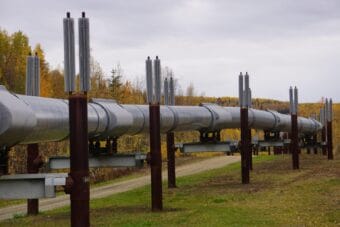
According to a Q&A posted by the Alaska Department of Natural Resources, the beneficiaries could include the proposed Ambler Access Project and the proposed trans-Alaska natural gas pipeline.

The state’s plans were disclosed the day before Thanksgiving in a public notice stating that DNR is planning “regulation changes on material sales and conveyances to state agencies.”

The Department of Natural Resources oversees mining on state lands in Alaska, including the extraction of gravel and fill dirt for use in construction.

While humble, gravel can be serious business — in November, DNR commissioner-designee John Crowther signed an order that prohibits gold, silver and other kinds of mining near gravel quarries along the Dalton Highway, which links Fairbanks to Prudhoe Bay.

For state maintenance crews that need to keep the highway open, gravel is more important than rare minerals.

In 2024, High Country News reported that for construction projects on the North Slope, gravel is a “precious commodity” because of its scarcity.

One of DNR’s proposed changes to its gravel rules declares “that the department convey material to a state agency or public corporation at a base price of $0.00 per cubic yard and without retaining a reversionary interest.”

Currently posted price charts show the state selling gravel for $3 per cubic yard in Interior Alaska.

State law prescribes that any time DNR wants to sell land or public resources for less than market value, the commissioner must declare that the sales “serve a public purpose and are in the public interest.”

The upcoming regulation change states that transfer to a state agency or state corporation is automatically consistent with that requirement.

That would allow the Alaska Department of Transportation and Public Facilities to get gravel from state land for free, excepting the cost of processing and transportation.

In a question and answer notice published Dec. 26, DNR said the change is intended to allow “for maximum use of state land consistent with the public interest.”

“Examples of a public purpose would be a state agency or public corporation using gravel to construct a gravel pad on a state leased site for infrastructure development; to construct a new state highway right-of-way or expand an existing state right-of-way; or to build an embankment along a river; or gravel needed for the development of a gas line right-of-way,” it wrote.

The free gravel and dirt would also be available to state-owned corporations, which is likely to affect some of the state’s biggest development projects.

The Alaska Industrial Development and Export Authority is developing a 211-mile road between the Dalton Highway and mine sites in northwest Alaska and would be eligible for the free rock and dirt. So would the Alaska Gasline Development Corp., which is now a junior partner in the development of the proposed trans-Alaska natural gas pipeline.

A spokesperson for Glenfarne, the pipeline’s lead developer, said the firm did not request the regulation change.

In 2024, the Bureau of Land Management estimated that the proposed Ambler Road would need between 15 million and 22 million cubic yards of gravel, plus an additional 220,000 to 347,000 yards annually for maintenance.

If the state of Alaska provides that gravel for free, it would be a revenue loss of between $45 million and $66 million for construction alone.

The public comment period on the change expired on Jan. 2, and it was not immediately clear when the change would take effect.

Lorraine Henry, director of communications for DNR, said by email that it isn’t yet clear how much gravel might be affected by the regulation change, and that the agency didn’t intend to benefit any specific project.

“DNR cannot speculate on the volume of gravel that may be involved, as each application from State of Alaska agencies will be evaluated on its merits – and will include a public process and follow statutory authorities,” she said.

Public comment period for proposed Cascade Point Ferry Terminal closes Friday

An aerial view of Berners Bay, where the state is proposing to build the Cascade Point Ferry Terminal. (Photo by Alix Soliman/KTOO)

The public comment period for phase 1 of the controversial Cascade Point Ferry Terminal in Juneau closes tomorrow, Jan. 9. 

The state’s proposed ferry terminal would be located about 30 miles north of the Auke Bay ferry terminal, on land owned by Goldbelt Incorporated, an Alaska Native Corporation. The project is slated to cost tens of millions of dollars.

Phase 1 of the project involves site preparation. The Alaska Department of Transportation already approved a $28.5 million contract for phase 1 construction to begin this summer. In December, the state signed a $1.3 million contract with Juneau Hydropower for equipment to electrify the proposed dock. 

The state has been pushing for the new terminal for several years, saying it would benefit travelers by reducing operating costs and travel time between Juneau, Haines and Skagway. 

The project stands to benefit the proposed New Amalga gold mine in Juneau, which would be established near the face of Herbert Glacier. In a press release last month, the Canadian company that proposed the mine, Grande Portage Resources, announced that it is working with Goldbelt to design an ore barge dock alongside Cascade Point.

Leaders in Skagway and Haines oppose the project. Members of the Alaska Marine Highway Operations Board have questioned the motives behind it. Some organizations, like the Southeast Alaska Conservation Council, have called it a bad idea when the money could be spent on improving the ferry system for riders. The Juneau Assembly hasn’t taken a stance on it.

The state’s comment period was initially set to end on Nov. 28 but was extended through Jan. 9. Comments can be submitted via email to gjc@mlfaalaska.com or through DOT’s Cascade Point webpage form.   

The state plans to open another comment period for phase 2 of the project, which will involve construction of the ferry terminal itself. 

Fred Meyer, other Juneau businesses close doors amid snow load concerns

Heavy equipment sits in the parking lot of Fred Meyer grocery store in Juneau on Friday, Jan. 2, 2026. (Photo by Mike Lane/KTOO)

Juneau’s Fred Meyer store closed yet again on Wednesday amid concerns about the heavy snow load on the roof following recent record-breaking snowstorms and cold temperatures. 

The closure began Tuesday evening when shoppers reported on social media that they were evacuated from the building. 

Tiffany Sanders, a spokesperson for Fred Meyer, said the closure is “out of an abundance of caution” while staff remove snow and address building maintenance. She did not say when the store would reopen.  

The store was already closed for multiple days last week due to concerns about the weight of the snow on the roof. The Fred Meyer gas station’s awning partially collapsed last week. Now, the station is partially reopened.

The recent heavy snow and rain in the capital city have caused several collapsed roofs across towns. On Tuesday, the roof of the Bill Ray Center, an empty building on F Street downtown, collapsed under the weight of the snow. 

Other businesses in Juneau have closed their doors as well. Nugget Mall has been closed since late last week due to safety concerns. That includes stores like Petco, Sportsman’s Warehouse and Office Max. 

“We are continuing to monitor snow load daily in coordination with structural engineers and qualified contractors,” the Nugget Mall owners wrote in a social media post on Wednesday. “Safety is and will remain the priority. That includes the safety of contractors, tenants, employees, and customers.”

The state also announced on Wednesday that the building that houses Juneau’s Department of Motor Vehicles was closed due to snow load concerns.

On Tuesday night, city and tribal leaders announced a joint disaster declaration and are asking for assistance from the state with snow removal.

Report shows negative job growth in Southeast due to federal layoffs, population decline

Workers construct a retaining wall at the outdoor food court location on Franklin Street on Monday, April 15, 2024. (Photo by Clarise Larson/KTOO)

A drop in new and existing jobs is forecast in Southeast Alaska this year due to federal layoffs, funding cuts and steady population decline in the region, according to a recent report released by the Alaska Department of Labor and Workforce Development.

Economist Dan Robinson heads the state’s labor research department. He said the region is expected to lose about 100 jobs this year, but it’s not clear exactly how many of those are in the federal sector.

“We don’t yet have a really good handle on what our federal job numbers will be, but they’re not growing for the first time in a long time,” he said. “They’re almost certain to fall.”

Robinson said the Trump administration’s continuous push to shrink the federal workforce and reduce government spending will counter job growth in the Southeast region.

According to preliminary data, the department estimates Alaska lost about 300 federal jobs statewide in 2025, and more cuts are expected this year.

Robinson said those cuts, paired with Southeast’s steadily declining birth rates and outmigration, will likely put major constraints on the region’s economy. A previous report by the department found Southeast’s overall population is projected to drop by about 17% by 2050, or roughly 12,000 people.

“Fundamentally, what’s a challenge for Southeast region is our negative net migration, so more people wanting to leave the region than move here,” he said. 

Cruise ship tourism and mining continue to be bright spots for Southeast jobs and its economy. Last year, Juneau welcomed just under 1.7 million cruise ship passengers, and new and proposed docks are anticipated to open up more job opportunities.

The state overall is expected to experience a 1% growth of an additional 3,000 jobs this year. Most of that is made up of jobs in oil and gas, health care, construction and transportation, according to the report.

Alaska Airlines works to fix issue that left Club 49 members with hefty baggage fees

The Alaska Airlines airport terminal in Bethel.
The Alaska Airlines airport terminal in Bethel. (Katie Basile/KYUK)

On Jan. 4, Bethel resident Shane Iverson said that he was shocked when he stepped up to the Alaska Airlines counter at the Anchorage airport to check in for his flight home.

“I had two kids. We each had three items to check in, so nine items. I was sitting there with a ton of boxes and luggage when they told me they were gonna have to charge me for most of it,” Iverson said.

It was a surprising bill that Iverson and some other Alaska Airlines passengers have faced while checking baggage that used to fly for free within the state. The company said that it is working to reverse an issue with its Club 49 program that has affected the baggage benefit.

That benefit is a longtime Alaska Airlines policy of allowing three free checked bags per person on flights within the state. Iverson said that maxing out on luggage is something a lot of Bethel residents do.

“That’s kind of part of the equation of your trip. If you can afford to fly in, at least you’re gonna get a little savings on your supplies that you can bring back, and the variety of things you can find,” Iverson said.

In October 2025, Alaska Airlines announced that it would be limiting the perk to Alaska residents enrolled in its Club 49 loyalty program.

For Iverson, the change seemed inconsequential. He’s a resident, and he’s been a member of the free loyalty program since it launched in 2011. But when he checked in on his phone the night before flying, the app showed that he would be charged hundreds of dollars in baggage fees.

“I was like, it’s probably just a computer snafu, pretty understandable. I’ll just go early because probably other people are going to be dealing with this too,” Iverson said.

Initially, Iverson said that he was told that he would need to re-enroll in Club 49, and that it would take a week or more to process. But after some back and forth, he said that a ticket agent agreed to waive the fees. But he said he’s still not sure what happened.

In an emailed statement on Jan. 5, Alaska Airlines spokesperson Tim Thompson confirmed that some, but not all, Club 49 members have been incorrectly charged bag fees since a new baggage policy went into effect on Jan. 3. Current Club 49 members do not need to re-enroll in the program.

Thompson said that the problem may be resolved as early as Jan. 7. Meanwhile, customers can get bag fees waived at ticket counters by showing they have Club 49 status in the mobile app, or by showing proof of Alaska residency. Club 49 members who were incorrectly charged bag fees should contact customer service for assistance.

Iverson said that he was disappointed to find that other Bethel residents affected by the error also had little idea of what to make of it.

“Who’s ever in charge of communicating really needs to do a better job. Because, you know, in rural Alaska we follow this closely. (It) really affects our lives,” Iverson said.

Meanwhile, Alaska Airlines’ new baggage policy means non-Club 49 members without other special statuses are on the hook for new fees. According to reporting by KNOM, non-members without an Atmos Rewards credit card or elite status now need to pay at least $230 to check three bags within Alaska.

On top of the three free bags, Club 49 membership offers two free checked bags for flights to and from Alaska.

Confirm enrollment in Club 49 online by opening your profile dropdown menu, clicking Account Overview, and navigating to Membership Card. On the mobile app, click the Account tab and scroll down to Atmos Rewards and member card.

Editor’s note: Shane Iverson is KYUK’s former general manager.

Pelican finally gets supplies after going a month without ferries or seaplanes

Pelican harbor, pictured here in late 2019. (Photo courtesy of Heather Bauscher)

Boxes of food, mail and late Christmas presents arrived by plane to the small Southeast Alaska fishing town of Pelican on New Year’s Day. The goods came after the isolated town went more than a month without access to outside services. 

From late November till New Year’s Day, the Chichigof Island town of Pelican relied completely on itself. Extreme weather this winter prevented any seaplanes and or ferries from visiting during that period, leaving its roughly 90 residents cut off from the rest of the region and the services many rely on. 

However, that all changed on New Year’s Day last week when Alaska Seaplanes sent five planes loaded with goods. 


View this post on Instagram


A post shared by Alaska Seaplanes (@alaskaseaplanes)

“We have kind of like a shot in our arm, just like to make it,” said Heather Bryant, a Pelican resident and cowner of the Pelican General Store, the town’s only grocery store. 

Bryant said the flights on New Year’s Day were a lifeline.

“But definitely more and more people have been just coming into the store, just because they’re mining their pantries, and I think are running out of stuff,” she said. 

Pelican is off the road system, and relies exclusively on planes and boats visiting from Juneau and other parts of Southeast to bring outside resources and services. But in recent weeks, Southeast Alaska has been pummeled with record-breaking snow and cold temperatures.

An Allen Marine catamaran that was supposed to head from Juneau to Pelican on Tuesday was cancelled due to hazardous conditions. Another flight from Alaska Seaplanes made the trip instead. Bryant said the deliveries — which included milk and eggs, produce and mail — will help them make it by for the time being.

“We’ll be okay for a little bit, and hopefully long enough to make it to the next plane or the next catamaran I hope – I’m just trying to stay positive,” she said. 

In the meantime, Bryant said the town is resilient despite all the cancellations. 

“The one thing I really like about out here is just people are just, they just keep going,” she said. 

Carl Ramseth is the general manager of Alaska Seaplanes. He said the recent weather has prevented many flights from visiting Pelican and other float plane destinations in Southeast Alaska like Angoon, Elfin Cove and Tenakee Springs. But pilots and operators fly when they can, like on New Years Day, when the company typically doesn’t operate.

“As long as we have the minimum temperature that we need to do that with float planes and good visibility, we’ll be operating,” he said. “We’re just kind of at the mercy of Mother Nature at this point.”

Another Allen Marine vessel is slated to arrive at the end of the month.

Site notifications
Update notification options
Subscribe to notifications