Economy

Residents at a mobile home park in Juneau go weeks without adequate water pressure

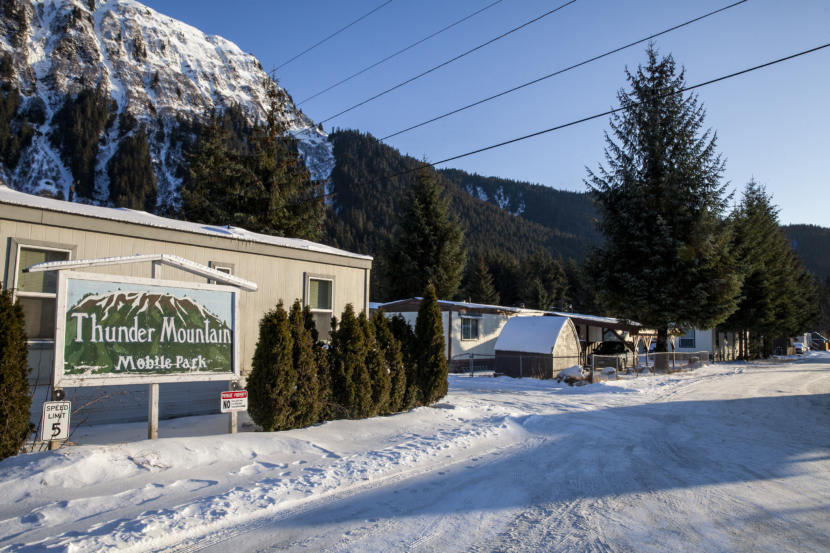
The sun sets on Friday, January 17, 2019 at the Thunder Mountain Mobile Park in Juneau, Alaska. Residents are currently under a boil water notice after several days of low-pressure. (Photo by Rashah McChesney/KTOO)
The sun sets on Friday, January 17, 2020 at the Thunder Mountain Mobile Park in Juneau, Alaska. (Photo by Rashah McChesney/KTOO)

Dozens of Thunder Mountain Mobile Park residents weren’t able to use their showers or do laundry over the holidays and during recent snowstorms. 

Wright Services, the company that owns the park, said it won’t be able to repair the main water line until temperatures warm. And warm weather isn’t in the forecast any time soon. 

Tammy Jablonski said it’s making it hard to live her life. 

“I had, like, just a trickle come out,” she said. “Not enough to flush the toilet, not enough to, obviously, to take a shower or wash dishes or do anything else. Laundry, nothing.”

Jablonski has lived at the mobile park for more than 10 years. In 2020, the park lost water pressure during a cold spell, but it was resolved after a few days. This time, she said her water has been nothing but a trickle since Dec. 20. 

Wright Services General Manager David Crocker said some of the pipes that connect the main city water line to individual mobile homes are frozen. 

“Once it happens up at the top, where the connection is that the residents are responsible for, it can freeze them down into the main line and cause issues with people, other people in the park, other than just that one unit,” he said. “So we’ve been working diligently to try to identify where those issues are and take care of them.”

But, Crocker said, they can’t reach the main line with construction equipment because the ground is frozen. Instead, they are trying to trace the blockage by investigating each report. 

According to survey results Crocker shared, out of 89 residences, 60 initially had issues with low water pressure, and as of Monday, people in 11 residences reported the pressure had improved. 

When the pressure issues started, the company provided each resident with cases of water, two day passes to Juneau’s pools for showers, and portable toilets in the park.

But Jablonski said that the cases of water are long gone, the local pools have been closed sporadically, and the porta-potties immediately froze and are unusable.

She said she called Wright Services before the New Year to ask if there would be a rent reduction. Instead, she was charged the full amount, plus a rent increase that the company informed residents of before the water issues started.

“I never got a phone call back, and I have an auto payment for the park on my bank account, and it came out big as you please,” Jablonski said. “And it went up.” 

She said she hasn’t been hearing much from the company as this problem persists. When asked about rent reduction, Crocker told KTOO the company is focused on repairing the issue and declined to answer the question.  

The Alaska Landlords and Tenants Act says tenants can seek damages via lawsuits if services that should be provided in their leases aren’t. 

Jablonski said she and other residents just want running water again. 

“We are asking for help. We’re not trying to be demanding. We’re not being ugly,” she said. “We’re asking for basic services.”

In the meantime, the lack of water has taken a toll, Jablonski said. Especially on top of the historic amounts of snow. 

“I love a good snowstorm. But this one has handed my tail to me. The amount of money I’ve had to spend to get dug out, to help dig out myself, to get my roof cleaned off, to not be able to come in and take a hot shower and cook a good hot meal with hot water,” she said. “It’s like are you kidding me?” 

With another snowstorm descending, she worries that a fix won’t come any time soon. 
M/V Lituya back sailing on a limited basis after brief grounding

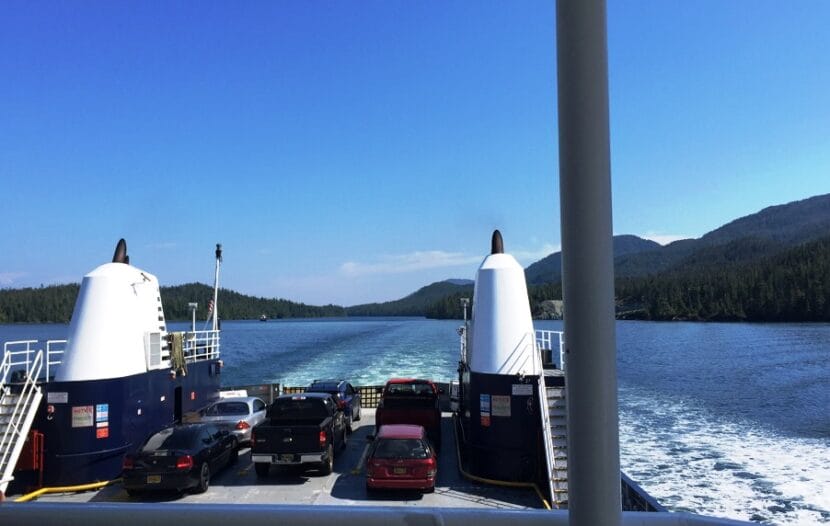
The Alaska Marine Highway System ferry Lituya provides regular service between Metlakatla Indian Community and Ketchikan. (KRBD file photo by Leila Kheiry)

The state ferry Lituya went aground on Tuesday at about 2:50 p.m. near Annette Bay in Southeast Alaska. The small ferry runs a daily shuttle service between Ketchikan and Metlakatla.

The brief grounding happened when the ferry left Annette Bay dock. It lasted less than a minute, according to Shannon McCarthy, a spokesperson with the Alaska Department of Transportation. She says the grounding is “a rare event” in Alaska’s fleet.

But the Lituya was out of service until Friday while inspections were conducted. Officials found damage to the ship’s hull, but not enough to keep it tied up. It is sailing on a limited schedule in daylight hours until it can be dry-docked in early February.

The U.S. Coast Guard led the investigation into the grounding.

Western Alaska evacuees in Anchorage slowly moving to temporary housing

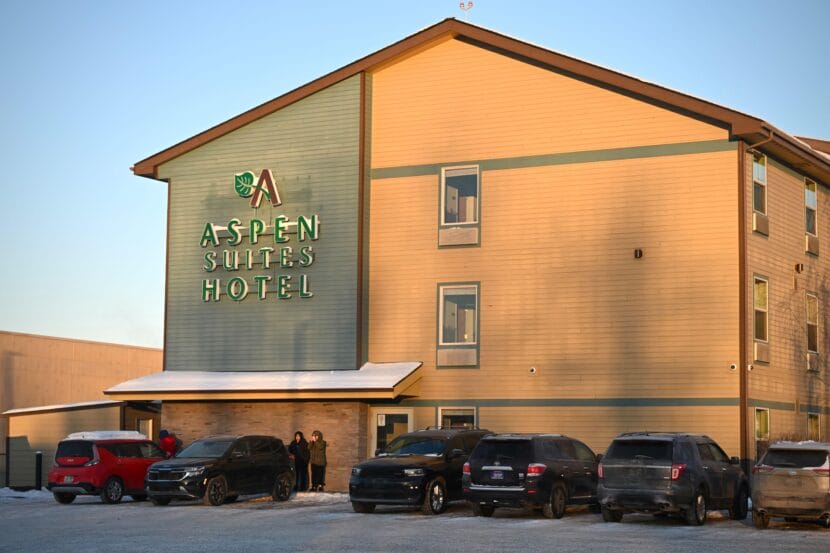
People stand outside a hotel with cars are parked in front
Evacuees of ex-typhoon Halong in Anchorage are moving out of hotels where they have been sheltering for months, and into temporary housing around the city. (Matt Faubion/Alaska Public Media)

Western Alaska residents who evacuated to Anchorage after the remnants of Typhoon Halong battered their villages are now moving out of city hotels and into temporary housing.

They’re looking forward to having more privacy, being able to cook for themselves and having more space, said Jeremy Zidek, public information officer for the Alaska Division of Homeland Security and Emergency Management.

“Hotel rooms are small,” Zidek said. “They’re meant to be someplace that you stay temporarily. These folks have been living there for quite some time.”

The state moved evacuees into hotel rooms around Anchorage in early November, after some had stayed in mass shelters for several weeks following the storm.

Ex-Typhoon Halong slammed into Western Alaska in October with wind, rain and flooding that devastated some communities, including Kipnuk and Kwigillingok, where homes floated off their foundations. One woman in Kwigillingok was found dead in the aftermath, and more than 1,000 people were displaced.

More than 500 people who evacuated to Anchorage are still in hotel rooms. But, as of the end of the year, the state had moved more than 150 people into temporary housing.

There are financial and logistical hurdles that slow down the process, Zidek said.

“With a diverse group of people with different capabilities, we have to really do that case by case and do that case work,” he said. “So it’s a complicated process, and to do that with 600 people is taking some time.”

Each move requires background and credit checks, and the homes need to be furnished, which Zidek said has been a challenge: They’re routinely buying out stores around the city. The state is also working to keep extended families close to each other. The cold weather this winter makes moving more difficult as well, Zidek said.

Another hurdle is the tight housing market in Anchorage. But housing is tight across the state, and Zidek said Anchorage actually has more availability than the rest of Alaska.

The state of Alaska has a cost-sharing agreement with the Federal Emergency Management Agency to fund the hotel stays, with FEMA paying 75% of the cost and the state covering the rest. Once people move into temporary housing, Zidek said, that changes.

“Most people moving into temporary housing are taking advantage of that FEMA rental assistance,” he said. “And then as we move down the road, there will be other housing assistance funding that could be brought to bear for people. It’s based on a case-by-case basis.”

Some people have started working and are able to pay their own rent, Zidek said.

There are some people who won’t qualify for temporary housing because they don’t pass background checks or credit requirements, Zidek said. The state plans to find alternative housing for those people, he said.

The state will focus on rebuilding in Western Alaska in the spring, Zidek said, so that those who want to return home can do so as soon as possible.

Fred Meyer closed for snow removal as Juneau continues to dig out

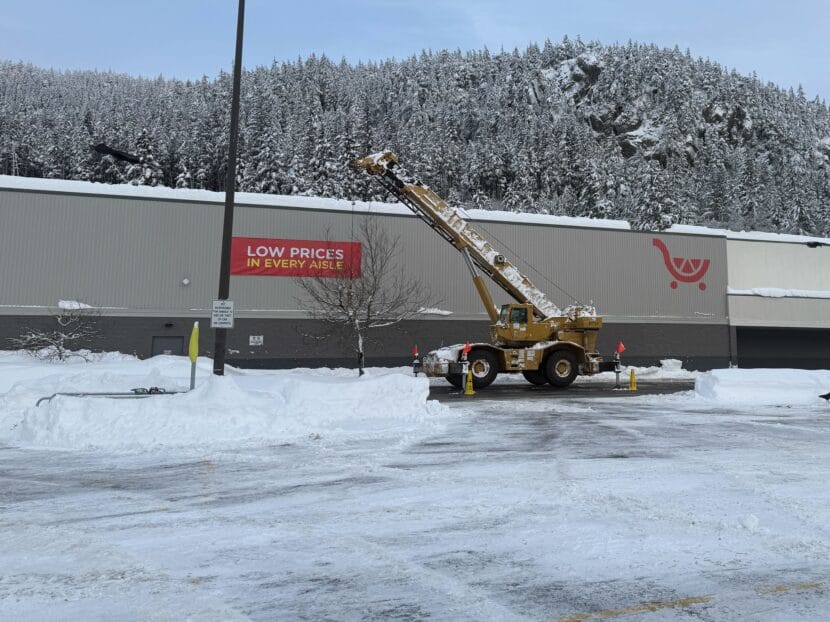
Heavy equipment sits in the parking lot of Fred Meyer grocery store in Juneau on Friday, Jan. 2, 2026. (Photo by Mike Lane/KTOO)

Update, Sunday: 

Fred Meyer reopened Sunday.

Update, Saturday 2 p.m.:

Fred Meyer remains closed. Nugget Mall is also closed due to snow accumulation.

Original story: 

It’s a new year, but Juneau residents are still digging out from four feet of snow that fell this week.

The heavy snow collapsed the roof of at least one Juneau business, and others have closed for snow removal. 

Fred Meyer closed early on Thursday and did not reopen on Friday morning. 

“Our Juneau Fred Meyer is temporarily closed to allow for snow removal and will reopen as soon as possible,” said Tiffany Sanders, a spokesperson for Fred Meyer, on Friday morning. “Thank you for your patience and understanding.”

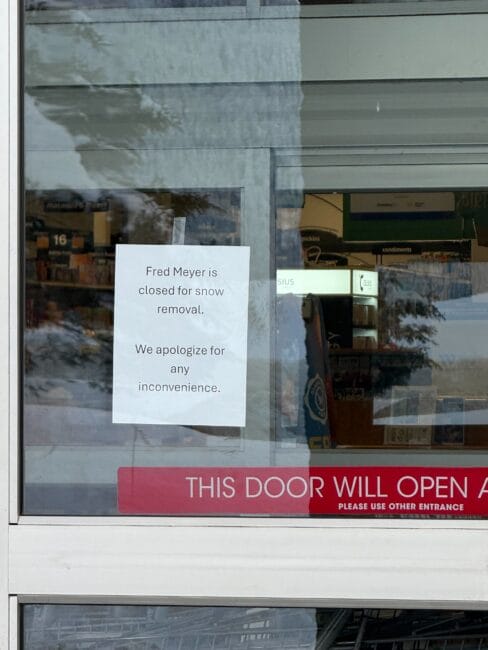
A sign on the grocery store of Fred Meyer grocery store in Juneau notifies customers that the store is closed for snow removal on Friday, Jan. 2, 2026. (Photo by Mike Lane/KTOO)

It’s unclear when the grocery store will reopen to the public. The Fred Meyer gas station is also closed after part of its awning collapsed. 

The roof of the Juneau Shotokan Karate dojo in the Mendenhall Valley collapsed on Wednesday morning, according to Vice President of the Board Sandy Burgess. She wrote on social media that no one was inside the building at the time.

At least nine vessels and multiple boat shelters sank at Juneau’s harbors throughout the week. The city’s docks and harbors staff are working around the clock to respond to reports and are pleading with owners to check their vessels.

Harbormaster Matt Creswell said dozens of boats have had near misses.

“It’s going to be a long process with the number of boats that are currently sunk, but staff are ready for that challenge,” he said on Friday morning. “We’ll be working in earnest, starting today, raising vessels, but expect that to be a couple week process to get everything up.”

The Alaska Department of Transportation reopened Thane Road on New Year’s Day after performing avalanche mitigation that morning. Officials say the avalanche danger remains high in all neighborhoods below Mount Juneau.

According to the National Weather Service, more than 80 inches of snow fell at Juneau International Airport last month. It made December the capital city’s second snowiest month ever recorded.

As plowing and roof clearing continue throughout the community, where to put all the snow is becoming an issue. 

“The snow removal process takes a long time because we basically have to either, with snowblowers or loaders, load all that snow into dump trucks and take it away,” City Manager Katie Koester said during a press availability on Wednesday. “We’re also having challenges at the snow storage sites, just because of the tremendous amount of snow.”

No major snow is forecast to fall in Juneau until Monday. However, temperatures are expected to drop this weekend.

This post has been updated. 

Hey Alaskans, it’s time to file for your PFD

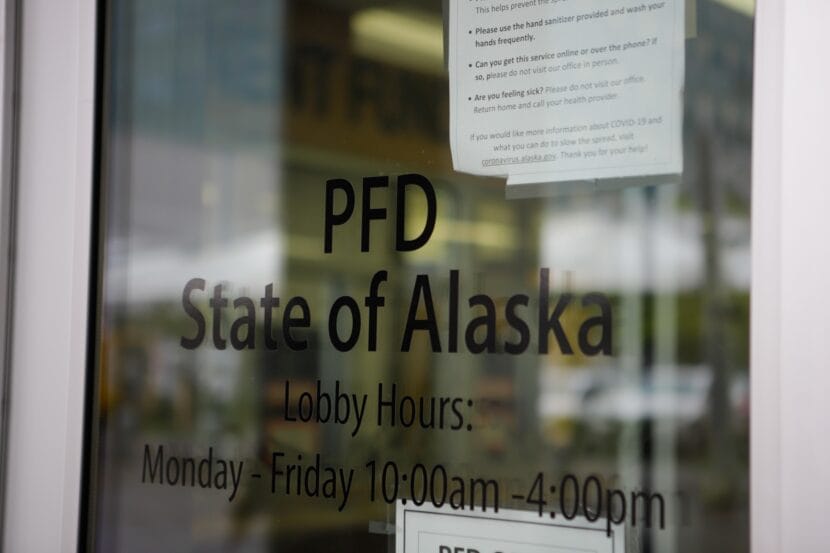
The glass door to the entrance of the PFD office. In black lettering is "PFD State of Alaska, Lobby hours Monday-Friday 10 a.m. to 4 p.m."
The State of Alaska’s PFD and Child Affairs Office is located in downtown Anchorage and pictured here on August 31, 2022. (Valerie Lake/AKPM)

For many, the New Year signals a fresh start. But for Alaskans, it also means it’s time to apply for the Permanent Fund dividend.

Applications for the 2026 PFD opened Thursday, with online filing starting at 9 a.m. Over 600,000 Alaskans receive the PFD each year, which is usually paid out in October.

It’s not yet clear how much the 2026 dividend will be.

In 2025, Alaskans received $1,000 — the smallest PFD in state history when adjusted for inflation.

The Legislature and Gov. Mike Dunleavy will determine the 2026 PFD amount during the upcoming legislative session, which starts Jan. 20.

Dunleavy’s budget proposal would pay roughly $3,600 per eligible resident, but passing it through the Legislature is a long shot. It would require using about half of the state’s savings — more than $1.5 billion from the Constitutional Budget Reserve, which is the state’s main rainy-day fund.

Already, some lawmakers have raised concern about withdrawing that much from savings, arguing that a large PFD is unwise given low oil prices. Others say the money would be better spent on priorities such as public school funding.

To be eligible for a PFD, you must be an Alaska resident for the entire calendar year, and intend to stay in the state.

Alaskans have until March 31 to apply. You can file online at mypfd.alaska.gov or pick up an application at any Permanent Fund Division office.

Winter weather leaves Pelican without seaplane, ferry access for weeks

Pelican Harbor (2020 Heather Bauscher)

Like many people during the holiday season, Sitkan Gaylen Needham was planning on spending Christmas with her adult children, who planned to fly in from Pelican.

However, due to record snowfall, low visibility and cold temperatures, Pelican has been without seaplane access since Nov. 28, cutting the Southeast community of 91 people off from the rest of the region.

“We lived out there full time in the 70s, and we had hard winters out there then, and the seaplanes landed, and they would often ice up,” said Needham. “I think now they’re just more cautious.”

With transportation to and from Pelican limited to Coast Guard and law enforcement helicopters in medical emergencies, not only was Needham unable to celebrate Christmas with her family, she also has had difficulty bringing the Christmas spirit to them.

“I was thinking of a Christmas package I was getting ready to mail out there, and knowing that the planes weren’t flying if you send it, then it ends up going into (the) Alaska Seaplane office and just sitting there. And in this case, the Christmas cookies would have been moldy, right?,” said Needham. “So we’ve just kind of been waiting to hear that they’ve gotten a plane.”

Ajax Eggleston is Needham’s son who has been living in Pelican off-and-on for about five decades, and says he thinks this is the longest period of time Pelican has gone without plane access.

He says it doesn’t help that Pelican’s December ferry was also canceled due to rough winter conditions in the region. Living in remote Alaska, Eggleston is used to the occasional mail delay, but dealing with decreased ferry capacity at the same time has not made things easy.

“That’s kind of a big part of this, is that we just don’t have reliable ferry service anymore, because we only have (the) LeConte that can tie up to our ferry terminal, and when the LaConte is laid up, we don’t have a big enough ferry to run in foul weather,” said Eggleston.

As a result, Eggleston is still waiting to receive the replacement parts he needs to repair his broken furnace and pipes. As for other residents in Pelican, he knows some who have rescheduled their medical appointments. Others are waiting on Costco orders of fresh produce that are stuck in Juneau.

“Everybody’s kind of hunkered down just watching their vegetables disappear,” said Eggleston. “We’re fine. We’re a subsistence-based community, so we’re not going to starve. But there’s no vegetables and no produce of any kind. So we’re overdue for a mail plane!”

Eggleston says Pelican residents have saved up enough frozen vegetables to get by. There is a Allen Marine catamaran expected to arrive on Jan. 6, as well as a state ferry on Jan. 10. Until then, Eggleston says right now, Pelican residents are in a waiting game for better weather.

Site notifications
Update notification options
Subscribe to notifications