Timber

Haines Assembly asks university to press pause on 400-acre timber sale

The Haines Assembly is asking the University of Alaska to press pause on a proposed timber sale which has alarmed local residents.

A couple weeks ago, the university put 400 acres of its Chilkat Peninsula land up for bid.

The timing of the sale was motivated by the threat of new local regulations.

At a recent special meeting, Assembly chambers were filled with residents who live out Mud Bay Road, south of Haines.

They were surprised that a timber sale of this this size could be allowed in their quiet neighborhood.
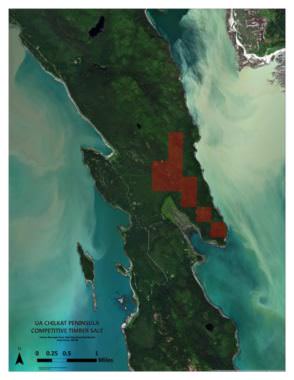
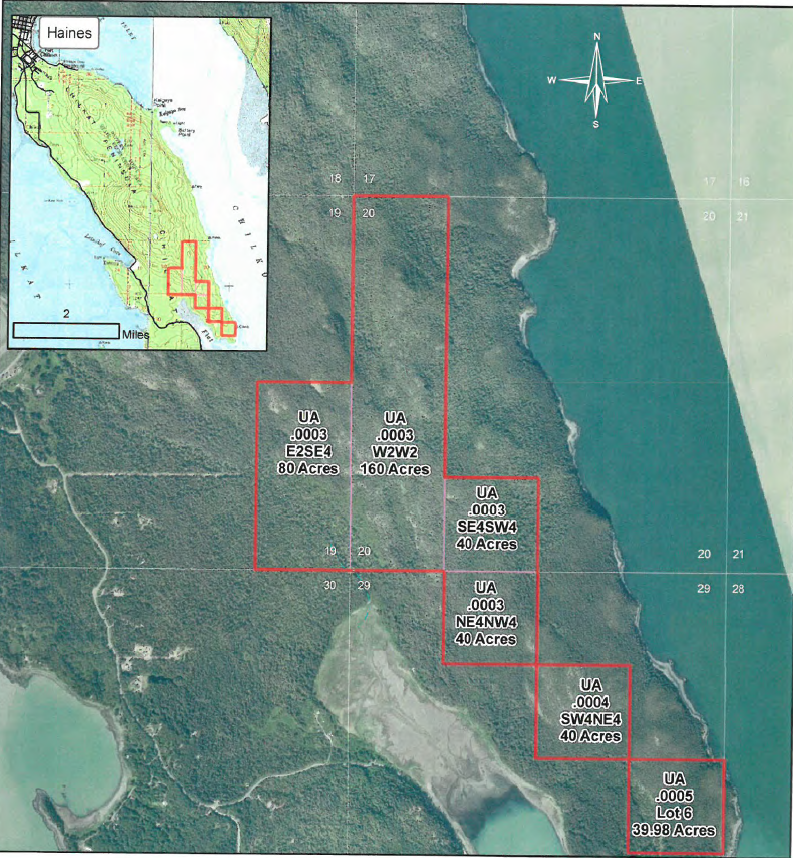
The proposed timber sale area on a map created by Haines Planner Holly Smith. (Image courtesy Haines Borough)

“It seems unbelievably clear that the intention and all the ordinance and code around it is not to have this kind of resource extraction or commercial use of the land in this area,” Heidi Robichaud said.

But that’s the problem that triggered this 400-acre proposal.

Mud Bay zoning code does not explicitly allow or restrict resource extraction.

Borough attorneys say the general rule in regulating private property is that unless something is explicitly prohibited, it’s allowed.

Since discovering this apparent oversight a few months ago, the planning commission has brainstormed what restrictions, if any, to implement in Mud Bay code.

“The public testimony by and large thought that small-scale resource extraction was fine, people selling a few trees or a few truckloads of trees to support local businesses was fine,” said planning commission chair Rob Goldberg. “People were generally opposed to large-scale resource extraction.”

But as the commission moved toward regulations on resource extraction, the Alaska Mental Health Trust and University of Alaska objected.

Both agencies own significant acreage in the Mud Bay area. And the university’s board of regents took action. The group put 400 acres of land up for timber sale.

The university uses money from sales like this to fund student scholarships.

A couple Haines residents, including Andrew Gray, spoke in support of the university’s right to profit off its land.

“If you do attempt to restrict this, I want to remind you that it would be incredibly clear message to send to the state of Alaska when we are fighting for services, to deny one of the state agencies who is attempting to profit off an allowed use of their land,” Gray said. “I don’t think that bodes well in terms of us fighting for state services.”

But Assembly members agreed with the concerns of Mud Bay residents – the timber harvest seems out of character with that area.

Assemblywoman Heather Lende is one of several people who questioned whether the borough really needs explicit restrictions on resource extraction to prevent this type of sale.

She pointed to other parts of code which indicate the Mud Bay service area is intended to prioritize residential over commercial uses.

“An outside entity proposing a 400-acre timber sale, I don’t know how that fits in with the intent of rural residential,” Lende said.

The Assembly wants to have a conversation with the university about all of this.

The group voted unanimously to request an in-person meeting with both the university and the mental health trust. The Assembly also is asking the university to delay awarding a contract for the timber harvest until after this discussion occurs.

The timeline right now is tight. The university is accepting comments and bids on the sale until Oct. 23.

Assembly member Tom Morphet said there might be room for negotiation.

He quoted from a letter written by university land manager Christine Klein.

“‘UA advertised its Chilkat Peninsula Competitive Timber Sale to protect out interests because the Haines Borough Planning Commission was not engaging us,’” Morphet read. “To me that suggests that the university is maybe not a in a big rush to log out there, but put forward this sale to a certain extent to get our attention.”

If the university doesn’t postpone the timber sale, the Assembly may consider legal action.

The group met in executive session with the borough attorney for more than an hour to discuss the issue.

Members did not say anything publicly about what they discussed with the lawyer.
Special meeting on proposed Chilkat Peninsula timber sale

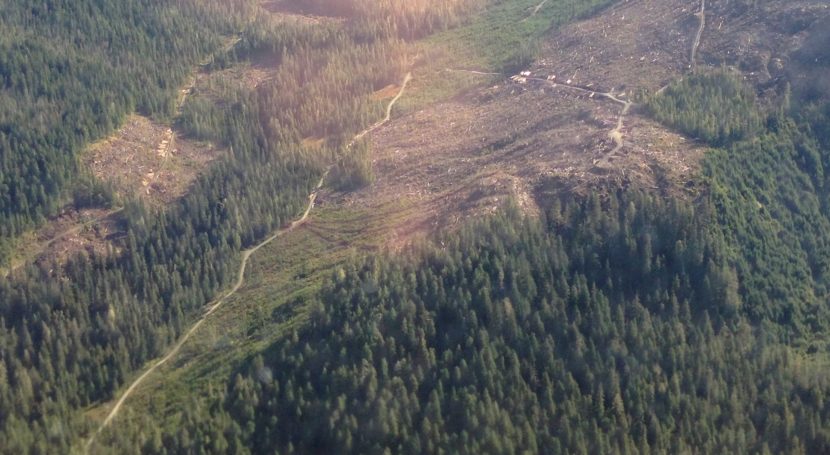
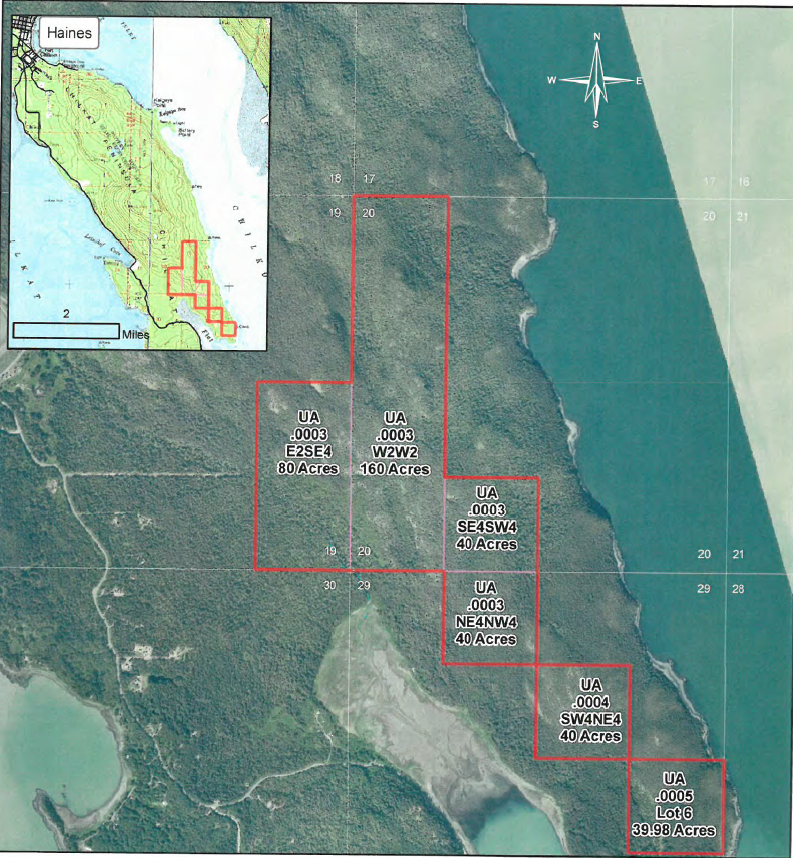
The University of Alaska’s timber sale area on the Chilkat Peninsula. (Photo courtesy University of Alaska)

The Haines Assembly is holding a special meeting this week to discuss what the borough manager has called a “politically motivated” proposed timber sale.

The University of Alaska is offering 400 acres of Haines-area land for timber harvest. The land is located on the Chilkat Peninsula and abuts many residential properties.

The university is advertising the sale at this time because of the threat of new local restrictions.

In the spring, the Haines Planning Commission realized the Mud Bay Rural Residential Zone does not explicitly allow or forbid resource extraction. The commission has been brainstorming potential restrictions over the last few months.

That worries university land managers, who want to capitalize on the property. Money from a timber sale would go to the university’s trust programs, which fund student scholarships.

At its last meeting, the Haines Assembly voted unanimously to explore potential land swaps in the Mud Bay area.

Member Heather Lende floated the idea of a temporary moratorium on resource extraction in Mud Bay, considering the planning commission’s work.

“Until we make a ruling on how resource extraction is gonna go on the peninsula, mainly in light of the Mud Bay land use area historic residential values and the situation out there,” Lende said.

Lende and fellow Assembly members Ron Jackson and Tresham Gregg requested a special meeting this week to talk about the proposed timber sale. The assembly members requested the planning commission and borough attorney participate.

The meeting is set for Thursday at 6 p.m. in Assembly chambers. Part of the discussion may be held in executive session.

Comments and bids on the Chilkat Peninsula timber sale are due by Oct. 23.

State-federal agreement awards Ketchikan company second-growth timber sale

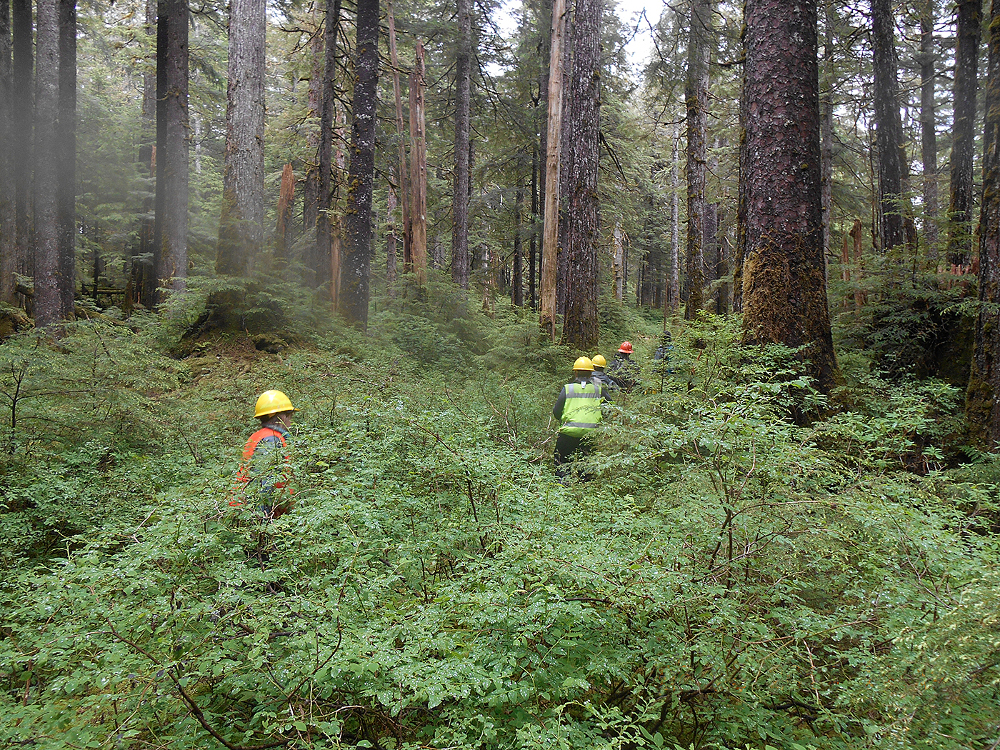
A U.S. Forest Service timber crew on Kosciusko Island (Photo courtesy U.S. Forest Service)

A Ketchikan company has been awarded a $2.6-million sale of second-growth timber on an island in Southeast Alaska.

The state of Alaska prepared and awarded the contract for logging on federal land on Kosciusko Island under an agreement with the federal government.

The sale is the first of its kind in Alaska under what’s called a good neighbor authority agreement, which allows the state’s Division of Forestry to handle sale preparation, administration and oversight for the logging on the Tongass National Forest.

The land is near the Southeast community of Edna Bay, west of northern Prince of Wales Island.

“The benefit for the state government is helping the Forest Service with capacity issues and actually getting timber sales prepared quicker and out for sale,” said Chris Maisch, state forester and director of the Alaska Division of Forestry. “Southeast Alaska has been struggling with the lack of timber volume off federal land and so this is a way for us to help get that volume out, which of course helps the economy of Southeast, the communities and people that depend on that for employment.”

Maisch said the Division of Forestry has been able to find the personnel to do the work.

“Because of the state’s budget problems we’ve had some cutbacks in my division, fairly steep cutbacks, about 42 percent over three fiscal years in my forest management side of my division and so I’ve actually been able to hire some employees back as temporary employees that previously been laid off.”

Staff in the division’s Haines office have been working on the project as well as newly hired employees on Prince of Wales Island.

Maisch expects the state to be working on other agreements with the Forest Service for similar sales elsewhere on the Tongass in the future.

Forest Service spokesman Paul Robbins said while all of the timber harvest will take place on national forest land, access will be across state property.

“The Kosciusko sale will be using state lands and roads as well as a log transfer facility on Division of Forestry land,” he said. “Even though all of the lands are federal, in order to harvest the sale and put the sale out there, we needed to use division of forestry lands. It just made sense to work alongside them on this sale.”

The sale will mean harvest of 29 million board feet of Sitka spruce and hemlock. Some of the money from the sale will reimburse the state for its costs.

The work-sharing agreement allows Forest Service staff to focus on other projects.

The 2014 Farm Bill authorized Forest Service use of such contracts with all 50 states.

The federal agency completed an environmental assessment on this project in 2015.

Since the logging is planned on federal lands, it has to be done under standards and guidelines of the forest plan, not less stringent standards under state law.

The Tongass is transitioning away from harvest of old growth to focus on younger trees that have grown back after logging in the mid-to-late 1900s.

In this project, harvest is planned for young-growth trees only, all around 60-75 years old. Old-growth trees originally included in the project were dropped from the final plan.

The state has applied for and received approval to allow export of all of the trees cut.

The company awarded the logging contract is Alcan Timber of Ketchikan.

Brian Brown, a partner in the company, said Alcan already is logging on Kosciusko and sees it as a good opportunity.

“It kinda speaks for itself,” Brown said. “It’s a large amount of volume for the recent history of what we’ve seen in the Tongass, so you know that’s good. It is second growth which allows us to do some things that we can’t do in old growth with mechanization and things like that. Overall we are looking forward to operating this timber sale.”

Brown said there’s no market for the second-growth timber in Alaska. But there’s a good market at mills overseas designed to handle the younger trees.

Regional environmental groups are glad the old-growth logging was dropped from the plan, but don’t like the export allowance because it means processing work is done elsewhere and not in Alaska.

Other concerns are about the impact on wildlife habitat even in the previously logged areas.

Larry Edwards is president of a regional organization now called the Alaska Rainforest Defenders, formerly known as the Greater Southeast Alaska Conservation Community. That group objected to the 2015 decision by the Forest Service to proceed with the project.

“Western Kosciusko’s just been hammered and will continue to be and this second growth that the Forest Service has remaining on west Kosciusko should really be allowed to go back to old growth just to help ameliorate all these excessive impacts on that island,” Edwards said.

Another young-growth project on Gravina Island near Ketchikan could be next up for the collaboration between the state and federal governments.

Federal court upholds contentious ‘roadless rule’ for national forests

A Tongass National Forest clearcut is shown in this 2014 aerial view. A new court decision limits logging on roadless areas of the forest. (Photo by Ed Schoenfeld/CoastAlaska News)
A Tongass National Forest clearcut is shown in this 2014 aerial view. (Photo by Ed Schoenfeld/CoastAlaska News)

A federal court upheld a rule limiting road construction and logging on about 50 million acres of national forestland nationwide.

The U.S. District Court for the District of Columbia’s decision Thursday was hailed by Alaska conservation groups defending the U.S. Forest Service’s roadless rule.

“It’s a huge victory,” said Meredith Trainor, executive director of the Southeast Alaska Conservation Council which opposes expanded logging in the Tongass National Forest. “The state of Alaska has been attacking the roadless rule almost since the rule was first written back in the early 2000s. The roadless rule protects intact forested lands within the national forest system, so it obviously has a big impact on the people of Southeast Alaska and the Tongass National Forest.”

The roadless rule was put into place by the Clinton administration and has since seen numerous challenges from Alaska and other states in federal courts all the way up to the U.S. Supreme Court.

Alaska Assistant Attorney General Cori Mills said the state is still reviewing whether it would appeal.

 “We are disappointed in the District Court’s ruling,” Mills said. “It upheld the 2001 roadless rule and that just has huge impacts on Southeast Alaska and the needed responsible resource development in the region.”

Alaska’s timber industry sided with the state. It said the rule denied access to some of the more valuable timber stands in the Tongass.

University offers 400 acres on Chilkat Peninsula for timber sale

The University of Alaska’s timber sale area on the Chilkat Peninsula. (Map courtesy University of Alaska)

The University of Alaska is offering up 400 acres of its Haines-area land for timber harvest.

The timing of the university’s decision was motivated by a conversation happening at the local level.

The Haines Planning Commission is considering whether to restrict resource extraction in the Mud Bay area.

At a Sept. 14 University Board of Regents meetings, Land Management director Christine Klein said the university’s ability to monetize its Chilkat Peninsula land was under threat.

“The reason we’re bringing this to you now is that there have been increasing efforts to put restrictions on the property and the area in Haines that this land is located at,” Klein said.

The conversation Klein is referring to started back in May, when the Haines Planning Commission noticed an apparent oversight in the code governing the Mud Bay Rural Residential Zone. There is nothing there to restrict resource extraction in the generally quiet residential neighborhoods.

Since then, the commission has brainstormed what kind of rules to put in place for that area. The university and the Alaska Mental Health Trust, both major landowners on the peninsula, spoke out in opposition to any limitations.

University President James Johnson wrote in a letter to Haines officials that revenue from land holdings is critical to UA’s trust programs, which fund student scholarships. University funding has plummeted by $61 million since 2014 in the wake of the state fiscal crisis.

At a meeting in June, planning commission chair Rob Goldberg said there was no rush to answer the Mud Bay resource extraction question.

“We’ve had this code in place for about 25 years and there hasn’t been any major resource extraction during that time,” Goldberg said. “And I haven’t seen a big rush for people to do it.”

Now there does seem to be a rush.

“If we don’t move forward with this, we may be in the situation of losing the ability to harvest the timber,” Klein said at the Sept. 14 regents meeting. “And in doing so, we would also lose our ability to check and verify if there is any mineral potential.”

Haines Forester Greg Palmieri says this is the largest potential timber sale on the Chilkat Peninsula in decades.

“I’m not aware of any timber sales on the peninsula in the last 10 to 20 years that weren’t on private property or very small,” Palmieri said. “This doesn’t compare to anything in the last 10 to 20 years.”

The 400 acres make up a significant swath of the peninsula south of the Haines’ townsite. Dozens of residential properties neighbor the sale area, including Eric Holle’s home.

“It’s not something I’m gonna lose sleep over at the moment,” Holle said.

Holle has lived across Mud Bay for 29 years. He’s also the president of a local conservation group. But he’s not too worried about the timber sale because he doesn’t think the university will be able to make money from it.

“Once they go through and do a timber cruise on this, I think they will be quite surprised on the lack of valuable timber in this area,” Holle said.

Planning commission chair Goldberg lives out Mud Bay, and he also questions the profitability of the timber harvest. He says creating residential subdivisions would be a much more valuable use of the land.

As for how this development will factor into the commission’s conversation around Mud Bay resource extraction, Goldberg says he’s not sure.

“If we were playing a game, it would be like the university has just wiped all the pieces off the board and said ‘game over,’” Goldberg said.

The university will find out if there are interested buyers for this timber sale by the bid deadline on Oct. 23. That’s also the deadline for comments on the plan, which can be sent to ua-land@alaska.edu.

Wildfires pop up near Chisana and Tanana

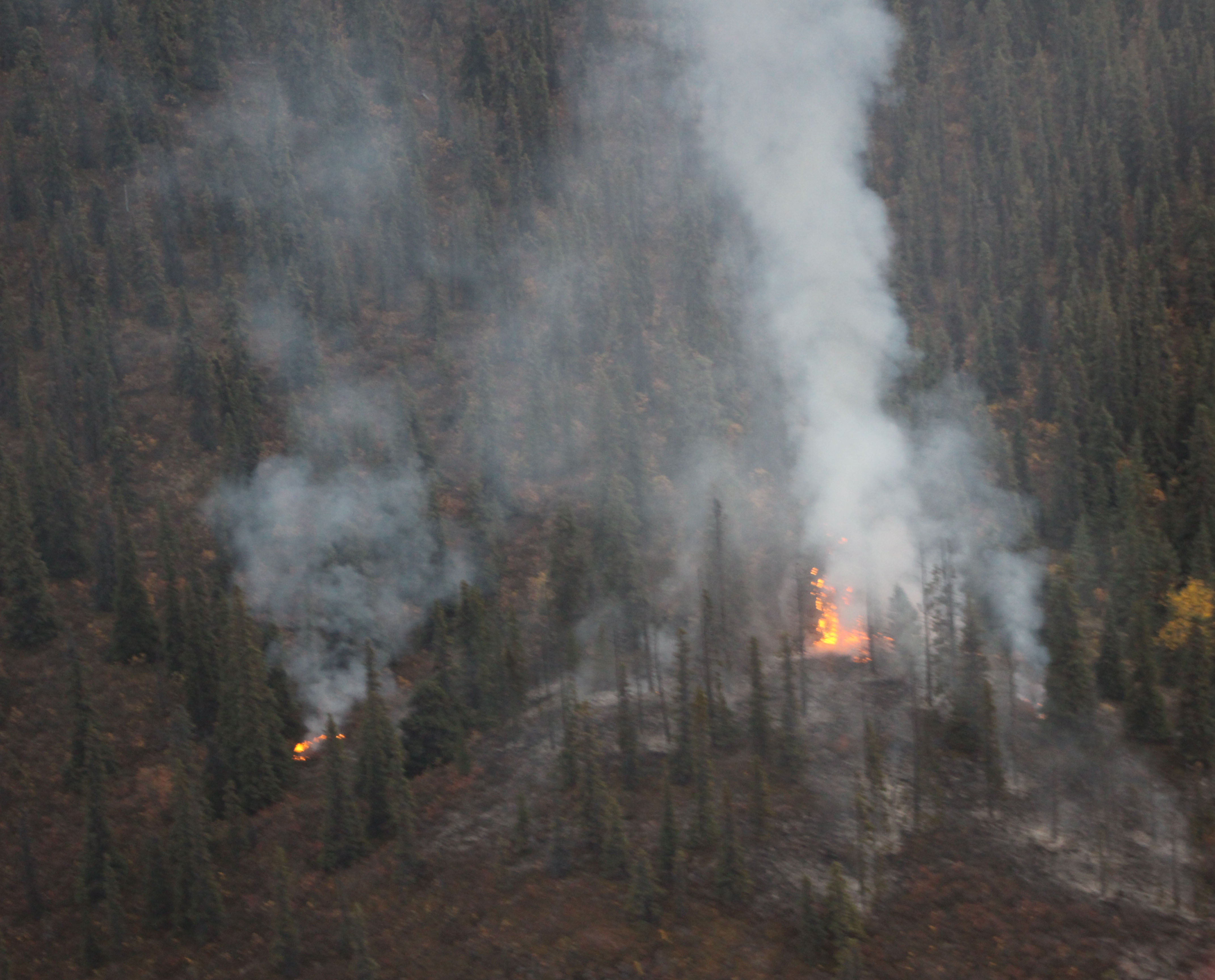
Red Hill Fire continues to burn Saturday evening. The fire, estimated at 1 acre, is approximately 100 miles northeast of Glennallen and 1.8 miles northeast of Chisana. (Photo courtesy Luke Wassick/National Park Service)

Recent warm, dry weather in the Interior has resulted in two late season wildfires.

Alaska Division of Forestry reports sending fire fighters last night to a 1-acre blaze, located about a hundred miles northeast of Glennallen, near Chisana.

The department said the fire, burning in Wrangle St. Elias National Park and Preserve, was observed to be creeping and smoldering with light rain falling on it last night. The fire is not accessible by road, and weather prevented firefighters from getting to it last night.

The other new fire was reported last week by a boater along the Tanana River, on a Native land allotment about 15 miles downstream from Nenana.

The Alaska Fire Service said two firefighters went to the site Friday to work the fire, which was estimated at less than an acre, with activity again described as smoldering and creeping.

Both fires are suspected to be human-caused.

State and federal agencies say Alaska has minimal staff on hand to fight fires in Alaska right now, as most are deployed to the battle major blazes in the western Lower 48.

The Alaska Fire Service said nearly 653,000 acres have burned in Alaska so far this year, well below the normal average of 1 million to 2 million acres.

Site notifications
Update notification options
Subscribe to notifications