Timber

Newly found disease could threaten Southeast Alaska spruce

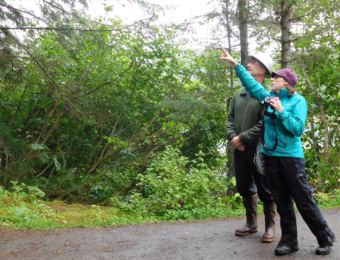
Forest Service Plant Pathologist Robin Mulvey points out infected spruce branches at Juneau's Shrine of St. Therese to shrine volunteer Brian Flory on July 11, 2017. (Photo by Ed Schoenfeld/ CoastAlaska News).
Forest Service Forest Pathologist Robin Mulvey points out infected spruce branches on July 11, 2017. at Juneau’s Shrine of St. Therese to shrine volunteer Brian Flory. (Photo by Ed Schoenfeld/CoastAlaska News).

A fungus that’s damaged trees in Southcentral and Interior Alaska has been discovered for the first time in Southeast.

But there’s a chance its spread could be stopped.

Forest Pathologist Robin Mulvey walks down the causeway to the Shrine of St. Therese, a forested island about 20 miles northwest of downtown Juneau.

“Right here you can see a small tree. It’s about 4 inches in diameter and it’s just a stump now because we removed that tree,” she said. “This was a fairly heavily infected tree, at least in the lower branches.”

The infection was spruce bud blight, which damages or kills the growing tips of branches. It was discovered here in late June, the first reported sighting in the region.

Fruiting bodies of spruce bud blight (Gemmamyces piceae) are shown on white spruce near Anchorage. (Photo by Lori Winton/U.S. Forest Service)

The blight could be a problem, because it infects Sitka spruce, one of the most common trees in Southeast Alaska’s rainforest.

“Right now, I’m considering it potentially a significant threat,” she said. “I’ll be incredibly happy to be wrong about that.”

Mulvey, who works for the U.S. Forest Service, explains that Southeast’s Tongass National Forest has just what the blight likes.

“The ideal weather conditions for the pathogen are temperatures between 55 and 65 degrees Fahrenheit, with precipitation,” she said. “If you’ve been in Juneau this summer, you know we’ve had very conducive weather conditions for this pathogen.”

The fungus is not easy to spot. It’s black and looks like a dead, crusty coating on the buds.

It’s actually a group of small, spherical fruiting structures.

If it doesn’t kill a bud, it hampers its growth, leaving another sign, a small, twisted branch with few needles.

“This is going to spread through spores moving on the air and it’s also going to spread through spores moving through rain splash,” she said.

But no one’s sure how the spruce bud blight found its way to this one, small patch of Southeast forest.

Mulvey said it’s unlikely it came in on the clothes or boots of one of the shrine’s many visitors.

It’s often found on Colorado blue spruce, a common ornamental plant used in landscaping. But her team found no infected trees in the area or at a nearby arboretum.

She said they were looking for another pathogen, the spruce aphid, when they came across the infestation.

“We just happened to turn and look at this spruce tree. And I said, ‘Hey! The shoots on that spruce look a little bit bent.’ So we went in for a closer look,” she said.

Spruce bud blight was first found in Homer four years ago, though it took until last year to figure out what it was. It’s also been identified elsewhere on the Kenai Peninsula and in Anchorage and Fairbanks.

Forest Service Plant Pathologist Lori Winton, who is based in Fairbanks, said her first encounter also was a surprise.

“The first time I saw it, I was skiing in the forest near Anchorage and I pretty much fell face-first right into a tree that had it,” she said.

That was about two years ago, and it wasn’t clear what it was.

Then, an article in a scientific journal described outbreaks on blue spruce plantations in central Europe’s Czech Republic.

“Suddenly, there were DNA sequences available that matched,” she said. “I had an identification and frankly it was a rather alarming identification.”

The potential for extensive damage in Southeast’s forests, or those statewide, is not known. And since no one’s sure how it got to Alaska, it’s not clear how rapidly it could spread.

The first trees hit by spruce bud blight were found at the Shrine of St. Therese, a Catholic church and landmark in Juneau. (Photo by Ed Schoenfeld/CoastAlaska News)
The first Southeast trees found with spruce bud blight were at the Shrine of St. Therese, a Catholic church and landmark in Juneau. (Photo by Ed Schoenfeld/CoastAlaska News)

Winton said there’s also a chance spruce bud blight could have been here all along and just hadn’t been spotted. After all, it is a big state.

“That’s currently the question, is whether it’s native to North America or not — or Alaska,” she said.

She said it could take a year of lab work to figure that out.

The blight has been found in eastern Canada, but not throughout the United States.

Mulvey wonders about the same question back in Juneau.

“Part of me says, ‘What are the chances that we detected the only site of infection in Juneau?’” she said. “I think the chances are pretty small.”

But if it isn’t here naturally, there’s a chance it could be stopped.

“I just have to do what I can to try and prevent any further spread, while it still seems feasible,” she said.

Her team is continuing its search for spruce bud blight in Southeast. It’s also asking for public help.

She suggests checking landscape plants on your own property, because it seems most common in developed areas.

“Look really closely at any dead buds on your spruce trees and if you see these small, spherical black fruiting structures, please give us a call because we’d love to come out and take a look,” she said.

And that’s just what was she doing during our visit to the Juneau landmark.

She and shrine volunteer Brian Flory were using binoculars to check out higher branches near the infected trees that were removed or trimmed. And sure enough, they found more.

Tongass timber sale short on timber

The harbor at Thorne Bay on Prince of Wales Island. (Photo courtesy Department of Commerce, Community and Economic Development; Division of Community and Regional Affairs’ Community Photo Library)

A large timber sale on the Tongass National Forest is not as large as it was advertised.

An environmental watchdog organization has uncovered a U.S. Forest Service document showing a 12-million-board-foot mistake on the Big Thorne timber sale on Prince of Wales Island in Southeast Alaska.
The U.S. Forest Service wants to settle the error with the Viking Lumber Company of Klawock, which was awarded the contract for harvesting the timber in 2014.

Public Employees for Environmental Responsibility, or PEER, based in Silver Spring, Maryland, has published Forest Service documents on its website detailing a review of timber sale contracts on the Tongass National Forest.

This spring, PEER highlighted a Forest Service review that found errors in procedures, oversight and contract enforcement.

Other documents from Regional Forester Beth Pendleton directed staff to fix an error in calculating the cost of hauling timber cut under the Big Thorne contract, but then rescinded that direction.

Jeff Ruch, PEER’s executive director, characterizes another document written by Acting Regional Forester Rebecca Nourse like this:

“One of the most extraordinary memos we’ve ever seen to the chief of the Forest Service basically demanding that he authorize additional retroactive payments immediately even though there’s in the terms of the memo no contract mechanism, meaning it’s not provided for under the contract, it’s not owed to them and in a situation where the company wouldn’t even file a formal claim,” Ruch said. “It’s a hell of a way to run a railroad ‘cause everyone thinks you guys up there on the Tongass are growing cedar and spruce but it looks like you’re growing money.”

In that memo, Nourse writes that a review of Big Thorne timber contract found the agency over-represented the amount of timber actually sold by 12 million board feet.

“The independent review shows unexplained departures from policy, which puts the Forest Service at risk of significant damages should the purchaser pursue a claim.”

The memo says the agency should seek to negotiate a settlement instead.

It proposes several options: taking no action and expecting a claim from Viking, or canceling the contract and re-offering the timber sale at a later date.

That could also result in a claim from the company.

Nourse’s preferred option is to modify the contract and change the rates charged to Viking.

That company was awarded the contract in 2014 and has been logging the timber on National Forest land around Thorne Bay on eastern Prince of Wales Island.

The contract at the time was for a harvest of 97 million board feet of timber valued at more than 6.5 million dollars.

As of the beginning of this year, the Forest Service said the company still had a little more than a third of that left to cut.

PEER’s Ruch calls for an in-depth audit of the sale contract.

“You would think given all of the confusion here they would bring in some outside people to basically go over the books to find out what’s going and that’s not the case,” Ruch said. “It’s sort of like the Region 10, the Alaska people of the Forest Service, are in flagrant violation of what we know as the rule of holes, which is when you’re in one, stop digging.”

The organization also has requested other documents under the Freedom of Information Act and subsequently filed a lawsuit in U.S. District Court in Washington, D.C., seeking to get more information on the agency’s review of Tongass timber sales.

The lawsuit says, “PEER has reason to believe that (sic) Forest Service was either actively engaging or complicit in the unlawful sale of high-value timber at prices far below market value.”

A call for comment from Viking Lumber was not returned.

Alaska Forest Association executive director Owen Graham said the industry group is not surprised to hear of less timber in that contract.

He did not trust the amount of timber that the sale supposedly contained in units to be logged by helicopter.

“The helicopter volume per acre that they were projecting for a partial cut was just triple what we’d experienced in the past,” Graham said. “We were always questioning whether that was, we didn’t believe it was there.”

Graham said there were other problems with the Forest Service’s timber cruise, or assessment of the quality, size and types of trees in various harvest units.

He thinks it makes sense for the agency to negotiate with the company to fix the mistake.

“You know, resolving issues on contracts is pretty common in all the industries, but particularly the timber industry,” Graham said. “You sit down and work it out. Everybody’s interested in long-term relationships, not just cash in your hand today or something.”

Graham thinks the other options would mean that sawmill runs out of wood and could be forced to shut down.

The Forest Service did not respond to a request for comment Monday or Tuesday.

An official previously said the agency would not discuss Big Thorne, because of PEER’s complaints.

Gold Rush Days marks 27th year

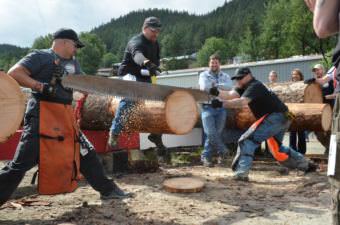
A contestant drives spikes at Juneau Gold Rush Days, Saturday.
A contestant drives spikes at Juneau Gold Rush Days on Saturday. (Photo by Quinton Chandler/KTOO)

It’s wet and muddy, but that isn’t stopping raincoat-clad Juneau residents from enjoying the 27th annual Gold Rush Days.

The two-day celebration promotes Juneau’s oldest industries: mining and logging. It has labor-intensive competitions like jackleg drilling, spike driving, axe throwing and log bucking. The games and fair atmosphere are part of a larger plan to strengthen relationships between residents and the workers who help build the local economy.

Right now contestants are finishing up the men’s spike driving competition.

It’s pretty much what it sounds like. Each contestant takes his turn hammering in metal spikes with the butt of an axe.

Nicolette Dunlap is sitting under the food pavilion with a friend. She says her favorite thing to watch are the men and women’s speed climbing competitions.

“When they climb the pole or whatever,” Dunlap says. “I don’t know it’s just really cool that someone could do that, because I could never do it.”

Across the way, Jerry Harmon is inside of a tent planting tiny pieces of gold in three plastic containers full of murky water. He is staging a hands-on gold panning exhibit for a herd of little kids waiting outside.

Harmon lifts a bowl out of the dirty water and holds it up for inspection.

“How does that look?” he asks.

Several tiny flecks of gold shine against the rough, worn bowl.

“Everybody finds gold, (I) guarantee it. There’s a lot of gold in there,” Harmon says.

He has been helping with Gold Rush Days since the very beginning. He says it was originally set up to give Juneau residents a place to come meet their miners and loggers.

“So that they could have friends that were miners and we have a lot friends now that are miners,” Harmon explains. “We have a lot of people who are not miners and not loggers that come out and compete as well.”

Juneau was founded shortly after gold was discovered in the area in 1880. The first strikes drew hundreds of new residents and sparked a need for logging to build the mines and people’s homes.

Harmon points out that today mining is still a big piece of Juneau’s identity.

“The Kensington mine is operating here. The Greens Creek mine is operating here and it’s part of the way of life,” he says. “(It’s) just a way of life!”

Harmon says usually up to 10,000 people come to this two-day event. It’s hard to gauge the crowd size today, but it’s easy to see that people are having a good time.

Kirk Ziegenfuss is a driller and blaster on mostly surface construction jobs. He used to be a miner and he also has been coming since the very first Gold Rush Days. Now, he jokes that he’s gotten too old to compete in most of the games.

“… I used to do all the events in my younger years,” Ziegenfuss says. “The hand mucking where you use a shovel or the spike driving where you’re driving these big spikes with an axe. I’m getting to slow on everything else to even think about those anymore.”

It’s a fun time for Ziegenfuss. It’s a free, family event.

“I kind of like it because I get to hob knob it with some of the miners that I know like, old timers like, this guy and some of the new guys coming up,” he says. “I just show up to give (them) something to shoot for. And they’re passing me up now.”

Kirk Ziegenfuss at Juneau Gold Rush Days, Saturday.
Kirk Ziegenfuss at Juneau Gold Rush Days, Saturday. (Photo by Quinton Chandler/KTOO)

But, he also likes that the party helps connect people in the community who work and live in very different environments.

He smiles and says, “Some people actually have to get in there and get dirty and wear their bodies out. It kind of brings everybody together and gives them something to … especially in Southeast Alaska, everybody likes a good fair.”

Gold Rush Days is sponsored by over 40 Juneau businesses including the Hecla Greens Creek Mining Company and the Kensington Mine. Jerry Harmon says local residents generally donate about $30,000 each year.
New road and landowner collaboration key to harvesting young growth Tongass timber

Photo of trees in the Tongass National Forest
The U.S. Forest Service is also looking at harvesting young growth on Kosciusko Island in the Southeast region. (Photo by Henry Hartley/Wikimedia Commons)

After new federal plans were set in motion last year, old growth logging in Alaska’s national forests is on its way out. Still, the feds have to make some timber sales available in the Tongass. And so, the U.S. Forest Service is in the early stages of planning one of its first young growth sales since the switch, just outside of Ketchikan.
Mike Sallee is a small mill operator in Ketchikan, who deals mostly in dead and down trees, and he owns a homestead on nearby Gravina Island.

His neighbors on Gravina are big landowners, like the state, the feds, the Ketchikan Gateway Borough, and the university and mental health trusts —  all of which can sell trees on their land for profit.

In the past, Sallee says some of the landowners haven’t left Gravina in good shape. He’s noticed a tangle of trees still on the ground after they’re done logging.

“Places that I had been hiking through and hunting for decades [were] basically turned into like a blowdown,” Sallee said.

Which is why Sallee says he’s not enthusiastic about a road being built by the state on the island, slated to be completed this year.

The road could make it easier for more timber sales to pencil out, including one being planned by the U.S. Forest Service. The agency has a new obligation: bringing more young growth trees from the Tongass to market.

Between the many landowners and the new road, there’s a kind of menu: an a la carte of trees.

“Access, access, access. Everybody wants to have access to their lands,” said Buck Lindekugel, a grassroots attorney for the Southeast Alaska Conservation Council (SEACC).

His organization petitioned the feds to transition away from old growth logging in the Tongass, so you’d think he’d consider harvesting the young trees to be a victory. But it’s not that simple.

“There’s some steep slopes in there so there’s real concern,” Lindekugel said. “It might not be the best thing to go back onto this land.”

Lindekugel says at the bottom of the slopes are salmon streams, and he worries the proposed logging could damage the area. He thinks the federal agency should learn from its past mistakes and stop clear cutting.

“We think the forest service needs to have a lighter touch on these areas,” Lindekugel said. “Pull out some marketable products but at the same time don’t unravel the habitat.”

Eric Nichols, a partner at Alcan Forest Products, says these trees have all been clear cut before. 

“It needs to be clear cut again,” Nichols said. “And start it all over.”

Nichols is eyeing the young growth sale for his company, which specializes in buying timber. He admits times have been tough for the industry — a death spiral, as he puts it. It’s estimated there are only a few hundred timber jobs left in the region.

Part of the problem Nichols says is there hasn’t been a steady supply of trees. So while this young growth sale is relatively small, at least it’s something. And if the forest service wants a buyer, Nichols thinks there shouldn’t be any more limitations.

“So its either get it now with these other landowners or they’re not going to be able to get it in the future,” Nichols said.

He says the road being built and collaboration is key. Once harvested, a company like Nichols’ would likely send the young growth to be milled in Asia.

Buck Lindekugel from SEACC says he doesn’t see the timber industry or the argument over the national forest going away — even with the transition.

“But it’s not going to be like it is was in the past where timber was first in the Tongass,” Lindekugel said. “Those days are over.”

Instead, Lindekugel imagines small mill operators like Mike Sallee selling specialty products from salvaged logs and more trees left in the ground on places like Gravina Island.

The forest service is taking public comment on its young growth plans on Gravina Island. The agency is trying to figure out how to harvest the trees and if the sale is viable. The comment period ends June 9.

Leaving timber behind, an Alaska town Ketchikan turns to tourism

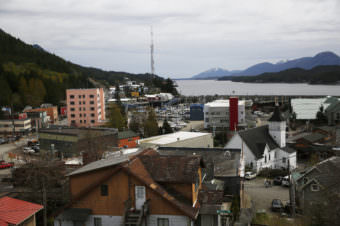
Ketchikan sits on an island at the southernmost end of southeast Alaska, a prime spot for cruise ships navigating Alaska's Inside Passage. (Photo by Elissa Nadworny/NPR)
Ketchikan sits on an island at the southernmost end of southeast Alaska, a prime spot for cruise ships navigating Alaska’s Inside Passage. (Photo by Elissa Nadworny/NPR)

What happens to a town when a key industry collapses?

Sometimes it dies. But sometimes it finds a way to reinvent itself.

Case in point: Ketchikan, Alaska, where the demise of the timber industry has led to a radical transformation.

Many people who used to earn their livelihoods through timber have now turned to jobs in tourism.

It’s an identity shift that makes the city far different from what it was in the logging heyday.

“It was this boomtown!” says longtime Ketchikan resident Eric Collins. “It was just a crazy, wild frontier place.”

Now, it’s a tourism magnet. Ketchikan is expecting 1 million visitors this summer. They’ll flow into town off as many as six giant cruise ships a day.

To give a sense of scale, figure that the borough of Ketchikan is home to about 13,000 people. In just one day, Ketchikan may see 13,000 cruise ship visitors.

“We’ll double in population for eight hours,” says Harbormaster Dave Dixon as he waits dockside for the morning’s first arrival.

Passengers aboard the Nieuw Amsterdam cruise ship look out at Ketchikan. (Photo by Elissa Nadworny/NPR)

Each season, he braces for the tourists’ questions that might come his way:

“Can we see polar bears here?” (Um, no, that would be more than 1,000 miles away, in the Arctic.)

And this humdinger: “Is Alaska part of the United States?” (Well, yes, since it became a state in 1959.)

“Kind of unexpected that someone would ask me that,” Dixon says with a chuckle, noting that he’s pretty sure the question came from an American. “Maybe geography class was not their high point.”

Ketchikan sits on an island at the southernmost end of southeast Alaska, a prime spot for cruise ships navigating Alaska’s Inside Passage. The landscape is spectacular: snow-capped mountains, glaciers descending into narrow fjords, and all around, the dense Tongass National Forest. At 17 million acres (bigger than West Virginia), the Tongass is the largest national forest in the U.S.

For many decades, the spruce, hemlock and cedar trees of the Tongass have also been a source of timber for the logging industry. At its peak, logging camps dotted the islands of southeast Alaska, and pulp mills were robust economic drivers of the region.

One by one, those pulp mills shut down, faced with global competition, new environmental regulations, lawsuits and fines for pollution violations.

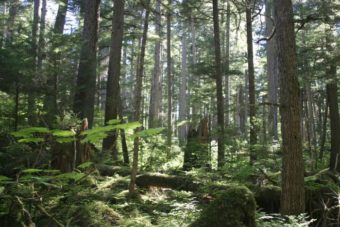
The Tongass National Forest, near Ketchikan, Alaska. The spruce, hemlock and cedar trees of the Tongass have been a source of timber for the logging industry. (Photo by Elissa Nadworny/NPR)
The Tongass National Forest, near Ketchikan, Alaska. The spruce, hemlock and cedar trees of the Tongass have been a source of timber for the logging industry.
(Photo by Elissa Nadworny/NPR)

Ketchikan’s pulp mill was the last one still operating in Alaska when it shut down in 1997. Hundreds of good-paying jobs and the businesses that supported them went with it.

For some, it’s been an uncomfortable transition. “We don’t know who we are anymore,” Collins says. “We had shoe stores in Ketchikan. We had work clothes stores in Ketchikan. We had a Chevy dealer and a Ford dealer. They’re all gone.”

What’s replaced them? Lots of jewelry and watch stores, some of them owned by the cruise ship companies themselves. Also, souvenir and gift shops, as well as local tour operations.

The newer businesses provide seasonal retail work, but it’s nowhere near as well paid as the old jobs: Those were year-round, “family-sustaining jobs,” Collins explains.

Now, he says, at the end of September, “within a few day period, the town will be boarded up downtown. Literally, most of the businesses will be closed. And then the people will leave town.” The workers will head on to their winter seasonal work, maybe in Colorado or the Caribbean.

Collins has a long view of the logging industry, and of Ketchikan.

Some of his earliest memories are of the nearby logging camp where he lived with his family in the late 1960s.

They moved to Ketchikan when he was 9. It was the heyday of timber, and Collins knew that a good job in the industry would be waiting for him after high school.

It was. He started working on tugboats, bringing supplies to the logging camps and the Ketchikan pulp mill, and eventually he worked his way up to captain,

When the pulp mill shut down in ’97, “it was crazy,” Collins says. “People were leaving town as fast as they could. Property values plummeted. I remember foreclosures, auctions at the courthouse, people losing everything, not being able to get a job, and selling their houses and leaving town.”

Longtime Ketchikan resident Eric Collins used to work on tugboats, bringing supplies to the logging camps and the Ketchikan pulp mill. Now, he's a cruise ship pilot, steering giant tour vessels into Ketchikan. (Photo by Elissa Nadworny/NPR)
Longtime Ketchikan resident Eric Collins used to work on tugboats, bringing supplies to the logging camps and the Ketchikan pulp mill. Now, he’s a cruise ship pilot, steering giant tour vessels into Ketchikan.
(Photo by Elissa Nadworny/NPR)

The company Collins worked for was in charge of cleaning out the logging camps and the pulp mill, and shutting them down.

“I ended up being the last employee, and I shut the lights out, ” he says. “Left the office, turned out the lights and went home, started my new job.”

Collins is now a cruise ship pilot, steering those giant tour vessels into Ketchikan.

He loves his work, but still, he says, “I miss tugboats. Tugboater at heart.”

Back on the Ketchikan dock, Harbormaster Dave Dixon spies the morning’s first arrival hoving into port.

“Yep! There they are,” he says, as he watches Holland America’s Nieuw Amsterdam cruise ship sidle to the dock, with some 2,000 passengers aboard.

The ship looks like a floating skyscraper, the length of three football fields.

When the gangplank is lowered, the tourists march ashore and find a gaggle of tour operators waiting to entice them with local offerings:

“The world’s largest totem poles!”

“An all-you-can-eat Dungeness crab feast!”

“Active eagle nests, seals, a chance for killer whales and humpbacks!”

And if the tourists want a theatrical taste of the industry that used to fuel Ketchikan, they can go watch timber sports at the Great Alaskan Lumberjack Show, where burly competitors in flannel shirts and suspenders chop stumps, saw logs, and heave axes at a bullseye.

The “Our Land” series is produced by Elissa Nadworny.

Copyright 2017 NPR. To see more, visit http://www.npr.org/.

About The ‘Our Land’ Project

Our Land is a project from special correspondent Melissa Block. She’s traveling the country, capturing how people’s identity is shaped by where they live. Help her decide where to go and who to spend time with by filling out this form.

Southeast Alaskans predict tariff’s effects on timber market

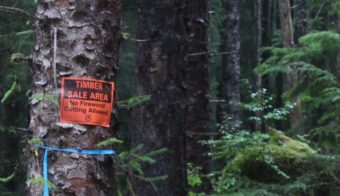
A timber sale sign is posted in the Tongass National Forest on Prince of Wales island. (KRBD file photo)

The Trump administration announced this week it is planning to impose a tariff of up to 24 percent on softwood lumber imported to the U.S. from Canada. It’s uncertain what this will mean for the timber industry in Southeast Alaska.

Ketchikan-based Alcan Forest Products has operations in the United States and Canada. Partner Brian Brown says the tariff will raise the price of lumber. While he says it will likely be a net positive for his business, he does not support the tax.

“I think the net result of this duty is bad. It’s bad for consumers. People are going to pay more for lumber, period. There’s no doubt in my mind on that. That’s a fact.”

In addition, Brown says it will be bad for businesses.

“If you’re a producer, particularly in Canada, how do you run a business? All of the sudden you have to pay a 20 percent tax. It’s tough to run a business. And Canada, the last time I checked, was an ally of ours. I don’t know. I think it’s fraught with risk.”

Owen Graham, executive director of the Alaska Forest Association, disagrees. He says he thinks the tariff will benefit the Southeast timber industry.

“A portion of our lumber, particularly hemlock, goes to the Lower 48. It would help that lumber. It would take some of the Canadian wood off the market, and that would tend to raise the price up a tiny little bit. So it would be a help to Alaska producers.”

Graham says more than a tariff, he would like to see the U.S. government adopt more business-friendly practices, similar to those in Canada.

“They’re more interested in jobs than they are in some of the other things that come off the forest. They tend to have a larger economy of scale that gives them a huge advantage over our sawmills.  And they allow the mills to manage some of the land for them, and so the mills can get additional savings that way.”

According to a U.S. Commerce Department report, Canadian exports of softwood lumber to the United States in 2016 were valued at $5.6 billion.

Site notifications
Update notification options
Subscribe to notifications