Timber

Petersburg residents ask tough questions on Mental Health land exchange

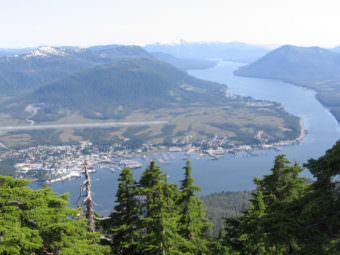
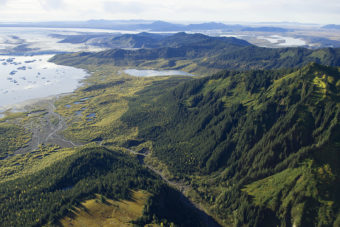
The Alaska Mental Health Trust owns land on the hillside south of Petersburg, near the top right of this photo. (KFSK file photo)

Alaska Mental Health Trust Land Office representatives faced some tough questions about a proposed land exchange between the Trust and the U.S. Forest Service in Petersburg last week. The Mental Health Trust Authority owns lands in Petersburg it wants to swap for Tongass National Forest acreage elsewhere in the region. Resulting timber sales would raise money for the Trust.

Mental Health is hoping to complete a swap that’s been under discussion for a decade. The state corporation is asking for about 20 thousand acres of Tongass National Forest land at Shelter Cove near Ketchikan and other parcels near Naukati and Hollis on Prince of Wales Island.

In exchange, the Trust would give up a total of around 18 thousand acres. Those lands are on the hillside above Mitkof Highway south of downtown Petersburg along with parcels on Deer Mountain and on Gravina Island in Ketchikan. Other Mental Health lands that would go the federal government are near Juneau, Wrangell, Sitka and Meyers Chuck along with a parcel on Kuiu Island.

“Get out of your back yard and be a little bit more remote,” said Paul Slenkamp, senior resource manager with the Trust Land Office. That office is part of the Alaska Department of Natural Resources and manages lands for the Authority. He presented arguments for the exchange to about a dozen people in Petersburg.

“We believe this will help protect jobs both in the timber industry, which is very beleaguered which you may be aware of, and also in the tourism industry by preserving some of the backdrops and viewsheds of the local communities, specifically Ketchikan and Petersburg,” Slenkamp said. “And then also there’s also some watersheds and viewsheds and old growth timber along the Inside Passage that will be retained through this transaction.”

The Land Office manages 130,000 acres of timber land statewide for the Trust. Money generated off that and other acreage goes to the Mental Health Trust Authority, which has been paying out around 20 million dollars annually for mental health services around Alaska.

Last year Trust officials said they’d be going forward with logging the lands in Ketchikan and Petersburg if legislation to enact the exchange did not pass Congress by mid-January of this year. They later backed off that deadline and have focused on getting that legislation passed at both the state and federal levels.

Land office CEO John Morrison gave an update on those pieces of legislation. “We understand that we have very good chances of imminent passage at the federal level. There was a first hearing in the Senate today at the state level for SB 88. So the state process appears to moving along. We don’t sense any resistance at the state level. And so we’re in constant contact with the timber community to see what their status is and so we don’t have a specific deadlines at the moment other than it is very important that both of these bills pass this session.”

Sitka Republican Senator Bert Stedman’s bill had its first hearings in the Senate Resources Committee in March. Ketchikan independent Dan Ortiz’ House bill also had hearings scheduled at the end of March in the House Resources Committee.

The Mitkof Highway Homeowners Association formed in late 2005 to oppose logging on the steep hillside above their homes south of Petersburg after the Trust Land Office announced plans to go forward with timber sales. The group has argued that logging would increase the chance of landslides on that slope and have documented slides that have already occurred in that area around Mitkof Highway and the electrical transmission line bringing power to Petersburg.

Some of those residents questioned the officials about how they could even consider logging there, given the risk of landslides.

“I understand,” Morrison responded. “I wouldn’t want to live at the bottom of a slide area or have something affect the area above my house. I certainly wouldn’t want to do something that endangered people below our house, or below land that we owned. So we certainly are taking those things into consideration. And as I said, we are committing significant resources to moving this exchange forward including coming down for meetings like this and working with a number of interested parties.”

Petersburg resident Becky Knight is opposing the exchange and instead thinks the land should be sold to the federal government. Knight points to an email from the Trust’s Slenkamp last August that gave an update on the land exchange and said the Trust was in final negotiations with Viking Lumber for purchase of all timber on Prince of Wales associated with the proposed exchange.

Knight questioned the Trust officials about how they could be negotiating to sell timber before the Trust owned that timber.

“I can still say that no we do not have a contract although we are talking with all members of the timber community as far as supply,” Slenkamp said.

“I can unequivocally say that we don’t have a contract and that we were misquoted the last time we were here,” said Morrison.

“Well, can you explain what final negotiations means?” Knight asked.

“No,” said Morrison.

“Well at the time and we still are… we don’t own the timber yet,” Slenkamp said. “And I know that’s exactly what we said. We cannot sell something we don’t own. And when we have ownership of it we will negotiate with…”

“We’ll go through our process to dispose of the timber,” interjected Morrison.

Trust officials anticipate 40 million to 60 million dollars in timber sale revenue from the lands near Ketchikan and on Prince of Wales Island during the next two decades if the land swap is completed.

Following the meeting, the Mitkof Highway Homeowners Association’s Ed Wood said the group is hopeful the exchange goes through. “It’s kinda disappointing the landslide issue isn’t really front and center of being discussed,” Wood said. “That’s our interest in this. Other than that we’ve just been waiting to see.”

Petersburg’s borough assembly sent a letter last September urging the Trust to go forward with the exchange instead of logging that land.

It can power an ice rink in Fairbanks. Could it power rural Alaska?

A hockey team plays a game at the Big Dipper Ice Arena. (Photo by Tim Ellis/KUAC)
A hockey team plays a game at the Big Dipper Ice Arena. The Alaska Center for Energy and Power, the University of Alaska Fairbanks and the Fairbanks North Star Borough are hoping an innovative energy system can help power the lights. (Photo by Tim Ellis/KUAC)

A system that could power remote Alaska is being tested in an unexpected place. Typically found in Scandinavian countries, a new cleaner energy technology is now coming to Fairbanks.

“Our PR campaign has been this isn’t wood burning. This is wood gasifying,” said Ben Loeffler, an energy management engineer at the Fairbanks North Star Borough.

He’s talking about an innovative system for generating both heat and power. It’s the first of its kind in Alaska, and it’s being installed at a location called the Big Dipper.

“It’s used for recreational skating, and it’s also where the Ice Dogs play their home games,” Loeffler said.

In December, the Alaska Energy Authority awarded a matching grant to help fund the new project in Fairbanks’ ice rink. It’s expected to cost upwards of $700,000 and the borough is picking up some of the cost.

Loeffler says this as a way to save money and an opportunity that could eventually create jobs.

It works like this: wood chips are heated up, driving a gas off the wood. The gas goes into an internal combustion engine driving a generator.

“And so it’s very similar to running a generator on natural gas,” Loeffler said.

An ice rink might seem like an unlikely place to try this out. And, there’s another reason you might not expect a wood gasification system in Fairbanks.

“We’ve run into a lot of healthy questions about emissions especially,” Loeffler said.

According to the Environmental Protection Agency, Fairbanks’ air pollution problem is serious. And it’s been linked to activities like burning wood.

That’s another reason, Loeffler says, the borough was interested in the investment: The gasification process separates out the harmful particles, so the system runs fairly clean.

Loeffler says it won’t supply all of the Big Dipper’s energy needs, but it could displace about about a quarter of the electricity and about half of costs to keep the building warm.

In remote Alaska  — in places that run on diesel — the savings could be a big.

“In rural communities, if this technology is viable and they can produce a suitable fuel to run it, the payback would be on the order of a couple years,” Loeffler said.

He says that pencils out to reduced energy costs of up to $200,000 a year.

Of course, this is a test project and it will take some time before they’ll know if this technology could apply to places in Alaska that need it the most.

Loeffler expects the system could be installed at the Big Dipper within the year. And the Ice Dogs can play their games under lights powered, in part, by wood.

Can home wood pellet boilers go from fringe to mainstream?

Higdon estimates they go through a little more than a $6 bag a day. (Photo by Elizabeth Jenkins/Alaska's Energy Desk)
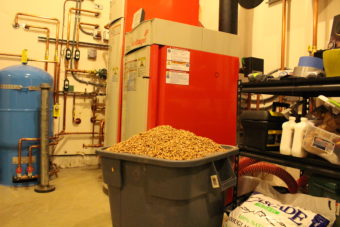
Christal Higdon estimates her family goes through a little more than a $6 bag of pellets a day in her wood pellet boiler. (Photo by Elizabeth Jenkins/Alaska’s Energy Desk)

The Ketchikan airport has one. So does the Walter Sobeloff Building in downtown Juneau. Now, a fringe group of homeowners are installing wood pellet boilers to heat their homes. Not to be confused with wood burning stoves, these boilers have been marketed as a cheaper alternative to heating oil, at least, in the long run. But is the framework there to make the technology go mainstream?
Christal Higdon takes me downstairs to her garage where her family recently had a reason to celebrate: They completed the installation of a new wood pellet boiler. When the moment came to hit the switch, after a year of anticipation, Higdon says they didn’t pop open champagne, but they did make brownies.

“[We] invited the electrician and the plumber and everyone over,” Higdon said with a laugh. She made a crock pot of chili to share with everyone as they were firing up the boiler for the first time.

Higdon is one about four homeowners in Juneau who have made the transition from electric resistance heat or oil to a wood pellet boiler.

It works like this: the pellets ignite and that heat is transferred through pipes of water around the home. The boilers can run about $12,000 — just for the equipment itself. Not included in that price are the installation and upgrades needed to the home.

But Higdon says, for her family, it seemed worth the initial investment.

“It just felt right for us to move away from the dependence on oil wherever we could,” she said. “And the time was right to replace our boiler, so we were looking at some kind of renewable energy we could use.”

Whether or not wood pellet boilers are a “renewable” form of energy is debated, especially when the pellets have to be shipped from someplace else. Still, Higdon says her reasons for wanting it were practical, as well as environmental. She learned about the system through word-of-mouth. And with any emerging technology, she says they’ve run into a few surprises with putting one in their house.

“Well, we had to find someone who could install it without maybe knowing how,” Higdon said.

And now there’s another hoop to jump through: Building a wood pellet shed. It’s not a necessity, but it would make it easier for Higdon’s family. They would only have to fill it up about once a year. The shed has special dimensions and a sloped floor which feeds the boiler.

“So the folks in town, several contractors had never built anything like that,” Higdon said.

Christal Higdon with wood pellet boiler (Photo by Elizabeth Jenkins/Alaska's Energy Desk)
Christal Higdon says she’s looking forward to being less dependent on oil. (Photo by Elizabeth Jenkins/Alaska’s Energy Desk)

“We were listening. She came at the right time,” said Justin Fantasia. He’s a faculty member at the University of Alaska Southeast and teaches construction technology.

“We were trying to figure out what kind of project we wanted to do,” Fantasia said.

He says — although it’s a unique arrangement — his class sometimes partners with people. Higdon is paying for the materials but Fastasia’s spring semester will be building the pellet shed. He says the main focus is to swing a hammer and to see a project through from start to finish. In a previous semester, university students built a tiny house.

“We don’t want to be trendy, but we want to pay attention to what people are excited about,” Fantasia said.

And for the time being, that seems like it could be wood pellet boilers. Fantasia says the university would consider teaching a class on the the installation — if there was interest.

“Construction technology changes super fast,” Fantasia said. “Seeing new products come on the market, new techniques, new concerns with changing cost of oil. Hopefully, going up for at least the state’s reason.”

Oil prices are going up but the overall price of heating fuel is cheaper than it’s been in the past. Higdon thinks her wood pellet boiler will eventually pencil out in the next four years.

In the meantime, as she waits for the shed, she’s keeping the golden pellets of Douglas Fir in a grey plastic bucket. Her family buys them in bulk at Home Depot — shipped from Oregon. There’s a business in Ketchikan that makes wood pellets but there’s not a bulk delivery system yet.

Higdon says, living in the Tongass, she would prefer to buy local.

“So if that’s available in the future, we’re hoping there’s enough demand that is created by people installing them, something like that could happen for Juneau,” Higdon said.

Sealaska, the regional Native corporation, outfitted its headquarters with a wood pellet boiler. About two years ago, it added another when it opened the Walter Sobeloff Building. In the past, the corporation has shown interest in developing the wood pellet market in Southeast by creating demand.

But as of now, the pellets they’re using come from Washington state and British Columbia.

USGS overhauling inaccurate, outdated Alaska maps

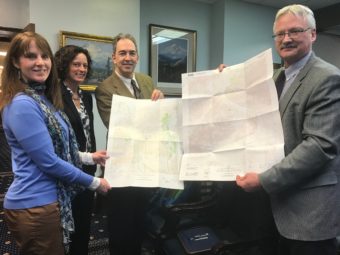
Sen. Natasha von Imhof, Kevin Gallagher, Ed Fogels hold new topographic maps of Alaska created through the Alaska Mapping Initiative.
Sen. Natasha von Imhof, Kevin Gallagher, Ed Fogels hold new topographic maps of Alaska created through the Alaska Mapping Initiative. (Photo by Caroline Halter/KTOO)

Unlike other states, Alaska is using topographic maps that were created over 50 years ago. These maps, some of which were hand-drawn, are rife with inaccuracies. Rivers flow upstream, mountains are out of place and some features are missing altogether.

These mistakes affect everything from aviation to back country hiking. This year, Alaska hopes to take a big leap forward by completing new maps for over half of the state.
The US Geological Survey (USGS) began updating topographic maps in the United States in the 1940s, but not in Alaska. When mapmakers match modern satellite imagery with Alaska’s old, imperfect elevation data strange things happen.

It’s kind of like trying to put a banana peel over cauliflower and make it fit seamlessly. It just doesn’t work,” said Nick Mastrodicasa, a project manager at the Department of Transportation, at a legislative hearing on Feb. 8.

In 2012, Alaska partnered with USGS to produce something called a Digital Elevation Model — a banana that fits today’s peels — and create over 11,000 topographic maps covering the entire state. The little-known project has been slow moving, but Ed Fogels, deputy commissioner at the Department of Natural Resources, explained why it’s so important.

“Alaska is the most poorly mapped state in the nation … some claim that we’ve spent more time and energy and money mapping some planets than we have the state of Alaska,” he said

Mapping Alaska is expensive, due to the sheer size of the state and temperamental weather. In the rest of the country, topographic maps were updated using a technology called LIDAR. In Alaska, new maps are being produced using a slightly cheaper alternative.

“The digital elevation model is actually created by flying a sensor around in an airplane, and it’s a technology called IFSAR. And so that’s just a lot of data that comes in that tells you what the shape of the earth is,” explained Fogels.

Fogels said that USGS then takes that data in combination with new satellite photos and uses it to create the topographic maps you see sold at national parks and outdoor stores. The digital elevation model is 77 percent complete.

USGS has plans to map new areas in Alaska in 2017.

So far, USGS has created 3,731 up-to-date topographic maps. Kevin Gallagher, the associate director at USGS, has set the bar high for 2017.

“This year we are ramping up our production,” said Gallagher. “We are going to try to produce 3,038 in 2017 alone and reach a status of 60 percent of the state covered with these new topographic maps.”

One particularly difficult part of the state to map is the Aleutian Islands. This 1,200-mile stretch of volcanic islands is too expensive to map, even with IFSAR.

“We’re looking at the IFSAR costing probably twice as much in that area,” said Gallagher, “So we’re actually considering some alternative technologies…”

Completing the digital elevation model for the remaining 23 percent of Alaska will cost about $14 million dollars according to Gallagher. There’s no date for completing the entire project, but the state is hoping for continued federal support.


Shee Atiká’s revenue fell 98 percent in 5 years; shareholders call for CEO’s resignation

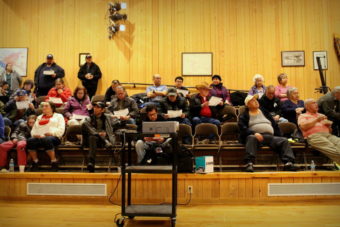
A crowd of Shee Atiká shareholders look over the corporation’s financial statements.
A crowd of Shee Atiká shareholders look over the corporation’s financial statements on Saturday, Jan. 28, 2017 (Emily Russell/KCAW)

Revenue for Shee Atiká, Sitka’s Native corporation, has dropped by nearly 100 percent since 2010. Shareholders packed the tribal community house on Saturday, Jan. 28 to discuss the fate of their corporation, and it’s more than just revenue they’re worried about losing.

It’s a Saturday night in downtown Sitka. Sheet’ka Kwaan Naa Kahidi is packed with people and the stage crowded with dancers in bright red and black regalia.

But this isn’t just a dance performance. It’s a meeting organized by Shee Atiká shareholders.

“We’re losing money. We’re losing our shareholder benefits. We could lose the land our corporation has,” explained shareholder Dionne Brady-Howard.

Brady-Howard isn’t alone. More than 150 Shee Atiká shareholders are here tonight to air their grievances.

Members of Shee Atiká’s board and management were invited to the meeting, but none of them showed. That includes CEO/President and Chairman of the Board Ken Cameron, who has previously declined to comment on the issue.

So, what are shareholders concerns? Let’s start with the money. Shee Atiká’s financial statements show that from 2010 to 2015, total revenue dropped from $182 million down to just $3 million.

Sandi Riggs was Shee Atiká’s Chief Financial Officer for five years. She saw the corporation’s profits begin to skyrocket in 2005. That’s when Shee Atiká started landing contracts with the U.S. military.

“There was eight years of huge cash flow coming in and nothing was really done on the management end to figure out– we’ve got all this cash, what are we going to do?” Riggs explained.

Riggs left the corporation in 2008, and in 2010 revenue began to plummet.

Shee Atiká is now scrambling to slim down its spending, which brings us to of shareholder benefits.

The corporation offers scholarship money and funeral benefits to its more than 3,000 shareholders, like Ethel Makinen. She just lost a son in early January.

Shee Atiká shareholder Herman Davis addresses the crowd.
Shee Atiká shareholder Herman Davis addresses the crowd. (Emily Russell/KCAW)

“It’s hard to lose your loved ones, and if you can’t afford to pay for it this helps,” Makinen explained.

In mid-January, though, Shee Atiká cut funeral benefits in half, from $1,750 to $875.

But Native corporations weren’t originally set up to pay for funerals or issue dividend checks. They were established to manage Native lands. The Alaska Native Claims Settlement doled out more than 44 million acres of land to newly established corporations.

Shee Atiká got 26,000 of those acres, but now most of the land– 22,000 acres– is being sold to the U.S. Forest Service.

Harvey Kitka voiced his concerns about that during the meeting. He’s the son of one of Shee Atiká’s founding directors Herman Kitka, who he says fought tirelessly for the land.

“The land over on Cube Cove area, right now they’re giving it away for almost nothing,” Kitka said.

The U.S. Forest service is paying $18.3 million for it. An appraisal in the 1980s did value the land at over ten times that much– $176 million– but that was before the land was logged extensively.

Whether it’s the land sale, the loss of shareholder benefits, or decline in revenue, there is one thing shareholders like Larry Garrity agree could be downsized.

“The only place we haven’t cut is our management’s salaries. Everything else is being cut,” Garrity said.

President/CEO and Chairman of the Board Ken Cameron’s salary has gone up in the last five years. According to Shee Atiká, Cameron took home $411,421.50 in 2015.
But removing Cameron or anyone else from the board requires shareholders to vote directly and not just by discretion. When shareholders vote by discretion, which is common, they’re essentially let the board vote for them. By doing so, shareholders are entered to win prizes like 50,000 Alaska Airlines miles, $1,000 dollars cash, and so on.

“After a point it’s going to be up to shareholders to decide that we can’t be bought with door prizes,” Dionne Brady-Howard told the crowd, “and that we to see a change not to just get higher dividends, but to make sure that we still have a corporation that still has land 20, 40 or 200 years from now.”

To make sure, of that, shareholders are calling for the board to remove Ken Cameron, and if that doesn’t work, it will be up to shareholders to vote him out directly.

Seeing the value of the forest in the trees: Chugach enters California’s carbon market

An aerial view of the eastern edge of Alaska’s Copper River Delta. The area is the focus of an innovative deal that safeguards old-growth forests and major coal reserves. (Photo courtesy David Little/Eyak Preservation Council)

“Anyone who’s been to Prince William Sound can tell you it’s an area of tremendous beauty,” said Josie Hickel, Senior Vice President of Chugach Alaska Corporation. “Glaciers, forested acres, wilderness areas. The area is full of wildlife and birdlife, and the fishing is obviously fantastic.”

Among Chugach Alaska’s 900,000 acres are hundreds of thousands of acres of forest — some of it old growth and a lot of it hard to get to. Instead of selling their trees directly, they’re selling the carbon stored in those trees. There’s a market for this in California, and it recently opened up to Alaskan landowners.

“The major emitters  of greenhouse gas have to have a permit or an offset for every ton of pollution they emit in the state of California,” said Brian Shillinglaw with New Forests, the group in California that will help Chugach manage its carbon assets.

Maybe you’ve heard California’s system called “cap and trade.” There’s a cap — or a limit — on how much pollution companies can emit and then there’s a trade for anything above and beyond the cap.

Think of any excess pollution as a carbon sin. Companies in California can pay to have their sins absolved. That absolution comes in the form of sustainably managed forests in other parts of the country.

“Five million acres of forest land are enrolled in this system nationwide,” Shillinglaw said. “This is the first time there’s been a real market for growing older growth forests. The system will pay you to not cut down your forest and to grow inventory.”

Basically, companies in California can emit more carbon because places like Alaskan forests are storing carbon in exchange.

A forest carbon offset project on Chugach Alaska Corporation land relies on a forest inventory based on field measurements conducted by New Forests. (Photo courtesy New Forests)

The California cap and trade market is the largest carbon market in North America, but currently there isn’t enough supply of carbon offsets to meet the demand of California’s polluters. Alaska’s entrance to the market could help change that.

Josie Hickel says other Alaska Native Corporations are considering similar deals, but Chugach’s is the first one that’s been finalized.

Chugach is waiting for spring for a complete forest inventory to take place, but Hickel says they estimate that they have several million carbon credits in their forest land. The carbon market fluctuates like any other market, but right now offsets are selling for around $13 per ton of CO2 emissions. That means that Chugach owns tens of millions of dollars worth of carbon credits that can be sold anytime a California polluter goes over their cap.

In the same deal, on the same piece of land, Chugach sold their right to develop the Bering River coal field to The Nature Conservancy. The Nature Conservancy doesn’t own a lot of coal rights and they’re not planning on doing any coal mining any time soon, according to Rand Hagenstein, Director of the Alaska Program for The Nature Conservancy.

“Our intent is to keep the coal underground in perpetuity,” he said.

And keeping that coal in the ground has positive impacts downstream — all the way to the  Copper River Delta.

“This area is globally renowned for its wildlife habitat. We all know about Copper River red salmon. Many people are also aware that this is one of the world’s premier migratory shorebird and waterfowl sites,” Hagenstein said. “So, there’s a tremendous amount of biological value there.”

For Josie Hickel, with the Chugach Alaska Corporation, the deal means more than just a new revenue source.

“We need to be able to have financial benefits for our shareholders as well as making sure we have the  funding for many generations to come in terms of upholding our heritage and our culture and our language,” she said. “This is a great way to be able to do that.”

This is uncharted territory for Alaskan landowners, but the economic benefits to the Corporation as well as to subsistence and commercial fisheries make California’s carbon market an attractive new frontier.

Site notifications
Update notification options
Subscribe to notifications