Timber

Trial opens for couple accused of starting 2015 Willow wildfire

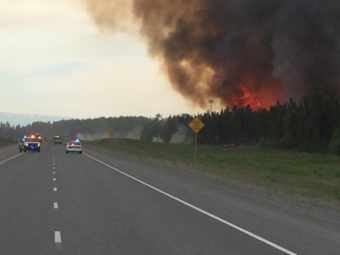
The Sockeye Fire devastated Willow in 2015. (Photo courtesy Mat-Su Borough)

A jury heard opening statements Thursday in Palmer in the trail over what became known as the Sockeye Fire began.

Prosecutors and state fire investigators say Anchorage couple Greg Imig and Amy DeWitt are to blame for starting the 2015 wildfire that devastated a big swath of Willow. Defense attorneys for the husband and wife told jurors that their own experts can prove otherwise.

Imig and DeWitt face charges of reckless endangerment, criminally negligent burning and burning without a permit.

The fire started June 14, 2015, and in the matter of a few days had charred thousands of acres and dozens of homes in Willow, home to many of Alaska’s dog mushers.

The fire forced mandatory evacuations and killed pets and sled dogs as it exploded through the area during those dry, windy days.

Investigators say they tracked the massive blaze back to smoldering embers from an illegal brush fire that Imig and DeWitt set in an earthen pit after clearing land on their Willow property.

Standing outside the courtroom just before the trial started, musher DeeDee Jonrowe, a veteran of the Iditarod Trail Sled Dog Race, fought back tears and said it had been a long two-year wait to see Imig and DeWitt in court.

“I’m anxious to just look ‘em in the eye and see how they feel about destroying so many people’s lives,” Jonrowe said. “We lost everything we’ve ever owned in the last, all of our lives. We lost our house, our two-story house, was turned into 3 inches of ash and an 8-foot hole in the ground.”

Inside the courtroom, several other victims sat in the front row with Jonrowe as the trial began.

Prosecutor Eric Senta described to the jury how evidence and testimony will show the fire crept away from the illegal burn pit through what are called microfuels: tiny, dry, dead leaves and sticks on the ground.

“Slowly at first, but getting stronger and stronger as it spread further into the dense forest,” Senta said. “After several feet of traveling the small dead leaves and twigs, the fire grew hot enough to catch the branches of one of those bone dry white spruce trees, and that tree went up like last year’s dead Christmas tree.”

Senta said that is when — after calling 911 — the couple and their son fled in an RV and drove home to Anchorage. All the while, Senta said, firefighters and good Samaritans rushed to evacuate people in the growing fire’s path, including some who had to run for their lives.

When it was the defense’s turn to lay out their case, attorney Kevin Fitzgerald told the jury that the prosecutor’s theory defied common sense.

Fitzgerald said the husband and wife admit they did not have a burn permit that day — permits had in fact been suspended — but they saw the fire well after it had started coming toward them from someone else’s land. And the family allegedly fled because 911 dispatchers told them to evacuate.

The defense’s expert witness will show the fire investigators’ work should have been deemed inconclusive, and that they were wrong about the pit, Fitzgerald said.

“He will tell you affirmatively that this pit was not the cause of the Sockeye Fire,” Fitzgerald said.

Biomass success stories shared from Galena, Ketchikan and Tanana

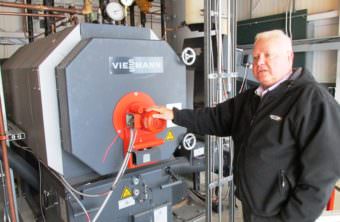
Airport Manager Mike Carney stands next to the Ketchikan International Airport’s new biomass wood-pellet boiler last summer. (File photo by Leila Kheiry/KRBD)

It’s great to talk about biomass as a renewable energy source, but how does it work in real-world situations?

During last week’s Alaska Wood Energy Conference in Ketchikan, participants heard three “case studies” from communities in Alaska that have invested in biomass.

Galena is a small village about 300 miles west of Fairbanks. It gets cold there in the winter – like 40 below zero cold – so heat is pretty important.Their big industry is education.

Galena is home to a regional boarding school on the site of a former U.S. Air Force base. Tim Kalke is a teacher at that school, and worked on plans to improve the heating system for the 14-building Galena Interior Learning Academy.

“Heat to these buildings was distributed through steam,” he said. “They had several steam boilers that took the load. Very inefficient, and very old. Annual consumption of fuel for that system was about 230,000 gallons.”

Kalke said getting a new wood-chip boiler was essential for the community to continue operating the school economically, and there were many steps from start to finish.

For example, they needed a forest inventory to make sure they had enough wood fuel.

They had to redo their entire water pipe system because, it turned out, one of the reasons the old steam boilers were so inefficient is the heat from that system kept the water pipes from freezing.

Then they had to convert the old steam boilers to hot water boilers – they supplement the wood chip boiler as needed.

And, they had to figure out a system for harvesting, drying, chipping and storing wood.

The new system has been in place for a season, and there were some kinks to work out when they first cranked it up. But, Kalke said, so far it’s displaced 52,000 gallons of fuel oil.

“Interesting enough, I probably got a higher bid to replace my oil-fired boilers with another oil system than I ended up with with biomass,” he said.

Ketchikan International Airport was another case study presented for the conference.

Airport Manager Mike Carney first looked into replacing the airport’s oil-fired boilers with another oil system.

Carney somewhat jokingly thanked everyone who made mistakes installing their own biomass systems. He learned from those mistakes.

One big lesson was to hire biomass engineers with a proven track record of successfully installed systems.

“When I say successful systems, I don’t go to the bean counters or to the contracting officer to find out if their system is successful,” he said. “I go to the guy who pushes the buttons.”

Ketchikan airport’s biomass boiler was installed and operational in summer of 2016.

It was almost entirely grant funded, and saves the airport an estimated 40 percent on fuel costs. It also uses locally produced wood pellets.

Tanana City Manager Jeff Weltzin talked about the project his community installed to heat the city’s public buildings. He said one of the city’s goals is reducing the need for imported fuel as much as possible.

To that end, they connected their old oil-fired boilers to the new biomass system, cutting their oil use significantly, even
during this last, extremely cold winter.

“We estimate this last winter, we displaced 40,000-50,000 gallons of fuel, so even at $3 a gallon, that’s $120,000 to $150,000 of savings,” he said.

Weltzin said the wood supply surrounding Tanana is good for many decades, and they expect they also can use standing-dead trees left after a massive wildfire came through the area a couple years ago.

“We found that standing dead in the Interior has a longevity of 30 years,” he said. “We have tens of thousands of acres of standing dead around the community. Our goal is to do a harvest plan and ultimately try to replant, regenerate, with some high-value trees.”

Along with hiring local residents to harvest trees for the biomass boilers, Weltzin said reforestation is another potential economic-development investment for the community.

They’re also working toward a biomass-heated greenhouse for local students to operate – yet another sustainable investment connected to wood energy.

Advocates push to move biomass up the menu of renewable energy options

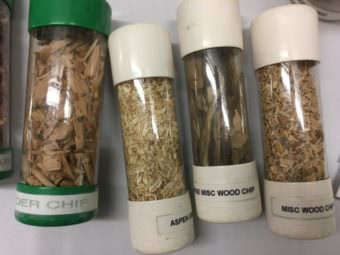
Different wood chips are displayed at the 2017 Alaska Wood Energy Conference at Ketchikan’s Ted Ferry Civic Center. (Photo by Leila Kheiry/KRBD)

Ketchikan hosted the annual Alaska Wood Energy Conference last week, where participants heard about how biomass works in different places, and how to make the technology more known, and eventually less expensive to install and operate.

Biomass is ancient.

Humans have been burning wood to produce heat and light for thousands of years; but new technology has turned that ancient energy source into low-emission fuel that fits nicely on the menu of renewable energy options.

Unlike wind and solar, for example, biomass doesn’t get a lot of policy perks, which has slowed its growth.

That was a recurring theme of the 2017 wood energy conference – building policy.

In his presentation, Chris Rose of the Renewable Energy Alaska Project spent some time making the case for biomass: energy demand is on the rise, fossil fuels will run out, and renewable energy is a fast-growing industry that the United States – and Alaska — shouldn’t miss out on.

One big reason is the potential cost savings.

“Alaskans are estimated to be using about $5 billion worth of energy every year,” he said. “So, if you collectively put together all the money that you and I put into transportation, heat and electricity: 730,000 people, we’re spending $5 billion. Let’s just say we can save 20 percent of that $5 billion. That’s a billion dollars we’re literally burning up every year.”

In Alaska, though, Rose said state funding for biomass has dried up.

Traditional banks don’t like to invest in biomass, because they consider the technology too new, and therefore risky.

Rose suggests that the state establish a “Green Bank,” an independent state agency, kind of like the Alaska Industrial Development and Export Authority, that attracts private investors for biomass projects by providing some guarantees for the loans.

“It’s all about not spending state money,” he said. “It’s all about leveraging state money and getting as much private money out of the markets as possible.”

The model already exists, and Rose pointed to the Connecticut Green Bank as a success story.

Canada already has taken a lead on encouraging biomass through policy. Several presenters from Canada talked about how that works for Alaska’s closest neighbor.

Fernando Preto, a biomass researcher based out of British Columbia, said the Canadian federal government has specific policies in its proposed budget to support renewable and sustainable energy projects, including biomass, for the northern territories.

The total for those projects is about $300 million Canadian.

That huge swath of land is sparsely populated, even by Alaska standards, with small, isolated communities. And a large portion of the territories is treeless, too.

So, like Alaska, there’s no one solution that will fit all the needs. They have to get creative, Preto said, and policies have to be flexible. It’s worth the investment, though, because of the potential long-term economic benefits.

“If you have wood resources, you have local employment, you have local development, but much more important than that is the capacity,” he said. “In some communities, especially in northern Ontario, they are at the capacity (or) near the capacity of their diesel generators. When they reach 75 percent of capacity, they go into a load restriction status. Any local industry is told you have to cut back on your power consumption.”

That’s not an attractive situation for industries exploring new locations.

Blair Hogan of the Teslin Tlingit Council in the Yukon also spoke. While they have hydro for their electric needs, they were on diesel for heat. He said their new biomass heat system uses chipped waste wood harvested locally.

How did policy help them? Hogan said government grants were a major contributor. And with the new system, the community now has a source of local jobs and a way to reduce the area’s wildfire risk.

Ryan Hennessy, senior energy planner with the provincial government of Yukon, said the government has a “basket of policies” to increase the viability of biomass.

One example is a policy to use biomass in public facilities and government buildings, which provides a large, steady customer for wood chips or pellets, thus supporting the industry.

“What went along with the biomass energy strategy was public consultation,” he said. “This proved very important to us. We heard a lot of things both for and against biomass. People were broadly in favor of biomass energy.”

But, he said, people also had concerns about the potential for overharvesting, and environmental problems related to emissions.

So, Hennessey said, they worked to calm concerns about timber supply and emissions – the newest technology provides a pretty clean burn — and they helped fund training within communities such as Teslin, teaching locals the various aspects of supplying and running a chip boiler.

Washington and Oregon also have some established policies to encourage biomass.

Dylan Kruse of Portland-based Sustainable Northwest said one of the challenges for biomass is, right now, it’s more expensive than natural gas. But, he said, policies can narrow that price gap through tax credits, like those that drive solar and wind-energy projects.

That would require people in the biomass industry to toot their own horns.

“We don’t do it as well; we’re not as proud of it. But we should be. It’s renewable; it’s base-load power, that’s very valuable to utilities,” he said. “It’s got diverse outputs and distribution, whether it’s electricity or heat or even transportation fuels. We can save money and reduce our dependence on fossil fuels, and it has a lot of other great ancillary benefits, like supporting forest stewardship and controlled waste disposal.”

There are some federal programs in place that help, such as the U.S. Forest Service’s wood energy grants.

But, Kruse predicts there will be less help on the federal side in coming years, so the focus should be on increasing and improving policies within individual states.

Kruse said the best way to encourage state policy is to talk with lawmakers and their staff, and to work with individual communities that are interested in biomass, so they, too, can lobby for state incentive policies.

State Senate approves Alaska Mental Health land exchange

A springtime view of Deer Mountain.
A springtime view of Deer Mountain. (File photo by Leila Kheiry/KRBD)

The Alaska Senate unanimously approved a measure Thursday allowing a land exchange between the state and federal governments.

Senate Bill 88, sponsored by Sitka Republican Sen. Bert Stedman, allows a land trade between Alaska Mental Health Trust and the U.S. Forest Service, in which the trust would receive nearly 20,000 acres for timber harvest in exchange for approximately 18,000 acres near several Southeast communities.

In a Thursday announcement, Stedman said that through the exchange, the trust would be able to raise revenue for its services, the region’s logging industry would have access to a timber supply, and communities would not have logging occur in sensitive areas.

The sites that would become Forest Service land include Ketchikan’s Deer Mountain and land above homes along Petersburg’s Mitkof Highway.

Completing the transfer requires approved bills from both the state Legislature and U.S. Congress. There are federal measures moving through the process, sponsored by U.S. Sen. Lisa Murkowski and U.S. Rep. Don Young.

A similar state House bill also was introduced by Ketchikan Rep. Dan Ortiz. That bill, HB 155, is still in committee.

Forest transfer bill won’t impact funding to Tongass, Young says

Alaska Rep. Don Young. (File photo by Liz Ruskin/Alaska Public Media)

U.S. Rep. Don Young, R-Alaska, defended his bill that could give up to two million acres of the Tongass National Forest to the state of Alaska.

Young was in Petersburg, a community that just passed a resolution opposing his legislation, on Monday.

Young told an audience in Petersburg that the municipality would not lose federal funding because of his bill and said he wouldn’t run for re-election if it did.

Young’s bill House Resolution 232 would allow states to select or purchase up to two million acres of National Forest land for logging or other uses.

Petersburg’s borough assembly came out against that bill earlier this month, citing concerns over state management of the forest land, potential loss of federal funding and U.S. Forest Service jobs.

Young explained to a couple dozen residents why he’s supporting the bill.

“The Tongass was not allowed to be selected lands when we became a state,” Young said. “We were allowed 103 million acres of land as a state, of our selection of lands that were not reserved at that time and the Tongass was reserved. So the only land you have are the communities themselves. There are no other lands. There’s no opportunity of any other type of resources development and you have to have resources development, in time you will need it. So if you don’t want it, if Petersburg doesn’t want it, that’s your business. But I am still going to push for two million acres of land in Southeast Alaska for the people in Southeast Alaska for the improvement of each of their communities.”

Petersburg receives Payment in Lieu of Taxes, or PILT payments, because the borough cannot collect property tax on the federal land.

Within the borough, 96 percent of the land is part of the national forest.

The borough in the past has also received payments for schools and road work, under the Secure Rural Schools Act. That program, passed by Congress in 2000, increased and stabilized the forest receipt payments that had once depended on federal revenue from timber sales and other economic activity on national forests.

It has meant hundreds of millions to rural communities near National Forests around the country. Both PILT payments and Secure Rural Schools need reauthorization by Congress to continue.

Young said his bill wouldn’t impact those payments.

“You’re not going to lose your PILT monies, you wont lose your Rural School monies if there’s any monies,” he said. “I think we’re gonna still maintain that. The whole thing was based on very frankly stumpage. We don’t cut any more trees, so if they wanna save the trees then they oughta pay for it. And so I think your school funding, somewhat protected, maybe not increased but protected. That’s what I’m predicting will happen. It’s part of the program.”

Both PILT and Secure Rural Schools payments are based on the amount of forest land in a borough. Audience members challenged Young on the point, questioning how Petersburg’s federal payments could remain the same if there’s less National Forest Land in Alaska.

“You won’t lose any money,” Young said. “If you lose any money, if you lose any money from that selection, I won’t run again. OK? That’s how confident I am you’re not losing any money.”

The topic of federal funding came up for other programs.

Audience members thanked him for his past support of funding for Essential Air Service, the Alaska Sea Grant Program and public broadcasting.

Those programs would be eliminated under a budget proposed by President Donald Trump.

Young thinks Congress will approve a budget with those programs funded.

“Now in the lower 48 it has been abused,” Young said of the Essential Air Service which pays airlines to provide stops in Alaska communities. “There’s people put in airports, some of the members of Congress put airports in their hometowns when there’s only another airport 20 miles away. But here we don’t have that alternative. We’re pretty sure the delegation is going to be able to protect the Essential Air Services for Alaska.”

Alaska Airlines receives a $1.6 million payment to serve Petersburg each year.

Young also was thanked for his lack of support for a repeal of the Affordable Care Act, which which withdrawn from the House when it lacked the votes.

Young expected to have another bill on health insurance before the House by July.

He also answered questions on climate change, enforcement of federal law on marijuana, cuts to the Environmental Protection Agency and a repeal of prohibited hunting practices on federal wildlife refuges in Alaska.

Young is visiting numerous communities around the state as well as attending a conference on the arctic in Seattle.

Forest Service mishandled timber sales, environmental group says

The Tongass National Forest includes most of Southeast Alaska. (Image courtesy U.S. Forest Service).

A Washington, D.C., environmental group is accusing the Tongass National Forest of breaking its own timber-sale rules.

Public Employees for Environmental Responsibility cites internal Forest Service documents in its critique of Tongass management. The national forest includes most of Southeast Alaska.

Executive Director Jeff Ruch said forest managers didn’t sufficiently review or monitor sales. They also allowed logging companies to cut corners, he said.

“And as a result, there were significant monetary losses,” Ruch said. “They didn’t accomplish their environmental goals. And the oversight was so poor that the Tongass National Forest didn’t even have copies of the contract, let alone the backup data,” Ruch said.

Read a Forest Service report identifying problems with some Tongass timber sales.

Alaska Forest Service officials responded with a news release, but wouldn’t grant an interview or answer specific questions.

In the release, officials said they’re already addressing issues raised in the internal review cited by its critics, which includes updating the appraisal process and making improvements to its timber sale administration.

“The Forest Service takes very seriously its obligation to ensure the accountability, integrity and effectiveness of the timber sale program,” the release said. “Internal reviews such as the Forest Management Activity Review referenced by (Public Employees for Environmental Responsibility) are routinely conducted to ensure the Forest Service achieves the management and strategic goals for the activities under review.”

Among its complaints, the public employees group said Tongass managers improperly allowed loggers to “cherry-pick” more valuable timber within sale areas, including spruce and cedar.

Alaska Forest Association Executive Director Owen Graham said that’s the only way to make timber sales economic.

“What they seem to be saying is the Forest Service should have forced them to log more hemlock trees, more lower-value trees. That would have got them more stumpage,” Graham said. “That doesn’t make any sense. If you harvest lower-value trees, you get less stumpage because the trees are worth less.”

The Ketchikan-based trade association has lobbied the Forest Service to provide enough timber to keep what’s left of the region’s industry alive.

Public Employees for Environmental Responsibility is calling for an in-depth, forensic audit.

Site notifications
Update notification options
Subscribe to notifications