Timber

Mental Health Trust backs off Southeast timber sales

Petersburg resident Jeff Meucci points to a lands map while Ed Wood looks on during a meeting on Alaska Mental Health Trust Land Office timber sales. (Photo by Angela Denning/KFSK)

The Alaska Mental Health Trust Land Office will not pursue timber sales at controversial sites in Petersburg and Ketchikan – at least for now.

The Trust had planned for sales at what’s known as Petersburg P-1, as well as Ketchikan’s Deer Mountain. Both met with community opposition.

Deputy Director Wyn Menefee said the Trust Land Office will focus instead on trading those and other parcels for Tongass National Forest timberlands.

Bills introduced in the U.S. House and Senate call for that exchange — and to speed up the process.

“While we’re pursuing this exchange we’re not pursuing any sort of timber harvest activity on Petersburg P-1 or Deer Mountain,” he said. “We are fully trying to get this exchange through.”

The organization’s board meets Jan. 25-26 at the Elizabeth Peratrovich Hall in Juneau.

The board packet includes a memo from land office Executive Director John Morrison. He said he’s confident the needed legislation will pass Congress this year. Bills authorizing the exchange failed to pass last year.

Menefee said a bill with nearly identical language must also be approved by Alaska’s Legislature.

“The ideal situation is we come out of the Congress efforts and have a federal bill enacted sometime by this summer and then likewise if we can get it through the state Legislature this … spring and get an approval, then those two marry up,” he said. “We can start putting the exchange in place.”

That’s a very tall order.

Federal land legislation usually passes only as part of a larger measure with a dozen or more other bills added in. That makes them more controversial.

But Menefee is optimistic. And he said timber sales won’t automatically be pursued if the legislation fails.

“If anywhere in the future … the whole exchange falls apart, we would come back to the board and we would speak to the board in a board meeting before pursing any timber harvest contracts,” he said.

The Trust Land Office announced last summer that it planned to move forward with timber sales on the two sites if exchange legislation wasn’t approved by this month.

After public outcry and questions about the office’s decision-making process, that plan was delayed.

The Petersburg property is on a steep hillside above Mitkof Highway south of downtown.

Residents say logging would make landslides, which have occurred in the area, more likely to happen.

Landslides are also a concern at the Ketchikan property, which is behind a residential area. It’s above the water supply for the adjoining town of Saxman.

Opponents also say planned clear-cuts would be unsightly and hurt the tourism industry.

The two properties, plus other land trust property in Sitka and Juneau, would be traded for remote parcels of federally owned land on Prince of Wales Island and near Ketchikan.

KRBD’s Leila Kheiry contributed to this report. 

After months of controversy, Deer Mountain might not be logged after all

A springtime view of Deer Mountain. (File photo by Leila Kheiry/KRBD )
A springtime view of Deer Mountain. (Photo by Leila Kheiry/KRBD )

Last summer, the Alaska Mental Health Trust announced its intent to log Deer Mountain — a popular scenic spot in Ketchikan. The trust uses its lands to make money for state programs, like mental health services, housing and addiction treatment. Now with a federal land swap in the works, the trust says they’ll pass on Deer Mountain.

From Alaska’s Energy Desk, Elizabeth Jenkins spoke with Leila Kheiry from KRBD in Ketchikan, who’s been reporting the story:

Looking outside your radio station, can you see Deer Mountain?

Not really today because it’s covered in clouds. Normally, though, yes. We would have a great view of Deer Mountain from here at the station. And really, there aren’t that many places in the core part of Ketchikan were you can’t see it. It’s definitely the backdrop for the community. There’s a popular hiking trail that people use in the summer and winter. And it’s probably featured in vacation photos for hundreds of thousands of cruise ship visitors who come here in the summertime.

So, for someone who’s new to this story can you explain why Deer Mountain is valuable and who owns it?

Valuable in terms of money? Because of the timber on it, the trees. It has stands of old growth that could be cut down, milled and sold. Timber is a big deal in this area. And that’s why they want to be able to log it. And be they, I mean Alaska Mental Health Trust and they’re the one’s who own at least part of Deer Mountain.

Last summer, the Alaska Mental Health Trust said they would move forward with plans to cut down trees on Deer Mountain. But there was an “if.” That is, if they didn’t get approval from Congress to do a land exchange. What is a land exchange?

Well, in this case, the land exchange would be a federal land trade. So, the federal government owns some land on Prince of Wales Island and in the Shelter Cove area, which is on this island, and they would trade that federally owned land and take control of the controversial parcels on Deer Mountain and in Petersburg. And those parcels would then be under U.S. Forest Service control.

The trust gave a January deadline for a decision to be made. Were people in Ketchikan and Petersburg surprised? 

It was a complete surprise. The fact that they were going to make this decision was not well advertised ahead of time. Mental health officials have even admitted as much. And so, local residents in both communities were very unhappy. Groups formed in Ketchikan and Petersburg to oppose the decision. Local government officials spoke strongly against it — state representatives, there was as online petition.

And keep in mind, people in Ketchikan especially tend to be very pro-logging. Except for a couple of folks, even the most vocal timber supporters said, “not Deer Mountain.” And the concern wasn’t just about how it would look. There was concern in both communities about landslides because the parcels in question are right above residential neighborhoods.

Did the trust give any indication about why they wanted to log Deer Mountain or do the land swap now?

Yeah, Trust officials said the timber industry in Southeast Alaska is dying. And if they didn’t log the land they have now, if they waited even a year, there wouldn’t be anyone left in Southeast who could cut down the trees. And timber is the only way they see to make money off of the land.

Getting back to the Alaska Mental Health Trust’s January deadline, is Congress going to be able to approve the land exchange for Deer Mountain in time?

Well, partly because of the community backlash, the Mental Health Trust board in November reconsidered that January deadline. So, at this point, we do not have that hanging over our heads. If the deadline had been in place, we would have missed it, though, because Congress was not able to approve the land trade in time.

With a new Congress, the bill has to start fresh and so about a week ago, Senators Lisa Murkowski and Dan Sullivan and Rep. Don Young introduced companion bills to accelerate the exchange.

These bills have been filed to accelerate a land exchange for Deer Mountain. Do people in Ketchikan seem optimistic that it will actually happen?

Yes, especially with the new Trump administration and a Republican Congress. Those bills do still have to go through committees before they get to the floor for adoption. But Paul Slenkamp, he’s the senior resource manager for Mental Health Trust land office, he told the Ketchikan Gateway Borough Assembly, just a few days ago, that he’s extremely optimistic that the exchange will pass very quickly.

And they’re so confident that in the mental health board packet for its regular meeting coming up is an update: the trust land office will not be pursuing timber sales on its lands in Ketchikan and Petersburg.

The Alaska Mental Health Trust will meet this week in Anchorage to discuss the issue on Thursday, Jan. 25.

Disclaimer: KTOO’s building sits on land leased from the Alaska Mental Health Trust Authority. KTOO has also applied for and received occasional grants for special reporting projects from the authority.

Deer Mountain logging off the table for now

A springtime view of Deer Mountain.
A springtime view of Deer Mountain. (File photo by Leila Kheiry/KRBD)

The Alaska Mental Health Trust Authority’s Trust Land Office is no longer pursuing action toward timber sales on Deer Mountain or land in Petersburg.

The trust board meets next week – Jan. 25 and 26 – and in the meeting packet is a memo from Trust Land Office Executive Director John Morrison.

Morrison writes that while a federal land exchange deal wasn’t approved by Congress during its last session, he is confident that the reintroduced bill will pass this year.

Therefore, Morrison writes, Trust Land Office  staff member are now focused on helping that bill make it through, and on introducing a complimentary bill in the state Legislature.

Last summer, the Trust Land Office announced that it planned to move forward with logging Deer Mountain and the Petersburg site if the land exchange wasn’t approved by earlier this month. After public outcry and questions about the Trust Land Office’s decision-making process, a final decision on that plan was delayed.

The federal legislation would put Mental Health Trust land on Deer Mountain and above homes in Petersburg under U.S. Forest Service control. In exchange, the Trust would receive federal land on Prince of Wales Island and in Ketchikan’s Shelter Cove area for logging.

The Trust Land Office’s decision to focus on the exchange and stop pursuing timber harvest on the controversial sites doesn’t mean it can’t happen. If the land trade is rejected or delayed by Congress, the state agency could still bring back the option of logging Deer Mountain.

Editor’s note: KTOO’s building sits on land leased from the Alaska Mental Health Trust Authority. KTOO has also applied for and received occasional grants for special reporting projects from the authority.

Culturally valuable yellow cedar on the decline

Wayne Price works on a 12 foot tall totem pole in his Haines studio. (Photo by Emily Files/KHNS)
Wayne Price works on a 12-foot-tall totem pole in his Haines studio. (Photo by Emily Files/KHNS)

Yellow cedar trees grow from the top of California, all the way to Alaska, and according to a recent study, the Southeast part of the state could be the hardest hit with yellow cedar’s decline, due to the planet heating up. The U.S. Fish and Wildlife Service has been petitioned to put yellow cedar on the endangered species list. The wood is commercially valuable. It’s culturally valuable, too.

Wayne Price is working on a 12-foot-tall totem pole in his studio in Haines. He uses a tool called an adz to shape an eagle and wolf design. He’s about six months into the project, which includes carving not one but two totems.

“All of it’s made out of yellow cedar,” Price said.

When it’s finished, it will make up a new sign for the local veterans housing complex.

Price has been carving for about 45 years. He says what makes yellow cedar a good material is that it’s resistant to rot. Traditionally, Alaska Native people used the bark from yellow cedar to weave blankets and clan hats. They used the trees to carve paddles and canoes.

Price says there’s a Tlingit creation story that highlights its importance:

“The killer whale was made out of red cedar and it floated too high. And it was made out of spruce it didn’t last very long,” Price said. “But when it was carved out of yellow cedar that it floated right and was given life and was the creation of the killer whales.”

Price buys most of his yellow cedar from a small mill in Hoonah. But in the past decade, while out on the water, he’s noticed more dead standing trees.

And he’s not alone.

A map of yellow cedar decline. (courtesy of Brian Buma/UAS)
A map of yellow cedar decline. (courtesy of Brian Buma/University of Alaska Southeast)

“Essentially, yellow cedar is freezing to death,” said Brian Buma, an assistant professor of forest ecosystems at the University of Alaska Southeast.

Buma recently released a paper on how much yellow cedar could decline across its entire range. His team pinpointed actual yellow cedar trees from California to Prince William Sound. With current climate projections, Buma was able to capture a glimpse of what that future could look like for yellow cedar.

“It’s suggesting major changes. We don’t think that it’s going to go extinct in 50 or 60 years but it is going to look like a very different forest in large parts of Southeast,” Buma said.

He says, so far, we’ve lost about 7 percent of the range of yellow cedar. That number might sound small, but it’s actually about a million acres of trees. In the next half century or so, we could lose another 8 percent.

Buma says yellow cedar is particularly vulnerable in the spring. In a normal year, a blanket of snow is there to insulate the roots.

“Climate change is taking away that blanket. So when the temperature goes to 33 on average, say, during the winter, we don’t get snow, we get rain,” Buma said. “And if we do get a cold snap, the soil gets very, very cold and that kills yellow cedar roots, essentially.”

He says scientists started to notice the decline of yellow cedar back in the 1980s. Now it’s one of the best documented cases of a tree species affected by a warming planet.

Ricky Tagaban prepares yellow cedar strips to later weave into warp. (Photo by Elizabeth Jenkins/Alaska's Energy Desk)
Ricky Tagaban prepares yellow cedar strips to weave into warp. (Photo by Elizabeth Jenkins/Alaska’s Energy Desk)

Ricky Tagaban has been weaving in the Chilkat tradition for about seven years. He’s soaking yellow cedar strips in warm water, preparing to spin them with merino wool into warp, a stiff thread he’ll use to weave commissioned items, or one of his commercial pieces: iPhone bags, pendants and long woven earrings.

“When I became a full-time weaver it was really crucial for me to learn how to make my own warp,” Tagaban said. “Because before I would have to save up a lot of money to buy enough just to start a project.”

Friends who weave baskets sometimes give him yellow cedar scraps. He’s also gone out a couple of times to collect it himself.

He says he is worried about the die-off of yellow cedar, but he doesn’t think that government officials should be in charge of its management.

“The point of colonization is outside groups coming in and controlling resources,” Tagaban said.

He says for thousands of years indigenous people collected yellow cedar sustainably.

“If you compare the way of life that came out of the 10,000 years of stewardship, with the changes that have happened just in the last 200 years. It’s insane the difference,” Tagaban said. “So the words like management, management is not stewardship.”

The U.S. Fish and Wildlife Service was petitioned to put yellow cedar on the endangered species list in 2014. But it still has a ways to go before a decision is made. A Fish and Wildlife spokesperson says there’s a backlog, due to federal funding issues.

Tagaban hopes to still be weaving in the next 50 years. And he hopes there’s enough yellow cedar for future generations to weave, too.

A Chilkat woven legging
A single Chilkat legging woven by Ricky Tagaban. (Photo by Annie Bartholomew/KTOO)

Southeast land exchange bill reintroduced in Congress

A springtime view of Deer Mountain.
A springtime view of Deer Mountain. (Photo by Leila Kheiry/KRBD)

With a new U.S. Congress convening, Alaska’s Congressional Delegation has reintroduced a bill that would trade federal land for land owned by Alaska Mental Health Trust – including Ketchikan’s Deer Mountain.
A joint statement Thursday from Sens. Lisa Murkowski and Dan Sullivan, and Rep. Don Young announced that companion bills to accelerate the exchange have been filed.

The House and Senate bills are pretty much identical, according to Matt Shuckerow of Rep. Young’s office. He said Sen. Murkowski, as the chair of the Senate Energy and Natural Resources Committee, is the main force behind the effort, which Rep. Young fully supports.

“This is something that’s been ongoing for a number of years and the Congressman has certainly been supportive of this effort,” Shuckerow said. “As has been detailed by others and the Congressman, this is an effort by all the stakeholders involved to come to some sort of resolution.”

The legislation would put Mental Health Trust land on Deer Mountain and above homes in Petersburg under U.S. Forest Service control. In exchange, the Trust would receive federal land on Prince of Wales Island and in Ketchikan’s Shelter Cove area for logging.

Last summer, the Alaska Mental Health Trust Land Office announced that it planned to move forward with logging Deer Mountain and the Petersburg site if the land exchange wasn’t approved by early this month. After public outcry and questions about the TLO’s decision-making process, a final decision on that plan was delayed.

Shuckerow said the legislation is the same bill that had been introduced in the previous Congress. He said the delegation hopes it will be approved fairly quickly.

“It is a model for governance where there is local support. It’s not a top-down approach; it’s really a bottom-up approach from the communities involved and the stakeholders involved,” he said. “That’s certainly a positive note in that regard, that it’s supported locally. That’s something we can relay to different members of Congress, that this is something that’s supported locally. Oftentimes that’s very helpful in moving legislation.”

Local governments in Ketchikan and Petersburg have approved resolutions in support of the land exchange, and there has been an effort to encourage individual residents to send letters of support.

In Thursday’s announcement, Murkowski states that the exchange will protect land that is valued by the communities while providing other land for timber harvest. She says logging the sites on POW and in Shelter Cove will assist the timber industry, and make money for mental health services in Alaska.

The U.S. Forest Service and the Trust already have agreed to the land exchange. The legislation would speed up the process.

The bill has just been introduced, which is the first step.

Forest plan has some changes for central Southeast Alaska

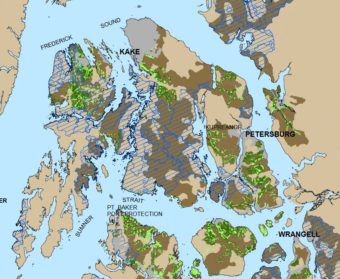
Timber production suitable lands are in green, dark green for old growth and light green for young growth, while conservation areas are shaded in blue. (Map courtesy of U.S. Forest Service)

Streams and watersheds in the Petersburg area are among those placed off-limits to old growth logging in an amendment to the Tongass Land and Resource Management Plan released in December.

However, some of those same streams may be sources for second-growth timber cutting. The plan amendment also makes some other changes for national forest land in the area.

The latest amendment to the forest plan does not make sweeping changes to the Tongass’ system of land use designations, which essentially spells out what parts of the forest can be used for what.

Instead the document focuses on an accelerated transition to logging young-growth trees, away from old and larger timber.

The plan adopts recommendations of the Tongass Advisory Committee, made up of representatives from Southeast’s timber industry, tribal organizations and conservation groups.

One of that group’s recommendations was an end to logging old growth trees around certain salmon streams and watersheds.

“To see this kind of protection given to wild salmon habitat is significant in my mind because we know that salmon is really important both culturally and economically in Southeast Alaska,” said Julianne Thompson, the Forest Service’s watershed program manager for the Tongass. “So to see that kind of protection given through the forest plan, it’s good for the Tongass forest and I think it’s good for Southeast Alaska.”

Those important salmon watersheds include a long list of streams named the Tongass 77 by Trout Unlimited. It also includes additional waterways called conservation priority areas by The Nature Conservancy and Audubon Alaska. And while they’re called watersheds, Thompson explained some are bays or stretches of coastline.

“Because we’re in this coastal, island-based landscape, a lot of these are not classically you know single river watersheds, they’re areas around bays like around Security Bay, around Rocky Pass, around Big John Bay,” Thompson said. “So they may not necessarily come to mind as people say oh yeah that’s a huge important salmon producing stream but when you look at the accumulation of streams that estuary and read what Trout Unlimited has put together on it, it does make sense.”

That list includes Big John Bay, Castle River, Totem Bay and Rocky Pass on Kupreanof along with Security Bay, Port Camden and Kadake Creek on Kuiu and Farragut Bay, Port Houghton and the Sandborn Canal on the mainland.

The plan amendment also adopts another recommendation of the Tongass Advisory Committee.

That will allow for greater flexibility for harvesting second growth timber in some of those same watersheds are now off limits to old growth cutting.

Susan Howle, the agency’s project manager for the forest plan amendment, explained there are 16 areas identified for young growth timber production.

“So if you look at the forest plan in the young growth section it identifies several T77 (Tongass 77) watersheds that they wanted us to monitor over five and 10 years just to make sure that if we harvest in these areas we wanna also consider what are the impacts to fish and wildlife habitat,” Howle said.

Three of those young growth watersheds are on the Petersburg Ranger District. Two are on north Kuiu, Security Bay and Kadake Creek and one is at Irish Lakes on western Kupreanof Island.

In addition, Howle explained the new forest plan opens up other possibilities for timber harvest.

“There’s some trade-offs there. The trade-off is it’s going to be protecting old growth forests but the trade-off is because we don’t have a lot of young growth that’s ready to be harvested, we have to look at other areas on the forest that our previous plan may not have allowed for in other words certain areas may have been not suited for timber production.”

That means that some areas designated as old growth habitat could be a source of second growth, along with beach fringe or creeks that have already been logged.

The plan amendment does not change most of the Land Use Designations or LUDs on the Tongass.

There are a few exceptions, including lands impacted by the Sealaska Land Entitlement finalized in 2014. That law established eight areas of the forest as LUD II management areas, off limits to commercial logging. Two of those areas are on the Petersburg Ranger District, at Kushneahin Creek on southwest Kuprenaof Island and the Bay of Pillars on western Kuiu Island.

The Sealaska bill also conveyed about 70,000 acres of national forest land to the Native corporation, most of it on or around Prince of Wales Island along with parcels near the north end of Kuiu.

Lands that are suitable for old growth and young growth logging and not in a conservation area are on northern Kuiu, on Kupreanof Island near Kake, Portage Bay and the Lindenberg Penninsula. Other timber suitable lands are in Thomas Bay, Mitkof and Zarembo islands along with northern Prince of Wales.

Howle said another new offering with this forest plan is a commitment by the Forest Service to publish an annual five-year plan of timber sales. “So this is something we are planning to have on our website, keep it up to date and it’ll be posted no later than December 31st of each year.”

Sales that are under consideration or could be offered in the next five years around Petersburg are two on Mitkof Island, two on Kuiu and one on Zarembo.

Site notifications
Update notification options
Subscribe to notifications