Timber

Frozen spruce make for extra dangerous woodcutting

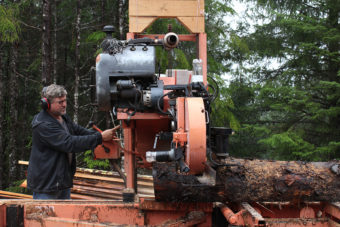
Bucking a 44–inch–diameter Sitka spruce on the Tongass National Forest in 1991.
Bucking a 44–inch–diameter Sitka spruce on the Tongass National Forest in 1991. (Courtesy U.S. Forest Service)

This first real cold snap in several years around Kodiak has got a local tree expert raising an alarm over tree cutting and log splitting. Dennis Symmons, a tree surgeon when he’s not tending to borough business as an assemblyman, says when the local Sitka Spruce tree freezes, it can become dangerous to handle.

“When it turns to plastic and peanut brittle from the cold, and it’s the one thing that even a professional forgets. And I was reminded yesterday, ‘Oh yeah, they’re not trees anymore.’ They’re giant sticks of celery. And when I attach my body to that, 60-feet off the ground, it takes on a whole different persona. Now, throw into the mix of these frozen sticks of celery, rotten cores, cancered bases, and they’re not trees anymore.”

He said the tree is more like “a sweaty stick of dynamite” at that stage, and the scenario could turn ugly quickly when topping or felling a tree.

“So here’s the novice and the professional putting that deep face, like he would into a green tree. Now that person’s coming through the back cut, and already making the first mistake, because all of that weight is getting smaller and smaller concentrated on one spot. The mistake’s realized, too late. Now that all that weight’s shifting on that little teeny stick, if a climber’s off the ground, that little stick is right in his face and he’s got nowhere to go.”

Symmons said that very thing happened to him some years ago when he was working on a tree.

“It looked like a really simple job … about a 90-foot spruce tree on its root wad. I just walked up it. I’m about 14-feet off the ground, with my sharpest, fastest-running chainsaw. And I zipped the top off really quick. And I step back, and without even computing what I just did, you know, leaving the frozen top, I slowly started cutting on that. And theoretically, the elasticity would just peel me to the ground. You now, kind of a show off mood,” he said.

“Well, I got three-quarters through that, seven-eighths through that, and realized – by that time it was too late – that it hadn’t moved. And then it exploded and it launched me upside down, into the air, feet-first. My experienced ground-man logger from Oregon thought I was showing off, doing some kind of stunt.”

Bucked Sitka spruce.
Bucked Sitka spruce. (Public Domain photo courtesy Wikimedia Commons)

He said the outside couple of inches have the most moisture and freeze the hardest. He says the dangers with cutting Sitka Spruce are present even when bucking up logs for firewood.

“(You) go to sink that saw and, ‘Wow, this is really weird, I know I just sharpened this thing, and it seems really dull.’ And about the time I punches through that inch-and-a-half frozen layer and grabs that soft wood, by then a person has already backed off and relaxed. Now the saw’s kicking back, coming at them, and the log’s trailing it,” Symmons said. “I’m trying to draw a real ugly scenario because that’s what it is – it’s an accident waiting to happen.”

And when the next windstorm hits and temperatures plummet to the single digits, what does Symmons recommend homeowners do if a tree in their yard starts to look threatening?

“I think the best thing to do is to get it secured. No matter what the conditions are, get the thing tied down. That’s a big deal. That’s why a tree gets topped, it stops its momentum,” he said. “Step one, if they’re in doubt, tie the thing down.”

Temperatures are expected to hover around the freezing point all week, but even when it thaws, Symmons cautions that the frozen ring around the Sitka Spruce could stay frozen for weeks afterward.

Too fast or too slow? 16-year phaseout of Tongass old-growth logging begins in 2017

A clearcut section of the Tongass National Forest in August 2010.
A clearcut section of the Tongass National Forest in August 2010. (Creative Commons photo by Alan Wu)

A 16 year plan to phase out old-growth logging in the Tongass National Forest was finalized Friday.

Tongass Forest Supervisor Earl Stewart signed the record of decision to amend the Tongass Land Management Plan after considering objections from environmental and industry groups. Some have applauded the decision and others are unsatisfied.

The U.S. Forest Service released the final decision for the Tongass amendment without many changes from its earlier draft. The plan offers an average of 46 million board feet of timber each year, far below the glory days of the industry. Mostly old growth will be offered during the first 10 years, almost three times the young growth.

During the last five, young-growth volume will double and old growth will be almost halved. At the end of the 16-year transition, only 5 million feet of old growth will be provided for small sales and specialty products.

Some of those objecting to the draft plan called for a full inventory of young, or second-growth, trees. Environmental groups argue a completed inventory will show a faster transition is possible. But industry groups argue the exact opposite. Tongass Supervisor Stewart addressed the concern in a press conference, saying 50,000 acres will be inventoried by 2018.

“The data collection and everything is being housed will continue to be assessed as we work through this project, and so it certainly could change. At this point it’s only partially finished because 2016 was the first year of actual on-the-ground inventory,” said Stewart.

Forest Service tree expert Sheila Spores said a large portion of young-growth stands slated for logging were first cut in the 1950s and 1960s. She noted that the agency is aware of how many stands are on the Tongass. She said today’s regulatory standards will be applied to inventory available stands.

Stewart explained that any young-growth acreage made unavailable may be swapped for additional lands elsewhere.

“There’s an adaptive management strategy that seeks to recognize the ongoing young-growth inventory and seeks to monitor the projected verses the actual harvest over time,” he said. “The result of the adaptive management strategy is reviewing the effectiveness of that adaptive management process in about five or 10 years.”

The decision explains that if amounts of timber harvested vary enough from estimations, those issues could be addressed in another amendment.

The decision was met with mixed results from environmental groups. Some applauded the decision, saying the plan protected several salmon-producing watersheds referred to as the “Tongass 77.”

“The thing the plan did do that was very good for conserving resources on the Tongass is identify the key areas that need to be taken off the table for timber harvest,” said Andrew Thoms, a Tongass Advisory Committee and Sitka Conservation Society member. “Everybody agreed that the top salmon-producing watersheds on the Tongass shouldn’t have any more old-growth harvest.”

The committee was made of 15 members from conservation, logging and Native interests.  Thoms noted that he would like to see old-growth logging end immediately, but said the amendment is the best compromise.

Other environmental groups argued in press releases that the decision’s language didn’t set the old-growth harvest volumes in stone during the transition. Others say they feel comfortable with the plan being finalized prior to President-elect Donald Trump taking office.

Shelly Wright of Southeast Conference, an economic development group, argues the decision was made without enough information.

“So what we’re asking for is a comprehensive inventory and a financial analysis before the transition accelerates,” she said. Wright disagrees with the accelerated plan and said there’s nothing wrong the 2008 forest plan’s transition. “They are transitioning at a pace that’s economically feasible for the industry in Southeast Alaska.”

The Tongass plan decision does say the Forest Service will monitor market demands and make changes through its adaptive management plan. Tongass Supervisor Stewart also mentioned that a study is being developed to examine ways to make young-growth products profitable.

The plan goes into effect on Jan. 8.

Forest Service announces final decision on Tongass old-growth logging phaseout

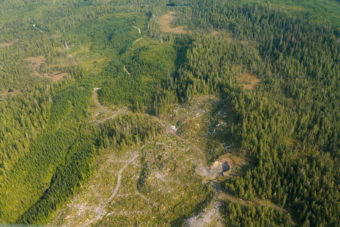
A Tongass National Forest clearcut is shown in this 2014 aerial view. A new court decision limits logging on roadless areas of the forest. (Photo by Ed Schoenfeld/CoastAlaska News)
A Tongass National Forest clear-cut is visible in this aerial photo taken in 2014. (Photo by Ed Schoenfeld/CoastAlaska News)

The U.S. Forest Service on Friday announced a final decision on amending the Tongass Land Management Plan to transition toward second-growth harvest within 16 years.

The decision comes about five months after the draft decision was announced this summer.

There were some corrections, definitions and clarifications, but the main points remain the same. During the 16-year transition, the U.S. Forest Service will offer an average of 46 million board feet of timber on the Tongass National Forest per year.

For the first decade, that will include almost three times more old-growth logging than second-growth. In years 11 to 15, the ratio will flip, allowing more young growth harvest and limiting old growth.

By year 16, timber stands offered for logging will be about 90 percent young growth, with 5 million board feet of old growth for specialty products.

The main objection from some environmental groups is that the transition isn’t happening fast enough – they want to move away from old-growth logging within the next five years. Logging industry representatives, though, say the switch is too fast. They think the full transition should be closer to 30 years.

Earl Stewart will become the top official at the Tongass national Forest in May. (Courtesy USFS)
Earl Stewart is the Tongass National Forest supervisor. (Photo courtesy U.S. Forest Service)

In a Friday teleconference announcing his decision, Tongass Forest Supervisor Earl Stewart said objections were noted and considered, and the Forest Service chose to stick with a plan endorsed by the Tongass Advisory Committee, a group made up of representatives from conservation, logging and Alaska Native organizations.

He acknowledged that there will be a change of administration when President-elect Donald Trump assumes office. But, he notes that the Forest Service’s mission remains the same. Stewart read from a prepared statement:

“While the U.S. Department of Agriculture has a transition team in place to work with the new administration, our employees will continue on our mission of sustaining the health, diversity and productivity of the national forest and grassland to meet the needs of present and future generations,” he read. “Beyond that, I’m not able to or going to speculate further.”

There had been calls to delay the final decision until after the new administration assumes office and provides direction. However, Stewart says the Forest Service doesn’t base decisions on what might happen.

“And so, the team was working very deliberatively to work through the process they had in front of them,” he said. “Concurrently, anything that was directed by federal law, we would have followed completely.”

The amendment to phase out old-growth logging has been in the works since 2014. It takes effect in 30 days.
Correction: An earlier version of this story overstated the ratio of old-growth to young-growth logging that will be offered at the end of the transition period. The Tongass plan amendment calls for about 5 million board feet of old growth to be offered each year, about 11 percent of the total board feet offered.

Alaska fire crews battling blazes in Southeast U.S.

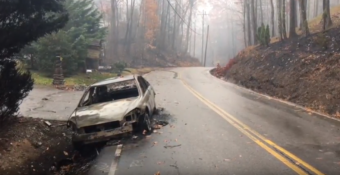
A burned-out car sits on the side of a road near Gatlinburg, Tenn. (Video screenshot from the Tennessee Department of Transportation)

Dozens of Alaska firefighters are battling blazes in the Lower 48, including deadly Tennessee fires that have destroyed or damaged hundreds of buildings.
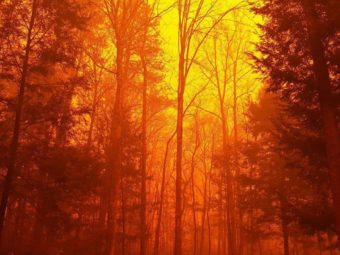
Fire crews from around the United States are working to extinguish more than a dozen blazes around Gatlinburg and Pigeon Forge, Tennessee, which have left seven people dead, as of noon Wednesday.

Alaska Division of Forestry Public Information Officer Tim Mowry said more than 20 Alaska-based staff were in Tennessee earlier this week, when the fire became deadly.

“That night before, I talked to one of our guys down there and he said the winds were blowing in excess of 80 miles an hour,” Mowry said.

More than 700 buildings have been damaged or destroyed in Sevier County.

At its peak, about 110 Alaska-based personnel were scattered around the Southeast U.S. fighting fires in the drought-stricken region.

Mowry was among the deployed, and spent two weeks working in North Carolina.

He said Alaskans are filling a variety of roles ranging from support staff to initial attack crews.

“Helping engage fires in several states: Alabama, Arkansas, Georgia, North Carolina, South Carolina, Tennessee, Virginia, Kentucky, Mississippi,” Mowry said. “It’s really dry down there and all the states are having extreme fire danger.”

And, Mowry said fire conditions there are much different than those that crews are used to battling in Alaska.

“It’s mostly leaves that have dropped from the trees, and these fires are burning across the forest floor, and these leaves can get blown around and create spot fires,” Mowry said. “And I think that’s when you had winds in excess of 80-mile-per-hour in that Tennessee incident, it’s really hard to do anything with fire like that that moves so quickly — it’s almost like a grass fire.”

While basic firefighting principles remain generally the same from fire to fire, Mowry said the difference in a fire’s fuel can require that crews use different tactics than those used in Alaska’s backcountry.

“One of the big pieces of equipment that firefighters were using on our fire were leaf blowers, because these leaves were continually falling down and blowing off trees,” he said. “And so they were constantly having to go back and clear areas with leaf blowers and rakes and things like that.”

Mowry said it was a interesting, yet positive experience to work in an area where residents aren’t as accustomed to dealing with destructive, large-scale fires.

“People were very, very supportive; very appreciative of not just Alaska, but every state that responded to the call to send folks there to help,” Mowry said. “That was impressive to see, and you see that all the time everywhere, but it just seemed like this was an unusual sort of a historic event for them, and they were very thankful.”

About 75 Alaska-based personnel remain in the region.

Funding to fight the fires, which includes bringing Alaska crews down south, comes from a mixture of federal agencies and the states where fires are being fought.

Wildfires still burn in Tennessee as death toll rises to at least 4

In eastern Tennessee, deadly wildfires are still burning and authorities say it’s still too dangerous for thousands of people to return to their damaged and destroyed homes and businesses.

On Wednesday, authorities in Gatlinburg, Tenn., said the confirmed death toll had grown to four people. Search and rescue crews from local law enforcement agencies and the National Guard combed through the remains of buildings looking for survivors.

Dozens of people were injured in and around the tourist town at the foot of Great Smoky Mountains National Park, where forested neighborhoods turned into hellscapes in a matter of hours Monday night.

“There were rivers of fire,” Gatlinburg resident Ric Morgan told the Knoxville News Sentinel. He said he escaped after a neighbor saw him waving a flashlight in his window as flames raced down toward his apartment.

Cindy Davenport arrived in town Tuesday to help her elderly father, who was evacuated from his home. She told the newspaper, “He said he could see the fire, and he’s blind.”

In all, about 14,000 people were evacuated from Gatlinburg and about 500 from nearby Pigeon Forge, according to Tennessee’s emergency management agency.

Officials rushed to get people out of town as the fire, which began inside the Great Smoky Mountains National Park, screamed into town on strong winds. On Tuesday and Wednesday, even as rain fell on the region, Gatlinburg’s fire chief, Greg Miller, said eight new fires erupted, reported The Tennessean.

Miller said the strength of the wind and the speed of the fire combined with the severe drought conditions the region has been suffering for months to create a situation that caught firefighters off guard, as Nashville Public Radio reported:

” ‘There were times … where we had wind gusts in excess of 87 miles an hour. That is hurricane force. That is nowhere to be when trying to fight a fire,’ Miller said.

Embers blew as far as a mile away, sparking new fires.

“At the same time we were facing that challenge, those high winds were knocking down trees. Those trees were hitting power lines and they were falling on this very dry, extreme drought-like condition, and everything was catching on fire.”

In all, the fire has destroyed more than 150 homes and businesses in Sevier County. On Wednesday morning, more than 10,000 people still didn’t have power in the area. The Red Cross said about 1,100 people remained in emergency shelters.

The welcome center sign wasn't spared as the Chimney Top Fire tore through Gatlinburg, burning at least 100 buildings. (Photo by Mark Nagi/Tennessee Department of Transportation) MARK NAGI / TDOT
The welcome center sign wasn’t spared as the Chimney Top Fire tore through Gatlinburg, burning at least 100 buildings. (Photo by Mark Nagi/Tennessee Department of Transportation)

Even as firefighters continued to work to contain blazes outside town, authorities were beginning to assess the damage in the hardest-hit neighborhoods of Gatlinburg.

On some residential cul-de-sacs, only building foundations remain. Where there once were red-tinged leafy forests, there are only the spindly trunks of charred trees.

The Tennessee Highway Patrol went door to door Wednesday checking on residents and sharing information about shelters — Gatlinburg was still under a mandatory evacuation order.

Road were still closed on Wednesday, according to the state department of transportation, as more than 100 members of the Tennessee National Guard helped transportation and utility workers remove debris from roads into and out of town.

Rain falling in the region could help extinguish the fires, but Tennessee Public Radio reported it is also complicating search and rescue efforts, causing “small mudslides on slopes where there’s no longer any brush to hold the ground in place.”

Copyright 2016 NPR. To see more, visit http://www.npr.org/.

Trump, Congress and Southeast timber, what are the possibilities?

A portion of the Tongass National Forest along Peril Strait is seen from the ferry Chenega in Sept. 3, 2015. (Photo by Ed Schoenfeld/CoastAlaska News)

Could President-elect Donald Trump and the incoming Republican-led Congress change logging plans in Southeast Alaska? Changes to the Tongass forest plan amendment, a contentious Forest Service regulation, are possible.

The Tongass Land Management Plan amendment is on its way to being finalized next month. The plan aims to move the Southeast timber industry away from logging old-growth forests over the next 16 years. Both environmental and logging industry groups have filed objections to the plan.

Environmental groups argue the transition can be made faster while industry groups want a larger assessment of young-growth stocks and to slow the transition. Several objections to the amendment are being evaluated by the U.S. Forest Service. Any changes will be announced later this month.

So when President-elect Trump and a Republican-led Congress begin work in January, could the Tongass amendment be on the table? Here are some possibilities.

Let’s start with Congress and the Congressional Review Act or the CRA.

“The Congressional Review Act gives Congress the ability to disapprove of federal regulations that have been issued within a certain period of time,” said Sofie Miller, a senior policy analyst at the George Washington University Regulatory Studies Center.

“So right now we’re looking at federal regulations that have been issued beyond about May 30 according to the Congressional Research Service. After Congress disapproves of those rules, they would go to the president,” said Miller. “If the president signs that into law, then it would overturn the rule in question and the agency that issued the rule would not be allowed to issue a rule that was substantially the same.”

The CRA has only been successfully used once during the George W. Bush administration. When Bush came into office, Republicans also controlled Congress.

“So we have a similar makeup in the sense that the new incoming president that disagrees with some of the past administration’s regulations and with a Congress that is politically aligned with that president,” said Miller. “They now have the ability to successfully use the Congressional Review Act.”

As to how the CRA can be used, that’s a hard question to answer. The Tongass amendment falls under the 2012 forest planning rule, a result of changes made to a 1982 Forest Service regulation that affects forest planning nationwide. The Bill Clinton, Bush and Barack Obama administrations all worked to make the rule more flexible for wildlife requirements.

The planning rule itself is out of the CRA’s reach, but the amendment could fall under its broad definition.

“One thing that’s interesting too is that the actions Congress takes under CRA are not judicially reviewable. So if they want to expand that bucket somewhat, I’m not sure that there’s necessarily a check there to prohibit it,” said Miller.

Also, A CRA bill can’t be amended and takes 51 votes in the Senate, not the usual 60. Miller said the CRA is a “blunt tool,” meaning that Congress wouldn’t be able to tell the Forest Service what they would like to see. A new amendment would just have to be different.

Miller notes that there are other possible ways Congress can manipulate regulations through funding appropriations and changing what authorities the Department of Agriculture and the Forest Service have.

As for Trump, who campaigned in the Pacific Northwest on bringing back sawmill jobs, he can’t change the Tongass’ fate with a stroke of a pen. Tom Waldo, a Juneau staff attorney with Earth Justice, said Trump could direct the Department of Agriculture or the Forest Service to change the amendment if it came onto his radar.

“At a minimum, the Forest Service would have to provide public notice of their intent to change the plan and provide an opportunity for members of the public the raise objections, or comments or concerns about those changes,” he said.

If Trump took a more broad approach and wanted to change the 2012 planning rule, the same idea would apply and a lengthy process with public comment would begin. Waldo said that depending on the changes, a new environmental impact statement could be needed for either option.

He said the topic of the potential changes to the amendment has been on people’s minds in Southeast, but all routes to significant change would be long ones.

The logging industry is still pushing back against the move towards young growth. Owen Graham of the Alaska Forest Association said the logging group is trying to persuade the Forest Service to back away from the amendment.

“We’ve also reached out to our congressional delegation and asked them to try to legislate either a delay or a complete rescission of this record of decision depending on whether it gets signed or not,” said Graham.

Site notifications
Update notification options
Subscribe to notifications