Timber

Largest Haines State Forest timber sale in a generation goes out to bid

The largest timber sale in the Haines State Forest in at least 20 years is out to bid.

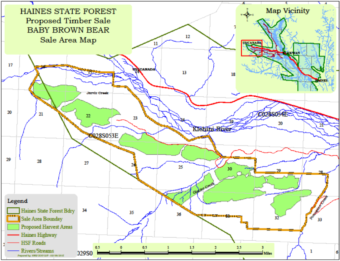
The State Department of Natural Resources is offering the 855-acre Baby Brown timber sale for a minimum price of $250,000.

A local conservation group worries the extensive logging project could harm wildlife and tourism.

In the past 15 years, the Haines State Forest has been utilized mainly for small sales that go to local timber operators.

Baby Brown is different. It is many times bigger and caters to an international market.

“The market for this sale is potentially two-fold,” said forester Greg Palmieri. “One is a chip market and the second is a small, saw log market. Both are on the Asian market.”

The sale area is about 35 miles up the Haines Highway.

The 20 million board feet of spruce and hemlock are located between Porcupine and Jarvis Creeks.

The State of Alaska views the Haines State Forest as underutilized.

Palmieri said less than a sixth of the 58 million allowable board feet has been harvested in the past decade.

This 20 million board-foot sale would bring that number up significantly.

“The main focus (behind the sale) was to generate income for the state as it was spelled out in the best interest finding,” Palmieri said.

The State released a final best interest finding for Baby Brown in March of 2015, allowing the sale to go forward. But a month later, three conservation groups appealed that decision.

“The issues that we appealed basically remain the same,” said Eric Holle, the president of Lynn Canal Conservation. “Concerns about impacts to fisheries and wildlife. Also economic impact. The sale, at least part of the sale, would be visible from the Haines Highway, which is important to the local tourism economy.”

The appeal was ultimately denied by the DNR Commissioner last October. The conservation groups did not take their case to court.

Palmieri says he’s taking peoples’ concerns into account as he creates forest land use plans.

“It’s not gonna be 855 acres of clear-cut, which is something that I think people were concerned about seeing,” Palmieri said.

The land use plans are guidelines drawn up by Forestry that dictate the area, size, timing and harvest methods for sections of the sale.

The land use plans for the first two parcels should be available for public review and comment within days, Palmieri said.

The units make up a combined 137 acres of land on the east side of Glacier Creek.

Parcels can’t be harvested until they have final land use plans.

“What I’ve tried to do is create a sale that balances out the economics with the public concerns,” Palmieri said.

He is applying the same principles he’s used in small sales to this bigger one, he said. That is, balancing clear-cutting with more selective harvesting.

The market for this timber is overseas.

And none of the three interested bidders Palmieri has heard from are in Haines.

But he does think this sale will have local benefits.

For one, Baby Brown includes several miles of road construction. That opens up new areas for local loggers.

“We get a road system that accesses a portion of the timber in the Haines State Forest that wasn’t available to the small-scale operators before,” Palmieri said. “And this is a huge benefit to our small sale program in the long-term.”

But Holle thinks there’s a downside to new roads as well.

“Roads have similar impacts to fisheries and to particular species of wildlife as clear-cuts,” Holle said.

There’s some irony in the timing of this sale.

The largest potential timber harvest in the Haines State Forest in years is going out to bid at the same time that the one remaining local forester job is hanging by a thread due to state budget cuts.

Chris Maisch, the director of the Division of Forestry, said the future of Palmieri’s position is still up in the air.

As to whether the Baby Brown sale would protect the job …

“I will say it certainly would help with revenue from the timber sale side of the division and that’s one of the factors we consider,” Maisch said. “So it will have an influence, but it’s not the only influence.”

Maisch said Palmieri’s job is funded until the end of this fiscal year.

What happens after remains to be seen.

The bid period for the Baby Brown sale closes Dec. 15. If there is a successful bidder, then the contract will be awarded immediately.

Harvest could start as soon as next spring or summer, and the company would have five years to complete its work.

The public still has the opportunity to weigh in on the land use plans for each section of the harvest. Those will be posted on DNR’s public notice website.

Alaska Mental Health Trust delays Deer Mountain logging vote

A springtime view of Deer Mountain. (File photo by Leila Kheiry/KRBD )

Alaska Mental Health Trust’s board of trustees voted Thursday in Anchorage to reconsider an August decision to potentially move forward with logging Deer Mountain and a section of land above homes in Petersburg, and then the board delayed a final decision until the end of January.

Since late August, many residents in Ketchikan, Saxman and Petersburg have had Jan. 15 on their minds, because that was the deadline the Alaska Mental Health Trust board set for Congress to approve a land exchange bill.

That exchange trades parts of Deer Mountain and land in Petersburg now owned by Mental Health for equivalent parcels of federally owned land on Prince of Wales Island and in the Shelter Cove area.

If the exchange failed to pass by Jan. 15, then that August vote called for Mental Health to move forward with logging the sites in Ketchikan and Petersburg.

That vote wasn’t well advertised, and came as a big surprise to many community members.

Groups organized in opposition to logging and to the process the Trust used leading to the vote.

The opposition, and a mountain-sized amount of public comment, inspired the board’s reconsideration.

Delaying the final decision wasn’t on the trustees’ meeting agenda, but Trust Land Office Executive Director John Morrison says there’s a lot of written public input for trustees to read.

“I think at this point, our recommendation is to potentially give the trustees a little more time to consider the comments you received recently before you decide which way you’d like to go on these two issues,” he said.

The trustees unanimously agreed to reconsider both the Deer Mountain and Petersburg logging votes, and then postpone final action until the next regular board of trustees meeting, which is Jan. 25 and 26.

Morrison told the board that his office is hearing “very optimistic” predictions that the land exchange will be approved by Congress in the upcoming session. In that case, there would be no need to take any action on logging the controversial sites.

In addition to the written comments that trustees received prior to the meeting, some Ketchikan and Petersburg residents chose to call in with comments on the first day of the board’s two-day meeting.

None spoke in favor of logging the parcels close to their homes.

Marta Poore in Ketchikan said there already have been landslides on Deer Mountain, and people who live near it are worried that logging would lead to more slides, and harming the water supply for the community of Saxman.

There’s also a popular trail on Deer Mountain.

“And I hike that trail weekly during the summer, as do many locals and tourists,” she said. “So, to do logging in there would devastate community mood, certainly quality of life.”

Suzanne Wood, co-founder of the Mitkof Island Homeowners Association, told the trustees that the group of 95 homeowners has actively supported the federal land exchange for the last 11 years, in order to avoid logging the site above their homes.

Group members are concerned about further destabilizing the steep hillside, she said.

“There have now been nine natural landslides above our homes on Mitkof Highway and the Tyee hydroelectric utility corridor, closing the highway to through traffic, damaging residential property and infrastructure; and disrupting residential utility service,” she said.

The association never wanted to litigate over this issue, but any action toward logging that site would lead to a lawsuit, Wood said.

Becky Knight in Petersburg said logging should be removed from consideration, whether it’s the sensitive parcels near communities or the exchange lands on Prince of Wales Island and in Shelter Cove. She saida federal buyout of the trust land is a preferable option.

Knight said that logging the controversial sites was never a serious threat. She says the trust already started negotiating with timber industry groups to log the exchange land.

“So why did they issue their threat? It appears that what (the AMHT) were really after was a stampede of support to seal the deal for their legislation,” she said.

Marvin Scott in Ketchikan said the timber sales in Petersburg and Ketchikan are not in the best financial interest of the Trust, because of the increased liability risk.

Scott said he understands Trust officials have said that a risk assessment has been completed, but, “I wonder if a geotechnical survey has been conducted, but even then one should realize that logging on steep slopes above residential development poses a very realistic liability. No one can guarantee landslides won’t occur on a steep slope, even if light selective logging occurs. The fact that trees would be taken, and a subsequent landslide happens, AMHT is then liable.”

Scott said a landslide could lead to damages exceeding $100 million, which makes the proposed $2 million profit from logging Deer Mountain not worth the risk.

Bob Weinstein in Ketchikan urged trustees to seriously consider a suggested amended motion that would add a land sale as an option to logging.

“Doing that will get the public in Ketchikan behind your goal of both the exchange legislation as your primary goal, and, secondary, an effort to retain Deer Mountain as it is,” he said. “It will also allow for the beginning of whatever processes need to take place regarding what the purchase process and related matters are.”

Because the trustees delayed a decision on logging, they didn’t vote on that motion, but it was briefly discussed.

Morrison told trustees that it was a way to officially affirm that the Trust Land Office would be open to options if the land exchange doesn’t pass.

Editor’s note: KTOO’s building sits on land leased from the Alaska Mental Health Trust Authority. KTOO has also applied for and received occasional grants for special reporting projects from the authority.

Wood energy grants again offered in Alaska

Andrew Haden of Wisewood, Inc., a Portland-based design firm, explains how the Ketchikan Airport’s biomass boiler works last June. It was partially funded by a U.S. Forest Service wood innovation grant. (Photo by Leila Kheiry/KRBD)
Andrew Haden of Wisewood, Inc., a Portland-based design firm, explains how the Ketchikan Airport’s biomass boiler works as it begins running in June 2016. It was partially funded by a U.S. Forest Service wood innovation grant. (Photo by Leila Kheiry/KRBD)

The U.S. Forest Service is offering another round of grants promoting wood-energy projects in Alaska.

Earlier grants have helped design boilers and plan wood-pellet mills in Southeast and Interior communities.

Forest Service Wood Innovation Coordinator Dan Parrent said they’re meant to expand use of blowdowns, mill scraps and similar material.

“We’re looking at ways of utilizing wood that needs to come out of the forest to reduce hazardous fuel loading or for forest health purposes,” he said. “We’re trying to create markets for that material that doesn’t otherwise have strong markets.”

He said most Alaska grants, for up to $250,000 each, go to wood-energy projects. But the program also helps develop new timber products, such as laminates, or expand existing markets.

Grants can go to businesses, organizations and government agencies. Recipients must contribute part of the funding.

Parrent said program guidelines limit how the money can be used.

“It’s mostly for the softer costs. It’s for project development, it’s for designs, it could be used for permitting. … But not for actual construction,” he said.

Applications must be submitted by Jan. 23. Awards will be announced in April.

A number of organizations have been promoting wood-energy projects around the state. One is the Southeast Conference, a regional economic-development group.

The conference’s energy coordinator Robert Venables said the grants have been valuable.

“It’s been used from Ketchikan to Haines to help some of these projects get vetted out and ready for either implementation or not, if that’s what the feasibility [study] shows,” he said.

Wood has been promoted as a low-cost energy source that causes less environmental damage than fuel oil.

But critics point out that it still releases carbon into the air, contributing to climate change. They also say forests should not be cleared of blowdowns and woody debris, which decays and helps build up soil and feed future trees.

Trustees to vote again on Deer Mountain plan

Alaska Mental Health Trust Authority’s board of trustees meets this week, and will vote on a “reconsideration” of an August decision to move forward with logging parts of Deer Mountain in Ketchikan and a parcel in Petersburg that sits above homes.
Trust officials visited Ketchikan and Petersburg earlier this month to talk about those plans. They said that, if logging does happen, it would be selective logging by helicopter, not clear cutting.

Logging on those parcels would not happen at all if a federal land exchange is approved by Congress before Jan. 15.

Trust officials have repeatedly said they vastly prefer a land exchange over logging the two controversial parcels.

The trustees’ August decision prompted groups in both affected communities to organize against any logging of those sites.

There also were questions about whether the vote was legal under the Open Meetings Act, which led the board to take another vote on the issue this week, following a Resource Management Committee recommendation last month.

The trustees’ meeting is scheduled for two days in Anchorage.

Public comment will be heard on Wednesday, starting at 4 p.m., and people can call in to participate. If people wish to send written comments via email, then trust officials recommend sending those comments by Tuesday.

The vote on the issue is scheduled for Thursday, at about 1:15 p.m. People can call in to listen.

Here’s a link with information about how to comment by phone or by email. We also have earlier reports on the issue here and here.

Editor’s note: KTOO’s building sits on land leased from the Alaska Mental Health Trust Authority. KTOO has also applied for and received occasional grants for special reporting projects from the authority.

Alaska crews deployed to Southeast U.S. wildfires

Alaska crews from multiple state and federal agencies are headed to the Lower 48 to assist in firefighting efforts there.

Tim Mowry, a public information officer for the Alaska Division of Forestry, said over the last two weeks more than a dozen Alaska people have been sent to drought-stricken areas in the Southeast United States.

“Unlike Alaska and some of the places in the West, these aren’t real big fires – I think the biggest fire is like 3,000 acres – but they’re getting a lot of fire activity, and because that area is much more densely populated than the areas in Alaska and even in the West, they have to jump on those fires pretty quick,” Mowry said.

The Alaska personnel have been assigned to fires in Alabama, Georgia, Kentucky, Mississippi, North Carolina and Tennessee.

Mowry said Alaska has primarily sent support staff.

“Dispatchers, division supervisors, crew bosses,” Mowry said. “Right now all our crews are laid-off because our fire season is over.”

Mowry said Alaska agencies are trying to cobble together at least one Type 2 Initial Attack team to send to the Lower 48.

Workers from the Alaska Division of Forestry, Bureau of Land Management – Alaska Fire Service, U.S. Fish and Wildlife Service and U.S. Forest Service have been deployed to other states.

Their involvement is part of a national effort to support firefighting efforts in the Southeast United States.

Running for U.S. House seat, Lindbeck says diversifying Alaska’s economy a key issue

Democrat Steve Lindbeck is challenging incumbent Republican Don Young for Alaska’s lone seat in the U.S. House of Representatives. (Photo courtesy Lindbeck for Alaska)

Democratic candidate for the U.S. House of Representatives Steve Lindbeck was scheduled to be in Wrangell on Saturday, but fog prevented him from making one of his final Southeast campaign stops.

The former public radio executive officially announced his candidacy in May, hoping to unseat Republican Rep. Don Young, the Alaska Dispatch News reported.

Lindbeck spoke with KSTK by phone.

One of Lindbeck’s key issues is diversifying Alaska’s economy.

He said developing the arctic is one way the federal government can spur development and help the state’s economy.

“We really should approve the law of the sea treaty because that will clarify boundaries and authorities as exploitation of minerals and fisheries takes place,” Lindbeck said. “There’s just a tremendous amount of opportunity and risk that comes with the way this place is opening up, and we are not prepared as a country today.”

Lindbeck said building a deep-water port is one the key infrastructure components needed, as well as greater Coast Guard coverage.

He promotes exploring for resources in the Arctic National Wildlife Refuge before making decisions on its development.

Lindbeck also supports Gov. Bill Walker’s push to build a natural gas pipeline.

Lindbeck argues he would be a strong advocate for transboundary mining issues in Southeast and would like to see the International Joint Commission become involved. That’s a U.S.-Canada panel that handles transboundary water issues.

“The State Department needs to push hard. The IJC obviously addresses this in other places and needs to do so here. We need to get President (Barack) Obama and Secretary (John) Kerry and President (Hilary) Clinton – presumably going forward – to stay after this problem,” Lindbeck said. “I think it’s probably a good idea to have a moratorium on approval of new Canadian permits until the government in British Columbia sort some of the recommendations.”

Among other Southeast issues, Lindbeck said the Tongass should be able to supply timber for at least one mill, while protecting fisheries in the region.

He said Alaska becoming exempt from the “roadless rule” would be one way of opening up logging lands.

The federal regulation set aside millions of acres of forest across the country. The U.S. Supreme Court declined to hear the state’s case for an exemption in March.

Lindbeck also said the proposed Alaska Mental Health Trust land exchange would be good for the state.

That’s been a contentious issue in Southeast.

If Congress doesn’t approve the exchange by January, then Mental Health wants to log Ketchikan’s Deer Mountain and land above Mitkof Highway in Petersburg.

Other issues Lindbeck is pushing for are broadband infrastructure expansion and legislation allowing college students to renegotiate loan debt.

Linbeck’s campaign said it will focus on Anchorage and Fairbanks voters leading up to Election Day.

Libertarian Jim McDermott and independent candidate Bernie Souphanavong also are  running against Republican incumbent Don Young.

Site notifications
Update notification options
Subscribe to notifications