Timber

One last chance to protest at the end of an era for the Tongass

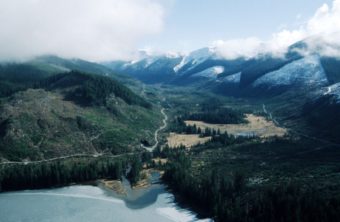
Part of the Tongass National Forest in April 2008. (Creative Commons photo by Xa’at)

The federal government is getting close to finalizing a plan that could shape the future of timber in the Tongass National Forest. Various stakeholders have given input through the years. But if the objection letters are any indication, several agencies and groups are still not content — for different reasons.

Buck Lindekugel has been spending a lot of his time with maps. They’re color coded to show which areas of the Tongass are suitable for timber harvests. And which areas are prioritized for conservation.

“But most of my time has been looking at these heavy books,” he said.

Forest Service books that outline how much timber is harvested from the Tongass.

The agency is expected to finalize a plan for the national forest this winter. Lindekugel is the grassroots attorney for the Southeast Alaska Conservation Council or SEACC. And although the planning phase is almost over, the organization still has issues with what’s left of the table. Namely, so many old growth trees.

Lindekugel says it’s not exactly clear where those trees can be cut down.

“And we think that lack of clarity is going to create confusion … Are they going to be logged or not logged? There’s ambivalence here in the maps,” Lindekugel said.

SEACC isn’t the only organization that thinks the plan needs more work. The forest service received more than two dozen objection letters. Most of the criticism is from timber industry groups that say the plan transitions away from logging more valuable old growth trees too soon.

And to address those concerns, the forest service is trying something new. It’s inviting its biggest critics to come together for one last series of hearings. One of those critics is the state of Alaska.

“Some would describe this as a battle almost among certain groups,” said Chris Maisch, a state forester.

Alaska’s Department of Natural Resources is another agency that doesn’t agree with how the Tongass plan has come together. He says the sixteen year transition period doesn’t give the industry enough time to adapt.

Milling young growth trees requires different equipment.

“And no one is going to make that kind of investment if they’re not certain they have a log supply they can depend on. And unfortunately right now, that’s not the case,” Maisch said.

Recently, a controversial timber sale on Kuiu Island didn’t receive a single bid. All of the wood was approved for export, meaning the logs wouldn’t likely go to Southeast mills.

Buck Lindekugel from SEACC says that makes the point that the timber industry has already transitioned. 20 years ago, it employed about 5,000 people.

“It used to be a main driver. There’s no question that for decades it was. But that industry couldn’t compete in today’s market,” Lindekugel said.

He thinks that’s due in part to Alaska’s remoteness. Tourism, not timber, is the region’s main economic driver.

But Chris Maisch, the state forester, says even though there’s less than 400 jobs left in the industry, he still sees the potential.

“Well, it is worth saving because I think everyone in the state is keenly aware of the financial state the state finds itself, and we need to do everything we can to diversify the state’s economy,” Maisch said.

The forest service is holding its Tongass objection meeting this week in Ketchikan and next in Juneau. Both Maisch and SEACC say they’re not sure what — if anything — will change.

Forest Service adds to Admiralty Island wilderness

Logged lands near Lake Kathleen, on Admiralty Island, are among those Shee Atiká has agreed to sell to the Forest Service. (Photo courtesy U.S. Forest Service.)
Logged lands at the head of Lake Kathleen, on Admiralty Island, are among those Shee Atiká has sold to the Forest Service to add to its Kootznoowoo Wilderness Area. (Photo courtesy U.S. Forest Service.)

About 4,500 acres of heavily-logged forest will return to wilderness under a deal involving the federal government and a Southeast Alaska Native corporation.

The U.S. Forest Service purchased the acreage near Cube Cove, on the west side of Admiralty Island,  about 30 miles south of Juneau and 20 miles north of Angoon.

Just under $4 million was paid to the owner, Shee Atiká, the Sitka-based Native corporation. It comes from the Forest Service’s Land and Water Conservation Fund.

Recreation, Lands and Minerals Director James King said the property is surrounded by Admiralty Island National Monument and its Kootznoowoo Wilderness Area.

“This restores the concept of creating an island and a monument that is left relatively intact,” he said.

The purchase price covers two of 13 parcels of Cube Cove land owned by Shee Atiká.

The total area is about 22,000 acres and the full value is around $18.3 million.

Cube Cove-area land is being sold to the Forest Service. The two southernmost parcels were purchased for about $4 million. (Map courtesy Forest Service)

The once-forested area was acquired by the corporation under terms of the Alaska Native Claims Settlement Act.

It was extensively logging over an 18-year period ending in 2002.

King said the Forest Service may spend additional funds to speed its restoration.

“It’s possible that as we do further analysis on it, that if we determine to better help the habitat that thinning may occur. But those decisions have not been made yet,” he said.

He said the agency hopes to purchase the remaining Cube Cove acreage, which includes three lakes, over time. But that depends on future federal budgets.

The sale also is part of legislation introduced by Alaska U.S. Sen. Lisa Murkowski earlier this year. Some environmental groups have said it would allow Shee Atiká to purchase and log timberlands on Prince of Wales Island.

Shee Atiká President and CEO Ken Cameron said  the Native corporation hasn’t decided what to do with the $4 million it’s being paid.

Cameron, who declined to be recorded, said it’s on the agenda for a fall planning meeting. He said the corporation understands further sales depend on Congressional appropriations.

The sale has its critics.

The Southeast Alaska Conservation Council’s Buck Lindekugel calls it a mixed bag.

“We’re glad that these valuable lands will be back in public ownership where they can heal,” he said.

“It’s sad, though, because we worked really hard in the 1980s and early 1990s to see if we could come up with an exchange so Lake Florence and Lake Kathleen could have been returned to public ownership before they were clear-cut,” he added.

In an earlier interview, Sitka Conservation Society Executive Director Andrew Thoms said it seemed like an odd deal.

“And now, in this situation, the government would buy back the lands that were logged? And Shee Atiká made a profit on them? And now the government’s buying it back from them? It’s a strange situation,” he said.

And Shee Atiká shareholder Mike Kinville said the corporation shouldn’t give up any of its property.

“Shee Atiká is not making, what is in my opinion, sound decisions. To sell our last pieces of land concerns me,” he said.

The purchase was announced Sept. 16 in a joint news release from the federal agency and the corporation.

King, of the Forest Service, said there’s a reason these particular parcels were bought first.

“It was determined that the most logical way to purchase the lands was to start at the backs of the property or the furthest from the water. And purchase our way out to the waterfront, so that we didn’t isolate pieces of property without access to them,” he said.

The Forest Service said buying up wilderness inholdings is a high priority for the Tongass and is listed in its land management plan.

U.S.-Canada trade deal creating uncertainty in Southeast timber market

Part of the Tongass National Forest in April 2008. (Creative Commons photo by Xa’at)

The U.S. is in the midst of negotiations with Canada over an agreement on Canadian lumber imports.

Many U.S. sawmill owners argue that the Canadian mills receive government subsidies on government-owned lands, making it difficult for the U.S. market to compete.
The 2006 softwood lumber trade agreement, meant to level the playing field, expired last year and a one-year freeze on tariffs, a tax on imported goods and services, ends in October.

The uncertainty of new tariffs is affecting Southeast timber.

The U.S. and Canadian governments have been at odds for decades on whether Canadian sawmills receive government subsidies, particularly “stumpage” fees, a tax on harvested trees.

Mills in the states say that gives Canadian producers an unfair advantage in the U.S. market.

The deal that was struck in 2006 was renewed in 2012.

It was designed to keep Canadian timber within a certain price range. If it fell below that range, then tariffs would be enacted. The deal expired last October, kicking in a one-year standstill period, including a freeze on U.S. tariffs.

What this means for the timber industry in Southeast depends on the lens you’re looking through.

Alcan Forest Products is based in Ketchikan, but operates in Canada as well.

Alcan Partner Brian Brown said the uncertainty of a new trade agreement is making Canadian sawmills unable to commit to prices on Alaska logs.

“We sell primarily in Canada, the red cedar log. Thirty (percent) to 40 percent of the red cedar we sell goes into Canada right now. The market is sort of a published-log-price market. We just did a shipment in there,” Brown said. “Right now, no one has been able to commit to a second one because of this duty. It’s hard to put a dollar figure on it because right now we’re in the same boat that the producers in Canada are. We don’t know what this agreement is going to consist of.”

Alcan does three to four shipments into Canada a year, Brown said. Each shipment is about 600,000 tons and is valued about $1 million U.S. dollars. If a deal is not struck in October, then the U.S. is likely to put tariffs on Canadian timber.

“If you take a 15 (percent) or 20 percent cut on the price, that’s just speculation of what the price would be, it’s a significant amount of money,” Brown said.

Brown doesn’t buy into the argument that Canadian companies are subsidized, and said he would prefer a free market and no tariffs, he said.

“For the sake of argument, I’ll say that’s true, that Canadian sawmills are being subsidized by their government. Who gets the benefit of that ultimately? It’s the U.S. consumer,” Brown said.

Others in Alaska disagree.

Owen Graham of the Alaska Forest Association said he would like to see the 2006 deal renewed. He said it’s needed not just because Canadian producers’ low operating costs, but also because the Canadian dollar is weaker.

“I would say it affects our hemlock, which is about 30 percent of our production. Probably 70 percent of our lumber goes to the Lower 48 so to speak,” said Grahm. “Of that, I would say the 30 percent of our hemlock that is just getting killed by the Canadians dumping low-cost lumber on the market, but it’s primarily because of the exchange rate.”

Graham said those numbers are based on Southeast’s largest mill, Viking Lumber.

Alaska State Forester Chris Maisch said he agrees that a renewal would be best. Most timber across Alaska is predominantly exported to foreign markets, mostly Asia.

According to a Bloomberg report, Canada’s Trade Minister Chrysita Freeland and U.S. Trade Representative Michael Froman spoke last week at the G-20 summit in China, but a deal could not be reached. Freeland was quoted as saying “there is no guarantee we are going to get to a deal that works for both sides.”

The deadline is October 12.

Petersburg assembly sends letter on Mental Health logging

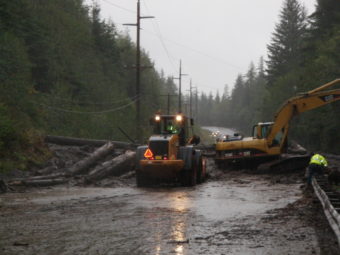
Crews worked to clear this landslide that blocked Mitkof Highway in September of 2009. (KFSK file photo)
Crews worked to clear this landslide that blocked Mitkof Highway in September of 2009. The Petersburg borough assembly agreed to send a letter urging land exchange rather than logging Alaska Mental Health Trust lands. (KFSK file photo)

Petersburg’s borough assembly Tuesday agreed to send a letter urging a land exchange rather than logging on Alaska Mental Health Trust lands on the steep hillside above Mitkof Highway south of downtown.

Local residents and homeowners are concerned about landslides that have occurred on that hillside and the potential for increased risk if the slopes are logged.

The Alaska Mental Health Trust board last month announced it would go forward with plans to log lands near Petersburg and Ketchikan if a land exchange does not get Congressional approval by Jan. 15.

In Petersburg, the Trust owns lands above Mitkof Highway from Scow Bay to south of Twin Creek. In Ketchikan, the trust owns a parcel on Deer Mountain.

Local resident David Beebe called the ultimatum from Mental Health “extortion.”

“These threats however are not just limited to the Ketchikan and Petersburg boroughs,” Beebe said. “These are threats to public safety, and our citizens home, and private property, our local economy, their highways and other public and private infrastructure.”

The Trust board made the decision to proceed with the timber sales because of the potential end of the timber industry in Southeast, which board members thought would make their land “valueless” if they are not logged soon. The Trust land office is tasked with funding mental health programs around the state using land and resources granted by the state.

Homeowners along Mitkof Highway have been opposing the Mental Health logging plans for a decade, and advocating for a land exchange.

The home owners have documented landslides over the past three decades in that area and say logging will increase the risk of slides on that slope.

Organized groups in Petersburg and Ketchikan are now asking the Trust for public records regarding last month’s decision to proceed with the logging.

Meanwhile U.S. Sen. Dan Sullivan told a Ketchikan audience late last month he didn’t know whether the land exchange would pass Congress.

Local resident Becky Knight wanted the borough to lobby for a buyout of the land by the federal government through an endowment.

She pointed to purchase of the Native corporation Shee Atiká’s land entitlement at Cube Cove on Admiralty Island.

Knight thought that Sen. Lisa Murkowski and the Alaska Mental Health Trust could make that agreement sooner.

“Murkowski and AMHT could mutually agree to change the action of the bill to an endowment instead of a land exchange, which would greatly improve its chance of passage, by reducing or even eliminating opposition,”Knight said. “Given it’s fair chance of passage, as demonstrated by the Shee Atiká buyout, which has already achieved partial success, AMHT could actually finalize the action sooner.”

Bill Tremblay thought the Shee Atiká Cube Cove buyout was a different situation, involving the federal government and the federal law that created the Native corporation and granted that land.

“We don’t have that with Mental Health,” Tremblay said. “Mental Health is a state caused problem in that they didn’t provide adequate support to mental health to begin with. Mental health got the scraps and they’re still trying to deal with what they have for opportunities.”

Petersburg’s assembly considered a letter urging the Forest Service and Mental Health to go forward with the land exchange and said logging should not take place on the slopes of Mitkof Highway under any circumstances.

Assembly member Cindi Lagoudakis was swayed by Knight’s testimony and wanted to add the option for a buyout.

“I would like to amend the letter to add the possibility of an endowment as a plan B option, but keeping the main focus of the land exchange if that would possibly play out,” Lagoudakis said.

The Assembly agreed to that change and also added information on past landslides in the area proposed for logging.

That amended letter passed 5-0 with Kurt Wohlhueter and Bob Lynn not at the meeting. The letter will be sent to the Mental Health Trust, U.S. Forest Service, Ketchikan Gateway Borough and Sullivan.

Feds release report on Chugach National Forest management

KENAI — The U.S. Forest Service is moving forward with plans to update its management plan for the Chugach National Forest on the eastern part of the Kenai Peninsula.

The Peninsula Clarion reports the federal agency began a revision process for the forest in 2012 by gathering input from the public and researching current use and environmental conditions.

A report released last week says the Forest Service is revising the forest plan because of a changing environment and public concern.

More than 1,400 responses were submitted during the public comment period. The comments included those from Alaska Native corporations that voiced concerns about access to the land for activities such as mining and logging and land ownership.

The Forest Service expects a draft environmental assessment to be finished in 2017.

Sullivan details some Alaska success stories

Sen Dan Sullivan, R-Alaska, speaks during a Ketchikan Chamber of Commerce lunch. (Photo by Leila Kheiry/KRBD)
Sen. Dan Sullivan, R-Alaska, speaks during a Ketchikan Chamber of Commerce lunch on Aug. 31. (Photo by Leila Kheiry/KRBD)

During his visit to Ketchikan last week, Sen. Dan Sullivan covered a variety of topics.

Alaska’s junior senator touched on a number of topics during his talk to the Ketchikan Chamber of Commerce.

Alaska’s economy in the face of low oil prices has been a big topic for a while, and will continue to be for the foreseeable future.

Sullivan said that as a U.S. senator, there are three primary areas where he can offer support as the state figures out to respond.

The federal government’s main areas of influence and responsibility are infrastructure building, resource development and taking full advantage of Alaska’s strategic military location, he said.

In support of infrastructure, Sullivan said Congress was able to approve a five-year highway bill last year, rather than a continuing resolution as it has in recent years.

“What we were able to do as your delegation is defend a very favorable formula, put in there by Don Young and Ted Stevens, in terms of what Alaska pays in and what Alaska pays out,” he said. “So, we have a highway bill. It passed. The president signed it. For the next five years, it’s going to bring the state close to $3 billion dollars.”

Sullivan said $20 million of that will go to the Alaska Marine Highway System in the first year, with increases for the ferries each year following.

Regarding resources, Sullivan said he defines that term broadly to include not only timber and mining, but fisheries.

Alaska is the “superpower of seafood,” and needs to be able to maintain that resource, he said.

“Almost 60 percent of all fish and seafood products landed in the United States of America comes from Alaska shores — 60 percent,” he said. “We are the 800-pound gorilla in the industry.”

Sullivan said he’s worked with Sen. Lisa Murkowski and Rep. Don Young to push for healthy management of fisheries, and to encourage research for the industry.

When it comes to timber, though, Sullivan said it’s challenging to get bills approved if they include measures favorable to logging.

The delegation has had some success with small land transfers, such as easements to allow road construction, he said.

“When you go off on smaller chunks, you can start to do that,” Sullivan said. “I think that’s really important: more federal lands to Alaskans, so we can develop those for the private-sector employment opportunities we need here.”

Sullivan said another extremely valuable resource in Alaska is the children, and it’s essential to provide a useful education for future generations.

He touted the Every Student Succeeds Act, which he said passed the Senate overwhelmingly.

“Essentially, over the last 20 years, the power to educate our kids has been going to Washington, D.C.,” he said. “What we were able to do with this bill is take that power and start shifting it back to where it belongs: Teachers, local school administrators, local school boards and the states.”

Regarding Alaska’s strategic military use, Sullivan said the state offers the ability to deploy troops quickly to many different locations, and a great base for missile defense and air-combat power in the Pacific.

“Let me give you just one example,” he said. “You may have seen that the F35 announcement, that Eilson Air Force Base is going to get two more squadrons. This is in addition to the F22s.  Those are called Fifth-Generation fighter aircraft. Alaska is going to have over 100.”

Sullivan said he plans to continue encouraging U.S. military investment in Alaska.

Site notifications
Update notification options
Subscribe to notifications