Timber

Q&A: DNR commissioner talks about background, Alaska’s resource issues

Andy-Mack-DNR-Commissioner-600x400
Alaska Natural Resources Commissioner Andy Mack at a press conference in Anchorage on June 28, 2016. (Photo by Graelyn Brashear, Alaska Public Media – Anchorage)

The state’s newest Department of Natural Resources Commissioner, Andy Mack, is one of several new additions to Gov. Bill Walker’s cabinet. Here are a few questions that couldn’t be included in the Alaska’s Energy Desk profile of him that ran earlier this week. This interview has been edited for clarity and length.

Alaska’s Energy Desk: The Governor just appointed John Hendrix as the oil and gas advisor, which is a role historically played by the DNR commissioner. What’s the division of responsibility between you, Hendrix and Keith Meyer at the Alaska Gasline Development Corporation?

Mack: I wouldn’t necessarily agree with the fact that the role of oil and gas advisor is historically the DNR commissioner. Every governor has the prerogative and the ability to rearrange their staff how they feel will best suit the needs of the state of Alaska.

The DNR commissioner has very specific regulatory obligations. I think that people shouldn’t forget that there’s some history there and there’s a fairly long history of having people in the Governor’s office with specific oil and gas experience.

Now, with respect to John Hendrix I think, number one, he’s got some incredibly valuable experience that  is very valuable to the Governor.  He has more flexibility than I do though in the sense that he can talk very broadly about policy without worrying as much about the regulatory functions of DNR. So, the distinctions in the roles between myself and John Hendrix are that he doesn’t have a specific regulatory function.

Now, on important decisions, let’s be clear, everybody in the State of Alaska, I think would agree, that the DNR commissioner should be in full consultation with the folks in the Governor’s office.

The second part of the question was on the role and the relationship between the new head of AGDC. It has been discussed quite a bit in the press that the work in the pre-FEED process has been moving along and that that process is, people can see the finish line there and they can see the conclusion of that process. Then really the question is raised well what do we do next?

There was a stage-gate approach which basically said we’re going to walk through this process we’re going to try to work together in an aligned manner and after pre-FEED there are subsequent steps and decisions to be made by the participants in AKLNG.

It’s no secret that not only are there economic headwinds in the oil industry,  but there’s significant economic headwinds in the gas industry too.

There’s been certainly pretty open statements by all of the parties involved and a fairly open discussion about the concerns with being able to move some of the future stages in the AKLNG process.

I think Keith Meyer has been tasked with is ensuring that timing wise the state’s interests are protected. And that we, to the extent possible, move that process along, that project along.

Alaska’s Energy Desk: You’re originally from Soldotna, can you tell me what that experience growing up in Cook Inlet has taught you about resource development there?

Mack: I was born in 1964 in Soldotna and, as a young kid, I had many friends whose families were engaged in the oil and gas industry either as direct employees or as service-side providers.

Nikiski and Kenai and Soldotna and the surrounding areas — it was this incredibly vibrant community and it really was full of hope and a big part of that hope was fueled by this engine, which was driving the local economy.

As I grew up and graduated from Soldotna High School and then went to college, things started to slow down as production waned in Cook Inlet and it got to the point in the 1990s where the economy and production levels were way down the price was was up and down in the 90s. It was actually, for me personally, hard to drive out past Kenai in a sense because there were lots of buildings that had been abandoned where businesses had once operated. People were very uncertain about their economic future and what has been kind of heartening is that a lot of that optimism and a lot of that economy has come back.

But again we’re now in a down-cycle on price so the ability and the willingness of folks to come in and invest in that region again is in question. And I think, I absolutely have personal experiences with that whole region, it’s a little personal to me and it’s very important that we simply understand that as a state what we do financially makes a huge difference.

Alaska’s Energy Desk: DNR identifies a lot of resources, like timber and oil, that the state has available to it for extraction. Are you having these discussions about resources that could be identified in the state that could be used specifically for environmental conservation and not necessarily for resource extraction purposes?

Mack: I think the question is, is there something that’s important enough for the state where they would say this is where we want to go on an issue like that?

So, that would probably have to be an organic conversation among Alaskans.

I think at the end of the day, the administration and the Governor’s going to say what’s in the best interests of Alaska and and that would be kind of the bedrock principle and there’d have to be a very, very forthright conversation about what Alaskans feel is best.

Do they want to extract resources or do they want to extract part of the resource and set aside some of it and that’s really a question for Alaskans.

Historically, the vast majority of Alaskans have come down on the side of – at this point we’d like to extract the resource — but that’s part of the ongoing discussion.  

Alaska’s Energy Desk: What is your vision for oil and gas exploration in the state?

Mack: The ability of the state of Alaska to continue to generate income from oil and gas will be created by our ability to maximize access. We’ve had fairly good access to the areas that we own and we have the ability to lease. I think Alaskans should be very proud of the work we’ve done since oil production began.

As a general rule — it’s not a perfect record — but as a general rule I think we should be very proud of the work we’ve done and the standards we’ve insisted upon as a state in protecting the environment and also ensuring that we maximize production.

There’s tensions between pace and standards but generally speaking in the areas where we’ve had access, we’ve done a good job.

I think the challenge for Alaska is how to approach areas where we historically have not had access or the access is controlled by the federal government and I think part of my experience lends itself very well to ensuring that we can generate access.

I think access in federal areas is going to be driven by a number of factors. A big part and probably one of the principal facts is going to be whether or not local stakeholders, whether or not they support going into areas which are managed by the federal government. I think that there’s a number of things that you have to take into account. But certainly areas and local communities always have an interest in big development projects. Doesn’t matter whether it’s building a highway, whether it’s building a mine, whether it’s drilling for oil or gas.

Alaska’s Energy Desk: So when you say access to areas that are controlled by the federal government, Arctic National Wildlife Refuge? Are you thinking the petroleum reserve?  What are those areas and what’s your strategy?

Mack: The answer is yes ANWR, the Outer Continental Shelf , and the National Petroleum Reserve – Alaska up in the Arctic area, certainly all oil plays that are very important.

Some of those areas are prolific and also economic in the sense that they’re companies that are willing to go out and do the work.

For example, there’s been lots and lots of discussion about what Shell has proposed and what they were doing in their exploration effort and that’s very expensive and very ambitious and very much a play where they were looking for a large field. That’s what their project required is that they find a large bunch of oil.

But, there’s other smaller plays along the North Slope there’s lots of activity.  There’s a number of those more discreet probably lower profile plays/investments/projects that make sense.

My work both prior to Pt Capital and then at Pt Capital was really drilling down on, fundamentally what it would take to do those types of projects and do them in a matter which would result in a program that could actually lead to production but also in a  manner that the stakeholders along the Arctic coast for instance could live with and support. I think those two are compatible concepts.

But, it doesn’t have to be that you have to go out and try to capture a basin, it can be a more graduated series of proposals which are smaller in nature but keep the economy of Alaska ticking along and ultimately do lead to production.


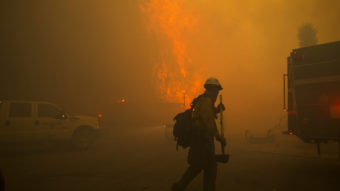
Out-of-control Southern California brushfire forces 80,000 to evacuate

A firestorm engulfs the Mormon Rocks area in the San Bernardino National Forest off State Highway 138 in Phelan, Calif., as the Blue Cut fire rages out of control Tuesday afternoon. (Photo by Gina Ferazzi/LA Times via Getty Images)
A firestorm engulfs the Mormon Rocks area in the San Bernardino National Forest off State Highway 138 in Phelan, Calif., as the Blue Cut fire rages out of control Tuesday afternoon.
(Photo by Gina Ferazzi/LA Times via Getty Images)

In southern California, an out-of-control wildfire that ignited Tuesday in a mountain pass east of Los Angeles has forced mass evacuations and destroyed an untold number of homes and businesses.

The Blue Cut fire is just the latest inferno to plague the historically dry state. In recent days, fast-moving wildfires have raced into mountain towns and even whole cities, blackening more than 300,000 acres and destroying hundreds of homes and structures.

What sets the Blue Cut fire apart is not its explosive growth – it’s the sheer number of people under mandatory evacuation orders. Initial estimates from the U.S. Forest Service put the number above 80,000. There are believed to be more than 34,000 homes in its direct path.

Complicating the evacuation efforts even further, one of the region’s most important east-west routes, Interstate 15 through the Cajon Pass, is closed indefinitely due to the fire. It’s not clear whether some people were unable to leave the area which is under threat. But fire officials say several firefighters had to shelter in place while trying to save a home as the fire raced through a neighborhood. Two were treated for minor injuries, according to the Los Angeles Times.

Meanwhile, shelters were being hastily set up in the region, as sheriff’s deputies from San Bernardino County went door to door in neighborhoods ordering people to pack up and flee.

“This fire is still raging out of control,” Tracy Martinez, a public information officer for the San Bernardino County Fire Dept. told the Times, saying it’s unknown how many structures have been lost.

Usually it takes hours, sometimes days, for crews to get in and fully assess the scope of the damage of major wildfires like this. California Gov. Jerry Brown declared a state of emergency in the county to free up state funds and other aid.

It’s the governor’s third such declaration in just over 24 hours. The others covered the Chimney fire that’s burned 6,900 acres and destroyed an estimated 40 homes near San Luis Obispo, and the 4,000-acre Clayton fire in northern California where authorities arrested a suspected arsonist in connection with the blaze late Monday.

Copyright 2016 NPR. To see more, visit http://www.npr.org/.

Man arrested on suspicion of setting Northern California wildfires

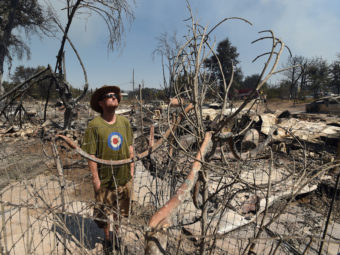
James McCauley looks over the burned-out remains of his residence in the town of Lower Lake, Calif. (Josh Edelson, Associated Press)

A 40-year-old man has been arrested on suspicion of setting the Clayton fire in Northern California, which officials say has burned more than 4,000 acres and destroyed more than 175 homes and businesses in the past few days.

Damin Anthony Pashilk of Clear Lake, Calif., is being held on suspicion of a total of 17 counts of arson in Lake County, Calif., over the past year. Lake County is a largely rural area of wineries and vacation homes about 120 miles north of San Francisco.

Damin Pashilk, seen here in a poster on display at a press briefing in Middletown, Calif., was arrested Monday for allegedly setting a wildfire that exploded over the weekend in the Northern California town of Lower Lake. (Josh Edelson, Associated Press)
Damin Pashilk, seen here in a poster on display at a press briefing in Middletown, Calif., was arrested Monday for allegedly setting a wildfire that exploded over the weekend in the Northern California town of Lower Lake.
(Josh Edelson, Associated Press)

Chief Ken Pimlott, director of the California Department of Forestry and Fire Protection, also known as Cal Fire, said in a statement announcing the arrest:

“The residents of Lake County have experienced senseless loss and endured significant hardship over the past year. Mr. Pashilk committed a horrific crime and we will seek prosecution to the fullest extent of the law.”

Cal Fire said the arson charges against Pashilk “will also carry enhancements due to the destruction of homes and businesses.”

The Clayton fire was named for the creek near where it began. On Saturday night, the fire reached the community of Lower Lake, forcing hundreds of residents to leave. The nearby community of Clear Lake, where Pashilk lives, also was evacuated. No injuries have been reported.

Cal Fire says more than 1,600 firefighters were fighting the blaze, which as of Monday night was 5 percent contained and threatened some 1,500 structures.

Copyright 2016 NPR. To see more, visit http://www.npr.org/.

Lower 48 wildfires prompts Alaska firefighters to help

More Alaska firefighters have gone to the Lower 48, as wildfires in western states there intensify.

State and federal firefighting agencies in Alaska report that five, 20-person crews were flown south Wednesday. They’re joining over 15 hundred people battling the Pioneer Fire in Idaho.

The agencies report that 2 dozen Alaska smoke jumpers and four crews, were earlier deployed to the lower 48. Alaska firefighting aircraft have also been going south, including helicopters, water and retardant dropping planes.

Murkowski discusses Trump, Tongass during Sitka stop

U.S. Senator Lisa Murkowski speaks to Sitkans at a campaign event in Sitka. (Emily Kwong, KCAW)

Alaska U.S. Sen. Lisa Murkowski spoke to a group of constituents over pizza and beer at Baranof Island Brewing Co.
Murkowski kept her remarks brief and circulated through the crowd, talking one-on-one with attendees. Many were wondering which presidential nominee she preferred, Trump or Clinton?

Murkowski hasn’t made up her mind. She has great concerns about some of Clinton’s policies and has issues with Trump in general.

“I’m not a fan of Donald Trump,” Murkowski said. “He’s made statements and raised opinions that I certainly can’t defend. In fact, some of them I find offensive. I am looking a long with a lot of Americans to see, OK, going forward in these next few months – what is he going to be laying down? What is he going to be putting down in terms of policies. How is he going to assure me as a woman, how is he going to assure me as an Alaskan who represents a state like ours, how is he going to assure me that he is going to make our nation safer?”

It’s not all about the presidential race. At the Capitol, Murkowski chairs the Senate Energy and Natural Resources Committee.

“Which essentially makes her one of the most powerful people in the world when it comes to climate change solutions,” said Sophie Nethercut, with the Sitka Conservation Society. Many Sitkans wanted to speak to the senator about the environment, climate change and the state’s dependence on oil.

“Hopefully we’ll be able to talk about how electric vehicles here in Sitka can fit into the climate change picture for Alaska,” Dave Nicholls said.

Murkowski floated around the room, talking to people one-on-one about their concerns.

“I think we need to recognize that we are a state that has been built off of our resources,” Murkowski said. “We are a resource-rich state, and so how we access our resources to the benefit of Alaskans and to the benefit of a larger community is important to the success of our economy. Right now I think we all acknowledge that with the price of oil and with the downward trajectory on projections, it is not something that we can count on with any reliability.”

While we can’t control oil prices, the state has the ability to control production on state land, she said. The problem is that roughly 60 percent of Alaska is owned by the federal government.

“It took Conoco close to seven years to get a permit to build a bridge. There is more that we can do to be a more cooperative process to gain access to the resource.”

Murkowski responded to questions about the Tongass Land Management Plan.

Three Sitkans served on the Tongass Advisory Committee, or TAC, which recommended a plan for transitioning logging from old growth to new growth trees. Murkowski proposed legislation that would halt the transition until a full inventory of the Tongass is completed.

“All I’m asking for is that we have an honest inventory,” Murkowski said. “There have been some that have suggested that it is my attempt to stop the TAC recommendations. That is not the case, that is not the plan, what I want to do is make sure that this transition that we’re moving to with young growth is, in fact, based on the good analysis that we will receive through this comprehensive inventory that was a direct recommendation of the TAC.”

Bill would speed Tongass-Mental Health Trust land trade

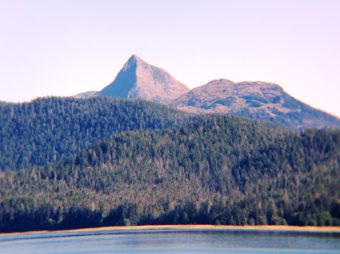
A mountain peak rises above the Tongass National Forest northeast of Sitka Aug. 3, 2016. (Photo by Ed Schoenfeld/CoastAlaska News)

A bill before Congress would speed a timberland trade between the federal government and the Alaska Mental Health Trust. It’s part of a larger legislative effort to increase logging in the Tongass National Forest.

The Alaska Mental Health Trust uses its land to make money to fund programs around the state.

Grants go toward counseling, housing, employment and other assistance to those with mental illnesses, developmental disabilities, chronic substance abuse and dementia.

It owns a million acres, about a quarter of it in Southeast.

Wyn Menefee of the trust lands office said it wants to exchange a little more than 18,000 of those acres that face opposition to development.

“Certain lands that we own next to the communities would be given to the Forest Service. In exchange, the trust [would be] receiving some lands that are more removed from the communities, that would allow development,” he said.

The land is in or near Ketchikan, Juneau, Petersburg, Wrangell, Sitka and Meyers Chuck, on the mainland between Wrangell and Ketchikan.

Southeast Alaska Conservation Council attorney Buck Lindekugel agrees those areas should be closed to logging.

“Some of the parcels that the trust has already received — above Mitkof Highway near Petersburg and Deer Mountain in Ketchikan — are very high-value public-use areas. And there’s been a lot of concern about their development,” he said.

In return, the trust would get about 21,000 acres of timberlands of equal value elsewhere in the Tongass.

Menefee of the trust lands office said the acreage would be near a different part of Ketchikan, and on Prince of Wales Island.

The Tongass National Forest includes most of Southeast Alaska. (Image courtesy U.S. Forest Service).
The Tongass National Forest includes most of Southeast Alaska. (Image courtesy U.S. Forest Service.)

“By making land that we can actually use for timber harvest or for some other purpose available to us where we don’t have conflicts with cutting behind a community or something like that, that does make the asset available or the land available and the resources available for us to use for financial benefit,” he said.

SEACC’s Lindekugel said some listed parcels on or near Prince of Wales should not be part of the trade.

He calls one a wild and scenic river corridor near the El Capitan Lodge, off the northwest part of the island. Another is a cave-rich parcel near the small town of Naukati that includes a cavern that may have cultural value.

But he said he’s optimistic those will be replaced.

“So far the trust has been willing to work with folks to avoid those areas of high conflict and we’re hoping that we’re able to continue and resolve those issues,” he said.

The mental health trust and the Forest Service negotiated the land swap about a year ago. It’s already working its way through the bureaucracy.

The trust’s Menefee said the trade, and subsequent timber sales, would allow more than income for the trust. He said it will provide logs for the region’s mills, which owners say don’t have enough to continue operations much longer.

“In order to make this exchange happen in a reasonable time frame, it needs legislation. Because if you do it through the normal administrative process, it could be seven years or something like that before we get an exchange completed,” he said.

U.S. Sen. Lisa Murkowski filed the Alaska Mental Health Trust Land Exchange Act in late May.

“It was not a question of whether or not the exchange should move forward, but simply to the point of how are we going to assess the value,” she said.

The measure is one of a group of recent Murkowski bills meant to increase Tongass logging.

Another would create five new Alaska Native corporations, each with 23,000 acres of forest land to develop. Other provisions would allow two existing Native corporations to sell or swap property that’s been logged.

Sitka Conservation Society executive director Andrew Thoms said Murkowski’s bills will hurt the Tongass.

“If you look at all these pieces of legislation, there’s a huge potential for a lot of impacts to the remaining forests on Prince of Wales Island. And the potential for a lot of impacts to the high-value, salmon-producing watersheds around the Tongass that are in a state of protection that could be opened up by this legislation,” he said.

He’s particularly concerned about a provision allowing Sitka’s local Native corporation to sell 23,000 acres of land to the Forest Service. It’s in Admiralty Island’s Cube Cove.

“And now, in this situation, the government would buy back the lands that were logged? And Shee Atiká made a profit on them? It’s a strange situation,” he said.

Shee Atiká President, CEO and board chairman Ken Cameron said the Forest Service wants the acreage because it’s an inholding surrounded by a national monument.

“Congress has appropriated $4 million for the first phase of the acquisition, and the appropriation of the rest of the purchase price will be as government funds are available,” said a corporate press release. “The government’s reacquisition of Cube Cove is anticipated to proceed in installments as Congress appropriates funds for the purchase.”

The Forest Service isn’t commenting on the legislation, other than to say it will do Congress’s will.

“The bottom line is our actions will be guided by the legal mandates resulting from legislation,” said Tongass spokesperson Kent Cummins in an email.

SEACC has said proceeds from the sale would allow the corporation to purchase other federal land, possibly on Prince of Wales Island. But Cameron, who would not speak on tape, said its board has not decided what it would do with the proceeds.

The Sealaska regional Native corporation owns subsurface mineral rights at the Cube Cove property. Murkowski’s legislation would swap it for about 14,000 acres of forest on Prince of Wales Island.

“Sealaska identified potential lands to exchange at Lancaster Cove on Prince of Wales Island that are adjacent to other Native-owned lands. Some of these lands were originally considered in the Sealaska land entitlement bill,” said a prepared statement from the corporation.

“It said such a trade remains subject to negotiation with federal agencies.

A bill transferring about 70,000 acres of the Tongass National Forest to Sealaska passed Congress in 2014. It was described as completing the corporation’s land selections, but did not exclude further trades.

Site notifications
Update notification options
Subscribe to notifications