Timber

Dam on slough helps Big Delta man protect home along Tanana River

Big Delta resident Tom Gorman said a small dam he built earlier this year to protect his home from the meandering Tanana River held steady over the past couple of weeks as the river rose to near-flood level, due to recent rains.

Gorman now hopes the river falls quickly enough to allow him to finish work on the dam before snow flies.

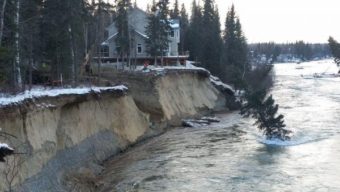
Gorman stands at the edge of a 20-foot-wide slough off the Tanana River that runs along the foot of a ridge on which he built his house about seven years ago and said this isn’t how it looked back then.

“Last year, it was dry!” Gorman said.

A couple dozen trees used to grow in and around the area, Gorman said, which served as a sort of buffer between his big three-story house and the Tanana River some 45 feet away. Until January, that is, when an ice dam on the Tanana diverted a torrent of water into the area that tore out the trees and gouged into the riverbank, threatening to undercut the ridge where his house sits.

“And that just came in and just took ’em out, one at a time – pow! Two hours later, another one – bam!” he said. “It just got behind ’em, the erosion behind ’em, and just ripped ’em up.”

That was near the beginning of an ordeal that lasted for several weeks, as Gorman and a small army of friends, neighbors, contractors and others tried to bust up the pile of thick ice slabs.

They attempted to melt it with a de-icing solution; they tried to bust it up with a 5,000-pound weight dropped from a helicopter; they even detonated explosives to blast it open. Nothing worked.

“No – well, not on 3-, 4-foot (thick) ice,” Gorman said. “That’s what you had over here, all the way across.”

Gorman said state and federal officials for the most part supported his effort to save the house. He didn’t get any help from his homeowner’s insurance company, he said, but he got lots from dozens of volunteers from all around the area.

“The community’s helped me out,” Gorman said, “And they really pulled together.”

Gorman, a retiree from Texas, said the cost of trying to break the ice jam further strained his finances, which he’d already deeply tapped to buy the land and, in 2009, build a house for his family, which includes his wife and elderly mom, disabled son and daughter with kids.

Why did he build his dream house so close to the river? Gorman said he’s been asked many times:

“We were safe,” he said, “we were really safe when we built this house.”

Gorman followed advice on where to build given by his contractor and two neighbors, both of whom have lived along that stretch of the river for more than 40 years. But the ice-jam backup surprised everyone, he said as he shows photos of river water tearing through the slough and frantic efforts to slow its destruction.

“It came around this way, and it starts cutting in here,” he said. “It cut in here and fell down. It cut and just headed right toward the house.”

When the ice jam finally gave way, he and his had crew a chance to bring in equipment to shore up 150 feet of riverbank with big rocks, Gorman said, and to build an 8-foot-tall dam across the slough.

“What this dam did here was to really stop the current,” Gorman said. “Once the current was stopped, then I could get in here and do something.”

When the river rose a couple of weeks ago, he saw that the dam, which is built of interlocking concrete barriers, wasn’t quite high enough. So he laid a course of sandbags on top it to slow the flow to trickle.

“It’s holding,” Gorman said, “but it’s not done. It has to be completed.”

But he can’t bring equipment back in until the river drops and the area dries out.

“The water has got to go down, because what happens is you put the equipment down there and it’s so soft that it’s going to push the dam away,” Gorman said.

Gorman said that may not happen before the first snow flies two or three months from now. He said he’d prefer to do the work before winter sets in, but if he runs out of time, he’ll pay the extra cost of doing the work in the winter to save his home.

Tongass Forest Plan amendment prompt objections

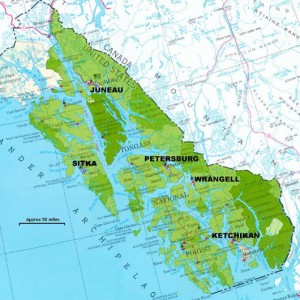
The Tongass National Forest makes up most of Southeast Alaska (Courtesy U.S. Forest Service)

The U.S. Forest Service announced its plan for a 16-year transition toward young-growth Tongass timber harvests in late June. In the midst of the 60-day comment period, industry and environmental groups are starting to submit their objections.

Both the industry and environmental groups on either side of the Tongass Land Management Plan amendment can agree on one thing: the Forest Service needs to complete a full inventory of young-growth Tongass timber.
But their reasons are fundamentally different.

“We have really been working hard to try to show the Forest Service that there is a quick exit out of old-growth logging on the Tongass,” said Geos Institute chief scientist Dominick DellaSalla.

“Our biggest concern is that we don’t believe that the young growth is big enough right now, nor is there enough acreage of young growth to support a small-log mill,” Owen Gram of the Alaska Forest Association.

Both agree that an inventory of the Tongass’ young growth needs to be completed to better inform the Forest Service’s transition to young-growth timber sales. The management plan amendment does allow some old-growth harvests for specialty products.

DellaSalla has formally submitted an objection to the amendment. He said the institute’s assessments concluded there’s enough young growth to complete the transition in nine years. He said the Tongass could supply 50 million board feet per year in four years.

“You’ve got enough young growth that is going to be a wall of wood by 2020 and you can avoid a wall of litigation by continued old-growth logging. But, unfortunately the agency is slow-walking the transition,” said DellaSalla.

He said by 2025, that number will grow to 95 million board feet per year. The Forest Service plans to offer about half of that projection at the end of its 16-year transition.

The Forest Association is working on an objection. Gram said the amendment won’t allow Southeast timber mills to be competitive with mills in Oregon and Washington that process young growth.

“The sawmill people tell me that the only thing they can produce is the lowest grade of commodity lumber, construction-grade lumber,” said Gram. “And, there’s tons of that being produced down in the Pacific Northwest right now out of young growth logs, and they are 800 miles closer to the market place then we are, so we’re at a big disadvantage.”

Gram said it would take about 350 million board feet to sustain the Southeast timber industry.

He said mills have traditionally gravitated towards old-growth timber because it can be used to produce several different high-quality products, offsetting transportation costs. Gram acknowledges a transition is necessary, but wants to hold off another 30 years.

“You know, I think we would convert over to 100 percent second growth once the trees are mature. That’s always been the plan,” said Gram.

Gram said waiting until young growth stands are about 90 years old, instead of the 60-year benchmark, will allow mills to produce several products and boost volume, making Southeast mills competitive.

DellaSalla said the Geos Institute approached the Forest Service earlier this year about a pilot project that could solve that problem. It would test new saw technology on smaller logs.

“This would have been implemented on Prince of Wales Island at the Dargon point sales – would have been process or at least scanned with new technology that would have at least started the process of how can you process these smaller logs on the Tongass and get profit out of them,” said DellaSalla.

He said Good Faith Lumber in Craig was interested in the project, on the northwest part of the island, but the Forest Service turned it down.

The final Record of Decision is expected before the end of the year. The objection period ends Aug. 29.

Several calls to Tongass Forest Supervisor Earl Stewart were not returned in time for this report. The environmental firm Earth Justice expects other groups to file objections.

Why a Canadian timber company stopped selling to Haines

The Stump Company timber operator in Haines
Local Haines timber operator The Stump Company at work in October 2015. (Photo by Emily Files/KHNS)

Dozens of Haines residents, who buy firewood from Canadian company Dimok Timber, will have to look elsewhere for their fuel source this winter. The company, located near Haines Junction, has been asked by the Haines Borough to pay sales tax and obtain a business license. But the owners say they shouldn’t have to because all sales are taking place outside the borough, and the country, for that matter.

The borough attorney weighed in earlier this month, supporting the borough’s decision. So, with both sides at an impasse, the company says it’s done with the Chilkat Valley.

Dimok has been doing business in Haines for a decade. Each year, it sells hundreds of cords of wood to residents who use it to heat their homes. Dimok owner Dorothy Clunies-Ross says customers continue to reach out to her about their displeasure, but, she says, there’s nothing more they can do.

“We’ve had a number of calls and emails and nobody is pleased,” she says.

She says if the borough rescinded the request for the Yukoners to collect and pay borough tax, they would consider coming back.

“We don’t feel that we have any right to actually collect tax. We’re a Canadian company, we’re a Yukon company. It just doesn’t seem right that they should put this pressure on us, because we don’t feel that we can comply, legally. We’re not a U.S. corporation.”

Dimok says for 10 years it would meet its Haines customers on the Canadian side of the border to purchase firewood. The customer was responsible for importing the wood and other paperwork. But Dimok representatives would physically drive the product to the desired location, escorted by the customer.

“We had a working relationship with customs, we were doing everything according to their rules,” she says. “So, there was no problem with the wood itself.”

The beetle-killed spruce is dry and ready to burn, which is why so many in Haines liked it. Clunies-Ross says Haines customers made up about 10 percent of their overall business.

“We’re not going to go under because of this, but when you’re in business, you make your projections based on your customer base and so, this definitely has affected us.”

Dimok is now in the process of letting its Haines customers know that they won’t be providing firewood anymore.

But some customers aren’t taking this development sitting down. Earlier this week, Steve Virg-In, who is a customer and a personal friend of the owners, wrote letters to the governor’s office, the attorney general, and the commissioners of revenue and economic development for the State of Alaska. He says he doesn’t believe the borough has the right to demand local tax from a foreign corporation. He calls the act an overreach of authority.

He wrote a letter to the borough and in it, he says he feels their demand for the tax is “politically, personally or monetarily motivated.”

The borough is shooting themselves in the foot, he says, because they’re also losing a dry source of wood for the upcoming biomass project.

Haines manager Bill Seward says the borough is within its rights to ask the business to pay.

“So, our position has essentially remained the same and the interpretation of our attorney is that Dimok is subject to our tax given the way they currently do business in Haines,” he says. “Now, should they change their business model perhaps to incorporate a common carrier for delivery of their product, that would change.”

In a response to an appeal from Dimok last week, Seward, with the help of the borough’s attorney, wrote that “the borough’s sales tax is to be ‘broadly interpreted’ in favor of taxability.” He went on to say that even though the transactions happen outside the borough, the product is driven into the borough and delivered in Dimok trucks. Therefore, the company must collect sales tax from its customers and pay the borough accordingly, the letter said.

“That was our hang up, was that they bought the product from a Canadian company,” Seward says. “The same company isn’t using a common carrier, they’re delivering it themselves.”

Seward says he’s gotten plenty of calls and emails from upset residents, but he adds it would  be “foolish to not embrace the legal advice of our attorney.”

He says borough staff became aware of the discrepancy in 2014, eight years after Dimok starting selling wood to Haines customers.

In an interview with KHNS last month, owner John Clunies-Ross said he had been threatened with fines and jail time if they didn’t start paying sales tax. He says he’s not interested in fighting with bureaucrats and so, the relationship between Dimok and Haines has been extinguished.

Timber bill signed, but will it make a difference?

Gov. Bill Walker poses with mill workers July 16 at Viking Lumber in Klawock. He's holding a bill he signed that could increase the mill's timber supply. (Photo courtesy the governor's office)
Gov. Bill Walker poses with mill workers July 16 at Viking Lumber in Klawock. He’s holding a bill he signed that could increase the mill’s timber supply. (Photo courtesy the governor’s office)

Gov. Bill Walker has signed legislation he says will provide more timber for Alaska’s mills. But it probably won’t be that much of an increase.
Walker inked Senate Bill 32 at Viking Lumber, in Klawock, on Southeast’s Prince of Wales Island. State officials say it’s Alaska’s largest operating mill.

Its owners have said they’ll have to shut down next year if they can’t harvest more timber, a claim challenged by the Forest Service and some environmental groups.

At the signing ceremony, Viking’s Kurt Dahlstrom said the bill will help.

“What it allows is the state to negotiate large timber sales with customers that want to saw the lumber. So this bill’s good for us because in the future we may be able to pick up a very big sale from the state that will last us a year or two,” he said.

Gov. Bill Walker shakes hands with workers inside the Viking Lumber mill July 16 in Klawock. (Photo courtesy the governor's office)
Gov. Bill Walker shakes hands with workers inside the Viking Lumber mill July 16 in Klawock. (Photo courtesy the governor’s office)

State timber sales are often small, since there’s a limited amount of forest available.

The governor signed the measure July 19 in front of about 25 mill workers.

He said it’s part of a larger administration effort.

“To me it’s all about jobs, it’s all about economy. So I will be extremely aggressive, I have been, on everything I can do to make sure this young man has plenty of timber opportunities to make this mill an ongoing generation of successes,” he said.

Walker and others say the bill will help the state replace Tongass National Forest timber, which has been less available in recent years.

But Regional Forester Beth Pendleton, in an earlier interview, pointed out that Viking is logging one substantial timber sale and can bid on others so it has enough logs to stay open.

The bill removes some limits on state sales.

Division of Forestry Director Chris Maisch said that allows his staff to negotiate terms guaranteeing more logs go to mills, rather than export.

“It allows us to consistently use this authority anywhere statewide. So it really doesn’t change the length of time or the amount that could be sold,” he said.

Read the state forest plan for timber sales.

The legislation is not without critics.

Many environmental groups have called for an end to logging, to preserve fisheries habitat and allow the forest to store more carbon, slowing climate change.

Southeast Alaska Conservation Council attorney Buck Lindekugel said it’s unfortunate the bill focuses on the Klawock mill. He said SEACC’s examination of Forest Service records shows it’s been shipping too much of what it logs overseas.

“We think there’s a little irony involved here where the state is going to be spending more money at a time of fiscal distress to make state timber available to Viking Lumber when the records show that Viking has been exporting nearly 55 million board feet of timber cut from the Tongass over the past six years,” he said.

State Forester Maisch said overseas sales are part of logging in Southeast. That’s because foreign buyers pay more than in-state mills.

“So some of the wood could find its way into the export market. But that will help the mill because they’re getting a big return for those logs. They’ll saw the ones that they can make money on and still will make money on any logs that are not sawed there,” he said.

He said the way the bill changes negotiated-sales rules will reduce the amount exported.

SEACC’s Lindekugel has his doubts.

“It’s really tough to predict how this is going to make a difference. But we know it costs the state a lot of money to offer these timber sales. So, it’s no free lunch,” he said.

Maisch said the rule change will actually save the state time and money. But he said it will reduce revenues, since fewer logs will be going overseas.

Debunking 3 myths Of wildfire safety

(Photo by Ian C. Bates)

Editor’s note: Anna King’s reports from the 2015 wildfires in Washington state earned national recognition in breaking news and crisis journalism. We asked our Richland correspondent to reflect on fire, safety, and what’s changed over the years. –Phyllis Fletcher

Last year I saw a lot of fire.

Fire in Walla Walla.

Fire in Chelan.

Fire in Twisp and Omak.

I’ve covered fires for more than a decade. The wildfires I’ve been seeing recently appear increasingly larger and more unpredictable, and draft more manpower than the ones I recall from early in my career. Several dry and drought years haven’t helped.

(Photo by Anna King/Northwest News Network)

Last year as I took photos and conducted interviews in downtown Chelan I felt relatively safe even with ash falling on my shoulders like snow. In the smoky haze near Twisp and Omak, I had some scary moments up mountain roads with no chainsaw or shovel, and no clear way out, that made me question my safety. I decided to get a reality check this year and learn more.

Myth #1: If you stay in the black you’re fine.

Firefighters say: Not always!

When a fire rolls through a landscape it can burn things down to the nubs, leave trees standing or miss whole patches of forest or desert landscape. Keeping to “the black,” I found out, is better than being in front of a fire — but it won’t always be safe.

Tod Kreutz, a battalion chief with the City of Kennewick, said there’s something called a “dirty burn” where some of the shrubs and trees are burned over — but the fire misses other parts of the fuel. And it can come back through again.

Another problem firefighters encounter is that stumps can burn and smolder underground for weeks or months after a fire has passed through.

“You may think you are just walking on burned out black land but you can actually step in a stump hole,” Kreutz said. “We have firefighters who step in hot stump holes and get burns up to their knees.”

(Photo by Ian C. Bates)

Also snags are a problem. Kreutz said a snag is a tree that has burned, but is still standing and can fall at any moment.

“Having witnessed that before, there is no warning,” Kreutz said. “It’s not like you hear this creaking sound and you look up, you’re walking by and all of a sudden, boom, there’s a tree on the ground.”

Sometimes it can crack halfway up and drop without warning. On my folks’ ranch we used to call those “widowmakers.”

So, being in the black is no guarantee of safety.

Myth #2: If you’re in the city on cement with firefighters you’re safe.

Firefighters say: Nope.

When I saw Costco-sized fruit warehouses go down, surrounded by concrete and made of concrete and steel, it messed with my brain on where wildfires go and how they behave.

(Photo by Anna King/Northwest News Network)

In Canada, Brad Grainger, Deputy Chief of Operations for Wood Buffalo, said he never planned to be on the front edge of the worst natural disaster his country has ever seen. But in Fort McMurray, Alberta more than 2,000 homes were destroyed in his community by a wildfire so large and powerful it created its own weather. He acted as the chief of operations for the emergency operation center during the fire. He said even trees that normally don’t burn, burned this year.

“This fire behaved very differently than they usually do,” Grainger said.

He also compares his area to Northwest cities like Seattle, Portland, Boise and Spokane. All those cities also have a growing fringy edge of residential and commercial property that intermix with timbered rural areas or fuel-loaded sagelands.

Grainger said his community has now logged and cleared a 100-foot-wide swath around its entire urban area to help stop future wildfires. City managers in Fort McMurray are also rethinking the way they manage vegetation in their urban parks; they are thinning some growth and removing downed and dead timber.

In Washington last year, near Chelan and Wenatchee, I saw where embers had floated across the Columbia River carrying the fast moving fire with it. It burned through irrigated fruit orchards, baking apples right on the tree.

(Photo by Anna King/Northwest News Network)

As more people in the Northwest are building into remote areas, fire managers say we create a larger fringe of development meeting wilderness — and the firefighting jurisdictions get fuzzy.

Grainger said city firefighters know how buildings behave, and wildland firefighters know how wildlands behave — but these new fires behave differently than what we’ve seen before. And on the cusp of urban-meets-rural things can get messy, especially when a fire is growing rapidly or is being pushed by thunderstorms or its own weather.

In Canada, Grainger said it wouldn’t have mattered how many helicopters, retardant-laden planes and engines had been put on the fire that took down a large swath of his community.

“This fire was moving so fast, even when we had all the resources within 24 hours, we were still unable to stamp it back,” he said. “We lessened what it did; that’s it.”

Myth #3: If you lose your escape route you can call 911.

Firefighters say: Not necessarily.

Working near active fires is hectic. There’s a lot going on, tracking the fire is confusing and early fire maps are often sketchy.

Kreutz, the Kennewick battalion chief, told me that listening to radio scanners doesn’t really help civilians as the information might be coded or too fast-changing for dissemination to the public. Also, maps might not show all the forest roads and remote farming roads one could encounter on the landscape.

“If you don’t know the area, you’re going down a gravel road and you can see the fire out in front of you,” Kreutz said, “do you really know your escape route? Do you know where the fire really is? A lot of times firefighters are setting additional fires to back-burn.”

Some roads are dead ends or unsigned in the hills. And — as I know well — there’s often no service on your cell phone.

(Photo by Anna King/Northwest News Network)

Best bet? Watch official firefighting channels on social media, and look for emergency management alerts to know where to go and what to do. If, like me, your job takes you close to the action, stick with firefighters or locals who know the terrain. Know your way out–or several ways out.

Further, Kreutz said firefighters can’t find and save you if there’s too much smoke, or if you don’t know where you are.

Also, in the case of the fire this year in Canada fire, 911 might be overwhelmed with callers.

When I saw the Taylor Bridge fire near Cle Elum in 2012, I thought that was a big one. Then, when we had the Carlton Complex near Twisp in 2014, again we journalists thought we had seen something unusual. Last year on the fires in Walla Walla, Twisp and Omak — I started to realize …

(Photo by Anna King/Northwest News Network)

… for the foreseeable future maybe fires in the West are just going to be bigger and badder. Canadians call what hit Fort McMurray “The Beast.”

As we encounter a new type of wildfire that burns between wilderness and population centers we need to learn quickly, stay safe and prepare as much as we can.

Anna King tweets from @AnnaKingN3

Forest Service moves forward with Tongass second-growth transition

A Tongass National Forest clearcut is shown in this 2014 aerial view. A new court decision limits logging on roadless areas of the forest. (Photo by Ed Schoenfeld/CoastAlaska News)

The U.S. Forest Service moved forward Thursday with plans to transition to second-growth harvest on the Tongass National Forest within 16 years. The draft record of decision represents a compromise that won’t leave anyone completely happy.

Tongass Forest Supervisor Earl Stewart has chosen Alternative 5 for the proposed Tongass Land Management Plan amendment.

What does that mean? Well, there’s a lot of detail in the draft Record of Decision, but the main point is that during the transition, the U.S. Forest Service will offer an average of 46 million board feet of timber on the Tongass National Forest per year.

For the first decade, that will include more old-growth logging than second growth – almost three times as much. But then from years 11-15, the ratio will flip, allowing more young growth harvest and limiting old growth.

By year 16, timber stands offered for logging will be almost 100-percent young growth, with a few microsales of old growth for specialty products.

Concurrent with Stewart’s announcement was a flurry of news releases from various groups. Trout Unlimited Alaska likes the decision because it protects more salmon streams; but various conservation groups are unhappy, and say that the transition should be faster.

On the timber industry side, Owen Graham of the Alaska Forest Association said the transition needs to slow down.

“We’ve always agreed that there needs to be a transition, but we wanted the trees to reach maturity, which is 30 years in the future,” Graham said. “If they cut the trees now, over the next 10-15 years, then they’ll be too small to be properly sawn in the sawmills, and they’ll just end up being exported to China.”

Graham said that the old-growth harvest planned during the transition isn’t adequate to maintain the few remaining sawmills. He added that a full inventory of young growth trees is needed before formalizing the amendment.

“To do this transition right now is purely politics and all the rubbish that people are making up that it’ll work; it’s all rubbish,” Graham said. “They know perfectly well that it won’t work and they don’t care.”

Dominick DellaSala, though, said it has worked in his state. He’s a scientist with the Geos Institute in Ashland, Oregon, and also is unhappy with the draft Record of Decision. But his complaint is that the proposed transition is too slow, and will not do enough to combat climate change.

“I think the Forest Service is missing an opportunity here because they’re basing (their decision) on old-school forestry and antiquated log processing techniques,” DellaSala said.

DellaSala, who advocates for a transition within five years, said there are new technologies that will allow mills to operate profitably with young-growth trees. He said Good Faith Lumber on Prince of Wales Island tested that equipment, and it worked, which shows mills that are willing to adapt can survive a transition.

The Tongass plan amendment has been in the works for a few years, ever since Secretary of Agriculture Tom Vilsack directed the Forest Service to transition to young growth. Part of that process was the formation of the Tongass Advisory Committee, or TAC: a group of 15 representatives of Southeast conservation, tribal and timber industry groups.

Andrew Thoms of the Sitka Conservation Society was one of the TAC members, representing environmental interests.

“As a conservationist, I’d love to see the Forest Service get out of old growth right now, but our involvement in the advisory committee really followed this ethic of trying to come up with a collaborative solution and make Tongass management work for all the stakeholder groups,” Thoms said.

Thoms said Alternative 5 protects high-value habitat and provides a road-map for a full transition to young growth. He added that dissatisfaction on the part of some timber industry representatives and some conservation groups indicates that the decision is a true compromise.

There has been some concern by Alaska’s congressional delegation that the amendment is moving forward before a complete inventory of young growth is complete, and there is pending legislation to delay the transition. But Tongass Forest Supervisor Stewart said that isn’t an impediment.

He said the Forest Service considered hundreds of thousands of comments on the issue, along with the TAC recommendations and input from scientists.

“We believe we have enough information at this time to go forward with the forest plan amendment, yet concurrently we will continue with the inventory for more on-the-ground decisions,” Stewart said.

And if that inventory shows there isn’t adequate young growth to support the industry, Stewart said there is flexibility within the Tongass Land Management Plan to evolve.

You can read the draft Final Environmental Impact Statement and Record of Decision here. The link also provides information on how to comment.

A final Record of Decision is expected by the end of the year.

Site notifications
Update notification options
Subscribe to notifications