Timber

Supreme Court won’t hear Tongass Roadless Rule exemption

A Tongass National Forest clearcut is shown in this 2014 aerial view. A new court decision limits logging on roadless areas of the forest. (Photo by Ed Schoenfeld/CoastAlaska News)

The U.S. Supreme Court will not take up a case that could have expanded logging in Southeast Alaska’s Tongass National Forest. It’s the final step in one legal battle involving what’s called the Roadless Rule.

About 15 years ago, the U.S. Forest Service issued a ban on logging, roadbuilding and some other development in many of the wilder lands under its jurisdiction.

Put in place at the end of the Clinton administration, it targeted areas without roads and became known as the Roadless Rule.

A portion of the Tongass National Forest along Peril Strait is seen from the ferry Chenega in Sept. 3, 2015. (Photo by Ed Schoenfeld/CoastAlaska News)
A portion of the Tongass National Forest along Peril Strait is seen from the ferry Chenega Sept. 3, 2015. (Photo by Ed Schoenfeld/CoastAlaska News)

It quickly attracted the scrutiny of the first Bush administration, which delayed its implementation. About two years later, that administration announced an exemption for Alaska’s Tongass – and later Chugach – National Forests.

Legal battles ensued and that exemption was upheld, struck down and appealed.

The latest – and final – action in the case came from the U.S. Supreme Court. It decided Monday not to hear a state challenge to a ruling against the exemption by the San Francisco-based 9th Circuit Court of Appeals.

Tom Waldo of the Earthjustice environmental law firm said that means roadless areas of the Tongass are protected.

“It just doesn’t make any sense to keep trying to build expensive new roads that no one can afford to maintain into the wild and remote parts of the Tongass,” he said.

Waldo and other Roadless Rule supporters say it protects salmon and wildlife habitat critical to the region’s tourism and fishing industries.

Owen Graham of the Alaska Forest Association trade group said the Supreme Court action delivers a substantial blow to a hard-hit regional economy.

“What the timber industry needs desperately is a timber supply. And this is one of a number of issues that are preventing us from having that timber supply,” he said.

State officials say they’re disappointed, but not surprised.

“Only about 4 percent of all petitions are ever granted review by the Supreme Court. So it’s always something of a long shot,” said Tom Lenhart, a state assistant attorney general involved in the case.

A separate state suit, filed in a District of Columbia court, challenges the whole rule, as well as its Alaska provisions. It claims the rule conflicts with terms of the Alaska National Interest Lands Conservation Act.

“We think very clearly that the Roadless Rule as applied to Alaska violates that federal law, which makes the rule invalid,” he said.

Southeast Alaska Conservation Council attorney Buck Lindekugel said that argument won’t hold.

“The Roadless Rule has survived many other legal attacks, like the State of Alaska’s, and we expect the Washington D.C. Circuit [Court] to uphold the Roadless Rule, just like the other courts have,” he said.

Even if that happens, the logging industry could try other approaches.

The forest association’s Graham said lawsuits are just one approach to increasing the amount of timber available for harvest. Another would be to seek congressional action.

“And then the other thing is we could just get a … federal administration that’s friendly toward responsible resource development and they can just rescind the rule because it’s an administrative rule. It’s nothing that Congress passed,” he said.

Tongass logging is a small fraction of what it was 20 or 30 years ago when the forest service regularly scheduled large timber sales and mills operated in Sitka, Ketchikan and Wrangell.

In recent years, the forest service has changed its focus from old-growth logging to harvesting younger trees.

U.S. Forest Service chief says no to delaying Tongass timber transition

Tongass National Forest
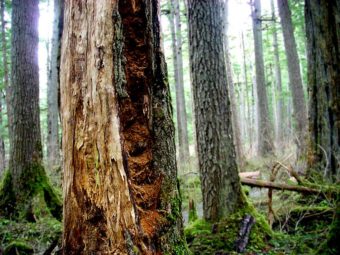
Part of the Tongass National Forest in April 2008. (Creative Commons photo by Xa’at)

The U.S. Forest Service is working on a plan to shift the timber industry in the Tongass away from old-growth trees. Forest Service Chief Tom Tidwell told the U.S. Senate Energy and Natural Resources Committee Tuesday that the plan can sustain Southeast Alaska’s timber industry.
“Without any question, I believe this approach that over time to transition to the young growth is the solution for us to be able to continue to provide (for) the integrated wood products industry in Southeast Alaska,” he said.

He faced skeptical questions from Sen. Lisa Murkowsk, who chairs the committee. Murkowski pointed out that the Forest Service hasn’t done an inventory of the newer stands, to prove commercial viability.

“So the question this morning is whether the Forest Service will consider postponing this transition until we have a complete young-growth inventory and a financial analysis that are completed in order to determine whether a transition is even feasible?” she asked.

Tidwell, essentially, said no.

“Senator, it’s essential that we move forward and complete the amendment to the forest plan,” he said.

Tidwell is under orders from the Agriculture secretary to expedite the Tongass transition. The Forest Service is working to have an amendment to its Tongass management plan by the end of the year before time runs out on the Obama administration. Tidwell put it in larger terms.

“Two decades of controversy and litigation around old-growth harvest and Roadless (rules), and that’s gotten us nowhere,” he said. He added that the Forest Service is working with stakeholders to develop new markets for the young-growth timber.

“New markets are good, chief, but you still have to have trees that are mature enough to harvest,” Murkowski responded.

Tidwell and Murkowski have had this argument at past hearings, too. He says the Forest Service will continue sales of old growth to serve as “bridge timber” during the transition. The senator told him constituents on Prince of Wales Island and elsewhere in Southeast believe the plan is unrealistic.

Watching the hearing was another group of Murkowski’s constituents — a small contingent of Southeast Alaska fishermen and guides, organized by Trout Unlimited. They came to Washington seeking protection for 73 areas of the Tongass they say are the most valuable habitat for salmon. Austin Williams, who works for the Alaska branch of Trout Unlimited, says he hopes the Forest Service preserves those areas in its amendment to the Tongass plan, and he doesn’t want the process halted while the government counts and measures the younger timber stands.

“We have an opportunity to get this plan amendment through in a way that provides some protection for high-value fish watersheds,” Williams said, after the hearing. “And we shouldn’t delay that out of concern for, you know, the inventory, at this point.”

Trout Unlimited and other conservation groups have been campaigning to protect this collection of watersheds, what they call the Tongass 77, for several years. They haven’t changed the campaign moniker, even after four watersheds on their list were removed from the Tongass in 2014, in the Sealaska land bill.

Conservation group says Obama should be tougher on Tongass

Tongass National Forest
Part of the Tongass National Forest in April 2008. (Creative Commons photo by Xa’at)

A federal proposal to make Southeast Alaska’s logging industry sustainable while preserving old growth in the Tongass National Forest does too little, too slowly, according to one conservation group. The Oregon-based Geos Institute says the Tongass National Forest draft plan is out of step with a global agreement to reduce climate change.

President Barack Obama visited Alaska in September to see the effects of climate change firsthand. Then, a few months later, the U.S. joined about 195 nations in signing the Paris Climate Change Agreement. The president has made reducing carbon emissions a talking point during his time in office.

“But his administration puts forth a plan that’s not ambitious enough,” said Dominick DellaSala, a scientist at the Geos Institute. What he’s referring to is the draft timber plan for the Tongass, which is open for public comment until February.

In a nutshell, the federal plan outlines dramatically reducing old growth logging while ensuring a sustainable supply of young growth trees. The problem, DellaSala said, is the plan isn’t aggressive enough.

“Those acres of trees over time being cut down would be equivalent to 4 million additional cars on Alaska roads every year,” DellaSala said.

That estimate is over a hundred years. The Geos Institute has been crunching the numbers with Forest Service data. DellaSala believes the transition from old to young growth logging could be done in five years, rather than 16. That’s what the plan is proposing.

DellaSala says trees soak up carbon dioxide from the atmosphere like a sponge. Essentially, a big stick of carbon.

“Now unfortunately, when a tree does fall in a forest and if it’s done by logging, you’re going to lose about 80 percent of that stored carbon,” DellaSala said.

Eventually, when it decomposes, it goes up into the atmosphere as greenhouse gas. And with old growth trees, DellaSala says you get more carbon.

With the Paris Climate Change Agreement, leaders came up with guidelines to slow global warming. They pledged to protect forests, like the Tongass.

“So it’s absolutely critical to everyone’s future that we keep those temperatures below that 4 degree Fahrenheit tipping point that most scientists believe that all hell will break loose in terms of climate change,” DellaSala said.

Owen Graham isn’t concerned with the Paris Climate Change Agreement. He’s the executive director at the Alaska Forest Association, a timber industry group.

“You know, I don’t really give a damn about the Paris, what they did over there with climate change,” Graham said.

Graham thinks the Tongass draft plan already transitions to young growth trees too soon. Any sooner could be devastating.

“That’ll put the local sawmills out of business. And it seems kind of pointless. It’s just cutting the trees early and exporting them,” he said.

Graham said most mills in the area can’t process the less valuable product. So the trees would likely be shipped overseas or down south, resulting in the loss of hundreds of regional jobs.

“The industry that we’ve had in Southeast Alaska has never been a big industry despite what you hear from some of the environmental groups,” Graham said. “We’ve never been a big industry and we’ve never had a significant impact on anything, let alone global warming.”

Dominick DellaSala said the goal of his report isn’t to reduce jobs. It’s to find alternatives.

“I think we need to demonstrate that with a pilot study that these young trees can be processed locally. They can add jobs and they can have value to them,” DellaSala said.

Forest Service reps said they need more time to review DellaSala’s report before commenting. But DellaSala says the clock is ticking. The president is wrapping up his term.

“This is not a legacy gift to Alaskans when we still have this much old growth on the table,” DellaSala said.

How much old growth is on the table? According to the plan, more than 43,000 acres by about the year 2117. That sounds like a lot. But it’s about a quarter of a percentage point of the entire Tongass.

The Forest Service is holding an open house on Jan. 19 to discuss the draft plan on the Tongass. It starts at 5 p.m. at the Juneau Ranger District conference room. Public comment ends Feb. 22.

Endangered species listing denied for Alexander Archipelago wolves

An Alexander Archipelago wolf. (Photo courtesy of the Alaska Department of Fish and Game)

Alexander Archipelago wolves in Southeast Alaska do not warrant an endangered species listing, the U.S. Fish and Wildlife Service announced Tuesday. The decision comes four years after a petition was filed by conservation groups asking for greater protection for the wolves.
They are known as Alexander Archipelago wolves, a subspecies of the gray wolf, and they range all over Southeast Alaska down to the British Columbia-Washington border. The population is estimated to be between 850 and 2,700 wolves, which is healthy according to the USFWS.

“In the majority of its range, the wolf population appears to be stable,” says Drew Crane, regional endangered species coordinator with the Fish and Wildlife Service.

The agency’s review compiled data on the wolf and its habitat from the U.S. Forest Service, the Alaska Department of Fish and Game, the University of Alaska Fairbanks and British Columbia.

It found that the population on Prince of Wales Island has declined 75 percent since the 90s due to hunting, logging and road development. Crane says the federal government is aware of that fact.

“We do have concern for the wolf population on Prince of Wales Island but Prince of Wales Island in general only constitutes 6 percent of the rangewide population of the Alexander Archipelago wolf,” he said.

In other words, a decline on just one island in the wolf’s total range doesn’t warrant an endangered species listing.

Larry Edwards with Greenpeace hasn’t read all of the 94-page decision yet but says logging and development in the region over the decades has negatively affected the wolf’s habitat.

“It’s very odd to us that the Fish and Wildlife Service acknowledges a 75 percent decline in the Prince of Wales wolf population and then basically writes that population off,” he said.

An ESA listing would have meant greater restrictions on hunting or trapping wolves and may have impacted logging or other development.

The management of Prince of Wales’ wolf population is the State of Alaska’s responsibility and they think the right decision was made with the report. Bruce Dale, the state’s director of wildlife conservation, says the overall population is in good shape.

“There’s no doubt that these populations are sound and will persist,” Dale said. “Throughout the area where they are distributed, they’ve been there for a long time, through a lot of change and we have no concern for this population.”

The state kept track of the island’s wolf numbers since the late 80s. A state study last summer found 89 wolves were on Prince of Wales and nearby islands, down from 221 the year before.

“But the densities that exist still on Prince of Wales Island and in Game Management Unit 2 are still amongst the highest in Alaska,” Dale said.

He says the state will continue to keep an eye on the island’s wolves and manage hunts accordingly.

The decision to not list the Alexander Archipelago wolf as endangered is the final act coming from the federal government for now.

Greenpeace’s Edwards says he doesn’t yet know what the conservation groups will do about the new decision.

Southeast’s year in review: ferries, logging and mining

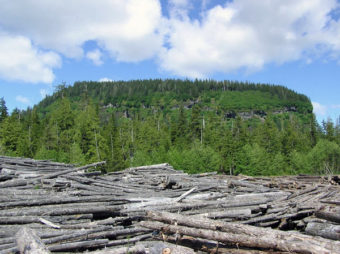
Three ferries dock at the Ketchikan Shipyard for repairs and upgrades in 2012. All ships would tie up by early July if the Legislature does not reach a budget compromise. (Ed Schoenfeld/CoastAlaska News)
Three ferries dock at the Ketchikan Shipyard for repairs and upgrades in 2012. Four of the 11-vessel fleet will leave service under a tentative plan released this fall. (Photo by Ed Schoenfeld/CoastAlaska News)


The year 2015 brought the beginning of major changes to the Alaska Marine Highway, the Tongass National Forest and the future of transboundary mines.
Ferry service cuts

The year began with plans to sail 11 ferries on a full schedule, from Bellingham, Washington, to Dutch Harbor/Unalaska, in the Aleutian Islands. It ends with four fewer ships and long gaps between stops at some small port cities.

Fast ferry Fairweather docked in Auke Bay (Photo by Ed Schoenfeld/CoastAlaska News)
The fast ferry Fairweather docks at Juneau’s Auke Bay ferry terminal. It and its sister ship have been tied up for the fall and winter. (Photo by Ed Schoenfeld/CoastAlaska News)

The state House and Senate passed operating budgets calling for drastic reductions in the face of declining oil revenues. Leaders from Railbelt communities questioned the system’s cost and value to commerce and travel.

The marine highway dodged a bullet at the end of the legislative session, when a last-minute compromise removed the deepest cuts, allowing the system to maintain most of its published summer schedule.

But that was a temporary fix. Fewer ships are sailing this winter, and deeper cuts will come in the summer.

Officials announced in June that they planned to tie up the fast ferries Chenega and Fairweather, as well as the mainliner Taku. A draft schedule released in October also put the Malaspina out of service during the fiscal year beginning in July. The final version, due out in January, may include some sailings from one of the fast ferries.

The schedule reflects cuts proposed by Gov. Bill Walker in his operating budget plan. The Legislature may make further cuts.

Tongass timber transition

The U.S. Forest Service developed plans to transition Southeast’s logging industry from old- to younger-growth harvests in 2015.

2-17-15 The Forest Service's Jason Anderson, left, talks with fisherman Kirk Hardcastle while Juneau Assemblymember Kate Troll reviews a report during the Tongass Advisory Committee meeting Feb. 17 in Juneau. (Ed Schoenfeld/CoastAlaska News)
Conservation representative Kirk Hardcastle listens while Juneau Assemblymember Kate Troll reviews a report during a Tongass Advisory Committee meeting Feb. 17 in Juneau. (Photo by Ed Schoenfeld/CoastAlaska News)

An advisory committee of business, tourism, Native and conservation leaders that began in 2014 continued meeting to draft recommendations on the transition.  It wrapped up its work in May and some, but not all, of its suggestions were incorporated into an updated Tongass land management plan.

That plan, released in November, calls for a 16-year transition to mostly young-growth logging.

Meanwhile, the Forest Service continued planning and scheduling timber sales.

The Big Thorne sale on Prince of Wales Island, one of the largest in years, made it past a court challenge in March. But a smaller Mitkof Island sale approved the same month was withdrawn in November in the face of legal challenges.

The Tongass also saw a change in its top leadership in 2015. Longtime Forest Supervisor Forrest Cole stepped down in April after 40 years with the Forest Service. He was replaced in May by Earl Stewart, who previously worked at Arizona’s Coconino National Forest.

Transboundary mining

Southeast Alaska also saw growing concerns in 2015 about transboundary mining.

British Columbia’s Red Chris project in the Stikine River watershed began full operations over the summer. A smaller mine, Brucejack, won permits needed to move toward construction and production.

B.C. Mines Minister Bill Bennett discusses the week's mine meetings as Lt. Gov. Byron Mallott and other state officials listen during a Wednesday press conference. (Photo by Ed Schoenfeld/CoastAlaska News).
B.C. Mines Minister Bill Bennett discusses transboundary mining as Lt. Gov. Byron Mallott listens during an Aug. 26 press conference. (Photo by Ed Schoenfeld/CoastAlaska News).

Lt. Gov. Byron Mallott started an internal state working group to study mine growth and its potential to damage salmon-rich rivers flowing from near mines into Southeast Alaska in February. He traveled to British Columbia in May to press the state’s concerns. And Bill Bennett, the province’s top mining official, visited Southeast in September.

As the year neared its end, the two governments signed an agreement to work together to address mine safety and pollution threats.

Critics, including tribal, fisheries and tourism leaders, said it lacked teeth. But Mallott said the state could only go so far.

Mining opponents continue to call for federal involvement that could strengthen Alaska’s options by sending the issue to the International Joint Commission, which takes on transboundary water disputes.


Tongass Forest advisers finish review of logging transition plan

Beached logs pile up in Shoal Cove on Revilla Island in the Tongass National Forest. A new report challenges old-growth logging spending in the forest. (Photo by Jim Baichtal/USFS)
Beached logs pile up in Shoal Cove on Revilla Island in the Tongass National Forest. (Photo by Jim Baichtal/USFS)

The Tongass Advisory Committee ended a 16-month series of meetings Thursday, formally completing its effort to advise the Tongass National Forest in a transition from old to young growth logging.

The committee met in Ketchikan last week to finalize its recommendations to the U.S. Forest Service and review the agency’s draft Environmental Impact Statement for a forest plan amendment.

The plan would transition the Tongass to second-growth logging in 16 years.

Les Cronk is a committee co-chair and a timber industry representative. He said the committee was happy with the Forest Service’s use of their recommendations in the agency’s preferred alternative.

“As far as our recommendations for the transition, we were. It fell short in certain areas when it came to the implementation and monitoring that we also recommended, so we have a few other recommendations,” Cronk said. “But as far as what needed to go into the plan amendment, yes.”

The committee began meeting in August 2014. Its charter ends in February. But Andrew Thoms, a conservation representative on the committee, said they will stay involved.

“We’re going to keep working together with the Forest Service, and other people that are on the TAC, to see that the implementation recommendations and the plan are put together in a way that is successful moving forward,” Thoms said.

Committee members are still working on a plan for a multi-stakeholder collaborative to provide input as the transition is implemented.

At the end of the meeting, committee members agreed the process was challenging, but that it went well.

Cronk said committee members had a lot of concerns at the beginning, but they were committed to finding a solution.

“People stayed at the table and worked through, compromised, and really did a commendable job of handling a very difficult topic: to come up with a unanimous consensus on how to achieve, hopefully, a positive transition for the Tongass,” Cronk said.

The Tongass Advisory Committee is made up of representatives from local government, Native tribes, the timber industry, environmental organizations and other forest users.

The draft Environmental Impact Statement for the Tongass forest plan amendment is open for public comment through Feb. 22.

Site notifications
Update notification options
Subscribe to notifications