Timber

SEACC executive director resigns for health reasons

Southeast Alaska’s largest environmental organization is advertising for a new executive director. Malena Marvin has led the Southeast Alaska Conservation Council for close to two years.

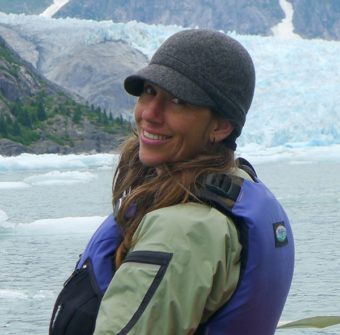
Outgoing SEACC Executive Director Malena Marvin poses while kayaking in Juneau's Mendenhall Lake. (SEACC Photo)
Outgoing SEACC Executive Director Malena Marvin poses while kayaking in Juneau’s Mendenhall Lake. (Photo courtesy SEACC)

She’s stepping down after being diagnosed with breast cancer. Marvin said her prognosis is good, but she needs time to recover and prevent a recurrence.

Under her leadership, SEACC expanded its opposition to British Columbia mine projects near waterways that flow into Alaska.

It formed a new group, Inside Passage Waterkeeper, and worked with other environmental, fisheries, tourism and tribal groups opposed to transboundary mining.

“We’re a people who survive on fish and seafood and we need clean water for that to continue to be a healthy resource for communities,” Marvin said.

It’s also continued work on climate change, forest preservation and transportation.

Marvin expects the organization to continue its course as promoters of clean water and healthy forests.

“As someone who has cancer and struggles with the seemingly random nature of the disease, it’s just really, really hit me how important it is that we ask the Department of Environmental Conservation to raise our standards,” she said.

That includes state rules listing the acceptable rate of cancer, which she said is too low.

SEACC began in 1970 as a Tongass National Forest preservation group that fought large-scale logging in the courts.

It continues to file timber lawsuits, but it also collaborates with some former foes, such as Sealaska and the Southeast Conference, on food security, sustainability and some other issues.

Board President Clay Frick said that will continue under new leadership.

“Anytime you collaborate with folks, I think you end with up a better outcome. You end up building more power and I think that’s something this region is very much in need of. So when we can we certainly will,” Frick said.

Frick said Marvin moved SEACC in the right direction, citing a new Tongass planning effort and other recent programs.

“She’s laid some really important foundation work for us to continue forward. … We look forward to whoever steps to the plate or whoever we find will have a very solid base to spring off of,” Frick said.

Marvin continues to do some work for SEACC. Her resignation takes effect Jan. 1st. The job was posted online earlier this month.

Marvin said SEACC’s strength is its regional roots.

“It isn’t an outside environmental group. It’s not somebody who lives in Anchorage or Seattle or New York. It’s thousands of people, the members of SEACC, who live here and work here and always have,” she said.

Before taking over at SEACC, Marvin spent five years with Oregon’s Klamath Riverkeeper. It campaigned to remove dams on the salmon-producing river.

SEACC’s prior executive director, Lindsey Ketchel, spent about five years on the job before resigning.

SEACC Development Director Emily Ferry is filling in as acting executive director, but said she is not applying for the permanent job.

Prince of Wales offers first exclusively young-growth timber sale

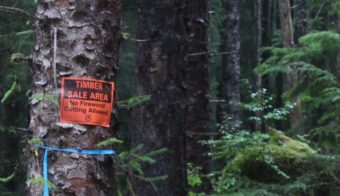
A timber sale sign is posted in the Tongass National Forest on Prince of Wales island. (KRBD file photo)

Timber sales on the Tongass National Forest have long been the center of controversy. Some question whether timber sales are too costly when managed by the Forest Service using tax dollars. Another area of contention is the act of cutting down trees that can be centuries-old.

The U.S. Forest Service on Prince of Wales Island and U.S. Department of Agriculture officials are working on a plan to help ease tensions by changing rules and selling younger timber.
The timber business is a juggling act of trying to make money, keep jobs and be environmentally friendly. Lean too much one way, and the other two collapse. The Forest Service on Prince of Wales Island is seeing this first hand as timber sales struggle to make a profit and face larger opposition from environmental groups.

In an effort to make money and uphold environmental interests, Thorne Bay District Ranger Rachelle Huddleston-Lorton says the Forest Service is transitioning to selling younger timber at the request of the Secretary of Agriculture Tom Vilsack.

“We understand and the secretary understands that the social acceptance for clear-cutting old growth trees,” Huddleston-Lorton said. “It’s just not there.”

This transition preserves some old-growth trees by harvesting a rotating crop of trees as young as 55 years old — just big enough to use as lumber at about 9 inches in diameter.

Prince of Wales is managing it’s first exclusively young-growth timber sale, called the Dargon Point sale. The first 9-acre slice of it, called Little Buck, already sold to a small local buyer named Good Faith Lumber. The larger chunk, or Big Buck, is still relatively small at about 50 acres, but Huddleston-Lorton says Secretary Vilsack and the USDA are very interested in the outcome. Huddleston-Lorton says the USDA has been strongly encouraging a fast transition to young growth timber.

The secretary issued a memorandum in July of 2013 calling for a transition into young-growth management in the Tongass over the next 10-15 years.

To help with a transition to young trees, new stipulations allow timber to be cut at a younger age. Another change is proposed for the Tongass Forest Plan, and would allow the Forest Service to sell timber that’s closer to beach fronts.

Southeast Alaska Conservation Council Community Organizer Seth Ballhorn says his group opposes a cutting near beaches.

“We would prefer to not open up areas that are in the beach fringe, in the riparian area,” Ballhorn said. “We feel like there is an adequate base of timber that can be developed.”

Ballhorn says they support overall young-growth transition because it means that the older Tongass trees will be preserved or at least sold in smaller amounts, allowing local companies to buy them and keep them on this side of the world.

“We just don’t want to see old growth being clearcut for export. If we’re going to be logging, clearcutting old growth, we would like that to be small and micro timber sales that support small businesses in Southeast Alaska,” he said.

However, using young growth isn’t a perfect solution. Young lumber is less valuable because it isn’t as hard and compact as old lumber. There’s also added costs for lumber mills that need new equipment to process smaller trees. Tongass forestry worker Garry Brand says another added procedure is “pre-commercial cutting.”

“We’re lucky here,” Brand says. “When we do harvest, we don’t really necessarily have to plant trees because there’s so much seed and it comes up so thick, we actually have the opposite where it really is actually beneficial to come in in 15 to 20 years and thin it out.”

Before any timber sale can happen, it must prove that it can come out with a profit and get a thumbs-up from biologists to make sure it won’t hurt animals, stream flows, or future habitat.


Conservationists declare victory in court’s Tongass road ruling

The 9th Circuit Court of Appeals struck down a 2003 exemption Wednesday that would have made it possible to build roads through the Tongass National Forest.

Malena Marvin, Director of the Southeast Alaska Conservation Council, says this decision underscores management that’s already happening.

“The Forest Service is already not planning sales in roadless areas and proceeding in the same direction as the rest of the country in preserving these areas for future generations,” Marvin says. “So we’re really seeing the final legal decision just guaranteeing that direction.”

Tongass National Forest near Ketchikan, Alaska. (Creative Commons photo by Mark Brennan)

“Roadless areas” are habitat for endangered species, subsistence hunting and fishing, outdoor recreation and sacred sites.

In 2001, the Department of Agriculture created the Roadless Rule, which limits road construction and logging on nearly 50 million acres of wilderness. The Tongass National Forest was exempted two years later when George W. Bush was in office. “Economic hardship” for timber-dependent Southeast communities was given as the reason.

Earthjustice attorney Eric Jorgensen says a coalition of conservation groups and Alaska Native tribes challenged that ruling. Earthjustice provided legal representation.

“(We) argued that the agency hadn’t adequately explained its rationale for reversing course and deciding to exempt the Tongass from the protection,” Jorgensen says.

In a press release, Sen. Lisa Murkowski called the ruling a “setback for the economies of Southeast Alaska.”

Owen Graham of the Alaska Forest Association echoed that sentiment. He believes the Forest Service has a “monopoly supply” over the timber industry in the region.

“They won’t allow enough timber sales to keep our industry alive and we’re dying,” Graham says. “It’s hindering all kinds of development for no good reason other than pacifying environmental groups but we hope to get it overturned eventually.”

The state could still petition the Supreme Court to exempt the Tongass from the Roadless Rule. The Supreme Court, however, declined to hear an appeal of the rule in 2012 when the State of Wyoming and the Colorado Mining Association challenged it.

Groups seek halt to POW wolf hunting, logging

The Alexander Archipelago wolf. (Photo courtesy Alaska Department of Fish & Game)

Citing a state study that shows a sharp decline in the wolf population on Prince of Wales Island and surrounding islands, six conservation groups have asked state and federal officials to take steps to help preserve the remaining animals.

Specifically, the six organizations want the state to cancel the upcoming wolf trapping and hunting season on POW, the federal Office of Subsistence Management to cancel the subsistence wolf harvest, and the Forest Service to halt logging activity on the Big Thorne Timber Sale.
Gabriel Scott is the legal director with the Alaska office of Cascadia Wildlands. He said the population numbers for POW wolves has not been clearly known for a long time.

“There’s new data, just come out, with a reasonable population estimate. And it’s much, much lower than it ought to be,” he said. “So that’s the bottom line: The population appears to be crashing on the island, and we can’t afford to let that happen.”

The Alaska Department of Fish and Game last month released a report showing that the number of wolves in Game Management Unit 2 had dropped in a single year from 221 to 89. The numbers are estimates, based on a relatively small study area on Prince of Wales Island.

To get that estimate, the number of wolves in the study area is counted, and that number is expanded to the rest of the game management unit. The estimate of 89 wolves is the midpoint of a range. The population could be as low as 50, or as high as 159, according to Fish and Game.

Gabriel Scott said the only way to get those numbers up is to halt all hunting for the time being, and make sure adequate habitat is in place for the wolves and their main source of food, which is Sitka black-tailed deer.

“One of the big pieces of this puzzle that often gets overlooked is the habitat component,” he said. “That’s where the rubber meets the road. The deer population is not high enough to support human hunters and wolves. And when that happens, the wolves are the ones who go.”

Habitat, in this case, means old-growth forest, which is why the groups want to stop logging on the Big Thorne Timber Sale.

Tongass National Forest Spokesman Kent Cummins confirms that the Forest Service has received the letter from the six conservation groups. He said officials will revisit the issue to see whether there is a need for a Supplemental Environmental Impact Statement, which is one of the requests in the letter.

“I think, with a sense of urgency, they’ll look at this information,” Cummins said. “If necessary, they’ll proceed with another supplement.”

He said the Forest Service takes its role as a steward of the land seriously. But, he said, it can be a delicate balancing act.

The Big Thorne Timber Sale is a critical project from an economic point of view, and it’s meant to help the timber industry stay afloat as it switches from old-growth to second-growth harvest.

“It gives a multi-year supply of timber there on Prince of Wales and stability for jobs and giving local businesses the opportunity to retool and seek new markets for the young growth trees,” Cummins said. “That’s the dilemma.”

He said logging is taking place now on the Big Thorne Timber Sale. Halting that activity immediately while the Forest Service looks into the wolf population report is unlikely without a court-ordered injunction.

And then there’s hunting and trapping.

Ryan Scott is Southeast Region Supervisor for Fish and Game. He said he hasn’t read the letter sent to the state asking for suspension of the coming wolf harvest on POW. However, he said that from the agency’s perspective, there isn’t a conservation concern about that wolf population.

“Even with the lower estimate, the number of animals there, and what we know about the animals there, suggests that they’re viable and they’re going to persist well into the future,” he said.

Ryan Scott said the state’s hunting and trapping season starts Dec. 1, which gives officials time to look into wolf numbers and options for the season. They’ve already reduced the maximum allowed harvest from 30 percent to 20 percent of the estimated population.

“Recognizing that we had such a decline in the estimates, I don’t think it’s very likely that we would open it to the maximum allowable harvest of 18 wolves,” he said. “Where that harvest quota would land, that’s undetermined at this point.”

Gabriel Scott of Cascadia said he doesn’t share the state’s confidence that POW wolves will be OK. He points to the fact that his organization is asking for a halt to the subsistence harvest as evidence of how serious they believe the situation has become.

“Asking to stop a subsistence hunt is a really extraordinary step for us to take,” he said. “It’s the absolute last thing that we would want to do.”

The subsistence harvest is set to start on Sept. 1. A call to the Federal Office of Subsistence Management in Anchorage wasn’t returned.

The six organizations that submitted the letters are Cascadia Wildlands, Center for Biological Diversity, Greater Southeast Alaska Conservation Community, the Boat Company, Alaska Wildlife Alliance and Greenpeace.

Wildfires are still a concern in rainy Southeast

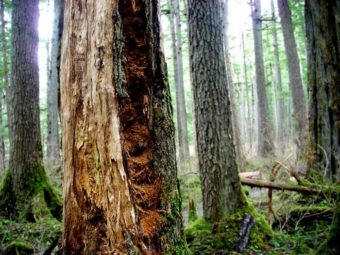
A fire left its mark on this Tongass National Forest tree trunk, as seen in 2008. (Creative Commons photo by Xa’at)

Much of Alaska has faced or is facing smoke and wildfires this summer. Southeast has too, though with far less impact.

As of Wednesday, Tongass National Forest officials counted 16 fires, one more than the regional average for a whole year. And despite some rainfall, the threat continues.

Assistant Forest Fire Management Officer Seth Ross says most are campfires that burned down into the forest’s flammable peat soil.

“We have had a few lightning fires. This season was warm enough that we did generate some lightning. But traditionally, human-caused fires are our main sources of ignitions,” says Ross, who works out of the Hoonah Ranger District.

That’s the case for two late-June fires north of the capital city.

Ross says one covered about an acre near 30-mile Glacier Highway and has mostly been extinguished. A section is near a cliff and could be dangerous for firefighters, so it’s being monitored.

The other, about a tenth of an acre, was on Bird Island, near Juneau’s mainland. Ross says it’s been extinguished.

Fires in a rainforest are rarely above the surface.

A fire pit burned into the ground is one of several signs of irresponsible forest use. (Photo courtesy U.S. Forest Service.)

“It’ll start to burn underground a little ways in and even the rain often times will not put it out. They won’t necessarily grow very big very fast. But typically, they creep underground and they hang out for weeks on end and we have to go to some lengths to kind of dig in and get those put out,” he says.

Firefighters most often pump water onto burning peat and roots. They may also dig into the ground and cut down affected trees.

Ross says picnickers, campers, boaters and hikers need to make sure their campfires are out.

“People are just enjoying our beautiful woods. And they have a fire and maybe they think the rain is going to put it out or they didn’t do quite as good a job. Or they didn’t realize how dry we are,” Ross says.

Putting one’s hand over a doused fire can show whether it’s still live.

Ross says the dry spring and summer, preceded by little snow, makes this a problem season.

“We also had a pretty light winter. So all those things do line up to make it a little bit more of a summer with higher fire danger,” he says.

Small fires have also hit Brown Mountain, northeast of Ketchikan, and Kupreanof Island, west of Petersburg.

The Forest Service also put limits on logging in May on Wrangell and Prince of Wales islands to reduce fire danger.

As of Wednesday, the agency listed a high fire danger in northern Southeast and a very high fire danger in the south.

More rain is predicted this week, but it may not be enough to change that status.

Landless Natives bill gets first hearing before Congress

U.S. Rep. Don Young poses in his office with Sealaska board member Richard Rinehart, right,  and landless spokesman Leo Barlow, left. Barlow and Reinhart were lobbying for Young's landless Natives legislation. (Photo courtest Don Young's office.)
U.S. Rep. Don Young poses in his office with Sealaska board member Richard Rinehart, left, and landless spokesman Leo Barlow, right. Barlow and Rinehart were lobbying this week for Young’s landless Natives legislation. (Photo courtesy Don Young’s office.)

A bill creating corporations for Native residents of five “landless” Southeast Alaska communities had its first hearing in Congress today.

Haines, Petersburg, Wrangell, Ketchikan and Tenakee were left out of 1971’s Alaska Native Claims Settlement Act. That bill gave land, money and corporate status to those in many other Alaska communities.

Wrangell’s Leo Barlow represented landless residents at the hearing, before the House Subcommittee on Indian and Alaska Native Affairs.

“Those of us who enrolled to these five communities during the ANCSA process did so because they are our traditional homelands and places of origin. Our families and clans originated in these communities and have lived here for hundreds if not thousands of years,” Barlow said.

He said about 3,500 Tlingits and Haidas were affected. They still became shareholders of the Sealaska regional Native corporation.

Congressman Don Young, who authored the legislation, chaired the committee hearing. Sen. Lisa Murkowski introduced a similar bill earlier this year. Sealaska is also lobbying for its passage.

A report by the University of Alaska’s Institute of Social and Economic Research found no clear reason why the five communities were excluded, other than Congressional intent.

Federal officials continue to oppose inclusion, saying it would break precedent and allow others to follow suit.

At the hearing, Young said the timber industry lobbied Congress before ANCSA passed because it wanted to keep more of the Tongass National Forest available for logging.

“The communities involved here had large lumbering, timbering operations. And there was effort put into this Congress at that time not to recognize them because it might have affected the long-term leases for that timber,” Young said.

Similar legislation has been introduced more than a half-dozen times.

Supporters have suggested it would only get serious consideration after a bill turning Tongass timberlands over to Sealaska passed.

That happened last year.

Site notifications
Update notification options
Subscribe to notifications