Timber

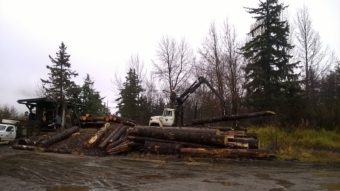
A Southeast timber company waits in limbo

Recently, the U.S. Forest Service released a plan that gives loggers a timeline for the transition to second-growth harvesting. The plan is currently open for public comment. A proposal to end clearcutting of old-growth trees in the Tongass National Forest has some Southeast logging companies concerned about the future.

Susan Tyler runs Icy Straits Lumber & Milling in Hoonah with her husband Wes. It’s a family business and one of the few surviving timber companies in the region

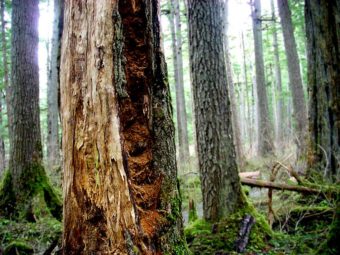
Wes has been harvesting trees in Alaska since 1967. For the past 34 years, he’s packed his truck with power saws, axes and wedges to drive along winding roads on Chichagof Island. Once in the woods, he searches for a tree the U.S. Forest Service has marked with paint, indicating it can be removed from the old-growth forest and processed into lumber.

“Typically we are harvesting in the summertime, although we have been out in knee-deep snow harvesting too,” Wes said. “We put in a good eight-hour day out there normally, you know, working in the woods.”

Following selective logging regulations managed by the Forest Service, the company has downsized from 200 employees in the 1980s to only 10 today. New proposed restrictions that would eliminate harvest of old-growth trees are troubling for the Tylers. In a phone call from Hoonah, Wes said the company is bracing for big changes.

“The timber industry today is barely existing,” Wes said. “So you know what’s available to us here is what we’re trying to create jobs with and keep our local people working to the best of our ability.”

Wes could talk about trees for hours.

He said that the company harvests four different tree species on the island: Sitka spruce, western hemlock, alder and yellow cedar.

“Yellow cedar is a lot smaller tree than either hemlock or spruce typically,” Wes said. “It just doesn’t grow that fast. And it doesn’t grow real straight so you have sweeps and curves and kinks and there’s a lot of defect in it, so it takes a lot of work to extract all the goodies that are in it. Which we do. We take everything in that yellow cedar tree right down to a very small size.”

Lately, Susan has been spending much of her time in Juneau — a 20-minute flight east of Hoonah. She has a showroom in the capital city that is typically closed. But with the flip of a switch the room becomes aglow with woodwork. The space resembles an upscale flea market featuring only wood. Pieces range from dollhouse-sized model cabins to full kitchen counters.

She manages the showroom herself because it would be too costly to employ someone else. Susan said Icy Straits Lumber & Milling is up against big corporations like Home Depot for business. Timber sales available in the Hoonah area only allow selective logging, making profits that much harder to come by.

Bidders on timber sales are told how much wood can be harvested from each plot, but they don’t know how much of the wood is actually valuable, Susan said.

“Right now we have a lot of very expensive equipment and it’s hard to go after another timber sale because you don’t know what’s in that timber sale,” Susan said.

The new proposed restrictions could reduce the supply of trees available for harvest.

“There is a lot up in the air because … they want to stop all old-growth harvesting. Of course, that would eliminate us from harvesting any,” she said.

According to the Forest Service, the supply of second-growth forest, regrown from past clear cuts, is large enough to allow a smooth transition into the new policy.

Icy Straits Lumber & Milling is considering a switch to harvesting regrown trees, but Susan worries the Hoonah area may not have enough second-growth forest to sustain her company in the future.

“We don’t know, and you don’t want to keep investing in equipment if you don’t know what the future holds,” she said.

To supplement what standing trees they can harvest, Susan says her company also collects trees that wash up on the beach, dead standing wood, danger trees, blow downs and trees that have a dead top but are mostly usable. All of this is also managed by the Forest Service.

Some of that wood ends up in the hands of Juneau woodworker Reid Harris.The young entrepreneur started a wood furnishing business called Northern Edge Craftworks. His tables are made from vertical woodcuts that keep the natural, rough edge of the tree.

Most of the logging company’s business comes from locals like Harris. His basement and garage workshops are lined with tree slabs ranging from the length of a baseball bat to that of a kayak.

Harris exemplifies optimism for an industry with an unknown future.

He wants to connect the people who purchase his pieces to the life of the tree, so he marks each table he makes with the coordinates of where the tree was taken.

Furniture from Northern Edge Craftworks is marked with the GPS coordinates of the tree it came from. (Photo by David Purdy/KTOO)


“We had this idea because we kind of wanted our pieces of wood to tell a story and each piece comes from a unique part of Alaska,” Harris said.

So now Wes carries a GPS into the forest with him.

The Tongass transition plan is open for public comment until February 22, 2016.


Tongass plan drafts timeline for transition to young-growth harvest

Tongass National Forest
Tongass National Forest (Creative Commons photo by Xa’at)

The U.S. Forest Service has released a new plan for managing timber lands on the Tongass National Forest in Southeast Alaska. It puts a timeline on the transition from young- to old-growth logging and it attempts to make it easier to develop hydro projects on forest land.

The draft Environmental Impact Statement document for the forest plan amendment is over 1,000 pages. It reflects this year’s unanimous recommendation by the 15-person Tongass Advisory Committee on transitioning to a harvest of younger, second-growth trees on areas that have already been logged. That was directed by the Secretary of Agriculture in 2013.

Forest Supervisor Earl Stewart said the agency’s analysis shows that transition is possible in 16 years. “In going to a young system, it’s going to require both accuracy and precision in the product availability and the ability to go to areas that have been harvested in the past,” Stewart said. “That’s certainly going to cause some concern from some parties as to what that represents in the meantime but recognize that this is the draft Environmental Impact Statement.”
The preferred alternative in the plan would see a harvest of 46 million board feet annually. In the first decade, 37 million of that would be continued harvest of old-growth trees. The old-growth harvest would drop to just 5 million board feet by the 16th year of the plan. To compare, harvests on the Tongass over the past decade have averaged around 36 million board feet a year.

Proposed timber sales that are already in the planning stages, involving old growth or young growth, will continue forward. The plan does not propose any new wildlife conservation strategies, wilderness areas or wild and scenic river designations. It does recognize changes from this year’s transfer of Tongass land to Sealaska Corporation.

The plan also proposes making renewable energy projects on Tongass lands easier to develop. “It really seeks to try and provide a better economic outcome for parties and communities across Southeast Alaska by allowing access for hydropower or other uses, to help supply those,” Stewart said. “If you’re familiar with some of those communities that are currently challenged by having to utilize diesel generation or anything like that, this is one of those opportunities to look at the landscape in a broader context, to provide a more renewable resource and use of energy production for those communities.”

While the plan does not recommend new lands for permanent protection, it would reduce the acreage that could be logged. Environmental groups are happy to see lands around some Southeast salmon streams would no longer be in the timber base. Southeast Alaska Conservation Council Deputy Director Emily Ferry says there’s both good and bad in the updated plan.

“And the good is that we’re very pleased to see that some of the salmon strongholds that we’ve working for years to protect, places like Port Houghton, Castle River and East Kuiu are no longer considered in the suitable timber base,” Ferry said. “The unfortunate part is that the Forest Service missed a huge opportunity to put the controversy associated with clear-cutting old growth behind them.”

Ferry said the plan does not transition out of old growth logging soon enough. She said concerns over impacts to fish and wildlife habitat, recreation opportunities and climate change will continue with logging old growth forests.

For the timber industry, the young growth available wouldn’t keep Southeast sawmills operating. Alaska Forest Association Executive Director Owen Graham doesn’t think the transition recommended by the Tongass Advisory Committee will work.

“For one thing there’s not enough young growth to support a round log export business for any length of time,” Graham said. “For a few years you could, but after that, there’s just not enough acres. The second concern is, right now the logs are too small for the saw mills to utilize and if you cut ‘em now then 30 years from now, when they would have been mature, they’re not going to be mature timber. And so, the only way to keep the sawmills operating is to continue harvesting old growth and we don’t want to be stuck with just one good sawmill. We want to have a number of mid-size saw mills and a number of small mills.”

The draft documents are available online. A 90-day public comment period is underway and ends February 22nd. The Forest Service plans to hold public meetings on the plan in Southeast communities.

Tongass supplying DC with ‘companion’ Christmas trees

This year’s National Christmas Tree is a 74-foot spruce from Alaska’s Chugach National Forest. The tree is traveling across the U.S. on its way to Washington, D.C., and as of Sunday, was in Indiana.

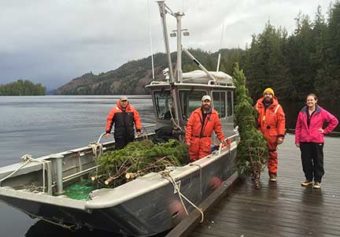
In addition to the spruce, which will be placed on the west lawn of the U.S. Capitol, seven smaller “companion” trees have been selected from the Ketchikan-Misty Fiords Ranger District of the Tongass National Forest.

According to a U.S. Forest Service news release, the seven shore pines were found in the Shoal Cove Road area on Revilla Island. They were shipped out on Saturday.

The companion trees will be used to decorate offices of Alaska’s Congressional Delegation and other offices in Washington, D.C.

The tradition of the National Christmas Tree began in 1964, when a live tree was planted on the Capitol lawn. That tree lived three years before succumbing to root damage, according to the Capitol Christmas Tree website.

In 1970, the capitol architect asked the U.S. Forest Service to provide another Christmas tree. Since then, a tree has been donated by a different National Forest each year.

Because this year’s trees are from Alaska, Alaskan children and community organizations have been asked to provide about 4,000 ornaments for all the trees.

DNR announces 3-month closure of Haines forestry office

The Stump Company timber operator in Haines
Haines timber operator The Stump Company at work in October. (Photo by Emily Files/KHNS)

The state Department of Natural Resources has announced dates for the short-term closure of the Haines State Forestry office.

The office will close to the public from Nov. 21 to Jan. 10. Then, it will open for two weeks from Jan. 11 to Jan. 22. A press release from DNR says the two-week reopening will allow staff to deal with “any issues that require a local presence.” Then, the office will close again until March 1.

Funding for the Haines forestry office was slashed by the state legislature earlier this year. One of Haines’ two long-time foresters to lost his job. The Division of Forestry shifted some funding to keep forester Greg Palmieri in his job and keep the local office open. But forestry officials warned that the funding was not year-round. In an interview in September, Palmieri said the three-month closure could have a direct impact on local timber operators.
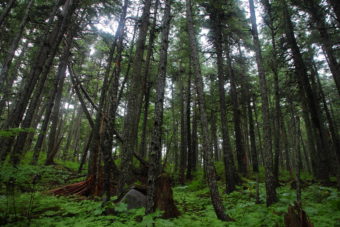
“Because the small operators manage on a tight budget, they don’t have a lot of capital to up-front purchase,” said Palmieri.

Scott Rossman of The Stump Company is one of those small operators. He said in an October interview that he’s tried to stock up on timber before the forestry office closes. What he is worried about is the office being completely shut down after the next round of state budget cuts.

“I can see somebody going, well there’s not anybody in Haines right now, what do we need to put anybody back there for? Don’t rehire them,” Rossman said.

The permanent closure of the Haines forestry office is a possibility. Forestry Director Chris Maisch says he has been told to expect more budget cuts.

The DNR press release says during the Haines office closure, anyone with questions about forestry issues in Haines should contact Joel Nudelman in Juneau at 465-5406.

Alaska warms up to biomass heat, Haines not far behind

Haines State Forest
Haines State Forest. (Creative Commons photo by ~dgies)

The Haines Borough government wants biomass fuel warming 10 municipal buildings in town from a central location.
The plan is moving forward, though a date for implementation is months, or more, away. Three refurbished Coast Guard boilers are now in Haines. But there are still a lot of details to figure out before the systems are up and running. An advisory group met this week to discuss the potential benefits of increasing the biomass presence in Haines.

Biomass heat is being used across the state to heat buildings large and small. The systems use pellets or wood chips to fuel boilers as an Earth-friendly, locally sustainable alternative or addition to oil-burning furnaces. Pellets have been heating the senior center for a few years, but not without glitches.

The borough recently received a $1.3 million grant from the Alaska Energy Authority’s Renewable Energy Fund to move forward with the massive undertaking. A maximum grant of $250,000 through the U.S. Forest Service’s Wood Innovation program is also up for grabs. That funding could help with permitting and design of the project, but not the actual construction, and requires a 35 percent match.

The idea of heating multiple facilities around Haines with wood products has been on the table for at least a decade. And residents like Stephanie Scott said the reasons to make the switch are many.

“We have in our valley, the Haines State Forest,” Scott said. “We have a ready supply. And if we can someday convert that into the fuel supply that we can use here locally, it seems that we have secured our future with a renewable source of energy.”

Scott was one of two members of the public that showed up at a meeting of the local biomass advisory group.  The committee features members from borough, state and federal agencies.

Ed Bryant sees to facilities maintenance for the borough and takes care of the boiler at the senior center. He said that there have been some issues, but with routine cleaning and care the system works, and works well.

“The boiler we have at the senior center is a beautiful piece of work,” said Bryant. “It works flawlessly. I think the problems we I still believe have to do with the fuel but we seem to have that worked out. The boiler is working beautiful right now.”

Biomass boilers can burn either wood pellets, wood chips or cord wood. The used boilers that the borough recently obtained for $60,000 can burn either pellets or chips. Pellets are manufactured in Ketchikan on a small scale and in North Pole on a larger scale.

There is also a huge pellet plant in British Columbia that supplies places around the world. Pellets are easy in that they come ready to burn. Chips require processing to get consistent sizes, and they also need to be dried. They must have less than 30 percent moisture content to burn efficiently. But the chip manufacturing and processing is something that could be done in Haines, providing local jobs and cutting costs. The group agreed that chips are the way to go long term, if the correct manufacturing system is figured out.

“If we can keep our heating dollars in our community instead of sending them to Seattle for diesel or Prince Rupert for pellets, that’s the huge win,” said borough consultant Darsie Culbeck. “We spend roughly $300,000 a year heating borough buildings and that money goes away and doesn’t create a lot of jobs here. But if it was to be spent in our local forest, wow, the multiplier on $300,000? That could be a million dollars or more that’s rolling around in the local economy.”

But, Culbeck said the biggest draw to producing chips to heat local buildings is the independence that comes with making your own fuel. Local forester Greg Palmieri agrees.

“I absolutely believe that it’s not only in our best interest but we could set an example for the rest of the rural communities across the state where they can see the reality of the resources around them, if they’re managed regionally,” Palmieri said. “And not looked at as some commodity that can be exported and a million dollars made one year because the market’s high.”

The biomass trend is gaining momentum in the state, says Devany Plentovich. She’s the biomass program manager with the Alaska Energy Authority. Plentovich and others in the field, including Culbeck, went on an Alaska biomass tour last month to see what other communities are doing. In Tok, for example, biomass fuel heats the school, but the steam is also used to produce 40 kilowatts of electricity each day. Also, the system heats school greenhouses used to grow vegetables and engage students. Plentovich says there are 32 systems operating across the state.

“There has just been an explosion of biomass projects in the state and we have some very, very good examples of how a biomass system can be integrated into the community,” she said.

The new boilers won’t replace the oil burning methods currently used, but would pick up much of day-to-day heating needs.

And as Robert Venables, the energy coordinator for Southeast Conference, said: The ebbs and flows of oil prices become irrelevant when we’re surrounded by a resource that could be used instead.

That, he said, makes this project worth the pursuit.

Conservation interests fear prized yellow cedar may face extinction

yellow cedar
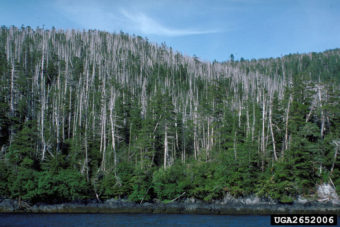
Yellow cedar in Southeast Alaska. (Photo by Paul E. Hennon/U.S. Forest Service via Bugwood.org )

In some areas, yellow cedar trees stand white and empty of needles against a background of green hemlock. The places appear skeleton-like, bare trees standing with limbs exposed, said Paul Hennon, a research forest pathologist with the U.S. Forest Service.

He said in some of its range, 75 percent of mature trees have died.

“Yellow cedar for me is by far and away the nicest wood to cut lines in and shape in,” said Donald Gregory.

Gregory is Tlingit Raven Beaver from Angoon, but was raised in Juneau. He began carving at a young age, inspired by other local artists.

Gregory carves almost exclusively with yellow cedar. Its wood is strong, yet easy to carve, and the tree has natural anti-fungal properties that inhibit decay. It is one of the few local woods that can withstand the elements over time and avoid rot outdoors.

These are the reasons that yellow cedar is valuable in the market.

Research suggests that yellow cedar could live up to 3,500 years. The tree grows slowly and can survive in nutrient-poor soils.  Bears gnaw on yellow cedar bark and deer shelter within the tree for warmth in winter.

In a 2012 paper published in the journal BioScience, researchers identified climate change as a culprit of yellow cedar deaths. A warmer climate has reduced snow cover and created areas with poor soil drainage. With no blanket of snow for protection, roots freeze, causing immense injury to the base of the tree system.  

This has killed swaths of trees prematurely.

Ecologist Lauren Oakes, a researcher at Stanford University, found that yellow cedar has a more difficult time regenerating in areas that have experienced die-off. She said that even in areas with healthy yellow cedar trees, it is often outcompeted by more vigorous species like western hemlock.

Conservation interests have petitioned to protect yellow cedar under the Endangered Species Act. The petition, citing two scientific journals, described yellow cedar’s decline as “the most severe forest die-off ever recorded in North America.” It claims the species will likely be extinct in the next hundred years without protection.

The U.S. Fish & Wildlife Service is reviewing the petition.

Sealaska Corp. has urged against the ESA listing.

ESA petitioners claim logging companies target yellow cedar, but Sealaska said it doesn’t.

While some scientists worry for yellow cedar’s survival, others are confident in the tree’s resilience. Brian Kleinhenz, a corporate forester with Sealaska, said the tree is thriving in parts of its range, despite mortalities  documented elsewhere.

“I’ve seen a lot of, especially in young forests, yellow cedar regeneration,” Kleinhenz said.  “I’m observing yellow cedar being more successful as we move north in Southeast Alaska, and then as you move up the slope, so as you move up to higher elevations, I’m finding a lot more yellow cedar seedlings coming in.”

Yellow cedar branch
A young yellow cedar branch. (Video still by David Purdy/KTOO)

Sealaska Timber Corp. owns land, manages it and clear cuts across Southeast. Kleinhenz said that yellow cedar is the most reliably valuable wood from the region. He said that yellow cedar wood sells at a high price in Asian markets.

Sealaska sold 28 million board-feet of wood from Southeast in 2014, but would not specify how much of it was yellow cedar or what the wood was worth.

Kleinhenz said he is worried that if yellow cedar is protected under the ESA, Native cultural connections with the tree will fade.

Alaska Natives in Southeast highly regard yellow cedar. The Tlingit and Haida transform it into totems, paddles and weave its bark into blankets. It has medicinal and spiritual importance to the tribes.

Native carver Donald Gregory said his favorite pieces to carve are wooden halibut hooks.

Halibut hook by Donald Gregory
A halibut hook made by Donald Gregory. (Photo courtesy of Donald Gregory)

Gregory said the Tlingit have harvested the tree for a very long time, even before saws. His people believe that all living things have a spirit, including yellow cedar.

“When they harvest the wood from the tree they do a ceremony and they thank the tree for the offerings of the wood. It’s just proper to do that,” Gregory said.

Gregory said the price of yellow cedar has gone up, but he has had no problem getting the wood. He thinks that 20 years from now the wood will be more scarce.

Gregory said that culture and carvers will adapt.

A decision on the yellow cedar listing is expected in 2017, according to the U.S. Fish & Wildlife Service. The listing would forbid taking yellow cedar from federal land, but not private land.

Other ramifications of protecting yellow cedar are undefined, but could affect harvests of other tree species such as spruce, hemlock, alder and red cedar if declared “critical habitat.” Fish & Wildlife defines critical habitat on a case-by-case basis.

Meanwhile, the Tongass Advisory Committee and U.S. Forest Service are creating a plan to transition out of logging old growth timber to only second growth.

Site notifications
Update notification options
Subscribe to notifications