Timber

Young, Murkowski bills would delay change for Tongass

The U.S. Forest Service has a plan for the Tongass National Forest that would shift loggers away from the harvest of old-growth trees and offer the industry young trees instead. At the U.S. Capitol this week, Sen. Lisa Murkowski and Congressman Don Young are working on separate bills to block the plan.

In the House Resources Committee Wednesday, Rep. Young said the plan doesn’t help the forest or the industry, because, he says, there’s no money in harvesting immature trees.

“Can you imagine killing all your kids? It’s what they’re doing. That’s really what they’re doing,” he told his colleagues. “And keeping the old people alive.”

The committee approved Young’s measure, which would require a full inventory of young growth timber before the Forest Service could launch its new plan. That’s not likely to occur before time runs out on the Obama administration.

Murkowski also wants a Tongass timber inventory in hand before the transition starts. She included the requirement in a spending bill that funds the Forest Service. Murkowski says a shift to harvesting new growth “is where we need to go.” She says, though, the pace of the planned transition is unrealistic.

“What I believe the inventory will show is that the transition is just going to take longer, because,” she said, “we cannot legislate a tree to grow faster.”

Andrew Thoms, executive director of the Sitka Conservation Society, says the lawmakers’ actions are disheartening. Thoms served on the Tongass Advisory Committee that helped craft the transition plan, along with timber industry representatives.

“I’d hope that the senator would have seen that people from Alaska worked together and wanted to turn the page away from the divisiveness and conflict of the past and move to a future where we’re all working together and finding solutions,” Thoms said. “And to have the carpet pulled out from under us from our senator when we’re trying to work together is disappointing.”

Thoms says the industry has to adapt to changes in the market and in the forest, because, he says, the economically viable old-growth has already been cut.

Young’s bill, which would also allow states to acquire millions of acres of National Forest, heads next to the House floor. Murkowski’s spending bill is likely to clear the Appropriations Committee Thursday.

Alaska senators revive landless bill

Lisa Murkowski at AFN 2015
Sen. Lisa Murkowski addresses the Alaska Federation of Natives Convention, Oct. 16, 2015. (Photo by Mikko Wilson/KTOO)

A U.S. Senate bill introduced last week would allow Alaska Natives in five Southeast communities to form urban corporations. Haines, Ketchikan, Petersburg, Tenakee, and Wrangell each stand to gain about 23,000 acres of land if the bill passes. But the legislation, which has been introduced before, does not come without controversy.

In 1971, more than 200 Native corporations formed under the Alaska Native Claims Settlement Act, known as ANCSA. But, Haines (Chilkoot Tribe), Ketchikan, Petersburg, Tenakee, and Wrangell were left out of the landmark legislation.

The Alaska Native Claims Settlement Improvement Act was introduced May 26 by Alaska Sens. Lisa Murkowski and Dan Sullivan. It would award those “landless” Native groups 23,040 acres of land each.

Leo Barlow represents both the Southeast and Wrangell Landless Coalitions. He says many in these communities have benefited from Southeast’s regional Native corporation, Sealaska, which pays dividends. But they lack the benefits provided by a local corporation.

“Other village corporations in the region that have received such a settlement have done a lot of things with their land. They’ve been able to do a lot of economic activates to the benefit of their shareholders. Start businesses, eco-tourism, start hotels a lot of relied on resource development on the land as a mean of providing an economic income.”

If passed, the improvement act would allow the five corporations to pick land of historic, cultural and commercial value, but would not allow conservation lands to be awarded.
The Southeast Alaska Conservation Council or SEACC is opposing the bill. Spokeswoman Emily Ferry says the group is concerned about the commercial activity.

“We don’t know how they would be managed. The land would be selected by Native corporations — these new Native corporations and the Secretary of the Interior — and as we know from the past, lands that were transferred to Native corporations previously were heavily logged.”

Ferry says SEACC called upon Murkowski to include the general public by holding hearings on the issue. SEACC would also like more environmental protection, particularly forest preservation, added to the bill.

“We would like to see a dialogue about how that can happen,” Ferry said. “That’s partly why we’re calling on Senator Murkowski to come to SE Alaska to open up a dialog, hold hearings, to talk with communities. Both the people who would benefit from this legislation and the communities who rely on our public land to go hunt and fish and enjoy the fact that we get to live in a spectacular place where we have vibrant runs of wild fish.”

Murkowski’s office did not respond to requests for comment or information.

The local corporations would have surface rights that would allow logging and other surface-based economic activity, but Barlow says he doesn’t expect any excessive clear-cutting.

“Obviously, there are timber resources that could be harvested,” Barlow said. “The whole goal would be to do that on a sustainable basis, not like the old days when there were large extensive clear-cuts all across the Tongass and Southeast Alaska.”

Barlow says the corporations could also focus on eco and cultural tourism to bring in money and says he thinks Natives would not be the only ones to see benefits.

“It actually benefits the whole community. As you can see throughout Southeast Alaska, a lot of the employment created by other corporations throughout the region goes to Natives and non-Natives alike. It would have a tremendous impact on the region and the economy of the whole Southeast panhandle.”

The ANCSA improvement bill is not the first legislative attempt at providing “landless” communities corporate status. The current version combines several Senate and House bills from decades past. Another section of the bill would allow Sealaska to exchange 23,000 acres of land on Admiralty Island for about 14,000 acres of more commercially viable land and could also award Native Vietnam veterans land as well.

SEACC spokeswoman Emily Ferry says the conservation group will wait for Senator Murkowski’s response before stepping up efforts to oppose the bill. Both Murkowski and Sullivan were unavailable for comment for this story.

Sealaska finances improve, but losses continue

Sealaska, Southeast’s regional Native corporation, continues its financial recovery. But its operational side is still losing money and even its investments are in the red.

Sealaska just released its 2015 annual report, which illustrates its financial ups and downs.

Those affect more than 22,000 shareholders, who receive dividends twice a year. It also impacts businesses and communities where shareholders spend their money. That’s mostly in Southeast and Southcentral Alaska, but also the Pacific Northwest.

Sealaska CEO Anthony Mallott discusses the regional Native corporation's finances May 2, 2016, (Photo by Ed Schoenfeld/CoastAlaska News)
Sealaska CEO Anthony Mallott discusses the regional Native corporation’s finances May 2, 2016, (Photo by Ed Schoenfeld/CoastAlaska News)

“We’re not where we want to be, but we are excited and happy that we are showing steady progress,” said Anthony Mallott, president and CEO of Sealaska, which is headquartered in Juneau.

He points to figures showing net income of about $12 million out of total revenues of nearly 10 times that amount. It’s a little less than the previous year, but far, far better than the disastrous year before that.

“Our operations are making money. They’re just not covering the full cost structure of Sealaska,” Mallott said.

Including those costs leaves an overall loss of around $12 million. That amount is also less than the previous year and a far cry from devastating losses the year before that. In 2013, Sealaska’s construction company badly underestimated two federal projects, losing more than $25 million. Problems with other businesses more than doubled that loss.

Like many regional Native corporations, Sealaska’s finances are like a three-legged stool.

One leg is a mix of business earnings and operational costs. Another is investments, which usually boost the overall total, but not last year.

“The investment market was flat-to-down in 2015. And it fell from over $7 million to about a $600,000 loss,” he said.

Then there’s what’s been the corporation’s largest revenue source for years. It’s a shared pool of all regional Native corporations’ resource earnings called 7(i).

That added about $25 million in 2015. Half covered losses and the rest went toward profits – and shareholder dividends.

Sealaska has a variety of businesses but reports their earnings in groups, not as individual enterprises.

Its service group, including contracts with government agencies, brought in close to $4 million — about a 10 percent increase from the previous year.

“There was improvement across the board. Sealaska Environmental Services improved their income. Managed Business Solutions and their data-analytics team improved their income,” Mallott said.

The natural resources group earned about $700,000 in 2015. That’s not much, but it was better than the previous year, when losses were twice that amount.

He says Sealaska’s logging subsidiary, once its largest source of income, should see revenues rise.

It almost shut down a few years ago as the timber supply ran out. But a Congressional lands-claim deal provided more than 70,000 additional acres of the Tongass National Forest.

Mallott says the corporation will still mostly clear-cut trees for overseas sales, but it’s a different operation.

“It’s much smaller. And we’re at the point where we have to save infrastructure, which means to be financially feasible, landowners have to work together and find those efficiencies,” he said.

Other landholders include the Forest Service and the state.

Sealaska’s longterm goal is to expand into seafood, natural foods and other industries closer to home. Corporate projections show that bringing full profitability by the end of the decade.

“We still want our businesses to cover that entire cost structure. Because the reality of having 7(i) and investment income, just income and cash flow on top of what the businesses create, can be very powerful for us,” he said.

The vetting process for acquiring new businesses has been long. But Mallott says announcements will be made soon.

Those will face intensive scrutiny from critics, who say Sealaska has been mismanaged for years.

Mallott calls new take on timber industry, environmentalism

A Tongass National Forest clearcut is shown in this 2014 aerial view. A new court decision limits logging on roadless areas of the forest. (Photo by Ed Schoenfeld/CoastAlaska News)

Lt. Gov. Byron Mallott is calling for less confrontation between environmentalists and Alaska’s timber industry.

The Ketchikan Daily News reports that Gov. Bill Walker’s lead on timber issues in Southeast Alaska discussed timber policy, the state budget and where he disagrees with Walker while in Ketchikan on Wednesday.

Mallot said there is plenty of blame to go around for the state of Alaska timber right now: environmental groups for over-litigating, the state for provoking environmentalists and the U.S. Forest Service for not managing the supply of timber.

The Forest Service manages the vast majority of Southeast Alaska forests. State government is the second-largest owner, with Alaska Native corporations the next largest.

Lt. Gov. Mallott talks mines, Tongass timber, budget

Byron Mallott at KRBD
Lt. Gov. Byron Mallott poses at KRBD-FM in Ketchikan. (KRBD file photo)

Lt. Gov. Byron Mallott visited Prince of Wales Island and Ketchikan this week. He stopped in at KRBD to talk about his visit to the big island, issues facing the state and what he called his “weird” job.

“You’re responsible for state elections, which is certainly an important responsibility, and you’re on a few boards and commissions,” Mallott said. “But, constitutionally, the principal responsibility of the lieutenant governor is to be available in the event that the governor is incapacitated or otherwise unable to serve. And that’s not a fun thing to do.”

But, Mallott said, working with Gov. Bill Walker, he’s able to do a lot more than previous lieutenant governors.

“And I really enjoy this job,” he said. “Since we’ve been in office, going on a year and a half now, I’ve traveled in this state pretty close to 180,000 miles.”

He meets with Alaskans, gives presentations and hears concerns. His active role in the administration is part of the agreement he and Gov. Walker came up with when they decided in 2014 to merge their gubernatorial campaigns.

Among Mallott’s responsibilities is the issue of transboundary mines – mines in Canada built near rivers that flow into Alaska. There’s been concern over environmental impacts of mine tailings.

That’s partly why the lieutenant governor went to Prince of Wales Island. He spoke during a symposium focused on that topic.

“They are concerned with the Unuk, the Stikine and the Taku. They are anxious that any mineral development in British Columbia not impact our waters or the environmental integrity of those river corridors that flow into Alaska,” he said.

The State of Alaska and British Columbia officials are working on a statement of cooperation regarding those mines. Mallott said he expects a draft of that statement from the B.C. government in the next month.

Mallott also visited various communities on Prince of Wales Island and said he was particularly impressed with some of the sustainable food projects that schools are running in Thorne Bay and Coffman Cove. Students in both of those Southeast Island School District schools help run greenhouse gardens heated by wood-fired boilers.

The Thorne Bay greenhouse provides vegetables to the cafeteria and a school-run restaurant.

“And then in Coffman Cove, they have another greenhouse that has 11,000 plants in it that allows the school district to provide fresh vegetables, mostly green vegetables, throughout the island,” he said.

Among the concerns he heard from POW residents was the issue of timber availability, and the recent announcement that Viking Lumber might close in the next year.

Mallott said the state can only do so much to make its own land available for logging. The problem, he said, is litigation that delays or stops federal timber sales and other projects, such as the Shelter Cove Road.

That’s a state project, but it requires a federal easement that recently was challenged in court by five environmental groups. Mallott said the constant litigation from national groups is “unconscionable” because it keeps small communities from having a viable economy.

He said it’s a pattern “of a strategy to essentially remove people from the equation of making public policy in the Tongass National Forest by, for example, calling the Tongass National Forest a salmon forest.”

Mallott said salmon are certainly important to the ecology of the entire forest. But, he said, calling the Tongass a salmon forest downplays the impacts policies have on people.

“I love salmon. Salmon is revered by us all,” he said. “I’m a Tlingit Indian. It’s an elemental part of my spirit and who I am as a human being. But when I look to the future of who I am as a Tlingit person, and as a resident of the region and as a citizen of the State of Alaska and even as a citizen of the United States of America, I want to put the face of a human child as a symbol of the Tongass Forest.”

He doesn’t necessarily support a push to transfer parts of the national forest to state control, though. Mallott said unless there’s a huge shift in the way people think in Washington, D.C., and throughout the Lower 48, that effort is the equivalent of baying at the moon.

“We do enough baying at the moon,” he said. “We need to be much smarter than we have been, I think, in many ways. And we haven’t been very smart. We also continue to litigate. We also continue to be confrontational.”

Mallott said the state should work on educating national groups, and working with them to establish policies that work better for everyone.

A big issue on pretty much every Alaskan’s mind these days is the state budget. Mallott said his biggest concern is that the legislature this year solves the problem of the state’s multi-billion dollar deficit, brought on by low oil tax revenue.

“To be able to look ourselves and the rest of the world in the eye and to say: We had the opportunity and the resources; it was a critical time in our history. We made the right decisions. We have a fiscal structure in place that allows us to go forward with a balanced budget and we can look to the future,” he said. “Anything else is crippling.”

But, Mallott said, the budget shouldn’t be balanced on the backs of municipal governments.

He doesn’t support phasing out revenue sharing, for example, and said the legislature needs to find a fair solution to costs associated with the state-mandated Public Employees’ Retirement System and Teachers’ Retirement System, commonly called PERS and TRS.

“We as a state rant and rail at unfunded mandates from the federal government. We as a state government, having done that, should be hugely sensitive to not doing that to our own forms of governance, which are local governments across our state,” he said.

Mallott said he and Gov. Walker have been told that they should find a big project that will be their legacy. But, he said, this administration’s goal – and maybe its legacy — is to help Alaskans get through the state’s current financial challenge.
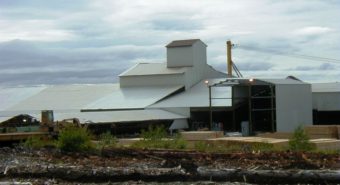
Southeast’s largest lumber mill may close

The Viking Lumber mill is on Prince of Wales Island. A spokesman says it will close in 18 months due to a shortage of timber. (Photo by Ed Schoenfeld/CoastAlaska News)
The Viking Lumber mill is on Prince of Wales Island. A spokesman says it will close in about 18 months due to a shortage of timber. (Photo by Ed Schoenfeld/CoastAlaska News)

Owners of Southeast Alaska’s largest remaining mill say it could close next year. It’s part of an ongoing battle over logging in the Tongass National Forest.

Viking Lumber is a family-owned business in Klawock, on the west side of Southeast’s Prince of Wales Island.

It would have been considered a small-to-medium-sized mill in the peak days of the timber industry. But now, it’s the biggest in the region.

That may change, because it can’t get enough logs.

“The amount of economic timber in the next five years is pretty much non-existent,” said Bryce Dahlstrom of Viking Lumber, addressing a recent meeting of the regional development organization Southeast Conference.

Bryce Dahlstrom of Viking Lumber tells the Southeast Conference about how his mill may close March 15. (Photo by Ed Schoenfeld/CoastAlaska News)

He said the U.S. Forest Service isn’t selling enough old-growth trees for Viking to stay in business. As a result, he said the mill, which 150 people depend on for their jobs, will have to close in about 18 months.

“For the sake of my employees and the employees of the businesses that we support, I would really like to see some action done, and something very drastic. I’m not up here blowing smoke saying we’re going away. We are going to go away unless something major happens,” said Dahlstrom, who took his case to Congress earlier this year.

The Forest Service disagrees.

Alaska Regional Forester Beth Pendleton points to the Big Thorne timber sale, not far from Dahlstrom’s mill. His business won the bid for that contract and has been logging since 2014.

“So there (are) still several years in that multiyear contract remaining for Viking Lumber,” she said.

While smaller than many past sales, it’s among the largest anywhere in the national forest system.

And that’s not all. Pendleton said loggers will have other opportunities.

“We have a number of sales over the next three to five years that we will be offering to industry, both Viking and other competitors, to provide that sustainable supply of timber,” she said.

Southeast Conference, the Alaska Forest Association and other industry supporters say there’s no guarantee that will happen. And if it does, the sales could get tied up in court.

“The federal government will not offer enough timber in the next two years to keep that mill running,” said Chris Maisch, who runs the state Division of Forestry.

His agency has devised a plan to sell some of its Southeast Alaska timber to Viking.

During a recent legislative hearing, he addressed Senate Bill 32, a Walker administration measure allowing the state to use a different kind of bidding procedure.

“And without the change in that statute, we will not be able to negotiate those sales. They’ll have to go competitive. And in Southeast Alaska, a competitive sale pretty much is guaranteed to go export because the export market can afford to pay more,” Maisch said.

Exported timber is sold in the round, not milled in the state. The bill has made it through several committees, but its chance of passing is not known.

Viking Lumber’s conflict with the Forest Service is tied to the agency’s transition from old-growth to young- or second-growth timber harvests. That’s been supported by tourism and fishing interests that say logging, as it’s been done, damages the environment and threatens their industries.

Andrew Thoms of the Sitka Conservation Society was an environmental representative on an advisory panel that helped draft the transition plan.

Tongass Forest Supervisor Earl Stewart and Alaska Regional Forester Beth Pendleton discuss the timber industry at Forest Service Alaska headquarters in Juneau. (Photo by Ed Schoenfeld/CoastAlaska News)

“As I’m seeing it, the Forest Service is doing its best to supply timber to the mills in the region. And I think that one of the big problems that we have is that a lot of the economic timber that’s easy to reach on the Tongass has already been cut,” Thoms said.

The Forest Service has been looking for new ways to harvest and process younger trees.

Tongass Forest Supervisor Earl Stewart said the agency remains committed to the transition, expected to take a decade and a half.

“The real intent is to use new market opportunities to develop new markets, develop new products and help sustain the communities across Southeast Alaska,” he said.

But do those new markets preclude the old markets?

“It would be very difficult for me to assess in 16 years what the market availability or the product interest might be,” Stewart said. “I think the key right now is to try to provide resiliency in this system so that you have latitude and flexibility to move and to shift.”

The transition is part of an update to the Tongass management plan, which began in 2014. It’s scheduled to be complete by the end of this year.

Site notifications
Update notification options
Subscribe to notifications