Timber

Wildfire victims seek help from their tribal community

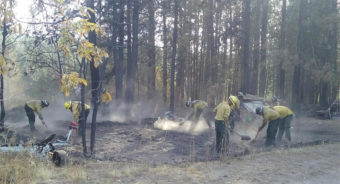
Firefighters mop up remaining fire and heat near residences threatened by the Cayuse Mountain Fire. (INCIWEB)
Firefighters mop up remaining fire and heat near residences threatened by the Cayuse Mountain Fire.
(INCIWEB)

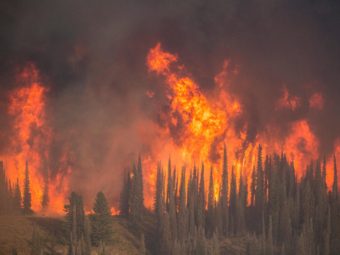
The Cayuse Mountain Fire has been the second largest in Washington state.

The blaze consumed 14 homes and displaced up to 50 people on the Spokane Indian Reservation, but the community is trying to get back to normal life.

Word of the fire and its damage spread almost as fast as the flames.

The day after it started, the community already had set up a donation center for victims in a warehouse next door to the high school.

Tammy Byers came from Muckleshoot alongside nieces, nephews and her son.

“We grew up here, and this is my family, even though I am enrolled in another tribe, this is where I am from,” Byers said. “My heart is here. My people are here.”

The warehouse filled quickly with odds and ends: shoes, clothing, small bits of furniture, even pallets of vegetables donated by a nearby Hutterite community.

Byers was particularly concerned about her elderly father.

“To have an 82-year-old father out there fighting a fire was hard and you can’t get there fast enough,” she said. “And my brother sacrificed his house to save my dad and my nieces. He lost everything. That’s the donations we’re taking back to him.”

Those displaced by the fire are staying with friends and family as the Spokane tribe’s Indian Housing Authority and tribal leadership hammer out a long term plan.

Only three of the 14 homes lost were insured.

Some will rebuild, others have already decided to relocate.

The tribe is requesting monetary donations to help defray temporary housing costs.

Fast-growing Idaho wildfire could keep burning until October

The Pioneer Fire has been burning in Idaho since July, and hot, dry weather caused the fire to grow rapidly this week. (National Forest Service)

In Idaho, a wildfire has burned nearly 250 square miles of forest and is growing quickly. About 157,000 acres are currently on fire in Boise National Forest in the western part of the state, northeast of Boise.

The blaze, known as the Pioneer Fire, has been burning for several weeks, but hot, dry weather this week caused the wildfire to get much larger.

Scott Graf of Boise State Public Radio reports for NPR’s Newscast Unit:

“The fire grew by 45-square-miles in one day early this week. It grew by another 25 yesterday, but not a single home has been lost to the fire — a testament to the rugged, remote area where it’s burned since mid-July.

“A cold front will bring some fall-like weather to the region this weekend, and fire managers say that should help slow the fire. But they say it will take fall rains and potentially even snow to extinguish the fire — something not likely to happen [in western Idaho] until October.”

Idaho wildfire officials say the Pioneer Fire was 58 percent contained on Wednesday. There are more than 1,100 people working to contain the fire, which is burning through backcountry forest, and currently doesn’t threaten any buildings. As of Wednesday, nine helicopters, 44 fire engines, four bulldozers and 24 water trucks were assigned to help fight the fire.

Large parts of the Boise National Forest have been closed to visitors, and fire officials warn people not to camp north of the blaze. There are no mandatory evacuation orders — the fire is burning in an uninhabited area — but summer cabins nearby are under Level 1 and Level 2 evacuation warnings, which means people staying there should get ready to leave in case the fire grows in their direction.

Smoke from the wildfire is trapped in a bulbous cloud that blocks out the sky for people who live around the national forest, even those 50 miles or more from the actual blaze. The smoke began to show up on images taken from space back in July. The blaze is 13 times larger now than it was on July 28, when this NASA photo was taken.

In the nearby towns of Garden Valley, Lowman and Stanley, smoke is polluting the air, but the Idaho Department of Environmental Quality predicts wind patterns will help to disperse it.

Copyright 2016 NPR. To see more, visit http://www.npr.org/.

Alaska junior senator addresses Deer Mountain, federal regulations

Sen Dan Sullivan, R-Alaska, speaks during a Ketchikan Chamber of Commerce lunch. (Photo by Leila Kheiry/KRBD)

Alaska’s Sen. Dan Sullivan has been in Ketchikan for a couple days this week.

He spent Tuesday meeting with local officials, touring around town and celebrating the new House District 36 Republicans office at The Plaza mall.

On Wednesday, he met with Ketchikan High School students, and spoke to a packed Chamber of Commerce lunch.

Sullivan said visiting communities in Alaska, and hearing directly from constituents, helps keep him inspired in the Senate. It also helps him know what’s important to Alaskans in those individual communities.
An issue that’s come up repeatedly in Ketchikan, he said, is Deer Mountain.

“You know when you meet with community leaders – the borough mayor, the city mayor, the managers, private sector – and you hear the same topic in every single meeting, with a lot of passion and a lot of concern: It’s very helpful. You get it. I get it,” he said.

The Alaska Mental Health Trust board recently voted to move forward with logging the face of Deer Mountain if federal legislation to trade that land for other timberland doesn’t pass by Jan. 15.

Sullivan is a co-sponsor of that federal legislation. He said he and Sen. Lisa Murkowski will work hard to get it approved, but there are limits to what they can do. He said other lawmakers are easily swayed by groups that might oppose the trade.

“I’m not sure we can get it through the Senate, because there might be outside environmental groups that think they know more about what’s going on in Ketchikan than you guys do,” he said.

But, as a former Alaska Department of Natural Resources commissioner, Sullivan said he knows many of the state and Mental Health Trust officials involved. He said he’s working on getting a meeting scheduled, so he can ask: “’Do you really understand that the community seems very, very, very uniformly opposed to what’s going to happen here?’ And that’s not necessarily a good thing to have a strong community like this, that’s a pro-resource-development community, to be really, really upset at the Mental Health Trust Authority.”

Sullivan said Alaskans shouldn’t be working against each other, and the different officials should be able to find a solution.

A recurring theme in Sullivan’s address to the Chamber of Commerce was the need for streamlined federal permitting processes. He said it can take many years, and millions of dollars, to get the permits before any construction can even start.

During a media event after his talk, Sullivan gave some examples of attempts he’s made to alleviate the burden of federal regulations. One bill he sponsored would have required federal agencies to remove one old regulation for any new one they plan to implement.

“Canadians are doing it. The UK is doing it. This is an idea whose time has come,” he said. “Because a lot of other industrialized democracies are recognizing that their agencies … never have to prioritize their regulatory regime. Unfortunately, we had a floor vote on that and it didn’t pass.”

But, Sullivan said, he will continue to fight for that kind of streamlining, which he said has public support.

Another bill he sponsored that almost passed would have allowed state environmental agencies to waive federal permitting requirements – including lengthy, expensive Environmental Impact Statements – for projects involving rebuilding or repairing any of the 61,000 structurally deficient bridges in the nation.

Sullivan said those projects wouldn’t change the footprint of the structures; they would merely improve safety. But, the bill fell short of passing by two votes.

Sullivan talked about judicial reform – specifically splitting the Ninth Circuit Court of Appeals, which covers Alaska along with West Coast states, Idaho, Montana, Nevada and Arizona.

Sullivan, who was a law clerk for the Ninth Circuit many years ago, said it’s way too big.

“And those judges rule – judges in Pasadena, Calif, who don’t know where Ketchikan is on a map – and they’re ruling on Tongass National Forest and Roadless Rule issues when they don’t have a clue,” he said.

Sullivan said he’s put forward a bill to split the court. But, he said, California lawmakers tend to block that kind of legislation.

Sullivan addressed the presidential election, as well. With Democratic nominee Hillary Clinton polling ahead of her Republican rival Donald Trump, Sullivan said he’s worried about what that means for Alaska.

He said Clinton opposes Arctic development and resource development in general, and favors additional regulations on gun ownership. If she wins, and sticks with those policies, Sullivan said that will create more challenges for the state.

“But, I’ll work with anybody,” he said. “I have a good relationship with a lot of the Obama administration officials… I’ll work hard to bring people up here, (and) have them understand Alaska better, because most don’t.”

Sullivan said he’ll also do what he can during confirmation hearings for cabinet appointees, using that process to vet the candidates and make sure they understand Alaska’s needs.

During his Ketchikan visit, Sullivan also planned to meet with local U.S. Coast Guard officials, and with veterans at the Ketchikan American Legion Wednesday evening.

Forest Service gives go ahead for Kuiu Island timber sale

In 2014, the U.S. Forest Service repaired streams on Kuiu Island damaged by logging in the 1970s. Now, 23 million board feet could be harvested on the north part of the island. (Photo by Elizabeth Jenkins/KTOO)
Kuiu Island in 2014. At the time, the U.S. Forest Service was repairing streams on the island damaged by logging from the 1970s. Now, 23 million board feet could be harvested on the north part of the island. (Photo by Elizabeth Jenkins/KTOO)

An old growth timber sale recently announced in a Ketchikan newspaper has one conservation group scratching its head.

That’s because this type of harvest — near valuable salmon streams — won’t be allowed in the future.

The U.S. forest service is working on a new timber plan in the Tongass National Forest, which is expected to be finalized by winter.  

In the meantime, forest managers are moving ahead with timber sales under the old rules.

Recently, in the Ketchikan Daily News an ad appeared along with advertisements of cars for sale and apartments for rent. The forest service was looking for a buyer for 866 acres of old growth trees on north Kuiu Island.

“You know, no one would know about it unless you’re reading the back pages of the Ketchikan paper,” Austin Williams said.

He learned about it from a Trout Unlimited member in Ketchikan. Williams is the director of law and policy for the organization.

What troubles Williams about the timber sale is where it’s slated to happen.

“Right in the middle of some of the most valuable and important fish and wildlife habitat in the region,” he said.

It’s one of a group of watersheds, known as the Tongass 77, that environmental groups want protected.

Logging can cause erosion,  creating problems for spawning salmon, Williams said.

Just a few years ago, the Forest Service repaired streams on Kuiu damaged by timber harvests from the 1970s, back when there were no regulated buffers along salmon streams.

That’s changed and this particular sale went through an environmental assessment and a public comment period before becoming final eight years ago.

“There’s been no opportunity for public involvement since the decision came out in 2008,” Williams said. “And you know, a lot has changed since then.”

One major change: soon sales like this won’t be possible.

The Forest Service is about to come out with an amended timber plan for the Tongass. Old growth logging in these watershed areas won’t be allowed.

Jason Anderson, a deputy forest supervisor, said sales that have already been approved — like the one on Kuiu — can move forward.

“We would not have necessarily crafted this sale under the new plan,” Anderson said. “But we’re also operating in that change-over period.”

Anderson said the Kuiu sale is happening now because the “market conditions” are right.

He’s not sure how many outstanding timber sales exist like this.

He thinks — compared with the overall size of the Kuiu sale —  the trees in the watershed area represent a relatively “small percentage.”

“While I can recognize the concerns that are out there. I think on the whole, the transition spells out how a lot of this will occur in terms of bringing forward more young growth over time,” Anderson said. “Being very deliberate about what old growth is offered. And again, considering and protecting those watersheds that have the highest fisheries value in the region.”

The Forest Service approved the Kuiu timber for export, which means the trees aren’t likely to go to local mills.

That’s OK with Owen Graham, the executive director of the Alaska Forest Association, a timber industry group.

The Kuiu sale is made up of a lot hemlock, a low value timber, he said.

“Those chips used to go to the pulp mills and now they have to be barged 800 miles south,” Graham said. “The economics of trying to harvest timber and manufacture on a remote island like Kuiu is pretty difficult.”

There are no pulp mills left in Southeast Alaska. The Forest Service’s red tape doesn’t make it any more cost effective for domestic buyers, Graham said.

Still, he thinks the Kuiu Island timber sale is significant for the logging jobs it does keep in the region.

The public should have another say before old growth trees are cut down in a watershed, Williams said.

“You know, one of the things about Southeast Alaska is that largely our fisheries are intact and our watersheds and streams are healthy,” Williams said. “But if we don’t take care of it, we risk losing those.”

The objection period on the amended Tongass plan ends this week.

The Forest Service is accepting bids for the Kuiu island timber sale until September 13.  

Editor’s Note: We’ve updated the story to clarify the definition of the Tongass 77. 

Trust takes first step toward logging Ketchikan’s iconic Deer Mountain

A springtime view of Deer Mountain. (File photo by Leila Kheiry/KRBD )

The Alaska Mental Health Trust took its first step toward logging Ketchikan’s iconic Deer Mountain, along with a parcel in Petersburg.
During a Board of Trustees meeting Wednesday morning, the board agreed with staff recommendations to move forward with plans to negotiate timber sales for both parcels by Jan. 15th, unless Congress approves a bill trading that land for selected U.S. Forest Service land.

Mental Health Trust executive director John Morrison said time is running out for the region’s timber industry, and the trust needs to make money while it can.

“We’ve reached the recognition that we need to be prepared to harvest the timber that we have while there is a timber industry to harvest it, in the event that the legislation is not passed this session of Congress,” he said.

Morrison said the trust has been working on the land exchange with the Forest Service for about a decade.

While Morrison is optimistic that the land exchange will be approved, he said this first step was necessary.

“Our process can be fairly lengthy, so this is to get the ball rolling and to let people know that we are serious about abiding by our mission, which is to maximize revenue to the trust,” he said.

Revenue from trust lands is the sole funding source for mental health programs in the State of Alaska.

Morrison said the lands to be exchanged have been identified through an administrative process. It just needs to get through Congress.

“We would be very much in favor of the legislation passing and having a successful exchange,” he said. “People who are concerned can certainly direct their efforts toward helping to pass that legislation.”

The Ketchikan Gateway Borough Assembly recently approved a resolution urging Congress to approve S. 3006, the Alaska Mental Health Land Exchange Act of 2016. The measure is sponsored by U.S. Sen. Lisa Murkowski, R-Alaska.

California firefighters contain Blue Cut fire, grapple with other blazes

Ten thousand fire personnel are battling blazes across California, including in San Luis Obispo County, where the massive Chimney Fire threatens homes and the historic Hearst Castle. (Associated Press)

Firefighters have reached full containment of a blaze east of Los Angeles that forced tens of thousands to evacuate their homes. At the same time, multiple wildfires continued to challenge crews throughout the state.

California’s Department of Forestry and Fire Information declared the Blue Cut Fire 100 percent contained Tuesday — but not before the 36,000-acre fire destroyed nearly 100 homes and forced the evacuation of 80,000 people in San Bernardino County.

By Saturday, crews had largely contained the blaze, allowing the lifting of evacuation orders for many residents. NPR’s Nathan Rott tells our Newscast unit that more than 300 crews were pulled off the fire as it dwindled.

“Attention is turning from that fire … toward others,” Nathan says.

Statewide, 10,000 fire personnel are battling six major wildfires, including the Chimney Fire, which is burning in San Luis Obispo County.

That inferno has already consumed 53 structures and 37,101 acres in Central California near the Hearst Castle, built by publishing magnate William Randolph Hearst, now a tourist attraction.

On Saturday, the California Parks Department announced the property’s closure owing to poor air quality. It remains closed through the week.

Nearly 4,000 fire personnel are working on that fire, which is considered 35 percent contained.

In Northern California, the long-burning Soberanes Fire is 60 percent contained. The fire has been burning for a month and has consumed some 87,000 acres north of Big Sur. At least one death has been attributed to the blaze.

And just west of Los Angeles, the Rey Fire is burning through wilderness in Santa Barbara County. So far, 27,000 acres have burned. The fire is 30 percent contained.

Copyright 2016 NPR. To see more, visit http://www.npr.org/.
Site notifications
Update notification options
Subscribe to notifications