Timber

Mental Health Trust officials hear concerns in Ketchikan and Saxman

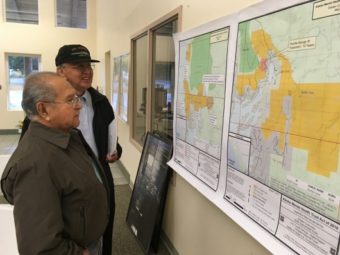
Saxman residents look at maps before the Alaska Mental Health Trust meeting at the Saxman Community Center. (Photo by Leila Kheiry/KRBD)

Alaska Mental Health Trust and Trust Land Office representatives got an earful Tuesday during informational meetings in Saxman and Ketchikan regarding the decision to potentially log Deer Mountain.

The big question, though, is whether the public input will make any difference.

The message Alaska Mental Health Trust officials heard over and over and over again was: don’t log Deer Mountain.

The message those officials gave back was: we won’t unless we have to.

And by that, they mean they will log Deer Mountain if Alaska Mental Health Trust officials and the board of trustees decide logging Deer Mountain is the best way to make money. That’s what the trust does – it makes money for mental health services throughout the state.

That’s typically not controversial.

But when the board of trustees voted in August to move forward with a timber sale on Deer Mountain and a site in Petersburg if a federal land exchange isn’t approved by mid-January, there was a public outcry, and questions about the legality of the vote and the lack of public process.

So, the board is revisiting the issue, and scheduled these public information meetings before a Nov. 17 re-do of that vote.

Trustee Carlton Smith of Juneau was one of the Trust officials hosting the meetings in Saxman and Ketchikan.

There are two things he hopes local residents get from his part of the presentation.

“We get it. We understand how important Deer Mountain is to you. We understand your feelings about Deer Mountain,” he said. “And we also – and this is coming from me – apologize to you for not having this consultation earlier in this process.”

Smith and other presenters repeatedly said that they vastly prefer the land exchange, which would trade the controversial parcels, along with Mental Health-owned land in Sitka and Juneau, for remote parcels of federally owned land on Prince of Wales Island and in the Shelter Cove area.

The trust then would log those remote parcels.

Trust Land Office Deputy Director Wyn Menefee said that land trade, which U.S. Sen. Lisa Murkowski has introduced, can pass during the lame-duck session following the Nov. 8 election.

“It’s a viable bill. It’s our preferred option. We want the land exchange. I know we discussed proposed timber sales, but we want the land exchange. That is the best interest of the trust, and that’s what we’re pushing hard to do,” he said. “There is good precedent that, even in a lame-duck session, land-exchange bills do go through.”

And, Menefee said, this particular exchange package has been vetted and approved by a variety of stakeholders, including environmental groups.

Ketchikan is a logging town, and very few people attending the public meetings have any concerns about logging in general.

The vast majority vehemently oppose logging Deer Mountain. It’s not just the visual impact; many were worried about landslides, wildlife and, especially for Saxman, water.

That community’s primary water supply comes from Deer Mountain.

Trust Land Office Senior Resource Manager Paul Slenkamp told the Saxman group that the timber sale would be designed with that in mind, but that didn’t do much to allay concerns.

Here’s Joe Williams, a lifelong Saxman resident.

Joe Williams of Saxman speaks during the Alaska Mental Health Trust meeting at the Saxman Community Hall. (Photo by Leila Kheiry/KRBD)

“You can last seven days without water. Beyond that, you can’t,” he said. “I’m saying loud and clear that you’re encroaching on our water supply. And I’m appalled that this organization is, ‘Oh, by the way, now we should meet with Saxman.’”

There also was repeated concern expressed during both meetings about the way trustees made their decision.

Menefee noted that the trustees, acting as the Resource Management Committee, revisited the issue on Oct. 26, and recommended that the official board take another vote during the Nov. 17 meeting.

Public comment will be accepted on Nov. 16 by phone or in person, or earlier by mail or email.

Menefee also noted that the vote is not to log Deer Mountain – it’s to accept the staff’s recommendation that the Trust move forward with a timber sale if the exchange doesn’t pass.

Slenkamp repeatedly said that the timber sale hasn’t even been designed yet – although it would definitely be selective harvest by helicopter — and then there would need to be a “best interest” decision, followed by a 30-day public comment period.

But, the Trust’s comment process is different from what people might be used to. Menefee said comments will only make a difference if they address the Trust’s primary mission.

“What we do, we don’t actually ask, like you would if you were the Forest Service or the state, saying what you think is in the best interest of the public? That’s not actually by statute and regulation what we’re supposed to ask. We actually ask, ‘Is what we’re doing the correct thing for the Trust?’” he said. “If you can show something that’s better – better financially for the trust – or some other thing like that, that very well may change it.”

One potential concept that’s been suggested – and would be financially beneficial to the trust — is for the communities to purchase the land from the trust, or at least purchase the timber rights.

Ken Arriola notes that the Trust Land Office expects to make about $5 million by logging Deer Mountain and the site in Petersburg.

“This community has spent far more than $5 million on a lot of other stuff,” he said. “I don’t know if that’s an accurate figure or not, but we could buy this timber on Deer Mountain and it could be ours in perpetuity. So, governing bodies, citizens of Ketchikan, if this really means that much to you, let’s get with it.”

Menefee said the Trust Land Office is open to options, including a land sale. The price tag would be negotiable following an assessment.

Listen to the full audio from the two-hour-plus event at Ted Ferry Civic Center.

Editor’s note: KTOO’s building sits on land leased from the Alaska Mental Health Trust Authority. KTOO has also applied for and received occasional grants for special reporting projects from the authority.

As objection hearings wrap, countdown to new Tongass plan

The U.S. Forest Service wrapped up objection hearings Wednesday on a plan that could shape the future of timber in the Tongass National Forest.

It was the last chance for the public to register opposition to to the Tongass Land and Resource Management Plan amendments, which has been nearly three years in the making and will go into effect this winter. The meetings took place during a two week span in Ketchikan and Juneau.

About 27 groups and organizations testified in opposition — including the state of Alaska.

Timber industry reps say the forest service plan transitions too quickly from logging valuable old growth trees to smaller young growth timber. Meanwhile, some environmentalists believe there’s too much old growth left on the table.

Beth Pendleton, of the Forest Service, said the plan outlines a new direction for the Tongass but that doesn’t mean it’s set in stone. This is called adaptive management.

“So, as new information becomes available because we’re moving into a new management regime for example around young growth, that we take that information more real time and make adjustments in the management approach,” Pendleton said.

In all, less than 400 timber industry jobs remain in Southeast.

Pendleton has until Nov. 28 to respond to the objectors about what changes the forest service will incorporate — if any. The final plan is expected to be completed this December.

After five days, Moose Creek fire nearly half contained

The Moose Creek fire near Sutton is nearly half contained, according to fire information officials Wednesday.

Fire managers expect to have the blaze, which is at 46 percent, fully contained by the weekend.

The wildfire started Saturday morning, sparked by a burning debris pile.

High winds in the Matanuska Valley drove the fire to consume more than 300 acres.

Winds diminished on Tuesday, allowing fire crews to get a start on a line around the fire.

The western flank of the fire also has significant heat remaining that firefighters are trying to extinguish.

About 80 personnel are still working on the blaze.

High wind hampers wildfire response south of Sutton

ANCHORAGE — Strong overnight winds hampered firefighters containing a wildfire north of Palmer.

The state Division of Forestry says the fire 12 miles north of Palmer and 5 miles south of Sutton is about 300 acres, or just less than one-half square mile.

Winds in the area Sunday night blew steadily at 25 to 30 mph and gusts reached 40 mph.

The fire just after 6 p.m. crossed a fire line. Helicopters with water buckets dropped water on the area. Managers shifted firefighters to keep the fire from spreading.

Temperatures in the low 30s have hampered firefighting.
Downed power lines Sunday started small fires in Butte and south of the main fire.

The Forestry Division also responded to burning debris piles that a landowner lit 1.5 miles down a trail in Butte.

U.S. producers push for tariffs on Canadian timber

Tongass National Forest
Tongass National Forest (Creative Commons photo by Henry Hartley)

The deadline to strike a deal on Canadian softwood lumber imports into the U.S. came and went Wednesday. The past agreement controlled Canadian lumber import prices which allowed Alaskan lumber to compete in the market. The U.S. Lumber Coalition said that leaves American producers with little choice but to push for tariffs on Canadian wood.

The U.S. and Canadian governments have been at odds for decades on whether Canadian sawmills receive government subsidies, particularly “stumpage” fees, a tax on harvested trees. Mills in the states say that gives Canadian producers an unfair advantage in the U.S. market.

The most recent deal struck in 2006, expired in 2015 and a standstill period was in effect until Wednesday. It was designed to keep Canadian timber within a certain price range. If it fell below that range, tariffs would be enacted. The U.S. Lumber Coalition said that leaves two choices in the matter, make a deal or file cases with the U.S. government to impose tariffs.

“It’s very likely you will see trade cases here relatively soon, soon as frankly we feel that it’s the best time to file such cases,” said Lumber Coalition spokesman Zoltan van Heyningen.

He said it would prefer a deal between the two countries and will continue to push for one, but for now is urging U.S. producers to file cases.

“At the same we’re going to be on a dual track of continuing to work with our government towards a new agreement,” said Heyningen. “We’re going to push really hard to make as much progress as possible as quickly as possible in that regard as well.”

The Coalition would like to see that deal be structured around limits on Canada’s share of the U.S. market. Heyningen said during the last deal, Canada’s share hovered around 28 percent and is now creeping up to about a third.

According to a Bloomberg report, British Columbia producers want something similar to the 2006 agreement by keeping tabs on prices.

Despite the deadline, officials are in Washington this week working towards a deal that would “maintain Canadian exports at or below an agreed upon U.S. market share.”

What this means for the timber industry in Southeast depends on the lens you’re looking through.

Alcan Forest Products is based in Ketchikan, but operates in Canada as well. Alcan Partner Brian Brown told KSTK in an earlier interview the uncertainty of a new trade agreement is making Canadian sawmills unable to commit to prices on Alaska logs.

“Up here in Alaska and northern B.C., we can’t sell logs a truck load at a time. We have to transport them to the market,” said Brown. “It’s a lot riskier when these guys start throwing threats of these tariffs out there.”

Brown said Alcan does three to four shipments into Canada a year. He said each shipment is about 600,000 tons and is valued around $1 million U.S. dollars.

He doesn’t buy into the argument that Canadian companies are subsidized, and said he would prefer a free market and no tariffs.

Others in Alaska disagree. Owen Graham of the Alaska Forest Association said he would like to see the 2006 deal renewed. He said Canadian producers’ low operating costs and a weak Canadian dollar is hurting Viking Lumber’s hemlock production. Viking is Southeast’s largest mill.

Alaska State Forester Chris Maisch said he agrees that a renewal would be best. He said most Alaska timber is exported to foreign markets, mostly Asia.


New Southeast atlas identifies valuable habitat and threats

Sockeye salmon. (Photo by Katrina Mueller/USFWS)
(Photo by Katrina Mueller/USFWS)

Audubon Alaska recently released an atlas showing where the most valuable salmon streams and bird habitat are located in Southeast. It also identifies the biggest threats to those areas.

Spread across 200 pages, the ecological atlas of the region includes a lot more than maps. Melanie Smith, the director of conservation science for Audubon Alaska, said the organization wanted to create something both policymakers and regular people could use.

It follows in the footsteps of other atlases Audubon has released about the Arctic and Western Alaska. Smith said this latest Southeast edition is another comprehensive overview that helps provide context.

“What do we know about how this place works?” Smith said. “And why it matters and what types of considerations we should be thinking about when we’re thinking about a sustainable future in the Tongass?”

The atlas features bear viewing hotspots and birding locations. But also, what Audubon Alaska believes are human-caused dangers to these environments, like old growth clear cut logging.

Smith said what surprised her the most while putting the atlas together is how quickly the climate is changing.

“I’m sorry to say that Southeast Alaska is supposed to become a little bit of a wetter place,” she said.

The region has enjoyed a recent sunny streak. But Smith said — in the future — more rain could be in the forecast due to warming. Climate projections suggest a 2-degree temperature rise by the year 2050.

“Which also has implications for how productive salmon populations may be so there’s a chain of possible effects.”

Smith said less snow pack and more downpours could affect salmon laying eggs in nearby streams. But for now, the atlas shows where the fishing is ripe in Southeast. And she hopes to encourage readers to keep it that way.

You can learn more about the regional atlas on Thursday in Juneau. Audubon Alaska will be presenting at the University of Alaska Southeast student recreation center at 7 p.m.

Site notifications
Update notification options
Subscribe to notifications