Timber

Southeast’s top 2016 stories: Ferries, elections, forests, rivers

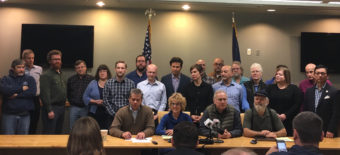
The new bipartisan House majority caucus. The leaders, seated left to right, include Majority Leader Chris Tuck, Rules Chairwoman Gabrielle LeDoux, Speaker Bryce Edgmon, and Finance Co-Chairman Paul Seaton. Nov. 9, 2016. (Photo by Andrew Kitchenman/KTOO/APRN)
The new bipartisan House majority caucus holds a press conference after forming in November. Southeast members are Juneau’s Sam Kito III, far left, Juneau’s Justin Parish, third from left, Sitka’s Jonathan Kreiss-Tomkins, center, and Ketchikan’s Dan Ortiz, second from right. (Photo by Andrew Kitchenman/KTOO/APRN)

The legislature, transboundary mining, timber harvest plans and a shrinking ferry system are among Southeast Alaska’s top stories of 2016.

November legislative elections significantly improved the region’s standing in the House.

Democrat Justin Parish narrowly beat incumbent Republican Cathy Muñoz in Juneau’s Mendenhall Valley district. That contributed to a statewide shift that put Democrats and their allies in charge of the House for the next two years.

Parish was among those promising to protect regional interests.

“From my seat there … I’ll able to quash any possible thought of a capital move,” he said.

He and Southeast’s three other representatives will all have majority leadership positions once they’re sworn in in January. Only one Southeast representative was in the majority during the past session.

The Taku loads in Sitka Sunday morning before sailing to Hoonah and Juneau. It was then tied up for repairs. Photo by Ed Schoenfeld.
The ferry Taku loads in Sitka in 2012. Now, it’s tied up and waiting to be sold or scrapped. (Photo by Ed Schoenfeld/CoastAlaska News)

Driving on or off an Alaska Marine Highway ferry became harder in 2016, as budget cuts shrunk the number of sailings and two ships went into long-term storage.

The 11-year-old fast ferry Chenega was tied up in Tacoma with an uncertain future. And the 50-year-old Taku was docked in Ketchikan with the intent of being scrapped or sold.

Exploration companies in 2016 continued drilling to expand ore bodies at potential mine sites near the British Columbia-Alaska border.

And critics in Southeast kept pushing for restrictions on mines in transboundary watersheds that drain into the state.

That led state and provincial officials to sign a statement of cooperation in October promising more openness and increased environmental monitoring.

The Tongass National Forest makes up most of Southeast Alaska (Courtesy U.S. Forest Service)

Critics – and the state — said it was not enough and will continue pushing for a binding federal agreement.

Also in 2016, the U.S. Forest Service finalized long-debated plans to move Tongass timber harvests from old-growth to younger trees.

The industry said the plan, announced in December, would make future timber sales uneconomical. Environmental critics said the transition was too slow and didn’t protect enough fisheries and wildlife habitat.

In other news, Southeast Alaska’s regional Native corporation rejoined the fishing industry in May by investing in Independent Packers Corp., a Seattle processing plant.

Northwest timber industry hit hard by heavy fall rains

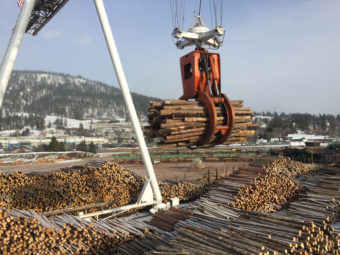
A giant port crane moves tree-sized timber at one of two mills owned by Vaagen Brothers Lumber Inc. in Pend Oreille County, Washington. (Photo by Emily Schwing/Northwest News Network)
A giant port crane moves tree-sized timber at one of two mills owned by Vaagen Brothers Lumber Inc. in Pend Oreille County, Washington. (Photo by Emily Schwing/Northwest News Network)

The rainiest fall on record in parts of eastern Oregon and Washington was good for keeping late-season wildfires at bay, but torrential rains wreaked havoc on some timber harvesters in the Northwest.
Still, employees at Vaagen Brothers Lumber in Colville, Washington, got lucky.

“We didn’t miss a day because of the wet weather,” said Josh Anderson, timber manager at one of two mills owned by Vaagen Brothers in Pend Oreille County.

Anderson pointed out a nearby tower of stock-piled logs from a wildfire salvage. He said having that much inventory was “abnormal for a fall wet season.”

“We build up inventory for fire season and we build up inventory to get through winter and the spring breakup but not through a fall breakup,” he said.

Instead of things freezing up when they were supposed to this fall, the weather stayed warm and wet, similar to the kind of weather expected when winter gives way to spring.

That stockpile of timber has kept the mill running after roughly 6 inches of rain soaked much of Eastern Washington for most of October and into November.

‘The storms just kept coming’

But no such stockpile exists for the guys who cut and deliver logs for companies like Vaagen Brothers, so Anderson said they weren’t nearly as lucky.

“It impacted our loggers and truckers a lot,” he said. “They bore the biggest part of the brunt and it’s hard for them to make that up.” 00:08

Jim Geisinger, executive vice president of Oregon’s Associated Loggers agreed with that sentiment.

“That’s correct,” he said. “It’s a lost opportunity, because when the weather does clear up, you’re off to your next job or maybe you are going back to finish up the one you got ran off of.”

Geisinger said fall rain in Oregon likely cut industry-wide production there in half.

“The storms just kept coming,” he said. “And so, I would say the impact to our industry is greater than it’s ever been.”

But he isn’t sure how that loss translates into lost dollars or board feet. Those aren’t numbers Washington’s Forest Protection Association keeps track of either.

“You know, when I say we lost 50 percent of the production, I think you can say that that percentage ripples through the entire supply chain in our industry,” Geisinger said.

A boost for loggers

For now, the rain has stopped and early in December, warmer than normal weather gave way to frigid temperatures that some parts of the region haven’t seen since 2014. Geisinger said cold combined with recent snowfall could be good for loggers in both eastern Oregon and Washington.

“Over on the east side, loggers like to have a few feet of snow on the ground and to have the ground frozen to do their logging,” he said.

It’s easier for logging trucks to transport heavy logs on frozen roads and frozen ground limits problems caused by erosion.

On the flipside though, single digit temperatures are tough on the many blades and moving parts back at the sawmill.

Is the forest service supplying enough Tongass timber?

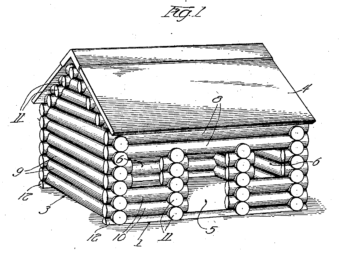
A Lincoln Log cabin.(Creative commons photo by (Creative commons photo by Lloyd Wright John)

A Lincoln Log cabin. (Creative commons sketch by Lloyd Wright John)

The U.S. Forest Service wears a lot of hats. The agency oversees federal lands, repairs salmon streams, and auctions off trees. In Alaska, timber sales are intended to stimulate the local economy, but industry groups say that through the years the forest service hasn’t made enough logs available to keep the industry alive. Now, with changes to federal regulations, even less old growth is slated for market.

It might surprise you but kids know a thing or two about timber — at least, they used to. Back before the glow of tablets captured the imagination of children, they played with Lincoln Logs. For those too young to remember, Lincoln Logs are the iconic toy that resemble … logs. You can stack them to build miniature houses or forts.

I brought a set to the federal building in Juneau to find out how a federal timber sale comes together.

Dave Harris, the director of forest management for the U.S. Forest Service, Alaska Region, looked amused by the stand-in timber.

“This will be interesting,” he said with a laugh.

I asked Harris if he played with the toy as a kid.

“Oh, gosh. Yes. And we won’t talk about how long ago that was,” Harris said.

But he would agree to use the Lincoln Logs to help demonstrate how a federal timber sale comes together in the Tongass National Forest. Although the Tongass is large, what the forest service has set aside for market is relatively small — somewhere between 6 to 8 percent.

First the agency has to figure out where a sale would be viable. Then, Harris says the timber sale goes through a lengthy process that includes environmental assessments and an objection period.

“There’s a lot of steps,” Harris said. “I don’t know how else to put it. It’s a heck of a lot of work.”

From start to finish, it should take about four years to complete a sale. It starts with advertising for 30 days, usually in Ketchikan’s newspaper. Then, the bidding can begin.

“You submitted a bid. And you are the high bidder on this contract,” Harris tells me during our Lincoln Log sale.

“How much did I pay for it?” I ask.

“How much did you bid for it? You bid at least the minimum price of what we appraised,” Harris explains.

And that’s an important point. I can’t bid below that. I can’t offer less than what the forest service thinks the timber sale is worth. But how the agency makes those calculations is hotly debated.

Eric Nichols, a partner at Alcan Forest Products, says the forest service looks at past timber sales to set the price today. So when there are market fluctuations, the industry can have very different ideas about price from what the forest service has set.

In 2014, the U.S. Forest Service repaired streams on Kuiu Island damaged by logging in the 1970s. Now, 23 million board feet could be harvested on the north part of the island. (Photo by Elizabeth Jenkins/KTOO)
In 2014, the U.S. Forest Service repaired streams on Kuiu Island damaged by logging in the 1970s.  (Photo by Elizabeth Jenkins/Alaska’s Energy Desk)

Nichols’ company specializes in the purchasing, managing and marketing of timber in Alaska, among other places.

It’s estimated that a few hundred timber jobs remain in the region. And Nichols thinks the industry’s decline is due, in part, to the forest service’s bad appraisals. Recently, a controversial timber sale on Kuiu Island received exactly zero bids — even after the forest service said the trees could be shipped overseas.

“I thought that the cost would exceed the value of the timber,” Nichols said. “You would have lost money if you bought that timber sale.”

With the exception of Big Thorne, the last sizable timber sale in the region, Nichols says, “the volume has been steadily decreasing to the point where the timber industry is in a death spiral at this point and time here.”

In January, the forest service will start to transition away from valuable old growth logging in the Tongass. That’s another barrier Nichols thinks could be bad for business as federal timber sales are scarce already.

“I don’t see how we’re going to make this transition unless we see some consistent supply coming from the forest service,” Nichols said.

Dave Harris, from the forest service, says he thinks that’s an accurate statement.

“I mean, we have seen our offers declined, our ability to get sales appraising positive. Ability to get past some of the challenges,” Harris said.

He says the agency is looking at coordinating with other landowners, like the State of Alaska or Mental Health Trust, to make more timber available — trying to bring more life-sized logs to market.

Kodiak borough awards contract to replant Chiniak land burned in Twin Creeks fire

The Kodiak Island Borough Assembly recently agreed to award a contract for the planting of spruce tree seedlings on Chiniak land burned in the Twin Creeks fire.
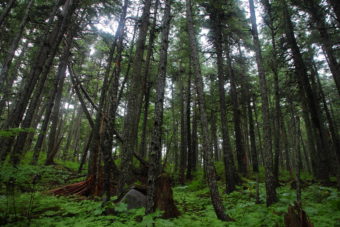
At last week’s regular meeting, the assembly OK’d the agreement with Alaska-based Carter & Carter Enterprises and, before the assembly passed that contract, the borough staff explained measures it took to ensure that the company carries out the work as expected.

Borough Manager Michael Powers said staff included a monitoring program in the document.

“We believe for the long-term health, and for making sure that the seedlings are planted properly, that a simple monitoring program is needed,” Powers said. “There are quite complex monitoring programs out there. We elected not to go that route. We were willing to keep something that was really simple and straightforward.”

Resource Management Officer Duane Dvorak said that in-person monitoring would help bolster the borough’s confidence, especially since the borough hasn’t worked with the company before.

“The contract’s been written with some checks and balances to ensure we’re getting the product that we’re paying for and that monitoring is intended to be done in the field in real time so that feedback can go back to the planting crew on a day by day basis,” Dvorak said. “So, we’re not going to do a final inspection, we’re going to have our person out there day by day moving with the crews.”

Powers expressed confidence that the borough could reach an agreement with the contractor should weather get in the way of the replanting or other issues should arise.

Carter & Carter’s bid was for roughly $186,300 and replanting is scheduled to begin in April.

Bidder chosen for 855-acre Haines timber sale

The largest Haines State Forest timber sale in decades is moving forward.

The State Division of Forestry selected a bidder for the 855-acre Baby Brown sale on Thursday.
Astoria Forest Products of Oregon bid $274,000 for the 20 million board feet of Sitka spruce and western hemlock.

It was the only bid. The minimum price was $250,000.

The timber sale is located about 35 miles up the Haines Highway, between Porcupine and Jarvis Creeks.

Astoria Forest Products is a subsidiary of Murphy Overseas USA Holdings.

The timber company now has 30 days to turn in a contract with its operational plan, including the timeline it follows for the sale. Forestry has set a five-year maximum timeline.

If the contract is approved, then the state will prepare forest land use plans that reflect the details of the contract.

The first forest land use plan was drawn up before the bid was selected, to get 137 acres on the east side of Glacier Creek ready for harvest. The land use plans give the public an opportunity to comment on the proposed method of harvest and other details. The first plan is in the public comment period until Jan. 5.

In an earlier interview, Haines Forester Greg Palmieri said that the large-scale sale will not be all clear-cut.

“It’s not going to be 855 acres of clear-cut, which is something I think people were concerned about seeing,” Palmieri said.

When Baby Brown was first proposed in 2015, three conservation groups appealed the sale, citing environmental, wildlife and visual concerns.

The Alaska Department of Natural Resources Commissioner denied the appeal and released a final best interest finding, paving the way for the harvest to go out to bid.

Astoria Forest Products Manager Stan Runnels declined to comment on the sale until the contract is final. But he did say “it could turn into a really good deal for people in Haines.”

Does salvaged sound better? Guitar maker opts for more sustainable spruce

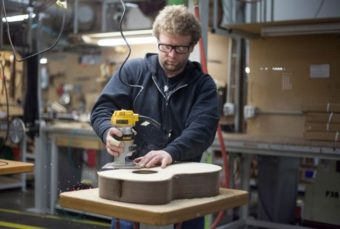
Worker routs the top of an acoustic guitar. Photo credit: RA Beattie/Musicians for Forests
A worker routs the top of an acoustic guitar. (Photo by RA Beattie/Musicians for Forests)

A little piece of Alaska has helped create some of the music industry’s biggest hits. Sitka spruce is a prized “tonewood” used to make guitars and violins. But one guitar company is pushing back and asking the feds and music insiders to reconsider clear cut logging in the Tongass National Forest.

Tom Bedell thinks when most musicians pick up an acoustic guitar, they don’t realize they’re strumming on wood — likely harvested from old growth clear cut logging.

“If they knew that, they’d be outraged,” he said. “But they don’t. They don’t think to ask.”

He says 80 percent of the world’s guitars are built, in part, with Sitka spruce, harvested from the forests of the Pacific Northwest and Southeast Alaska. Guitar makers say a good piece of tonewood should ring like a wine glass, and Sitka spruce does the trick.

“You name it. Crosby, Stills and Nash, Bob Dylan. Anyone who plays an acoustic guitar, odds are, they played a Sitka top,” Bedell said.

That’s the part of the guitar that Sitka spruce is used for: the guitar’s top.

Bedell started his own guitar company in the basement of his parents’ garage as a teenager.

“In 1966 I opened my first retail store and that same year I opened a second one,” Bedell said. “So when I was a junior/senior in high school I was doing about a half a million dollars in business.”

Bedell says, back then, the idea was to make an affordable guitar, but he also realized the wood likely came from old growth clear cut logging.

After becoming a teenage guitar tycoon, Bedell sold the company and went into a different career for almost 30 years, before starting Bedell Guitars back up again in 2009 in Bend, Oregon. This time, he says, with the intent to make a different kind of product.

“I said, ‘OK, we’re going to stop using any clear cut of any kind in any of our instruments.’ … Because it’s not just about the tree,” Bedell said. “We get emotional about how that tree was treated. It’s the neighborhood it lives in.”

In Southeast Alaska, Bedell says that neighborhood is close to valuable salmon streams and important habitat, so he now relies on a supply of salvaged Sitka spruce from dead or down trees.

Brent Cole is the owner of Alaska Specialty Woods on Prince of Wales Island — Bedell’s supplier. His company deals mainly in salvaged trees, which they mill themselves.

The U.S. Forest Service is gearing up to transition away from old growth logging in the Tongass. But it won’t end the practice entirely. Meanwhile, some timber industry groups have said less old growth could mean fewer jobs in the region.

“Some of my timber constituents wonder why I built this factory with old growth on its way out like that. Where am I going to get my resource?” Cole said. “I guess if I stay as a small boutique of supplying custom builders, I guess that’s one way.”

Tongass National Forest
Tongass National Forest (Creative Commons photo by Henry Hartley)

Cole says there are two barriers to convincing the bigger guitar manufacturers to build with reclaimed materials: it can be more expensive than clear cut and the wood isn’t always pretty.

But when Charles Barber wanted to buy a guitar, he knew he didn’t want a cookie cutter instrument. Initially, he was looking at a rock ‘n roll design with inlaid snakes.

“I sent [an image] to my wife and she said, ‘please do not get a guitar that is that tricked out. Get something that is more traditional.’ And I said, ‘don’t worry,'” Barber said with a laugh.

Barber is a director at World Resources Institute: A global research organization that focuses on forests, climate and energy.

He’s having a high-end guitar built by Bedell to the tune of about $6,000. And while there are no inlaid snakes, you could call it sustainably tricked out. It’s being built with salvaged wood and details that include fossilized mammoth ivory, some of which has been unearthed by climate change.

Barber says he wanted this guitar to tell a story.

“People listen to music, they play music, they have more of a personal relationship with something like a guitar than they do the 2X4s that go into making your deck extension,” Barber said.

Tom Bedell agrees. He’s asking for lawmakers to end clear cut old growth logging in the Tongass, and he’s asking guitar makers to make the same pledge.

He says he wants to show the world that salvaged sounds better.

“I’m doing this because to me there’s something really special about the music that’s part of our lives and the forests that enable the wood,” Bedell said.

He says it might be a while before more musicians start asking for guitars made out of reclaimed Sitka spruce; it would be music to his ears.

Site notifications
Update notification options
Subscribe to notifications